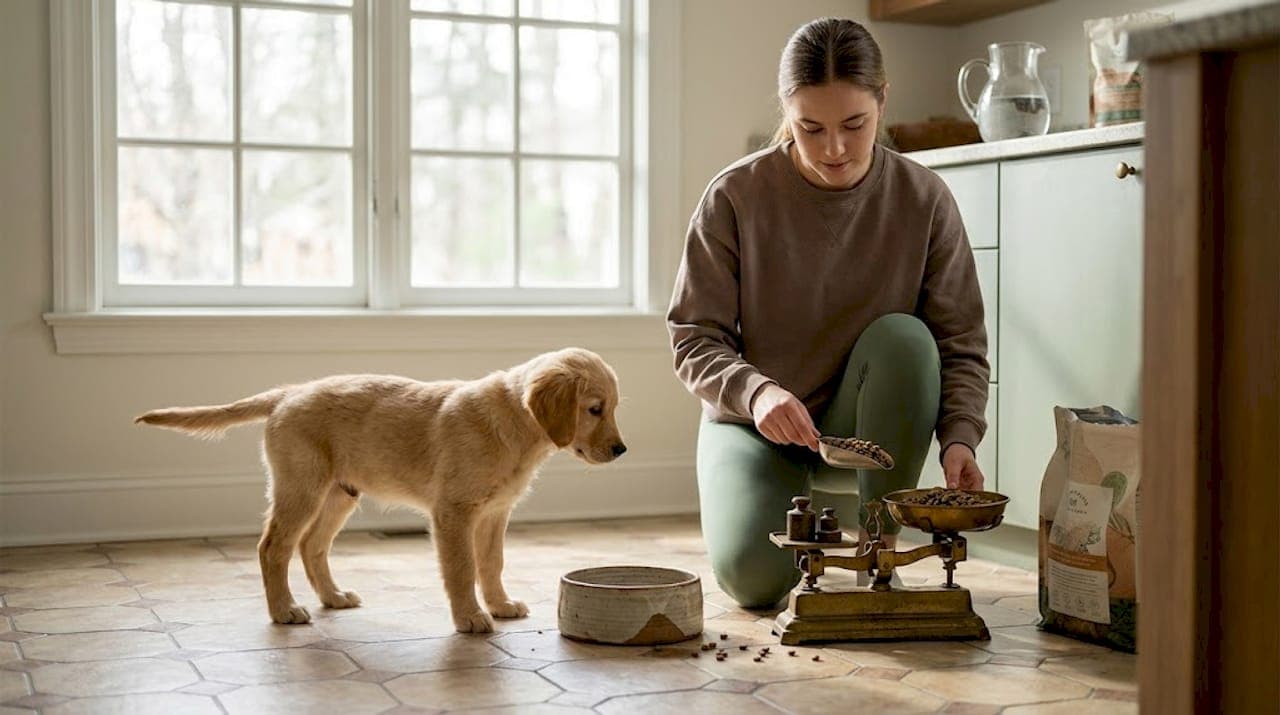
You brought home a puppy and suddenly you're staring at a food bag, a measuring cup, and a lot of conflicting advice. Getting puppy feeding amounts by age right is one of the most impactful things you can do for your dog's long-term health, yet most new owners either overfill the bowl out of love or underfeed out of caution. Both choices carry real consequences. This guide breaks down exactly how much to feed your puppy at every growth stage, how often to feed them, and how to adjust portions as they develop, without the guesswork.
Table of Contents
- Key Takeaways
- Puppy feeding amounts by age: why growth stage matters
- How to set a feeding schedule by age
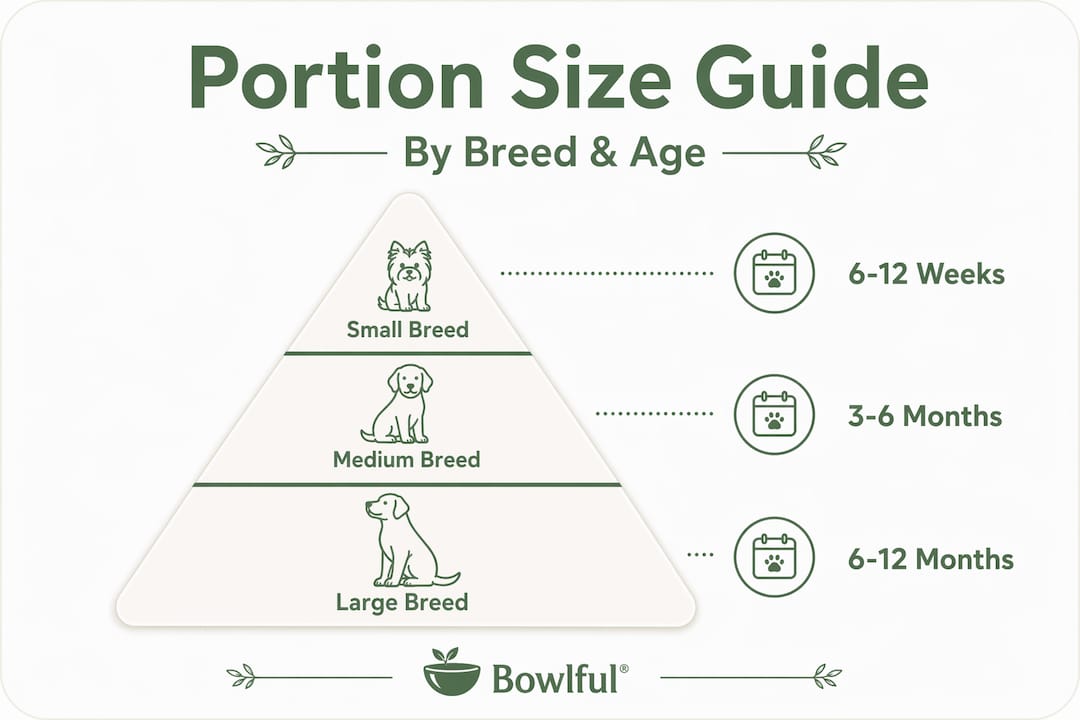
- Portion size reference by breed and age
- Common feeding mistakes and how to fix them
- Tracking progress and adjusting portions over time
- My honest take on puppy feeding advice
- How Bowlful takes the guesswork out of puppy feeding
- FAQ
Key Takeaways
| Point | Details |
|---|---|
| Age drives portion size | Feeding amounts and frequency must change as your puppy grows through distinct development stages. |
| Breed size changes the timeline | Small breeds mature by 9 months; large breeds may not finish growing until 24 months, so feeding plans differ significantly. |
| Start with the bag, then adjust | Bag feeding charts are your most reliable baseline because formulations vary widely between brands. |
| Frequency tapers with age | Puppies need 4 meals a day early on, dropping to 2 meals by 6 to 12 months as their stomachs grow. |
| Track body condition, not just weight | Visual and tactile checks help you catch overfeeding or underfeeding before it becomes a health problem. |
Puppy feeding amounts by age: why growth stage matters
Every puppy goes through rapid physical changes in their first year, and those changes demand very different amounts of food at each stage. You cannot pick a number and stick with it from 8 weeks to 12 months. The role of age in puppy feeding schedule is not just about frequency. It shapes total calorie needs, meal texture preferences, and even which nutrients should dominate the formula.
Here is a quick breakdown of the four key growth phases every puppy passes through:
- 6 to 12 weeks: Rapid growth, very small stomach capacity, highest meal frequency needed. Still transitioning from mother's milk or milk replacer to solid food.
- 3 to 6 months: Growth continues fast, digestive system matures, meal frequency begins to taper. Coordination improves, making dry food easier to eat.
- 6 to 12 months: Growth slows in small and medium breeds; large breeds are still adding significant mass. Meals consolidate to twice daily.
- 12 months and beyond: Most small and medium breeds are nutritionally adults. Large and giant breeds may still need puppy-formula food past 12 months.
Breed size creates one of the biggest variables in puppy nutrition guidelines. Small breed puppies reach maturity by around 9 months, while large breeds may continue growing for 15 to 24 months. That difference matters because you are not just adjusting portion sizes. You are also deciding when to switch from puppy food to adult food, and getting that timing wrong can affect bone density, joint development, and weight management for years.
Pro Tip: Feeding should reflect your puppy's growth life stage, not just their age in months. A compact 8-month-old Chihuahua and an 8-month-old Great Dane have almost nothing in common nutritionally.
How to set a feeding schedule by age
The most common mistake new owners make is confusing meal frequency with total food amount. These are two separate questions, and you need to answer them in the right order. Determine the total daily amount first from the feeding chart on your puppy food packaging, then divide that amount into the number of meals appropriate for their age.
Here is the standard puppy feeding schedule by age that most veterinarians and canine nutritionists recommend:
- 6 to 12 weeks old: Feed 4 times per day. Stomachs are tiny, blood sugar is unstable, and frequent meals prevent energy crashes. This is especially critical for small breeds, which are prone to hypoglycemia.
- 3 to 6 months old: Drop to 3 meals per day. Your puppy's stomach has grown and they can handle slightly larger portions per sitting without discomfort.
- 6 to 12 months old: Move to 2 meals per day. Most puppies handle this well, and it aligns with the routine you will likely maintain into adulthood.
- 12 months and beyond: Continue twice daily feeding for most breeds. Giant breeds transitioning later should follow their vet's guidance.
Once you have the schedule, the next variable is food texture. Large breed puppies transition to unmoistened dry food by around 9 to 10 weeks, while small breeds often need moistened kibble a bit longer, until about 12 to 13 weeks. As texture shifts from softened to dry, actual intake adjusts because dry food is more calorie-dense per cup. Recalculate your portions when you make that shift.
Pro Tip: If you are switching puppy foods or adjusting texture, weigh portions on a kitchen scale instead of measuring by cup. Kibble density varies enough that a measuring cup can be off by 20% depending on the brand.
Portion size reference by breed and age
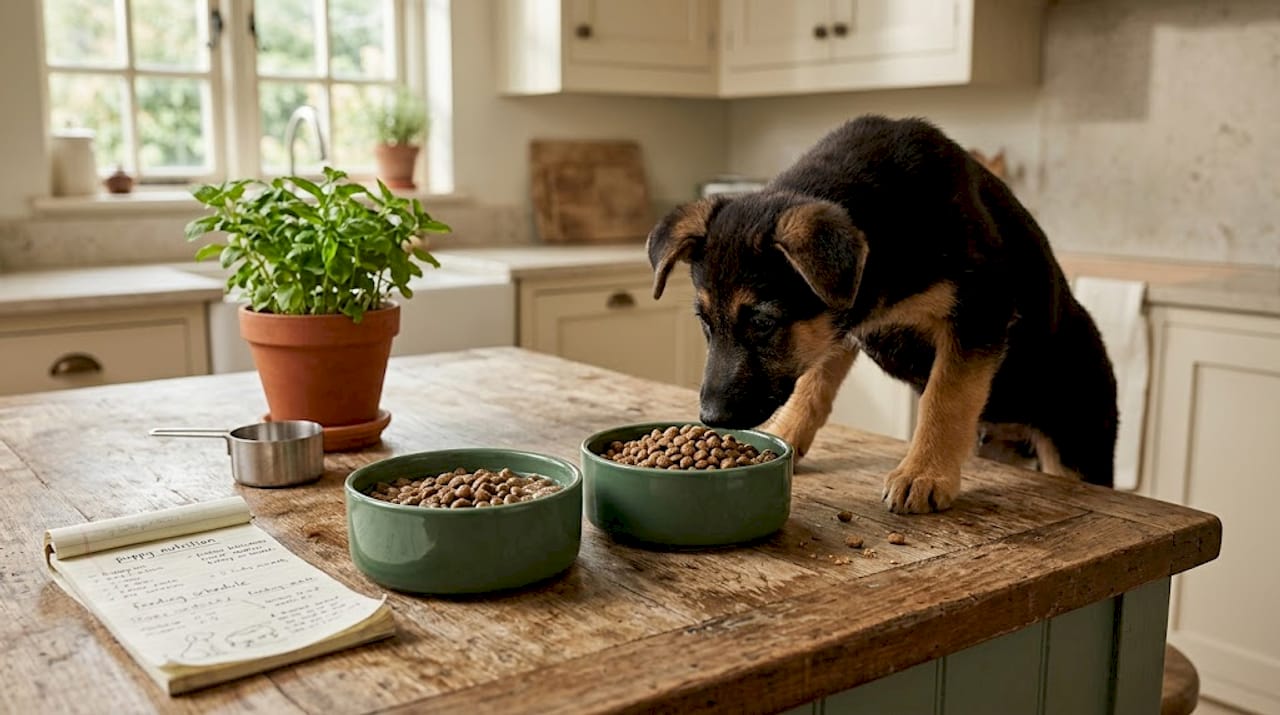
Puppy food portion sizes vary significantly depending on breed size. The table below gives you a general framework. Always cross-reference with your specific food bag because calorie density differs by brand and formula.
| Age | Small breed (under 20 lbs adult weight) | Medium breed (20 to 50 lbs) | Large breed (50 to 100 lbs) |
|---|---|---|---|
| 6 to 12 weeks | ¼ to ½ cup per day, split 4 ways | ½ to 1 cup per day, split 4 ways | 1 to 2 cups per day, split 4 ways |
| 3 to 6 months | ½ to ¾ cup per day, split 3 ways | 1 to 1½ cups per day, split 3 ways | 2 to 3 cups per day, split 3 ways |
| 6 to 12 months | ¾ to 1 cup per day, split 2 ways | 1½ to 2 cups per day, split 2 ways | 3 to 4 cups per day, split 2 ways |
A few critical things to watch as you apply these numbers:
- Large breeds need calorie control, not just portion control. Large breed puppies need lower calorie diets and controlled mineral levels to prevent developmental orthopedic problems. Overfeeding a Labrador puppy is not just a weight issue. It can affect joint formation.
- Small breeds need consistent meal timing. Missing a meal for a tiny puppy can trigger a dangerous blood sugar drop. Never skip feedings for puppies under 3 months, regardless of breed.
- Energy level is a real adjustment factor. A puppy that tears around the yard all day burns more calories than a calm, indoor pup of the same weight. Adjust portions up or down by about 10% based on activity, then monitor the response over a week.
- Your food bag is the most accurate guide you have. Bag feeding instructions are formulated based on the actual calorie content of that product. Generic charts online are estimates.
Common feeding mistakes and how to fix them
Even well-intentioned owners fall into predictable traps. Here are the most common ones and what to do instead.
Free-feeding is one of the biggest mistakes you can make with a puppy. Leaving food out all day removes your ability to track how much your puppy is actually eating. You will not notice early signs of illness, and many puppies will simply overeat.
Abrupt food transitions cause digestive upset every time. Whether you are switching brands, moving from wet to dry food, or transitioning to adult formula, gradual food switching over 7 to 10 days prevents diarrhea and stomach cramps. Start with 75% old food and 25% new, then slowly shift the ratio each day.
Ignoring breed-specific needs is surprisingly common. Many owners buy a generic "puppy food" without checking whether it is formulated for their breed size. A large breed puppy eating a high-calorie small breed formula over months can develop real skeletal problems.
What does a healthy puppy look like from the outside? You should be able to feel the ribs easily but not see them. There should be a visible waist when viewed from above, and the belly should not sag when seen from the side. If you cannot feel the ribs at all, your puppy is likely being overfed.
Picky eating is usually a management problem, not a food problem. If your puppy skips a meal, pick the bowl up after 20 minutes and do not offer anything until the next scheduled feeding. Healthy puppies do not starve themselves, and this approach quickly resolves most picky eating behavior.
Tracking progress and adjusting portions over time
Getting the starting amount right is only half the work. Puppies change fast, and the portions that were correct at 10 weeks will be wrong by 16 weeks. Building a habit of regular checks is what separates owners who manage their puppy's nutrition well from those who just hope for the best.
Weigh your puppy every two weeks for the first six months. You do not need a vet visit for this. Most feed stores and vet offices will let you use their scale for free. Log the numbers so you can see a trend rather than reacting to a single reading.
Body condition scoring is more useful than weight alone. Run your hands along your puppy's sides. You are feeling for a light padding of fat over the ribs, not a thick layer and not a bony ridge. A healthy puppy at any age should have a defined waist and a flat or gently tucked abdomen. If the body condition drifts out of range, adjust portions by about 10% and reassess after two weeks.
Pro Tip: Take a photo of your puppy from above and from the side every two weeks. Visual changes are much easier to spot in a side-by-side comparison than in real time.
Talk to your veterinarian any time you see rapid weight gain, noticeable weight loss, persistent loose stools, or a puppy who seems consistently hungry despite eating the recommended amount. These are signals that the feeding plan needs professional input, not just a portion tweak.
My honest take on puppy feeding advice
I've spent years watching new puppy owners do what I call "love feeding." The bowl gets a little fuller because the puppy looks so happy eating, or because skipping a treat feels cruel. I get it. But in my experience, this is where the real damage happens, slowly and without any obvious warning signs until a vet flags weight issues or a joint problem shows up on an X-ray.
What I've found actually works is treating the bag instructions as your starting point, not your final answer. The bag instructions are more accurate than any generic internet chart because they are calibrated to the actual formula you are using. Start there, then observe your puppy's body condition every week and adjust in small increments.
The thing most articles will not tell you is that large breed puppies are far more sensitive to overfeeding than small breeds. I've seen owners of Golden Retriever puppies adding a little extra "because they're growing" and unknowingly setting up joint issues that surface at 2 or 3 years old. Controlled growth in large breeds is genuinely protective.
My best advice for any new puppy owner: build a routine, stick to scheduled mealtimes, and learn to read your dog's body condition. The scale and your hands will tell you more than any amount of online research.
— Robert
How Bowlful takes the guesswork out of puppy feeding
Knowing the principles is one thing. Applying them to your specific puppy, with their exact breed, current weight, and growth stage, is where most owners struggle. That is exactly the problem Bowlful was built to solve.
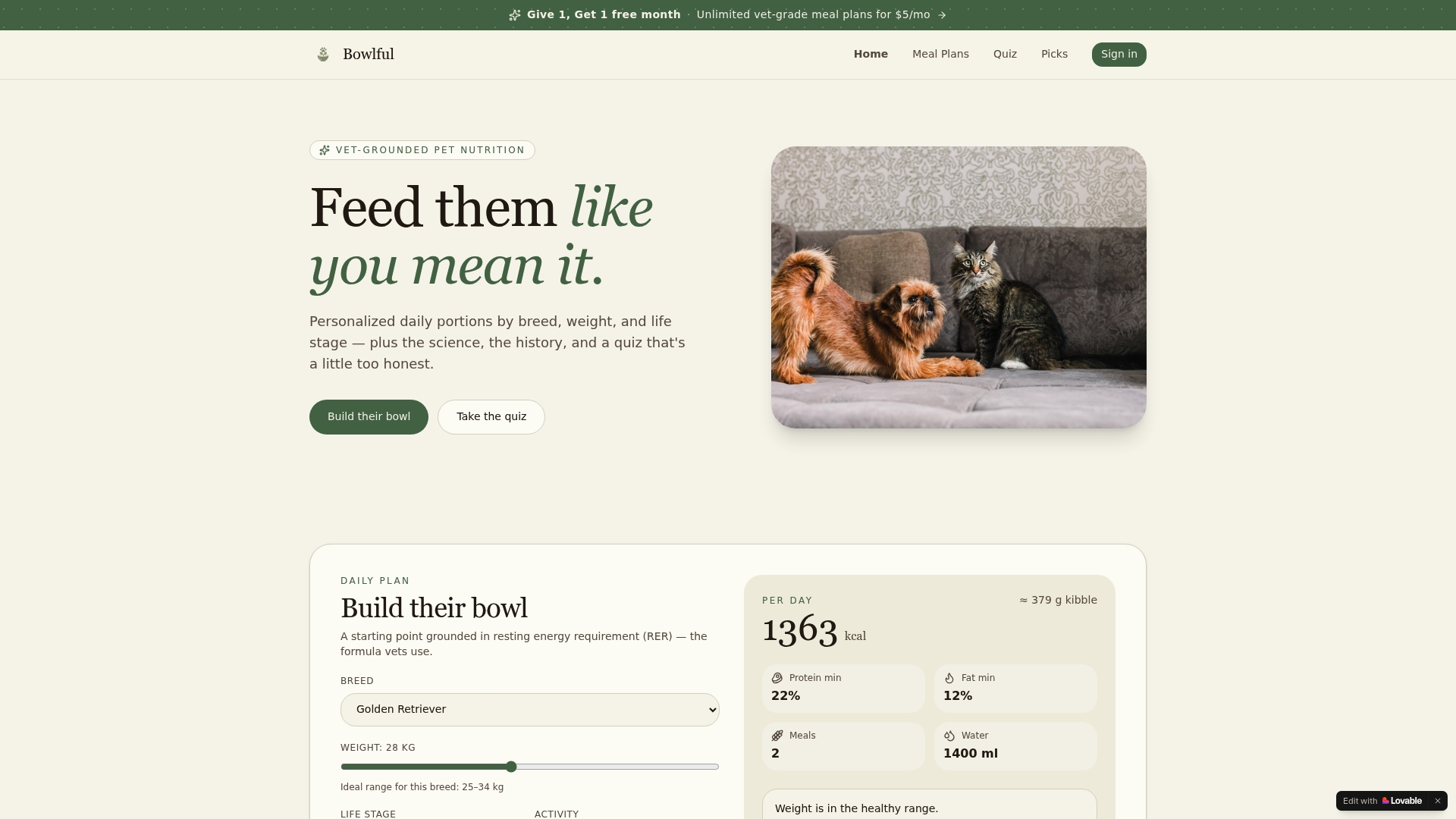
Bowlful uses the resting energy requirement (RER) formula that veterinarians rely on, combined with a breed and life stage quiz, to calculate personalized daily feeding amounts for your puppy. Instead of squinting at a generic bag chart and hoping it applies to your dog, you get a feeding plan built around your puppy's actual numbers. For new owners trying to get puppy food portion sizes right from day one, this kind of precision removes a significant source of stress and error. Visit Bowlful to build your puppy's personalized feeding plan today.
FAQ
How often should I feed my puppy each day?
Feed puppies 4 times daily from 6 to 12 weeks, dropping to 3 meals at 3 to 6 months, and twice daily from 6 to 12 months onward.
How do I know how much food to give my puppy?
Start with the feeding chart on your puppy food bag, which accounts for your puppy's weight and the specific calorie density of that formula. Adjust based on body condition over time.
When should I switch my puppy to adult food?
Small breeds can transition at around 7 to 9 months, while larger breeds should stay on puppy formula until 12 to 14 months to support their longer growth window.
Can I overfeed a puppy even with healthy food?
Yes. Overfeeding puppy food, especially in large breeds, can cause developmental orthopedic issues by promoting growth that is too rapid for healthy bone and joint formation.
What if my puppy seems hungry after every meal?
Check your portion against the bag instructions and your puppy's current weight. If amounts are correct, use scheduled mealtimes and remove the bowl after 20 minutes. Persistent hunger despite correct portions warrants a vet check.