
For most dogs and cats, a high-quality dry food matched to their life stage and fed in measured portions is the most practical path to long-term health. The Whole Dog Journal notes that no single formula works for every pet — the right kibble depends on age, activity level, and any diagnosed sensitivities, not on which bag has the boldest marketing.
Here's a fast shortlist to orient your search:
- Best for puppy/kitten growth: A formula labeled "for growth" or "all life stages" with an AAFCO nutritional adequacy statement confirmed by feeding trials
- Best for adult maintenance: Grain-inclusive kibbles from Hill's Science Diet or Royal Canin, calibrated to body weight and breed size
- Best for sensitive stomachs: Limited-ingredient or single-protein formulas (Open Farm, Weruva) with a named protein source in the first ingredient slot
- Best budget-conscious choice: Purina Pro Plan, which sits at the intersection of wide retail availability and clinical research backing
- Best high-protein option: Orijen, with regionally sourced animal ingredients making up the majority of the formula
Two things to confirm before you buy: the AAFCO adequacy statement on the bag (it tells you whether the food is nutritionally complete or just supplemental), and whether your portions are measured by your pet's Resting Energy Requirement rather than the bag's generic serving guide. Bowlful's RER-based meal plans handle that second part automatically.
Table of Contents
- Which dry food is right for your pet's needs?
- How to pick the right dry food for your pet
- Veterinarian-backed feeding guidance: portioning, transitions, and storage
- What should you buy? Final picks by goal
- Key Takeaways
- The case for personalized plans over packaged picks
- Bowlful makes portioning and transitions simpler
- Useful sources and further reading
Which dry food is right for your pet's needs?
The table below maps the seven most-discussed brands to the buyer goals that come up most often. Prices are approximate US retail cost-per-day estimates for a 30-pound adult dog; cats and smaller dogs will run lower.
| Brand | Best for | Primary protein | Special-diet support | Kibble size / breed fit | Approx. cost/day | US availability | Sourcing notes |
|---|---|---|---|---|---|---|---|
| Open Farm | Sourcing transparency; all life stages | Named animal protein (chicken, salmon, turkey) | Grain-free and grain-inclusive options | Standard; multiple size variants | ~$3–$4 | Online + select retail | Traceable sourcing claims; publishes supplier info |
| Weruva | High-protein or picky eaters | Named fish or poultry | Grain-free options; limited-ingredient lines | Standard; cat-focused dry lines | ~$2–$3 | Online; specialty pet retail | Protein-forward recipes; palatability focus |
| Purina | Wide availability; budget to premium | Varies by line (chicken, salmon, lamb) | Sensitive skin, weight management, grain-free (Pro Plan) | Small, medium, large breed sizes | ~$1–$2.50 | Mass retail + online | Broad manufacturing; internal quality testing |
| Hill's Science Diet | Vet-recommended; medical/life-stage needs | Chicken or fish (line-dependent) | Prescription and OTC therapeutic lines | Breed-size specific | ~$2–$3.50 | Vet clinics + retail | Clinical feeding trials; AAFCO feeding-trial backed |
| Blue Buffalo | Natural-ingredient positioning; functional add-ons | Deboned chicken or fish | Grain-free (Wilderness), limited-ingredient (Basics) | Small, medium, large | ~$2–$3 | Mass retail + online | "LifeSource Bits" vitamin blend; natural positioning |
| Orijen | High-protein; premium ingredient density | majority animal ingredients (poultry, fish, red meat) | Grain-free; high-protein for active dogs | Standard to large; not breed-specific | ~$4–$6 | Specialty + online | Regionally sourced; biologically appropriate claim |
| Royal Canin | Breed-specific needs; clinical life-stage diets | Varies by formula | Breed-specific, veterinary diet lines | Engineered per breed/size | ~$2.50–$4 | Vet clinics + retail | Kibble shape engineered per breed; clinical research |
A note on trust signals: Before buying, check that the bag carries an AAFCO nutritional adequacy statement. FEDIAF explains that labels must indicate whether a product is "complete" (all daily nutrients covered) or "complementary" (must be paired with other foods). A food without that statement is not a complete diet. Also worth doing: a quick recall-history search on the FDA's pet food recall database before committing to a new brand.
Kibble production typically uses extrusion, and many formulas are spray-coated with flavor enhancers after drying. That process is why a bag listing "fresh chicken" may actually deliver chicken meal — the moisture is cooked out during manufacturing. Neither is inherently inferior, but knowing this helps you read ingredient lists more accurately.
How to pick the right dry food for your pet
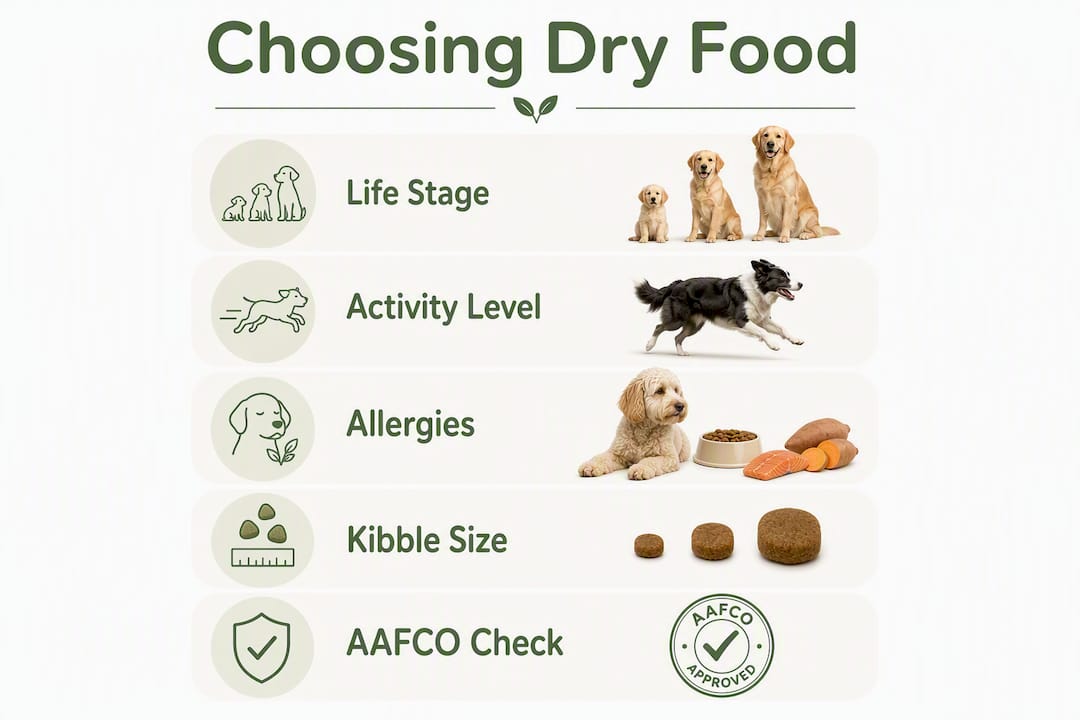
The decision comes down to five filters, applied in order.
1. Life stage first. Puppies and kittens need higher protein and fat ratios for growth; seniors often benefit from reduced phosphorus and adjusted calorie density. An "all life stages" formula covers both, but a breed-specific or life-stage-specific formula is usually more precise. Royal Canin and Hill's Science Diet both engineer formulas around this axis.

2. Activity level and body condition. A working border collie and a couch-dwelling basset hound have genuinely different calorie needs even at the same weight. Check the pet feeding schedule by weight to see how activity multipliers change daily ration targets.
3. Known allergies or sensitivities. The Whole Dog Journal cautions that "grain-free" and "high-protein" are marketing claims, not medical prescriptions. Use a limited-ingredient or single-protein formula only if a vet has confirmed a specific sensitivity — otherwise you may be paying a premium for no clinical benefit.
4. Kibble size and breed suitability. Small breeds can struggle with large kibble; giant breeds benefit from larger pieces that slow eating. Royal Canin takes this furthest, engineering kibble shape per breed. For most mixed-breed dogs, matching kibble size to jaw size is enough.

5. Label literacy. Look for three things on every bag: the AAFCO adequacy statement (feeding-trial backed is stronger than "formulated to meet"), the named protein source in the first ingredient slot, and the calorie count per cup. Understanding what nutritional adequacy statements mean can save you from buying a food that looks premium but isn't complete.
Red flags to walk away from
- "Meat" or "animal protein" with no species named
- Unnamed by-products in the first five ingredients
- No calorie-per-cup figure anywhere on the bag or brand website
- A history of multiple Class I FDA recalls in recent years
- Functional-ingredient claims (joint support, immune boost) with no clinical evidence cited
What does dry food actually cost per day?
Two quick examples using approximate US retail prices:
A 10-pound adult cat eating roughly ¼ cup of a mid-range kibble ($35 for 7 lbs) costs about $0.60–$0.80 per day. A 60-pound adult dog eating 2.5 cups of a premium formula ($75 for 25 lbs) runs closer to $2.50–$3.50 per day. The per-day math almost always looks better than the sticker price on the bag.
Pro Tip: Compare calories per cup across brands before comparing bag prices. A 400-calorie/cup kibble fed at smaller portions often costs less per day than a 280-calorie/cup formula fed at larger ones, even if the bag price is higher.
At the store or on a product page, run through this sequence: (1) find the AAFCO statement, (2) confirm the named protein source is first in the ingredient list, (3) locate the calorie count per cup, (4) calculate your pet's daily ration using their weight and activity level, (5) divide the bag price by the number of daily rations to get true cost-per-day.
Veterinarian-backed feeding guidance: portioning, transitions, and storage
Measured portions based on your pet's Resting Energy Requirement reduce obesity risk more reliably than any single ingredient choice. Forbes recommends measured portions over free-feeding specifically because calorie-dense kibble makes it easy to overfeed without noticing — the bowl empties at the same rate whether you filled it correctly or not.
RER basics
RER is calculated as 70 × (body weight in kg)^0.75 and gives the baseline daily calorie need for a resting adult. From there, a multiplier (MER) adjusts for activity, reproductive status, and life stage. A neutered adult dog at moderate activity typically uses an MER multiplier of around 1.6. Bowlful applies these calculations automatically through its RER-based meal plans, adjusting for breed, weight, and life stage so you get a specific daily gram or cup target rather than a range.
Transitioning to a new kibble
Switching foods too fast causes GI upset in most dogs and cats. FEDIAF's guidance recommends a 7–10 day staged swap:
- Days 1–3: 25% new food, 75% current food
- Days 4–5: 50/50
- Days 6–7: 75% new food, 25% current food
- Days 8–10: 100% new food
Cats tend to be slower adapters than dogs. If you see loose stools or vomiting at any stage, hold that ratio for an extra two to three days before moving forward.
Storing kibble correctly
Fat in kibble oxidizes quickly once the bag is open. SafetyCulture's storage guidance recommends transferring kibble to a food-grade airtight container and keeping the original bag inside the bin so you retain the lot number and expiry date for any future recall check. Store the container in a cool (50–70°F), dry, well-ventilated space. Humidity above roughly 60% accelerates spoilage and attracts pests. An open bag left on a warm kitchen floor is one of the most common ways a quality food loses its nutritional value before it's finished.
What should you buy? Final picks by goal
- Best for growth (puppies/kittens): — Hill's Science Diet Puppy or Royal Canin breed-specific puppy formula, both backed by AAFCO feeding trials
Before purchasing any of these, confirm the AAFCO adequacy statement on the specific formula you're buying, not just the brand. Formulas within the same brand line can vary. And if you're switching from a current food, follow the 7–10 day transition schedule above rather than making an abrupt change.
Key Takeaways
The single most important rule for feeding dry food: match the formula to your pet's life stage, confirm the AAFCO adequacy statement, and measure every portion using RER-based targets rather than the bag's generic guide.
| Point | Details |
|---|---|
| Life stage drives the choice | Match the formula to growth, adult maintenance, or senior needs before comparing brands or prices. |
| Measure portions, don't estimate | Free-feeding calorie-dense kibble is a leading cause of preventable weight gain; use RER-based daily targets. |
| Read the label carefully | Confirm the AAFCO adequacy statement and a named protein source in the first ingredient slot before buying. |
| Transition over 7–10 days | Use the 25/75 → 50/50 → 75/25 → 100% schedule to avoid GI upset when switching foods. |
| Bowlful for personalized portioning | Bowlful's RER-based meal plans give breed- and weight-specific daily ration targets, removing the guesswork from portioning. |
Contact a veterinarian if your pet shows persistent weight change, chronic loose stools, or coat deterioration after a diet switch — those are signs the formula may not be the right fit.
The case for personalized plans over packaged picks
The brands in this article are genuinely good options. But here's what the comparison table can't show you: whether the portion size printed on the bag is right for your dog or cat specifically. Bag guidelines are built for a hypothetical average animal. A 12-pound neutered indoor cat with low activity needs meaningfully fewer calories than the same-weight cat who roams outdoors. The difference, compounded over months, is the gap between a healthy weight and a vet visit for obesity-related joint disease.
Most pet owners I've spoken with assume the bag knows best. It doesn't. The bag is optimized for palatability and repeat purchase, not for your pet's metabolic rate. RER-based portioning, adjusted for life stage and activity, is what veterinary nutritionists actually use. The brands above are the raw material. How much you feed matters as much as which brand you choose.
Bowlful makes portioning and transitions simpler
Picking a quality kibble is step one. Knowing exactly how much to feed it is where most pet owners lose the thread. Bowlful's personalized meal plans are built on the same RER/MER formulas veterinary nutritionists use, calibrated to your pet's breed, weight, and life stage rather than a generic average.
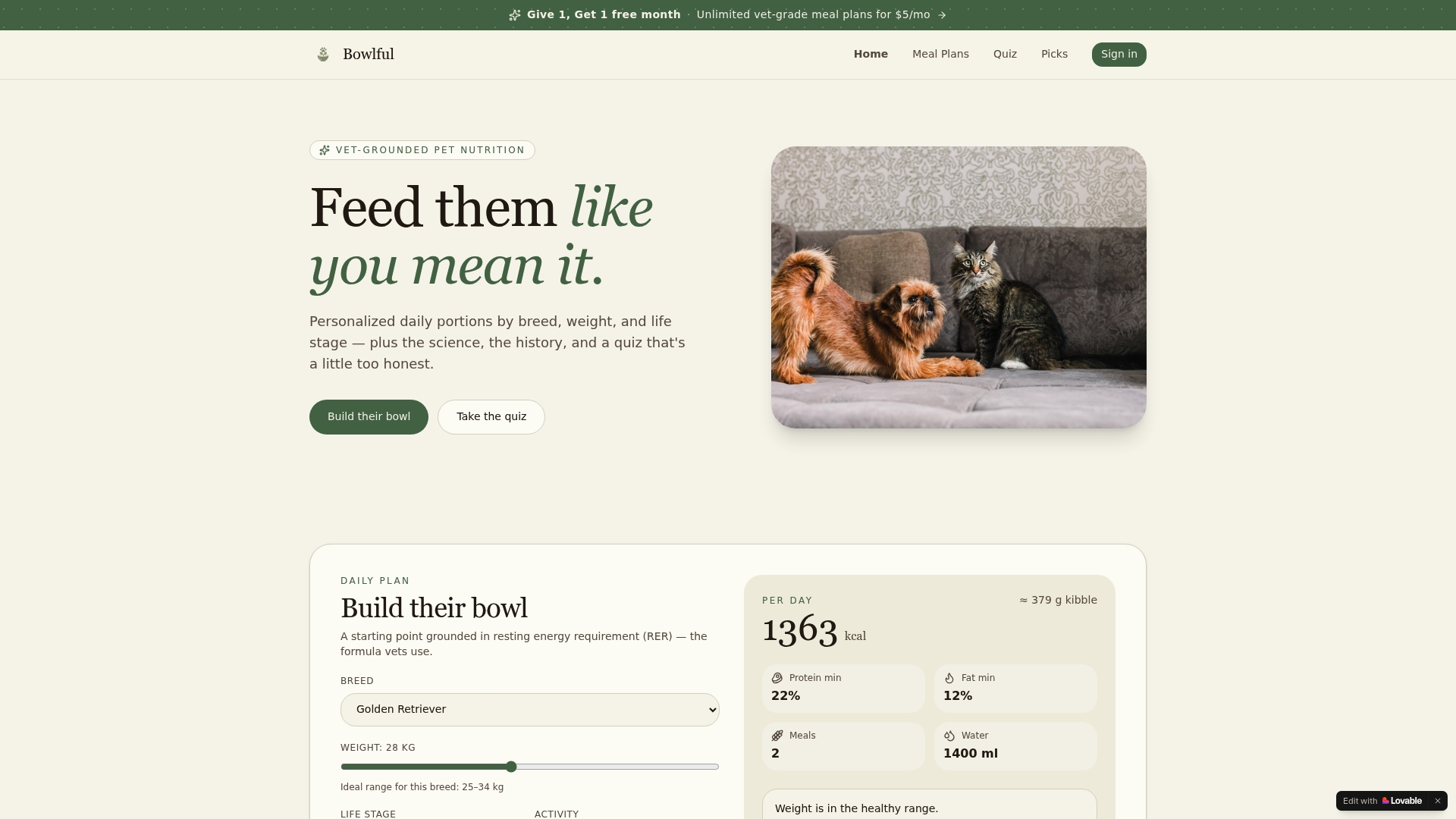
Owners managing weight issues, multiple pets with different needs, or a pet moving into a new life stage (puppy to adult, adult to senior) get the most out of Bowlful's approach. The interactive quiz takes a few minutes; the output is a downloadable meal-plan PDF with a specific daily ration target, a transition schedule if you're switching foods, and curated product recommendations matched to your pet's profile.
Take the Bowlful pet nutrition quiz to get a personalized feeding plan for your dog or cat today.
Useful sources and further reading
| Source | What it covers |
|---|---|
| How dry pet food is made — FEDIAF | Manufacturing process (extrusion, coating), complete vs. complementary labeling, and transition guidance |
| Reading Pet Food Labels — AAFCO | Official explanation of AAFCO adequacy statements and how to interpret label claims |
| Best Dry Dog Food — Whole Dog Journal | Expert selection criteria, life-stage guidance, and why marketing claims can mislead |
| Best Dry Dog Foods — Forbes Vetted | Portioning advice, calorie-density checks, and measured-feeding rationale |
| Dry Food Storage Guidelines — SafetyCulture | Airtight storage, original-bag retention, and fat-oxidation prevention |
| Food Storage and Maintenance — GFS | Temperature and humidity guidelines for dry-food storage (50–70°F, below ~60% humidity) |
| Packaging and Storing Dried Foods — NCHFP | Food-grade container selection and insect-proofing for long-term dry storage |
| Bowlful personalized meal plans | RER/MER-based feeding plans, interactive pet quiz, and downloadable meal-plan PDFs |