
A nutritional adequacy statement on a pet food label confirms that the food provides complete and balanced nutrition for a specific species and life stage, based on standards set by the Association of American Feed Control Officials (AAFCO). This statement is the single most important phrase on any pet food package, yet most pet owners scroll past it without a second thought. Understanding what it says, how it was earned, and whether it matches your pet's actual needs is the foundation of smart feeding. This guide breaks down every layer of that label language so you can shop with confidence.
What is a nutritional adequacy statement for pets?
A nutritional adequacy statement is the official declaration on a pet food label that tells you whether the food is complete and balanced for a named species and life stage. AAFCO's PF4 model regulation places this statement at the bottom of the Nutrition Facts box, making it a standardized, findable piece of information rather than buried marketing copy. The statement is not optional for foods claiming to be a sole diet. It is a regulatory requirement.
The pet food adequacy definition comes down to two things: species and life stage. A food labeled for dogs cannot legally claim adequacy for cats, and a food formulated for adult maintenance cannot claim adequacy for puppies. This specificity matters because the nutritional requirements for a growing Labrador Retriever puppy and a seven-year-old Chihuahua are genuinely different in calorie density, calcium-to-phosphorus ratios, and protein levels.
You will typically find two types of wording on labels. The first reads: "[Product name] is formulated to meet the nutritional levels established by the AAFCO Dog (or Cat) Food Nutrient Profiles for [life stage]." The second reads: "Animal feeding tests using AAFCO procedures substantiate that [product name] provides complete and balanced nutrition for [life stage]." These two phrasings are not interchangeable. They represent fundamentally different levels of evidence, which the next section explains in detail.

Foods that do not meet complete and balanced criteria must carry the phrase "for intermittent or supplemental feeding only," which legally excludes them from being used as a sole diet. Treats, toppers, and many raw frozen products fall into this category. Feeding them as a primary diet creates real nutritional gaps over time.
Pro Tip: Flip the bag or can to the back panel and scan the bottom of the Nutrition Facts box before anything else. If you do not see an AAFCO adequacy statement there, the food is not designed to be a complete diet.
How do pet foods earn a nutritional adequacy claim?
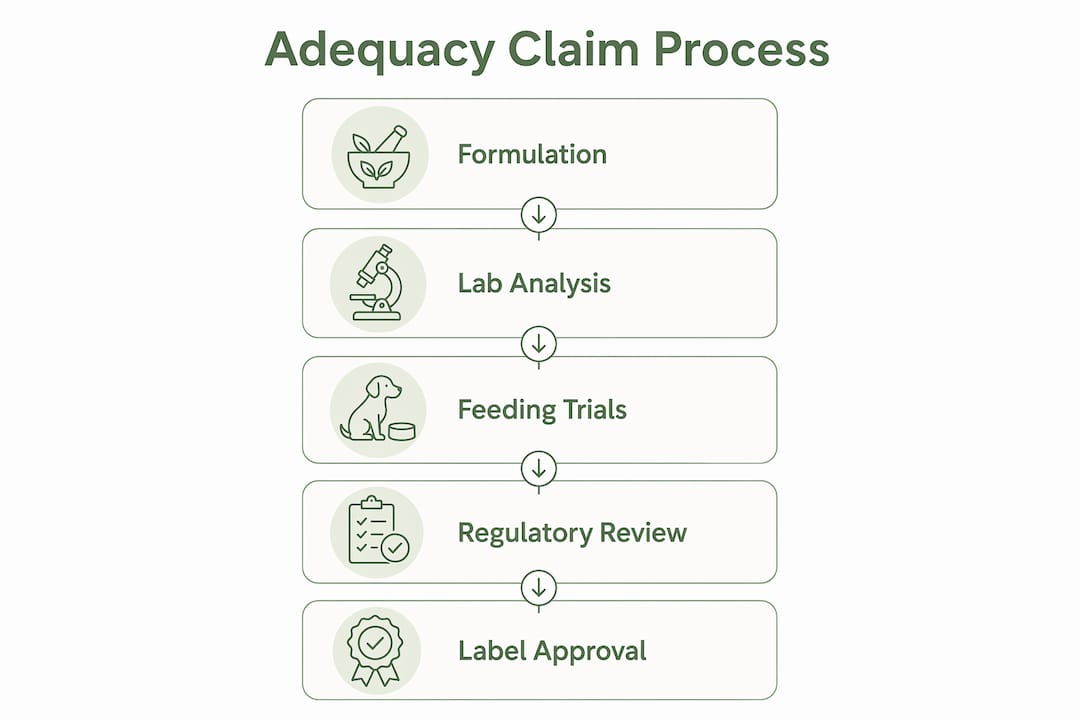
Manufacturers substantiate nutritional adequacy claims through one of three methods, each with different levels of rigor.
-
Formulation method. The manufacturer analyzes the recipe in a laboratory and compares the nutrient levels against AAFCO's published nutrient profiles for the target species and life stage. If the numbers meet the minimums and maximums, the product earns the "formulated to meet" statement. This method is faster and less expensive, but it measures nutrient presence rather than nutrient absorption.
-
Feeding trial method. The manufacturer feeds the product to a group of animals under controlled conditions for a defined period. AAFCO feeding trials require a minimum of 26 weeks for adult maintenance diets and 10 weeks for growth and reproduction diets, with regular monitoring of body weight, blood chemistry, and physical condition. A food that passes earns the "animal feeding tests substantiate" statement.
-
Family rule method. A manufacturer can extend a feeding-trial claim to related products within the same line if those products meet defined similarity criteria. The family rule reduces the need for repeated trials across an entire product range, which is why you may see the feeding-trial statement on a flavor variety that was never independently tested.
The practical difference between formulation and feeding trials is significant. Feeding trials provide stronger biological evidence because they measure whether animals actually absorb and use the nutrients, not just whether the nutrients exist on paper. A food can be formulated to contain adequate zinc, but if the zinc source has low bioavailability, the animal may still become deficient. Feeding trials catch that gap. Formulation analysis does not.
| Method | Evidence type | Key limitation |
|---|---|---|
| Formulation | Lab nutrient analysis vs. AAFCO profiles | Does not confirm nutrient absorption |
| Feeding trial | Live animal health monitoring over weeks | Costly and time-intensive for manufacturers |
| Family rule | Extended claim from a tested related product | Relies on similarity criteria, not direct testing |
Pro Tip: When choosing between two foods with similar ingredients and price points, prioritize the one whose label reads "animal feeding tests substantiate." That phrase signals a higher standard of evidence for nutrient bioavailability and real-world health outcomes.
Which life stages do adequacy statements cover?
AAFCO recognizes four life stage categories that appear in nutritional adequacy statements: growth, adult maintenance, gestation and lactation, and all life stages. Each category carries different nutrient requirements, and mismatching a diet to a life stage is one of the most common feeding errors pet owners make without realizing it.
Here is what each category means in practice:
- Growth covers puppies and kittens from weaning through the end of rapid development. Growth diets are higher in calories, protein, calcium, and phosphorus to support bone and muscle development. Feeding an adult maintenance food to a large-breed puppy, for example, can cause skeletal problems because the calcium levels are insufficient for rapid bone growth.
- Adult maintenance covers healthy adult animals with no special physiological demands. This is the most common statement on the market and is appropriate for the majority of adult dogs and cats.
- Gestation and lactation covers pregnant and nursing females, who have dramatically elevated calorie and nutrient needs. A maintenance diet fed during late pregnancy or nursing can result in significant weight loss and reduced milk production.
- All life stages means the food meets the most demanding nutrient profile, which is the growth and reproduction standard. This statement is appropriate for puppies, kittens, pregnant females, and adults, but it is often calorie-dense and may contribute to weight gain in sedentary adult animals.
Selecting the right statement requires matching your pet's current age, reproductive status, and body condition. A two-year-old neutered Beagle does not need an "all life stages" food. A nursing Border Collie absolutely does. For guidance on puppy-specific nutritional needs by growth stage, the life stage category on the label is your starting point, not your ending point.
How to interpret adequacy statements when choosing pet food
Reading the adequacy statement is step one. Using it correctly requires a few additional checks.
- Match species first. A food formulated for dogs is not adequate for cats. Cats require taurine, arachidonic acid, and preformed vitamin A at levels that dog food does not provide. This distinction is non-negotiable.
- Check the life stage against your pet's current status. A senior dog with reduced activity needs a maintenance diet, not an all-life-stages formula that adds unnecessary caloric load.
- Look beyond the statement for ingredient quality. The adequacy statement confirms nutrient levels, not ingredient sources. Two foods can carry identical statements while using vastly different protein sources and processing methods. Signs of quality dog food go beyond the AAFCO statement and include named protein sources, minimal processing, and transparent sourcing.
- Identify supplemental-only products before feeding. Treats, chews, raw food toppers, and many freeze-dried products carry the "intermittent or supplemental feeding only" label. Using them as a primary diet creates deficiencies that may not appear for months.
- Cross-reference feeding amounts with your pet's weight and activity level. The adequacy statement tells you the food is nutritionally complete. It does not tell you how much to feed. Overfeeding a complete and balanced food still causes obesity.
Veterinary nutrition assessment should complement label reading because individual health conditions, medications, and body composition affect optimal dietary needs in ways no label can predict. A dog recovering from kidney disease, for instance, needs a therapeutic diet that falls outside standard AAFCO adequacy categories entirely.
Pro Tip: Use a weight-based feeding schedule alongside the adequacy statement. The label confirms nutritional completeness; the feeding schedule confirms you are delivering the right amount for your pet's size and energy needs.
How regulatory bodies govern pet food adequacy claims
AAFCO publishes the model regulations that define what nutritional adequacy statements must say and how they must be substantiated. However, AAFCO does not test or certify foods directly. It provides the rulebook. Enforcement falls to individual state feed control officials and, at the federal level, the FDA's Center for Veterinary Medicine.
This structure has real implications for pet owners:
- Manufacturers self-certify. A company chooses its substantiation method and declares adequacy on the label. No third party verifies the claim before the product reaches store shelves.
- AAFCO nutrient profiles are a floor, not a ceiling. Meeting minimum nutrient levels does not mean the food is optimal. It means it clears the baseline threshold.
- Adequacy statements do not cover safety or palatability. Recalls have occurred on foods labeled complete and balanced, because the FDA handles contamination and safety enforcement separately from AAFCO's labeling standards.
- Brand reputation and recall history matter. A company with a consistent record of clean manufacturing and transparent sourcing provides a layer of assurance that the adequacy statement alone cannot.
- Natural and holistic claims are unregulated. These marketing terms have no legal definition in pet food labeling and carry no nutritional meaning. The adequacy statement is the only label claim with regulatory teeth.
Understanding this regulatory structure means you can trust the adequacy statement as a meaningful baseline while recognizing it is not a guarantee of excellence. Pair it with research into the brand's manufacturing standards and recall history for a fuller picture.
Key takeaways
The nutritional adequacy statement is the only label claim on pet food with regulatory backing, but it confirms a baseline standard rather than guaranteeing ingredient quality, safety, or optimal nutrition for your specific pet.
| Point | Details |
|---|---|
| Statement location | Find it at the bottom of the Nutrition Facts box on the back or side panel. |
| Feeding trial vs. formulation | "Animal feeding tests substantiate" signals stronger evidence than "formulated to meet." |
| Life stage matching | Always match the statement's life stage to your pet's current age and condition. |
| Regulatory limits | AAFCO sets the standard but does not test products; enforcement is state and FDA-level. |
| Beyond the label | Pair the adequacy statement with ingredient quality checks and a weight-based feeding plan. |
What I've learned from years of reading pet food labels
Most pet owners treat the nutritional adequacy statement as a checkbox. Either the food has one or it does not. That binary thinking misses the most useful information on the label.
The distinction between "formulated to meet" and "animal feeding tests substantiate" is not a technicality. It is the difference between a food that looks adequate on paper and one that has been tested in living animals. I have seen well-intentioned owners spend significant money on premium-looking kibble that carries only the formulation statement, while a mid-priced brand with feeding-trial backing sits on the same shelf unnoticed.
The life stage issue is equally underappreciated. I regularly encounter owners feeding "all life stages" food to adult dogs because it sounds inclusive and reassuring. In practice, those foods are formulated to meet the growth standard, which means higher calorie density than most adult dogs need. The adequacy statement is correct. The application is wrong.
My honest recommendation is to use the adequacy statement as your entry filter, not your final decision. A food without an AAFCO statement is disqualified immediately. A food with a feeding-trial statement earns a closer look. Then check the ingredient list, the brand's manufacturing transparency, and whether the feeding amounts align with your pet's actual weight and activity level. Label knowledge and veterinary nutrition guidance together produce better outcomes than either alone.
— Robert
How Bowlful helps you go beyond the label
Understanding the adequacy statement is the starting point. Applying it correctly to your specific pet's breed, weight, and life stage is where most owners need support.

Bowlful builds personalized feeding plans using the Resting Energy Requirement (RER) formula that veterinarians use in clinical practice. Rather than relying on generic bag guidelines, Bowlful's interactive quiz factors in your pet's actual weight, breed, and life stage to calculate precise daily feeding targets. Research shows lean-fed pets may live 1.8 years longer than their overweight counterparts, and that kind of outcome starts with getting the amounts right, not just the label. Visit Bowlful to build a feeding plan grounded in the same science your vet uses.
FAQ
What is a nutritional adequacy statement on pet food?
A nutritional adequacy statement is the label declaration confirming that a pet food is complete and balanced for a specific species and life stage, substantiated through AAFCO formulation standards or feeding trials. AAFCO's PF4 regulation places this statement at the bottom of the Nutrition Facts box.
What does "formulated to meet AAFCO nutrient profiles" mean?
It means the manufacturer analyzed the recipe in a lab and confirmed that nutrient levels match AAFCO's published minimums and maximums for the stated life stage. This method does not confirm that animals actually absorb those nutrients, which is why feeding-trial statements carry stronger evidence.
Can a food be recalled even if it has an adequacy statement?
Yes. The adequacy statement covers nutritional completeness under AAFCO labeling standards, but safety and contamination are enforced separately by the FDA. Recalls have occurred on foods carrying complete and balanced statements.
What does "for intermittent or supplemental feeding only" mean?
It means the food does not meet AAFCO's complete and balanced standard and cannot serve as a sole diet. Treats, toppers, and many raw or freeze-dried products carry this designation and should supplement a complete diet rather than replace it.
How do I match a nutritional adequacy statement to my pet's life stage?
Identify your pet's current age and condition: puppy or kitten (growth), healthy adult (maintenance), pregnant or nursing female (gestation and lactation), or any age (all life stages). Match the label's stated life stage to that category, and consult a veterinarian if your pet has health conditions that fall outside standard categories.