
Most pet owners are guessing when it comes to portions. They eyeball a scoop, follow the bag's generic chart, and call it done. The problem is that a pet feeding schedule by weight requires more precision than that, because the difference between a lean, energetic dog and an overweight one often comes down to just 10 to 20 extra calories per day over months. Studies consistently link obesity in pets to shorter lifespans and reduced quality of life. This guide walks you through exactly how to calculate, schedule, and adjust your pet's food based on their actual weight and body condition.
Table of Contents
- Key takeaways
- Building your pet feeding schedule by weight
- Calculating daily portions from your pet's weight
- Structuring meals throughout the day
- Monitoring and adjusting your pet's plan
- My take on feeding by weight
- Feed smarter with Bowlful
- FAQ
Key takeaways
| Point | Details |
|---|---|
| Use ideal weight, not current weight | If your pet is overweight, calculate portions from their target weight to support safe weight loss. |
| RER is your starting formula | The Resting Energy Requirement formula gives you a science-backed calorie baseline before any adjustments. |
| Calorie density varies by brand | Two cups of different foods can differ by hundreds of calories, so always check the label's kcal per cup. |
| Treats count toward daily calories | Cap treats at 10% of daily calories and reduce meal portions accordingly to avoid unintentional overfeeding. |
| Reassess every two to four weeks | Body condition and weight change over time, so your feeding plan needs regular updates to stay accurate. |
Building your pet feeding schedule by weight
Before you calculate a single calorie, you need two numbers: your pet's current weight and their ideal weight. These are not always the same number, and mixing them up is one of the most common errors pet owners make.
How to get an accurate weight
Weigh yourself on a bathroom scale, then hold your pet and weigh again. The difference is your pet's weight. For small pets, a kitchen scale works better and gives you precision to the nearest 10 grams. Convert pounds to kilograms by dividing by 2.2. You will need kilograms for the calorie formula.
Body condition score matters more than weight alone
Weight is a number. Body Condition Score (BCS) tells you what that number actually means for your specific animal. BCS is a 9-point scale used by veterinarians: a score of 4 to 5 is ideal, anything above 6 signals excess fat, and below 3 indicates the pet is underweight. You assess it by feeling the ribs. On an ideal-weight pet, you should feel ribs easily but not see them.
Here is why BCS changes your math: a dog currently at 30 kg with a BCS of 7 has an ideal weight closer to 25 kg. Using the ideal weight in your calculations rather than the current overweight figure produces portions that support weight loss rather than maintaining excess fat.
Factors that modify feeding amounts beyond weight:
- Life stage: puppies, pregnant or nursing females, and seniors all have different multipliers
- Activity level: a working dog or highly active cat burns significantly more than a sedentary apartment pet
- Neuter status: spayed and neutered pets typically need 10 to 20% fewer calories than intact animals
- Health conditions: hypothyroidism, diabetes, and joint disease all affect how you should feed
Pro Tip: Ask your vet to assign a BCS at your next visit and write it down. Use it as a reference point to track progress over time, not just the number on the scale.
Calculating daily portions from your pet's weight
This is where pet nutrition by size gets scientific, and where most generic feeding guides fall short. The formula veterinarians use is called the Resting Energy Requirement (RER).
The RER formula
The RER formula is RER = 70 × (body weight in kg)^0.75. There is also a simplified linear version: RER = (30 × body weight in kg) + 70, which works well for pets between 2 and 45 kg.
RER gives you the calories your pet needs just to exist at rest. Every pet needs more than that in real life, which is where the Daily Energy Requirement (DER) comes in.
Applying life stage multipliers
| Life stage or status | Multiplier (× RER) |
|---|---|
| Intact adult, typical activity | 1.8 |
| Neutered adult, typical activity | 1.6 |
| Weight loss goal | 1.0 |
| Highly active or working dog | 3.0 or higher |
| Puppy under 4 months | 3.0 |
| Puppy 4 months to adult | 2.0 |
A neutered adult dog at 10 kg: RER = (30 × 10) + 70 = 370 kcal. DER = 370 × 1.6 = 592 kcal per day.
Converting calories to actual food portions
This is the step most pet food calculators skip. Knowing your pet needs 592 kcal is useless unless you know how many calories are in the food you are actually using. Different foods have widely varying calorie densities, so two identically sized cups can differ by 150 kcal or more.
Check your food bag or can for the kcal per cup (dry) or kcal per can (wet). The calculation is straightforward:
- Find the kcal per 100g on the label (or convert from kcal per cup using the bag's gram weight per cup).
- Divide your pet's daily calorie need by the food's kcal per 100g.
- Multiply by 100. The result is the grams of food to feed per day.
- If you prefer cups, divide the gram total by the gram weight of one cup for your specific food.
Example for a real scenario: Your cat needs 240 kcal per day. Your dry food contains 360 kcal per 100g. Daily amount = (240 / 360) × 100 = 66.7 grams per day.
Pro Tip: Switching food brands? Recalculate the gram amount every time. A "premium" food may have 400 kcal per 100g while a standard brand has 310. Feeding the same cup size across both would be a significant daily overdose.

Structuring meals throughout the day
Once you have your daily gram or cup total, the next step is spreading it across meals. This is where your pet feeding guide by weight moves from math to practice.
Adult dogs generally do well on two meals per day, morning and evening. Cats can follow the same schedule, though more frequent, smaller meals tend to suit their natural hunting pattern better. Puppies are a different story entirely.
Recommended meal frequency by life stage:
- Puppies under 12 weeks: 4 meals per day
- Puppies 3 to 6 months: 3 meals per day
- Puppies 6 months to 1 year: 2 to 3 meals per day
- Adult dogs and cats: 2 meals per day
- Senior pets with appetite issues: 3 smaller meals per day
For feeding frequency by breed size, small breeds like Chihuahuas benefit from more frequent small meals because they are prone to hypoglycemia, while large breeds benefit from two structured meals to reduce bloat risk.
Accounting for treats in your schedule
Treats are not free calories. Cap treats at 10% of your pet's total daily calorie budget, and subtract that amount from their meal portions. If your dog's daily budget is 600 kcal and you give 60 kcal in treats, each meal should provide 270 kcal rather than 300.
Choosing the right treats matters here. Vet-approved natural treats tend to have more predictable calorie counts and fewer additives that could interfere with weight management.
Sample daily schedule by weight category
| Weight category | Daily food (approx.) | Meal split |
|---|---|---|
| Small dog, 3 to 5 kg | 60 to 90g dry food | 2 meals, 30 to 45g each |
| Medium dog, 10 to 15 kg | 150 to 220g dry food | 2 meals, 75 to 110g each |
| Large dog, 25 to 35 kg | 300 to 420g dry food | 2 meals, 150 to 210g each |
| Adult cat, 4 to 5 kg | 55 to 75g dry food | 2 to 3 meals |
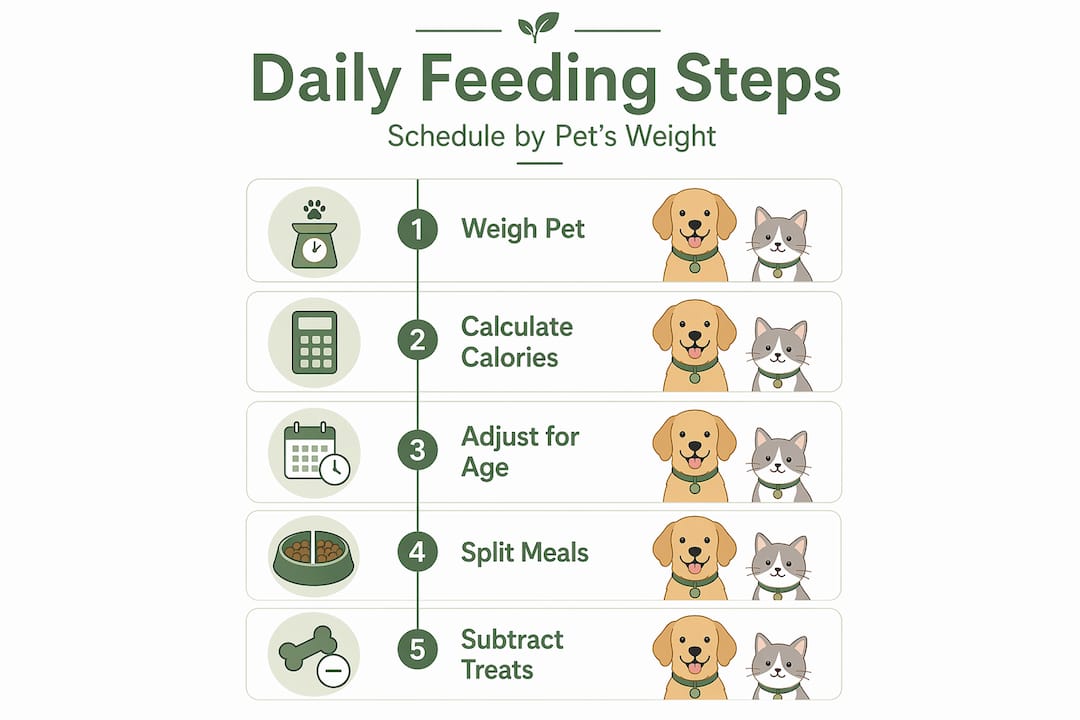
Note: These figures assume a standard dry food at approximately 350 kcal per 100g for a neutered adult. Your actual food's calorie density will shift these numbers.
Monitoring and adjusting your pet's plan
The math gives you a starting point. What actually keeps your pet healthy is what happens after you set the plan.
Reassess your pet's weight every two to four weeks and check their BCS at the same time. A pet losing weight faster than 1 to 2% of body weight per week is being underfed. A pet not losing weight despite a calorie deficit might have a health issue worth investigating.
Signs your current portions need adjustment:
- Visible weight gain or noticeable ribs starting to show
- Dramatically increased or decreased interest in meals
- Lethargy that was not present before the diet change
- Loose stool, which can signal too much food too quickly
- Persistent begging despite a full feeding schedule
When adjustments are needed, change portions gradually. A 10% reduction held for two weeks gives you clean feedback without stressing your pet's digestive system. Larger jumps create confusion about what actually worked.
Feeding charts are a starting point, not a permanent prescription. Body condition should always override a printed number. A chart cannot account for your specific dog's metabolism, muscle mass, or the calorie density of the exact food you bought this month.
For pets with thyroid conditions, kidney disease, or a history of obesity, bring your vet into the adjustment process. These cases often need calorie targets outside the standard multiplier range, and guessing carries real risk.
Pro Tip: Take a photo of your pet from above and from the side every four weeks. Visual tracking catches subtle changes in body condition that a scale alone will miss, especially in fluffy or long-haired breeds.
Preventing long-term weight creep is much easier than reversing established obesity. If you have a small breed dog, the small breed obesity prevention principles are worth understanding early, before an issue develops.
My take on feeding by weight
I've seen pet owners with genuinely good intentions accidentally overfeed their dogs for years, simply because they trusted the bag. The bag is written to sell food. The RER formula is written by veterinarians.
What I've learned from working with feeding schedules is that the biggest mistake is treating a weight-based plan as a permanent setting rather than a live experiment. Your pet's activity changes seasonally. Their metabolism slows after spaying or neutering. A dog that walked five miles a day now walks two. The food has not changed, but everything else has.
I've also found that body condition beats the scale almost every time. I've worked with dogs who were technically at their target weight but visually overfat, because they had lost muscle. The scale said they were fine. Their ribs and waist said otherwise.
The other thing I push back on is the idea that this process needs to be complicated. You need a kitchen scale, a food label, and a fifteen-minute investment once a month. That is genuinely it. The math sounds intimidating until you do it once, and then it becomes second nature.
My honest advice: do the RER calculation once, track body condition monthly, and collaborate with your vet annually. Everything else is fine-tuning.
— Robert
Feed smarter with Bowlful
If calculating RER and food density every time you switch bags sounds like more work than you signed up for, that is exactly the problem Bowlful was built to solve.
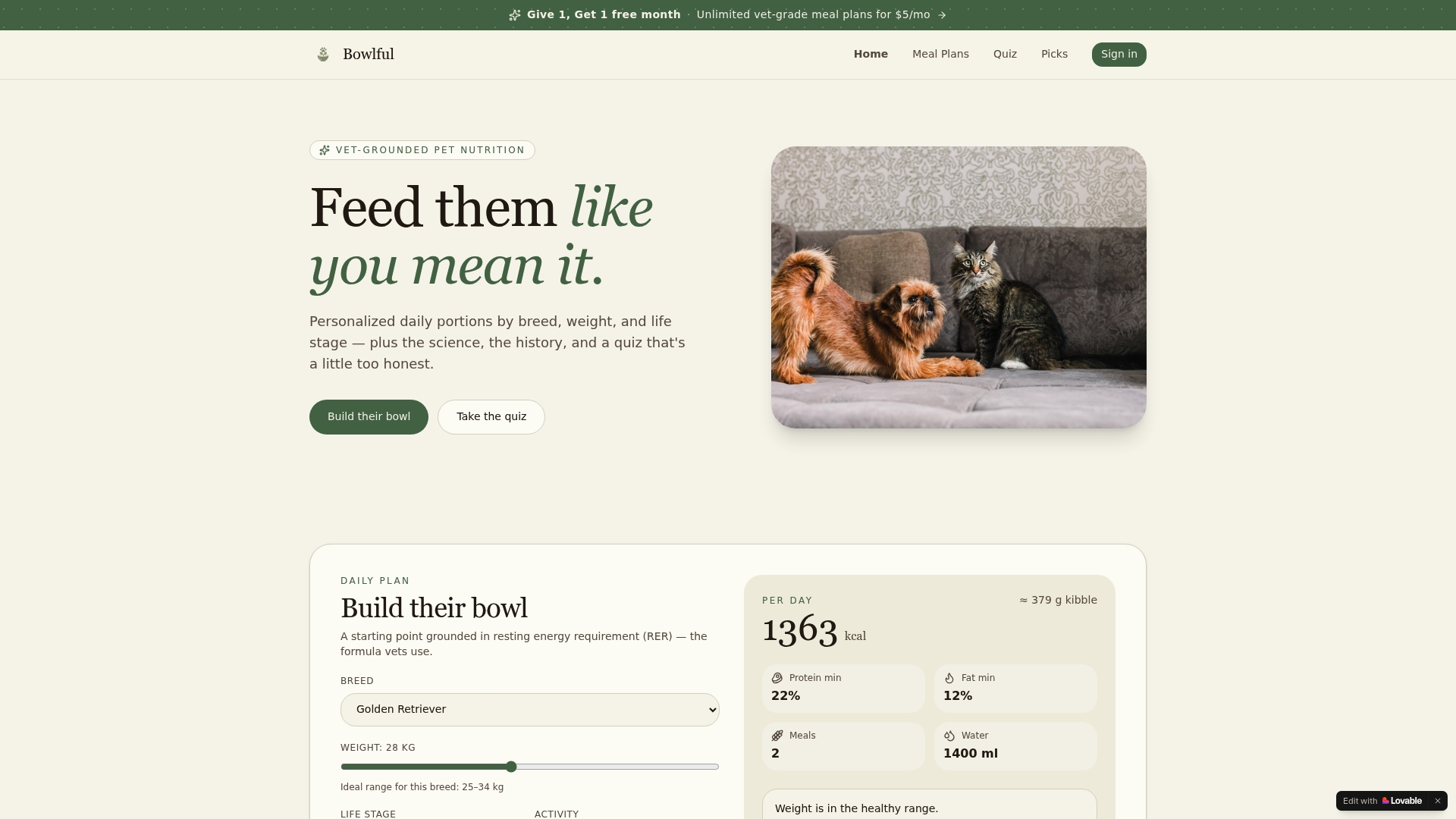
Bowlful builds personalized pet nutrition plans based on your pet's breed, current weight, life stage, and activity level. The same RER formula veterinarians use is built directly into the process, so the math is done for you. Whether you have a 6-pound senior cat or a 70-pound active retriever, Bowlful's approach accounts for the details that generic bag charts ignore. Visit Bowlful to get a feeding plan tailored to your pet's actual needs, not a weight range printed on a label.
FAQ
How often should I update my pet's feeding plan?
Reassess every two to four weeks, checking both weight and body condition score. Pets in active weight loss phases or those going through life stage changes (growth, pregnancy, senior years) need more frequent reviews.
Should I use my pet's current weight or ideal weight to calculate portions?
Use their ideal body weight, not their current weight if they are overweight. Calculating from an inflated current weight will produce a calorie target that maintains excess fat rather than reducing it.
How do treats affect a weight-based feeding plan?
Treats should account for no more than 10% of total daily calories. Subtract the calories provided by treats from your pet's total daily meal allowance to avoid consistently overfeeding.
Why do two foods with the same cup size give different results?
Calorie density varies significantly between brands and formulas. A cup of one food might deliver 300 kcal while another delivers 450 kcal. Always base portions on grams calculated from the food's actual kcal per 100g, not on volume alone.
How many meals a day does my dog or cat need?
Adult dogs and cats generally do well on two meals daily, while puppies under six months need three to four meals. Splitting the daily portion into multiple meals supports stable energy and reduces the risk of overeating at a single sitting.