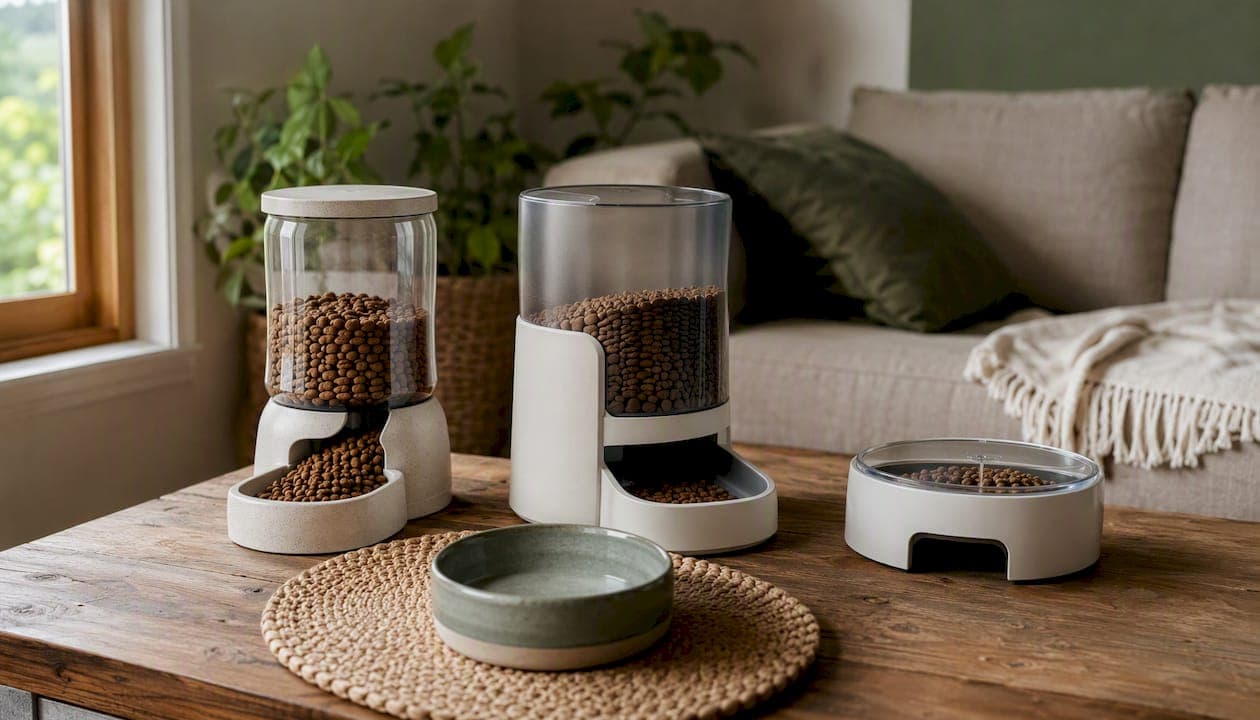
For most U.S. households feeding dry kibble, a programmable hopper or Wi-Fi smart hopper offers a good balance of reliability, portion control, and convenience. That said, the right type shifts fast once you add a second pet, switch to wet food, or have a dog that inhales meals in under ten seconds.
Here's how the main feeder types map to common situations:
- Single indoor cat, dry food: Programmable hopper (timed auger or conveyor). Consistent portions, low maintenance, no app required.
- Multi-cat home with different diets: Microchip/RFID feeder. Each cat only accesses its own bowl, which is the only reliable way to separate meals without supervision.
- Wet-food household: Refrigerated or ice-pack dish feeder. Wet food left at room temperature spoils within two to four hours; preservation matters more than any smart feature.
- Frequent traveler or remote worker: Wi-Fi smart hopper with camera. Remote feeding, real-time alerts, and video confirmation that your pet actually ate.
- Fast eater prone to bloat: Slow-feed conveyor or scale-based feeder. The Cornell Feline Health Center recommends multiple small meals daily, and a slow-dispense mechanism enforces that pacing mechanically.
Consumer Reports testing confirms no single feeder fits every household. Bowlful's feeding-plan approach adds the layer most feeders skip: matching the portion size to your pet's actual caloric need using vet-standard RER/MER formulas, not just a generic cup measurement.
Table of Contents
- How do the main feeder types compare at a glance?
- A detailed breakdown of each feeder type
- How do you choose the right feeder type for your situation?
- Why does feeder type affect your pet's nutrition and weight?
- What are the most common feeder failures, and how do you prevent them?
- Which models best illustrate each feeder type?
- Key Takeaways
- The feeder type question most owners ask too late
- Bowlful pairs with any feeder type to get portions right
- Useful sources and further reading
How do the main feeder types compare at a glance?
The table below maps every major feeder type against the dimensions that actually matter when you're choosing. "Price shape" reflects the general market range, not a specific model.
| Feeder type | Best for | Food compatibility | Portion accuracy | Capacity | Power & backup | Multi-pet support | Ease of cleaning | Anti-jam / reliability | Price shape |
|---|---|---|---|---|---|---|---|---|---|
| Gravity | Free-feeders, dry-only | Dry only | None (free-flow) | Large (varies) | None needed | None | Easy | High (no mechanism) | Budget |
| Programmable hopper (auger) | Single pet, dry kibble, scheduled meals | Dry only | Moderate (±10–15%) | 4–24 cups | AC + battery backup | Limited (one bowl) | Moderate | Moderate (jam risk with small kibble) | Budget–mid |
| Dish-style / multi-compartment | Wet or dry, short absences | Dry, wet, freeze-dried | Fixed (per compartment) | 1–6 meals | Battery or AC | One pet | Very easy | High (no mechanism) | Budget–mid |
| Smart / Wi-Fi hopper | Remote workers, travelers | Dry only | Moderate–good | 6–30 cups | AC + battery backup | Limited | Moderate | Moderate–good | Mid–premium |
| Microchip / RFID | Multi-pet, diet separation | Dry or wet | Fixed or programmed | Small–medium | AC or battery | Excellent | Easy–moderate | High | Mid–premium |
| Refrigerated / ice-pack wet feeder | Wet-food diets, short trips | Wet, raw, freeze-dried | Fixed (per tray) | 1–5 meals | Battery or AC | Moderate | High (spoilage risk) | Budget–mid | |
| Dual-hopper / multi-food | Two-food diets, multi-pet | Dry (two types) | Moderate | 2× hopper | AC + battery | Good | Moderate | Moderate | Mid–premium |
| Slow-feed / scale / conveyor | Fast eaters, weight management | Dry only | Good–excellent | 4–24 cups | AC + battery | Limited | Moderate | High (conveyor) | Mid–premium |
How to read this: Start with food compatibility. A feeder rated "dry only" is a hard no for wet-food households regardless of any other feature. The "not for wet food" flag on gravity and hopper types is the single most common buying mistake. Most smart hoppers also require 2.4 GHz Wi-Fi, which Good Housekeeping's testing flags as a frequent setup frustration in homes with newer 5 GHz-only routers.
A detailed breakdown of each feeder type
Gravity feeders
A gravity feeder is a container that lets kibble fall into a bowl as the pet eats. There are no timers, no motors, no apps. The entire mechanism is gravity.
Who it fits: Pets that self-regulate naturally and stay at a healthy weight without portion limits. Some cats do this; most dogs do not.
Pros: Virtually nothing to break, no power needed, cheap, and easy to clean.
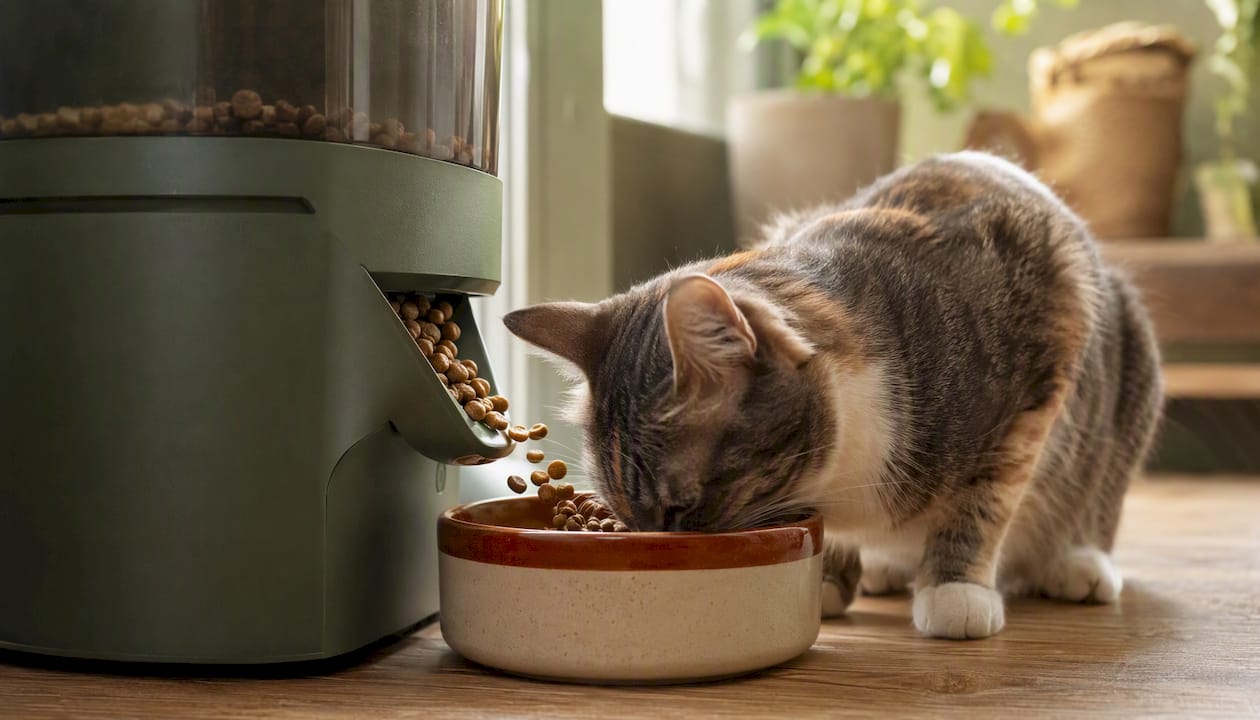
Cons: Zero portion control. A pet that eats fast will drain the bowl and overeat. Completely unsuitable for weight-management diets or multi-pet homes where one animal dominates the food.
Rule of thumb: If your vet has ever mentioned your pet's weight, this type is generally not recommended.
Programmable hopper feeders (timed auger)
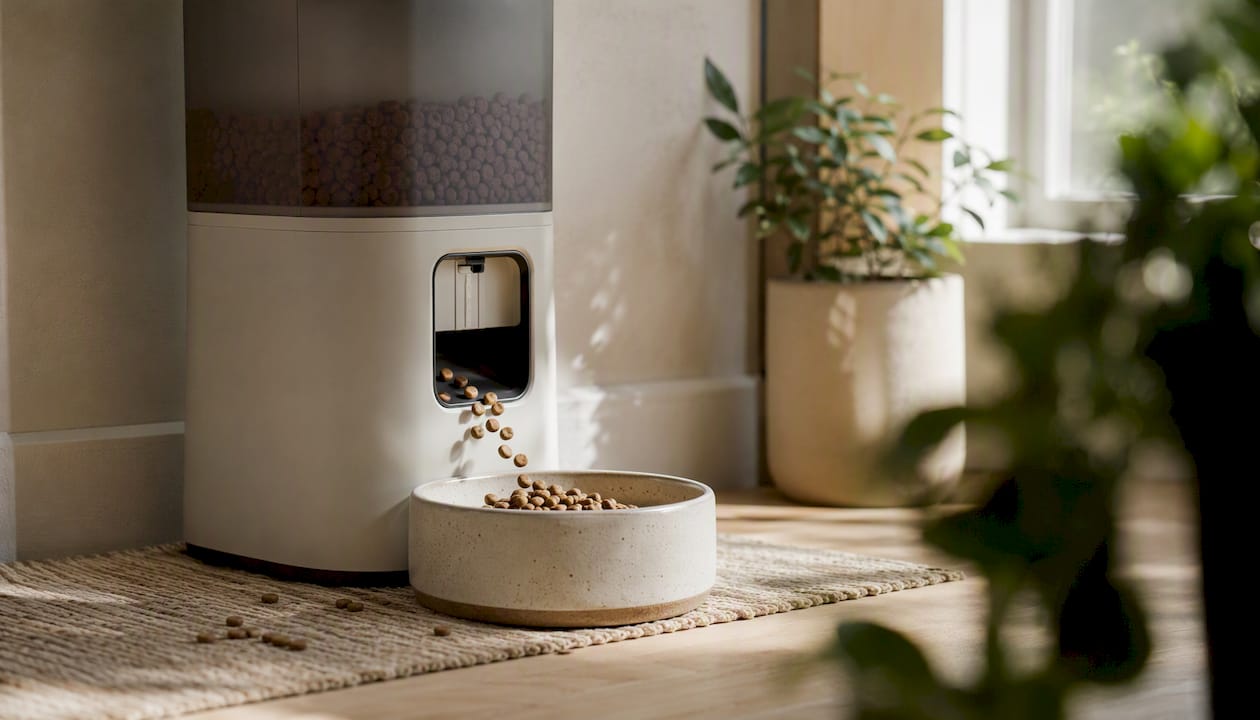
These are the workhorses of the automatic feeder world. A motor-driven auger or paddle rotates on a timer and drops a set amount of kibble into a bowl. Brands like Petlibro and WOpet offer well-regarded versions at accessible price points.
How it dispenses: The auger turns a fixed number of rotations per meal, which translates to an approximate cup or tablespoon measurement. Accuracy typically runs ±10–15% depending on kibble shape and size.
Ideal for: Single-pet dry-kibble households where the owner wants scheduled meals without paying for app connectivity.
Pros: Reliable, widely available, battery backup on most models, easy to program.
Cons: Auger mechanisms can jam with small, round, or irregularly shaped kibble. Overfilling the hopper increases jam risk. No wet-food compatibility. Pickly's comparison notes that matching kibble size to the feeder's auger diameter is the single most overlooked step when setting one up.
Rule of thumb: Best for one pet on a consistent dry-food diet; avoid if you feed small-breed kibble under 8mm diameter without checking manufacturer specs first.
Dish-style and multi-compartment feeders
These rotate a tray of pre-filled compartments on a timer, revealing one section at a time. The Cat Mate C500 is a widely cited example, offering five compartments with an ice-pack slot for wet food.
How it dispenses: A lid rotates or slides to uncover the next compartment at a programmed time. No motor-driven dispensing mechanism means almost nothing to jam.
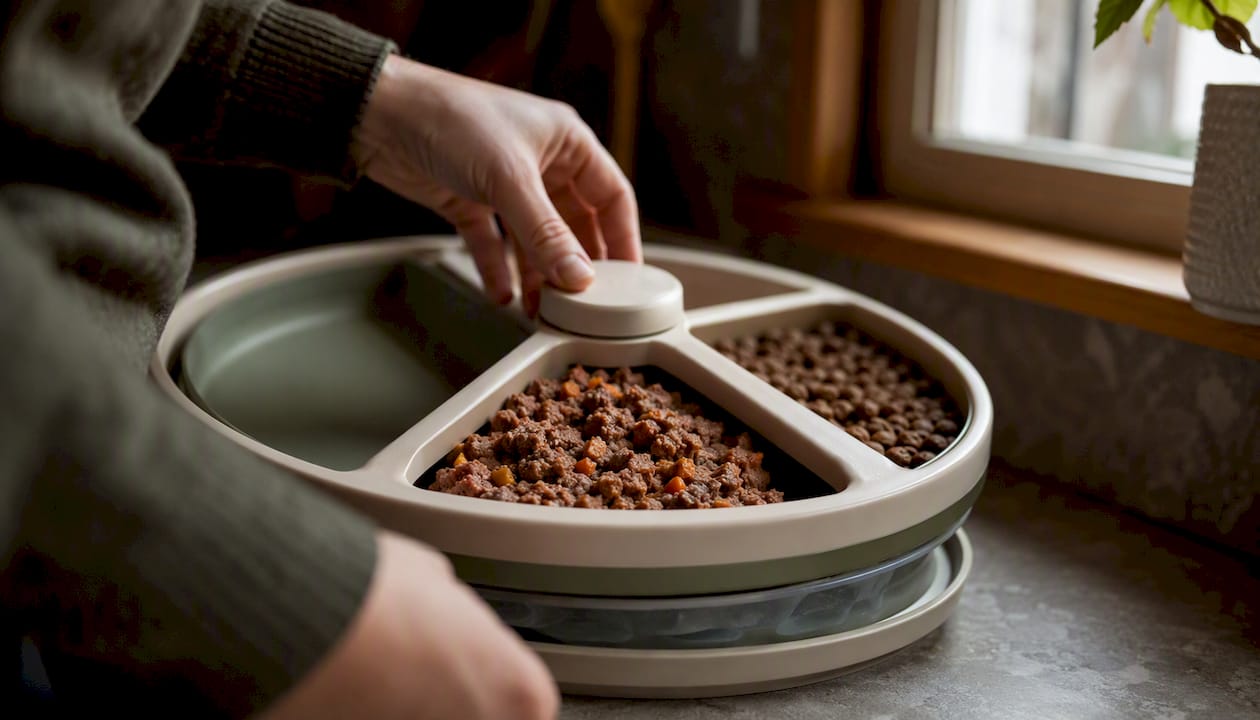
Ideal for: Short absences (one to three days), wet-food diets, or owners who want fixed portion sizes without measuring.
Pros: Works with wet food, raw food, and freeze-dried meals. Extremely reliable mechanically. Portions are exact because you fill them yourself.
Cons: Capacity is limited to the number of compartments, typically three to six meals. Not suitable for extended trips. Ice packs need replacement every 10–12 hours to keep wet food safe.
Rule of thumb: Perfect for a weekend away with a cat on wet food; not a long-term solution for a household that needs seven-plus meals per day.
Smart / Wi-Fi app-connected feeders
Smart feeders add a Wi-Fi module, a companion app, and often a camera to a standard hopper design. Petlibro's Granary Camera model and Petkit's Yumshare are examples of this category. You can trigger a meal remotely, watch your pet eat, and get low-food alerts on your phone.
How it dispenses: Same auger or conveyor mechanism as a standard hopper, with app-controlled scheduling layered on top.
Ideal for: Remote workers, frequent travelers, and owners who want feeding confirmation and real-time monitoring.
Pros: Remote feeding, push notifications, feeding logs, some models include two-way audio.
Cons: Dependent on Wi-Fi stability. Most require 2.4 GHz networks. App updates can break functionality temporarily. If the router goes down, a feeder without local manual backup leaves your pet unfed. TheFamilyPick's comparison frames this trade-off clearly: smart feeders give you control and data; basic timed feeders give you mechanical simplicity and privacy.
Rule of thumb: Worth the premium if you travel or work long hours; overkill for a stay-at-home owner with one cat.
Microchip / RFID access feeders
These feeders read a pet's microchip or an RFID collar tag and only open for the registered animal. SureFlap's SureFeed and Petory's RFID feeder are examples of this approach.
How it dispenses: A motorized lid opens when the registered chip is detected and closes when the pet steps away.
Ideal for: Multi-pet homes where animals need different diets, one pet is on a prescription food, or a dominant animal steals from others.
Pros: The only type that reliably separates meals by individual pet without human supervision. Works with wet or dry food.
Cons: Smaller capacity than hopper feeders. Requires each pet to be microchipped or collared. Some pets take time to learn the lid-opening behavior.
Rule of thumb: Non-negotiable for households where one pet is on a medical diet; unnecessary overhead for single-pet homes.
Refrigerated and ice-pack wet-food feeders
Wet food left at room temperature becomes unsafe within two to four hours. Refrigerated feeders (like some Pawsync models) keep food chilled until the scheduled meal time. Ice-pack versions, like the Cat Mate C500, use a frozen insert under the tray.
How it dispenses: A timer opens a compartment or lid at the scheduled time. The food itself is pre-loaded and kept cold.
Ideal for: Cats or dogs on wet, raw, or prescription wet diets who need meals dispensed while the owner is away.
Pros: Extends safe food window significantly. Works with any food type. No mechanical dispensing means high reliability.
Cons: Limited meal count. Ice packs require daily replacement. Refrigerated models are bulkier and more expensive. The Smart Snout's guide identifies three viable preservation approaches: refrigeration, ice packs, and vacuum-sealed pouches, each with different capacity and power trade-offs.
Rule of thumb: Required for any wet-food diet where the owner is away more than two hours; skip if you feed dry kibble exclusively.
Dual-hopper and multi-food feeders
Dual-hopper feeders hold two separate food types and can alternate or blend portions. Some camera-equipped models from Petkit and newer Pawsync designs fall into this category.
Ideal for: Pets on combination diets (dry plus supplement kibble) or households with two pets that eat the same schedule but different foods.
Pros: Reduces the need for two separate feeders. Some models allow ratio programming.
Cons: More complex to clean. Jam risk doubles with two auger mechanisms. Not a substitute for RFID separation in multi-pet homes where animals compete for food.
Rule of thumb: Useful for a single pet on a blended diet; not a reliable multi-pet separation solution.
Slow-feed, scale-based, and conveyor feeders
These are the precision end of the market. The Whisker Feeder-Robot uses a conveyor-style mechanism with anti-jam engineering and holds up to 32 cups. The PetSafe Smart Feed supports up to 12 meals per day with a slow-feed mode that trickles kibble over several minutes. Scale-based feeders weigh each portion before dispensing.
How it dispenses: A conveyor belt or rotating drum moves kibble in a controlled stream. Scale models weigh the output and stop at a target gram weight.
Ideal for: Fast eaters at risk of bloat, pets on precise medical diets, and households where portion accuracy is non-negotiable.
Pros: Best portion accuracy of any dry-food feeder type. Slow-feed mode reduces gulping. Conveyor design dramatically reduces jam risk compared to auger models.
Cons: Higher price. More mechanical complexity means more to clean. Scale models require calibration.
Pro Tip: Conveyor-style feeders are the most jam-resistant dry-food option on the market. If your pet eats large-breed kibble or you've had jam issues with auger feeders before, the conveyor mechanism is worth the price step-up.
Rule of thumb: The right choice for any pet on a vet-prescribed calorie target or with a history of eating too fast; unnecessary for a healthy pet with no weight concerns.
How do you choose the right feeder type for your situation?
Work through these questions in order. The first answer that eliminates a type saves you from a return.
Step 1: What food type do you feed?
- Dry kibble only: all types are on the table.
- Wet, raw, or freeze-dried: you need a dish-style, refrigerated, or RFID feeder. Gravity and hopper types are out.
Step 2: How many pets, and do they eat different foods?
- One pet: any compatible type works.
- Multiple pets, same diet: dual-hopper or separate feeders.
- Multiple pets, different diets: microchip/RFID is the only reliable answer.
Step 3: How long will the feeder run unattended?
- Under 12 hours: almost any type works.
- 12–48 hours: you need a hopper or smart feeder with battery backup, or a refrigerated wet feeder.
- Over 48 hours: a high-capacity smart hopper (24+ cups) with battery backup and remote monitoring.
Step 4: Is portion precision medically necessary? If your vet has prescribed a specific calorie target, a scale-based or conveyor feeder is the only type that delivers the accuracy to support it. Auger feeders running ±10–15% can meaningfully under- or over-deliver on a tight medical diet.
Step 5: What's your tolerance for tech complexity? Smart feeders require app setup, Wi-Fi configuration, and occasional firmware updates. If that sounds like a chore, a battery-powered programmable hopper does the same core job with less friction. TheFamilyPick's analysis puts it plainly: basic timed feeders win on mechanical reliability; smart feeders win on visibility and control.
Must-have features vs. nice-to-have:
- Must-have: Food-type compatibility, battery backup, anti-jam mechanism (if dry food), portion accuracy matching your pet's health needs.
- Nice-to-have: Camera, app connectivity, voice recording, feeding logs.
Quick decision flow:
- Wet food → dish-style or refrigerated feeder.
- Multi-pet, different diets → RFID/microchip feeder.
- Medical diet or fast eater → conveyor or scale feeder.
- Traveler or remote worker, dry food → Wi-Fi smart hopper.
- Single pet, dry food, home most days → programmable hopper.
- Free-feeding, healthy weight, self-regulating pet → gravity feeder.
Pro Tip: For travel redundancy, pair a Wi-Fi smart hopper as your primary feeder with a simple battery-powered timed feeder set to a single backup meal. If the router goes down or the app fails, your pet still eats. This two-feeder setup costs less than most premium smart feeders alone and eliminates the single biggest failure risk.
Why does feeder type affect your pet's nutrition and weight?
Portion accuracy is not a convenience feature. It's a health variable. The Cornell Feline Health Center recommends feeding cats multiple small meals per day to support healthy weight and reduce the risk of conditions tied to overeating. For dogs, the same principle applies, particularly for breeds prone to bloat or obesity.
Veterinary feeding calculations use two formulas: Resting Energy Requirement (RER) and Maintenance Energy Requirement (MER). RER establishes the baseline calorie need; MER adjusts for activity level, life stage, and health status. The output is a daily calorie target, which then converts to a specific gram or cup measurement for a given food. The problem is that most feeders measure in cups, not grams, and cup measurements vary by kibble density. A "half cup" of a dense small-breed kibble can deliver 30% more calories than a "half cup" of a large-breed formula.
The table below shows typical portion accuracy by feeder mechanism:
| Feeder mechanism | Typical portion unit | Accuracy range | Notes |
|---|---|---|---|
| Gravity | Continuous | None | No portion control |
| Auger (programmable hopper) | Tablespoon / fraction cup | Moderate accuracy | Varies with kibble size and shape |
| Dish-style / compartment | Pre-filled by owner | Exact (manual fill) | Accuracy depends on owner measurement |
| Conveyor / slow-feed | Tablespoon increments | better accuracy | Better than auger; less jam risk |
| Scale-based | Grams | high accuracy | Most accurate dry-food option |
| RFID / microchip dish | Pre-filled by owner | Exact (manual fill) | Same as dish-style |
For a pet on a prescription weight-loss diet, the difference between ±15% and ±3% is meaningful over weeks. Bowlful's feeding schedule by weight tools translate RER/MER outputs into exact gram targets you can use to calibrate any feeder type, removing the guesswork from the cup-to-calorie conversion.
Pro Tip: Test your feeder's actual portion accuracy before trusting it with a medical diet. Set it to dispense one meal, catch the output in a bowl, and weigh it on a kitchen scale. Run three consecutive tests and average the results. If the variance exceeds 10%, either recalibrate the feeder or switch to a scale-based model.
What are the most common feeder failures, and how do you prevent them?
Most feeder problems fall into four categories: mechanical jams, connectivity outages, food spoilage, and pest access. Each is preventable with the right setup.
Routine maintenance tasks:
- Weekly: Wash the food bowl and any removable hopper components with warm soapy water. Kibble dust and oil residue build up faster than most owners expect.
- Monthly: Inspect the auger or conveyor mechanism for stuck kibble fragments. Clear with a dry brush, not water.
- Every 3 months: Replace desiccant packets if your feeder includes them. Moisture in the hopper causes kibble to clump and jam.
- As needed: Check battery backup charge. A dead backup battery defeats the entire purpose of having one.
Common failure modes and fixes:
- Jams: The most frequent issue with auger feeders. Caused by kibble that's too small, too round, or too oily for the mechanism. Fix: match kibble diameter to the manufacturer's recommended range, and never overfill the hopper past the marked line. Pickly's analysis identifies conveyor-style mechanisms as the most jam-resistant design for households with irregular kibble shapes.
- Connectivity outages: Smart feeders that rely solely on cloud connectivity will fail to dispense if the router goes down. Fix: choose a model with a local manual feed button and battery backup, so the feeder operates independently of Wi-Fi when needed.
- Power outages: Any AC-powered feeder without battery backup stops working during an outage. Fix: confirm battery backup is present and test it quarterly.
- Wet-food spoilage: Wet food is unsafe after two to four hours at room temperature. Ice-pack feeders require fresh packs every 10–12 hours. Refrigerated models extend this window but add bulk and cost. Never leave wet food in a standard hopper feeder.
Food safety note: Wet food left unrefrigerated beyond four hours poses a genuine bacterial risk. If you use a dish-style feeder with wet food and will be away longer than that, a refrigerated or ice-pack model is not optional.
Pro Tip: For material safety, prioritize BPA-free plastic or stainless steel bowls. Plastic bowls that aren't BPA-free can leach chemicals over time, particularly when repeatedly exposed to warm, moist food. Stainless steel is the easiest to sanitize and the least likely to harbor bacteria in surface scratches. On noise: conveyor and motor-driven feeders produce a brief mechanical sound at each meal. Most pets adapt within a week, but noise-sensitive cats may startle initially. Running the feeder empty for a day or two before loading it helps desensitize them.
Which models best illustrate each feeder type?
These examples are here to show how specific designs map to the types above, not to rank products. Consumer Reports and Good Housekeeping both note that real-world performance varies by household, so treat these as starting points for your own research.
- Precision portion control (conveyor/scale): The Whisker Feeder-Robot demonstrates anti-jam conveyor engineering with a 32-cup hopper and offline operation. It's the clearest example of what high-capacity, high-reliability dry-food dispensing looks like.
- Slow-feed for fast eaters: The PetSafe Smart Feed with its slow-feed mode, 24-cup hopper, and up to 12 meals per day is the clearest illustration of how timed slow-dispense works for dogs prone to gulping.
Pro Tip: Before buying any specific model, check whether your dry food's kibble size falls within the feeder's recommended range. Most manufacturers list this in the specs. A mismatch here causes more returns than any other single factor.
Key Takeaways
The right feeder type comes down to food compatibility first, then portion accuracy, then connectivity: get those three right and most other features are secondary.
| Point | Details |
|---|---|
| Food type decides first | Wet or raw food requires a dish-style, refrigerated, or RFID feeder; dry-only types will not work. |
| Portion accuracy varies widely | Auger feeders run ±10–15%; scale-based models reach ±1–3%, which matters on medical diets. |
| Battery backup is non-negotiable | Any feeder without a backup power source risks a missed meal during an outage or connectivity failure. |
| RFID is the only reliable multi-pet solution | Gravity, hopper, and smart feeders cannot prevent one pet from eating another's food without chip-reading lids. |
| Bowlful feeding plans pair with any feeder | Bowlful's RER/MER-based meal plans convert calorie targets into exact gram portions you can program into any feeder type. |
The feeder type question most owners ask too late
Most automatic feeder buying guides lead with brand comparisons. That's the wrong starting point. The question that actually determines whether a feeder works for your household is simpler: what does your pet eat, and how accurately does it need to be measured?
A gravity feeder is fine for a healthy, self-regulating cat. It's a bad idea for a Labrador. A smart Wi-Fi hopper is genuinely useful for someone who travels two weeks a month. For a person who works from home, it's an expensive solution to a problem they don't have. The mismatch between feeder type and actual household need is where most buyer regret lives, and it's almost always avoidable.
The piece that most feeder comparisons skip entirely is the calorie math. Knowing that your feeder dispenses "half a cup" twice a day tells you nothing unless you know how many calories are in that half cup for your specific food. A 10-pound cat on a weight-loss plan and a 10-pound cat at maintenance weight may need the same volume but very different calorie counts depending on the food's density. That's where a vet-standard feeding plan, not just a feeder, becomes the actual tool for managing your pet's health.
Feeder type is hardware. Portion size is the variable that moves the needle on weight, energy, and long-term health. Get the type right first, then calibrate the portion with something more precise than the bag's feeding chart.
Bowlful pairs with any feeder type to get portions right
Picking the right feeder type is half the job. The other half is knowing exactly how much to put in it.
Bowlful builds personalized feeding plans using the same RER/MER calorie formulas veterinarians use, adjusted for your pet's breed, age, weight, and activity level. The output isn't a generic "feed 1 cup twice daily." It's a specific gram target for your pet's actual food, formatted as a printable or phone-ready feeding card you can use with any feeder type you've chosen.
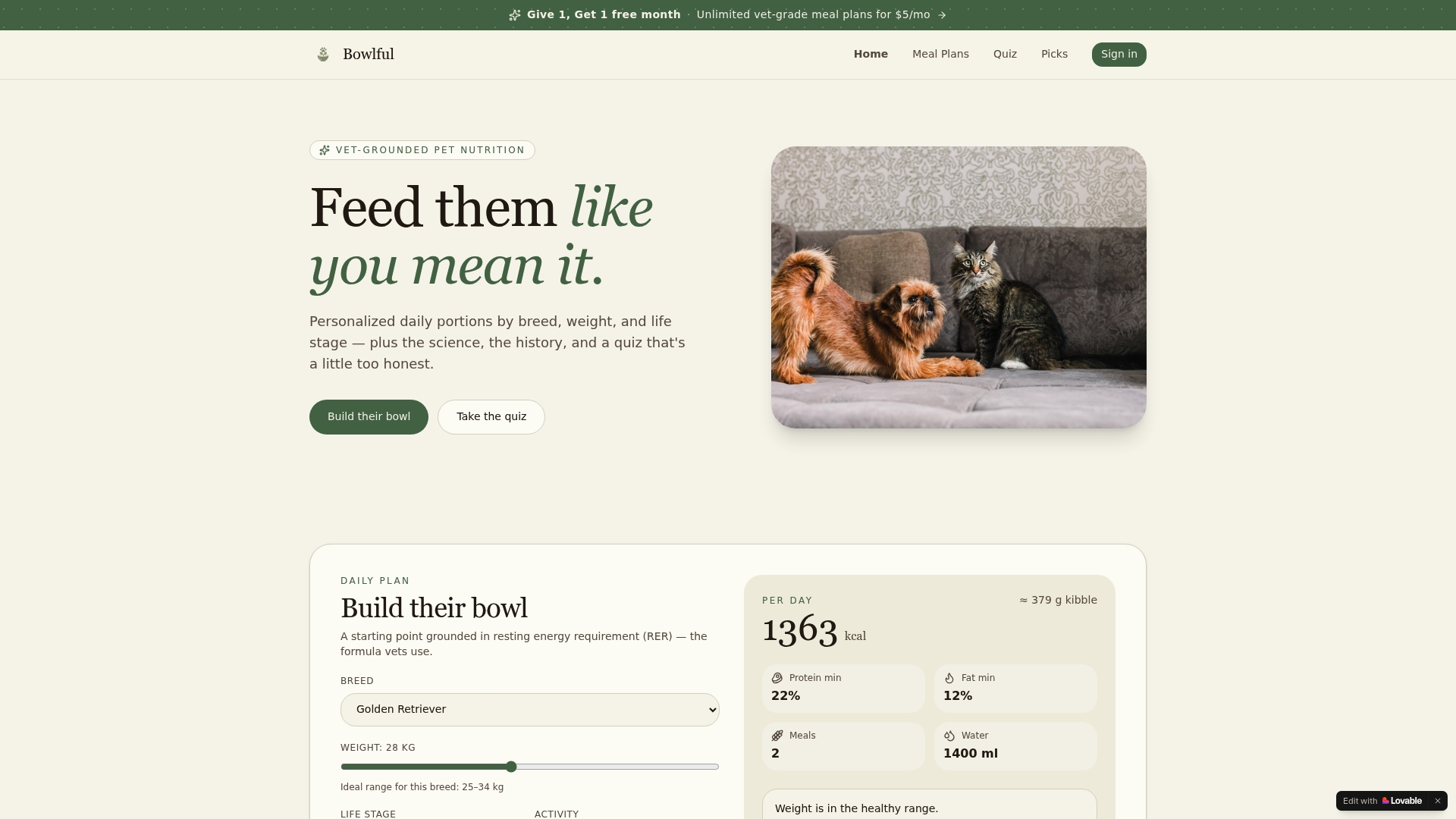
Whether you're programming a PetSafe Smart Feed, filling a Cat Mate C500 compartment, or calibrating a Whisker Feeder-Robot, Bowlful's personalized meal plans give you the exact numbers to enter. The free tools cover the basics; Meal Plan Pro adds downloadable PDFs, multi-pet support, and a feeding schedule aligned to your feeder's meal-count capabilities. If you want a feeding routine built around your pet's actual caloric needs rather than a bag chart, start with Bowlful's free plan and upgrade when you're ready.
Useful sources and further reading
The sources below were used to build this guide. Each is worth bookmarking for ongoing reference.
- How often should you feed your cat
- Best Automatic Dog Feeders
- Feeder-Robot Automatic Pet Feeder for Cats and Dogs
- Smart Feed Automatic Dog and Cat Feeder, 2nd Generation | PetSafe®
- Automatic Pet Feeders Review 2026: The Ultimate Guide to Smart Feeding — The Smart Snout
- Best Automatic Pet Feeders 2026: PetLibro vs PetSafe | Pickly
- Smart WiFi vs Basic Timed Pet Feeders
For medical-diet decisions, always confirm portion targets with your veterinarian. For a feeding plan built to vet-standard calorie formulas, Bowlful's tools are a free starting point.