
A pet feeding routine is a consistent, scheduled system of meal times and measured portions designed to match your pet's nutritional needs at every life stage. Done correctly, it supports healthy digestion, prevents obesity, reduces food-related anxiety, and gives you a reliable window to spot early signs of illness. Most pet owners underestimate how much structure matters here. A kitchen scale, a fixed feeding location, and two set meal times per day can do more for your dog or cat's long-term health than any premium ingredient list.
How to establish a pet feeding routine by life stage
The foundation of any pet feeding schedule is meal frequency, and that number changes significantly as your pet ages. Puppies and kittens aged 0 to 6 months require 3 to 4 feedings daily to fuel rapid growth and stabilize blood sugar. Their small stomachs cannot hold enough food in a single sitting to meet their caloric demands, so spreading meals across the day is a metabolic necessity, not a preference.
Adult dogs and cats between 2 and 7 years old thrive on two meals per day, typically morning and evening. This schedule mirrors natural predator feeding patterns and keeps energy levels steady without long fasting gaps that can cause digestive discomfort or anxious behavior around food. Senior pets aged 7 and older also do best on two smaller meals per day, since their metabolism slows and their digestive systems become less efficient at processing large volumes at once.
Here is a quick reference for establishing pet meal times by life stage:
| Life Stage | Age Range | Meals Per Day | Notes |
|---|---|---|---|
| Puppy / Kitten | 0 to 6 months | 3 to 4 | Small, frequent meals support growth |
| Junior | 6 to 12 months | 2 to 3 | Transition gradually to adult schedule |
| Adult | 1 to 7 years | 2 | Morning and evening meals work well |
| Senior | 7+ years | 2 smaller | Easier on digestion; monitor appetite closely |
Species matters too. Cats are obligate carnivores with a higher protein turnover rate than dogs, which means their caloric density requirements per kilogram of body weight differ. Dogs are more flexible in meal timing, but consistent daily feeding hours between 6 to 8 AM and 5 to 7 PM support digestive health and reduce anxiety. The exact hour matters less than the consistency. Shift your pet's schedule by more than 30 minutes and you will likely see restlessness, begging, or digestive upset.
For dog owners looking at the latest veterinary science, Bowlful's overview of 2026 dog feeding guidelines covers updated frequency recommendations worth reviewing alongside this guide.
How to determine portion sizes and measure food accurately
Guessing portion sizes is the single most common cause of pet obesity. The correct approach is to calculate portions based on your pet's ideal body weight, not their current weight. Feeding amounts based on ideal body weight prevent overfeeding in pets that are already carrying extra pounds, since using their actual heavier weight would only maintain or worsen the problem.

The veterinary standard for calculating daily calorie needs starts with the Resting Energy Requirement, or RER. The RER formula is 70 multiplied by your pet's ideal body weight in kilograms raised to the power of 0.75. From there, a multiplier based on activity level, reproductive status, and life stage converts RER into the Maintenance Energy Requirement, or MER. That MER figure is then divided by the caloric density of the food (listed in kcal per gram on the bag) to get the daily gram amount. Bowlful's feeding schedule by weight walks through this calculation in practical terms if the math feels unfamiliar.
Here is a step-by-step process for measuring portions accurately:
- Find your pet's ideal body weight. Ask your veterinarian, or use your pet's weight at 12 months if they are currently overweight.
- Calculate RER. Multiply 70 by (ideal weight in kg)^0.75. For a 10 kg dog, that is roughly 400 kcal/day at rest.
- Apply the activity multiplier. A typical neutered adult dog uses a multiplier of 1.6, giving approximately 640 kcal/day.
- Check the food's caloric density. Most dry kibble runs between 3.5 and 4.5 kcal per gram.
- Weigh each meal on a kitchen scale. Divide the daily gram total by the number of meals and weigh each serving separately.
Treats should never exceed 10% of daily caloric intake, and that 10% must come out of the total daily allowance, not be added on top. A single medium dog biscuit can represent 50 to 100 kcal, which is a meaningful chunk of a small dog's daily budget.
Pro Tip: Switch from measuring cups to a digital kitchen scale. Cups are inconsistent because kibble density varies by brand and shape. A scale accurate to 1 gram removes the guesswork entirely and costs less than $15.
What environmental and behavioral strategies support a successful feeding routine?
The physical setup of mealtime matters as much as the timing. Veterinarians recommend a calm, consistent feeding station with the same bowl in the same quiet location for every meal. This creates what behaviorists call a "calm anchor," a predictable sensory cue that signals to your pet that food is coming and that the environment is safe. Pets fed in chaotic or shifting locations show higher rates of food guarding and stress eating.
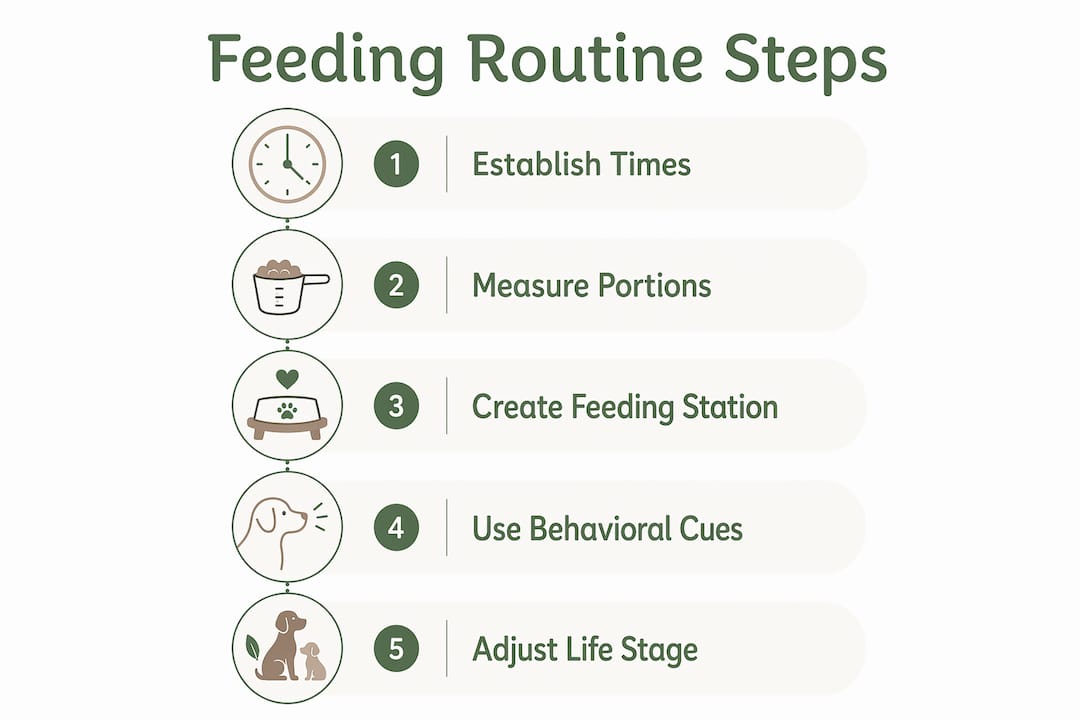
Behavioral cues reinforce the routine further. A specific phrase like "dinner time," the sound of a particular cabinet opening, or even the sight of you picking up the food container all become conditioned signals over time. These cues reduce the frantic pacing and begging that many owners find frustrating, because the pet learns that food arrives on schedule and does not need to be demanded.
Transitioning a pet from free feeding to scheduled meals requires patience. Shift feeding times gradually, by 15 to 30 minutes over several days, rather than making an abrupt change. An abrupt switch can cause digestive upset and spike anxiety. Start by offering food at a set time and removing the bowl after 20 minutes whether or not it is finished. Most pets adapt within one to two weeks.
Managing feeding across multiple caregivers is where routines most often break down. A written feeding chart posted on the refrigerator, or pre-portioned containers labeled by meal, prevents the classic double-feeding problem. Pre-portioned containers and written feeding charts are the most reliable coordination tools when family members, dog walkers, or pet sitters share feeding responsibilities.
"Consistency in feeding routine allows early detection of health changes by observing shifts in appetite or eating behavior." — Sams Cats and Dogs
Automatic feeders dispense measured portions at programmed times, which is particularly useful for owners with irregular work schedules. They do not replace the bonding value of hand-feeding or supervised meals, but they maintain schedule consistency when you cannot be home.
How to handle feeding in multi-pet households and during life changes
Multi-pet households require a more deliberate approach to creating a pet feeding plan. When dogs or cats eat together, competition for food leads to faster eating, overeating, and in some cases outright aggression. Separate feeding stations prevent food guarding and overeating in homes with multiple animals, and the separation does not need to be elaborate. Different rooms, opposite sides of a kitchen, or even a baby gate between bowls is enough.
Microchip feeders take this further by opening only for the pet whose chip is registered. This is the most practical solution when one pet is on a prescription diet or weight management plan and another is not. Raised feeding stations serve a different purpose: they reduce neck strain in large breeds and slow down fast eaters by changing the physical mechanics of eating.
Here is a comparison of feeding tools for multi-pet households:
| Tool | Best For | Limitation |
|---|---|---|
| Microchip feeder | Pets on separate diets | Higher cost; requires chip registration |
| Raised feeding station | Large breeds, fast eaters | Not suitable for flat-faced breeds |
| Separate rooms | Any multi-pet home | Requires owner supervision at meal times |
| Pre-portioned containers | Multi-caregiver households | Needs daily prep |
Life changes disrupt feeding routines more than most owners anticipate. Moving homes, adding a new pet, or a shift in your work schedule can unsettle a pet that has relied on predictable meal timing for months. The fix is the same as the initial setup: gradual adjustment over days rather than an abrupt change, combined with keeping the bowl, location, and food type as consistent as possible during the transition.
Seasonal activity changes also affect how much food your pet needs. A dog that runs three miles a day in summer but barely walks in winter needs a portion adjustment of roughly 10 to 20% between seasons. Monitor body condition score monthly rather than relying on a static portion year-round.
Pro Tip: Learn to assess your pet's body condition score at home. Run your hands along their ribcage. You should feel ribs easily without pressing hard, but not see them. This monthly check tells you more than the scale alone.
Key takeaways
A structured pet feeding routine built on life-stage appropriate meal frequency, precise portion measurement, and a consistent environment is the most direct path to long-term pet health and reduced behavioral problems.
| Point | Details |
|---|---|
| Meal frequency by life stage | Puppies and kittens need 3 to 4 meals daily; adults and seniors do best on 2 meals per day. |
| Portion accuracy matters | Use a kitchen scale and calculate from ideal body weight, not current weight, to avoid overfeeding. |
| Consistent environment | Same bowl, same location, and same mealtime cues reduce food anxiety and reinforce routine. |
| Multi-pet separation | Separate feeding stations or microchip feeders prevent competition and support individual diet needs. |
| Gradual schedule changes | Shift meal times by 15 to 30 minutes over several days to avoid digestive upset during transitions. |
Why I think most pet owners overcomplicate this
After years of writing about pet nutrition and talking with veterinarians, the pattern I see most often is this: owners research endlessly, buy expensive supplements, and switch foods every few months, but they never fix the one thing that would make the biggest difference. The feeding schedule.
A dog that eats at 7 AM and 6 PM every single day, measured to the gram, will almost always be healthier than a dog eating premium food at random times in random amounts. The routine itself is the intervention. Feeding routines build trust and reduce food-related anxiety, which improves emotional well-being alongside physical health. That is not a soft benefit. Chronic food anxiety in pets is linked to destructive behavior, weight fluctuation, and stress-related illness.
The other thing I have learned from consistent feeding is how clearly it reveals health problems. When a dog that cleans his bowl every morning suddenly leaves food untouched, you notice immediately. That early signal has caught everything from dental pain to early kidney disease in pets whose owners were paying attention. Without a routine, appetite changes get lost in the noise.
My honest advice: start with two meals a day, weigh the portions, pick a quiet spot, and do it at the same time every day for 30 days. You will see a calmer, more predictable pet. Then you can fine-tune from there.
— Robert
Make mealtime easier with Bowlful
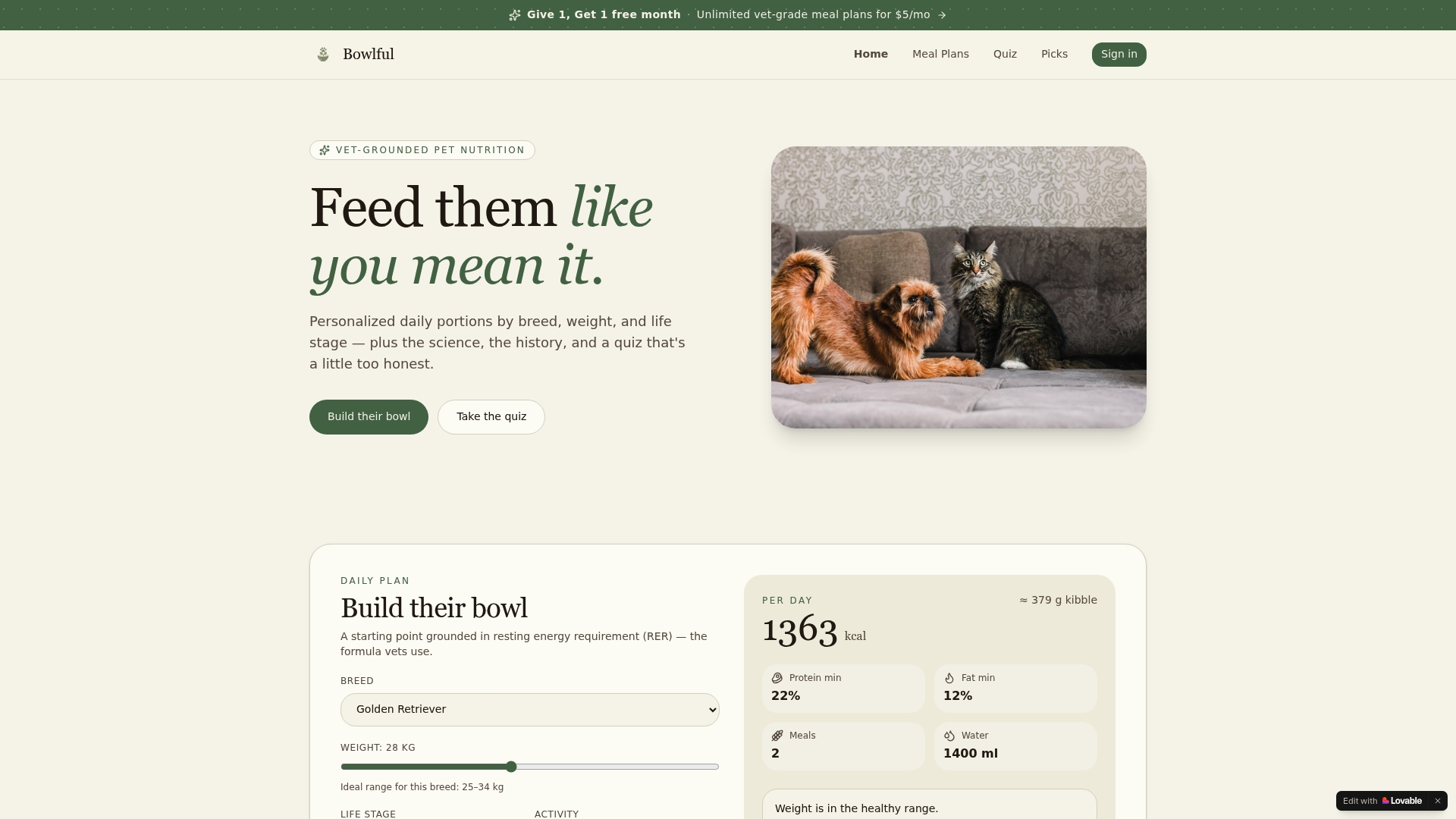
Bowlful builds personalized feeding plans using the same RER formula veterinarians use, calibrated to your pet's breed, weight, and life stage. If you have been estimating portions or struggling to keep a consistent schedule, Bowlful's interactive quiz takes the guesswork out of the equation entirely. Every plan accounts for your pet's specific caloric needs, so you know exactly how much to feed at each meal. For pet owners who want a data-driven starting point rather than a generic bag label, start your pet's plan at Bowlful and get a schedule that actually fits your pet's life.
FAQ
How many times a day should I feed my dog or cat?
Adult dogs and cats thrive on two meals per day, while puppies and kittens under 6 months need 3 to 4 meals daily to support growth and stable blood sugar.
What is the best time to feed my pet?
Feeding dogs between 6 to 8 AM and 5 to 7 PM aligns with natural activity cycles and supports digestion. Consistency matters more than the exact hour, so pick times you can maintain every day.
How do I calculate the right portion size for my pet?
Start with your pet's ideal body weight, calculate the Resting Energy Requirement using the formula 70 x (weight in kg)^0.75, apply an activity multiplier, then divide by the food's caloric density. Bowlful's portion guide by weight walks through each step.
How do I transition my pet from free feeding to scheduled meals?
Remove the food bowl after 20 minutes at each scheduled meal and shift feeding times gradually by 15 to 30 minutes over several days. Most pets adapt fully within one to two weeks.
How do I manage feeding in a home with multiple pets?
Use separate feeding stations, different rooms, or microchip feeders to prevent food guarding and overeating. Separate stations prevent competition and make it easier to monitor each pet's individual intake.