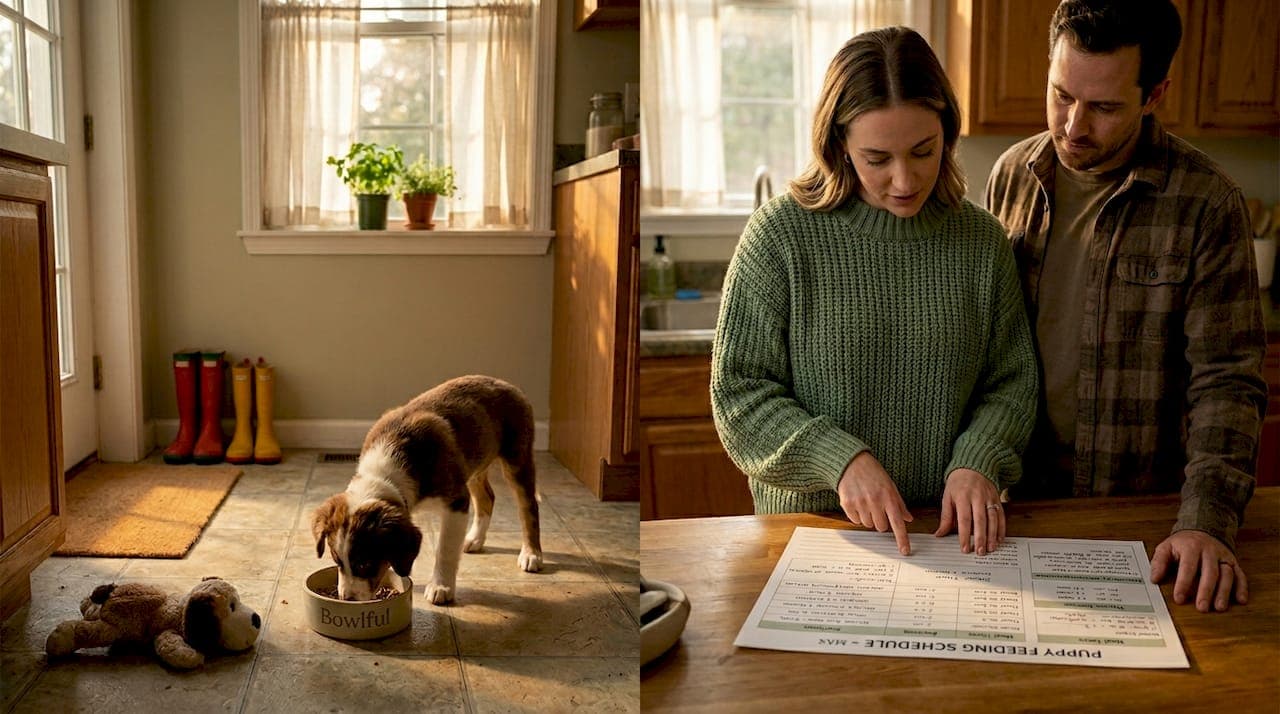
Most new puppy owners buy a bag labeled "puppy food" and assume the job is done. It isn't. What is puppy growth stage nutrition, really? It's the practice of matching your puppy's diet to where they are in a defined biological window of rapid development. Get this right, and you're setting your dog up for a healthy skeleton, a sharp brain, and a strong immune system. Get it wrong, and the effects can be permanent. This guide breaks down every stage, every key nutrient, and how to feed your puppy with confidence.
Table of Contents
- Key takeaways
- What is puppy growth stage nutrition?
- Core nutrients every growing puppy needs
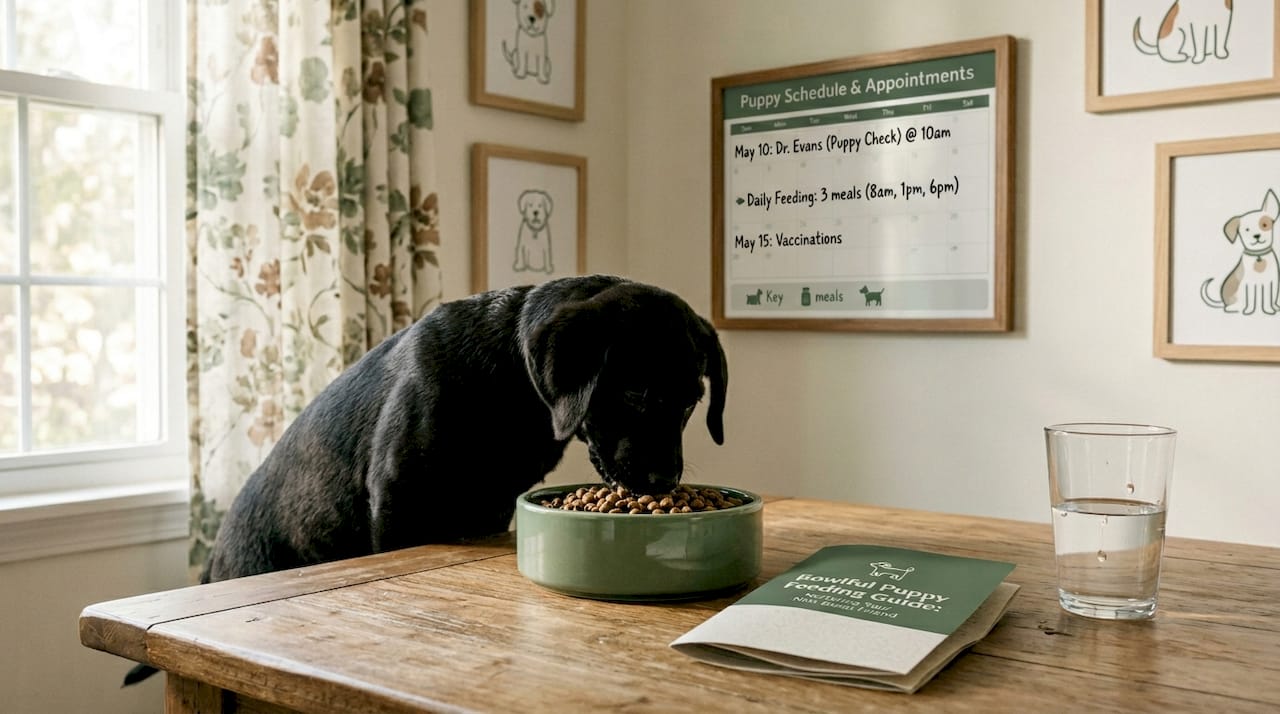
- Feeding schedules and portion control
- Choosing the best food and managing transitions
- My honest take on puppy feeding
- How Bowlful helps you feed your puppy right
- FAQ
Key takeaways
| Point | Details |
|---|---|
| Growth stages vary by breed size | Giant breeds grow until 24 months; small breeds finish around 12 to 15 months. |
| Nutrients are non-negotiable | Protein, DHA, calcium, and phosphorus have specific roles at each growth phase. |
| Meal frequency shifts with age | Puppies need 3 to 4 meals daily early on, tapering to 2 as they mature. |
| Body condition beats scale weight | Check ribs weekly to catch overfeeding or underfeeding before it becomes a problem. |
| Food choice matters more than price | AAFCO-compliant, veterinary-backed formulas outperform trendy boutique diets for real growth outcomes. |
What is puppy growth stage nutrition?
Puppy growth stage nutrition is a structured approach to feeding that accounts for the biological changes your puppy goes through from birth to full maturity. It isn't a single formula. It's a moving target, and understanding the stages is the first step to feeding your dog well.
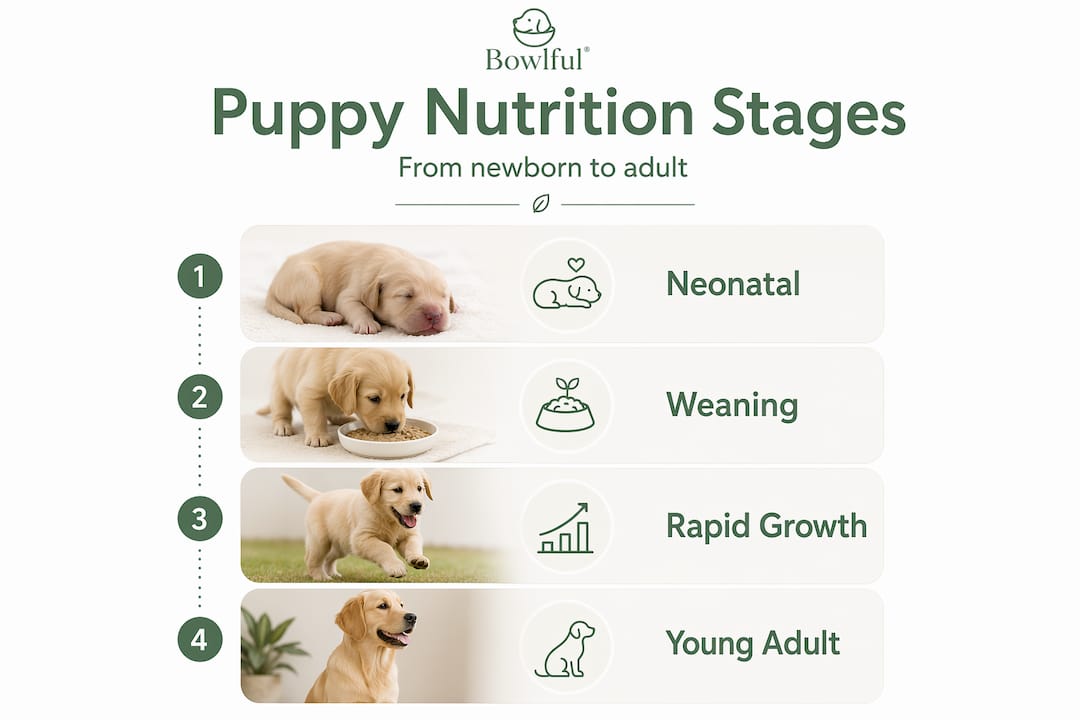
There are four broadly recognized stages. The neonatal phase (birth to 2 weeks) is entirely dependent on the mother's milk. The weaning phase (3 to 7 weeks) introduces solid food and marks the start of your involvement in feeding. The rapid growth phase (2 to 6 months) is where skeletal, muscular, and neurological development happens at a pace that won't occur again in your dog's life. The adolescent phase carries growth to completion, and its length is almost entirely determined by breed size.
This is where breed matters enormously. Transition timing varies significantly by size: small and medium breeds wrap up puppy nutrition at 12 to 15 months, large breeds at 15 to 18 months, and giant breeds at 18 to 24 months. Feeding a Great Dane the same timeline as a Chihuahua isn't just imprecise. It can cause real developmental harm.
Tailored feeding by growth stage prevents two common failure modes: underfeeding critical nutrients during peak growth, and overfeeding calories or minerals in ways that damage joints and bones. Early nutrition errors can cause irreversible orthopedic and developmental problems, particularly during the neonatal and rapid growth phases. This is not a category where close enough is good enough.
Pro Tip: Write your puppy's breed size and expected adult weight on your feeding chart from day one. It will help you track the right transition timelines and avoid feeding mistakes that are easy to make when a puppy looks "big enough."
| Breed size | Expected adult weight | Puppy phase ends |
|---|---|---|
| Small | Under 20 lbs | 12 to 15 months |
| Medium | 20 to 50 lbs | 12 to 15 months |
| Large | 50 to 90 lbs | 15 to 18 months |
| Giant | Over 90 lbs | 18 to 24 months |
Core nutrients every growing puppy needs
You'll see a lot of ingredient lists with impressive-sounding items, but only a handful of nutrients actually drive healthy puppy development. Knowing what they do lets you evaluate a food on substance rather than marketing.
Protein is the foundation. It builds muscle, supports organ development, and provides amino acids that your puppy cannot produce on its own. Look for named meat sources like chicken, salmon, or lamb in the first few ingredients. Vague terms like "meat by-products" aren't necessarily bad, but named sources give you more transparency.
Fats and fatty acids often get undervalued, but they carry fat-soluble vitamins and fuel the brain during its most intensive growth window. DHA, an omega-3 fatty acid found in fish oil, is particularly notable. Research connects DHA directly to brain and eye development in puppies, which is why quality puppy foods carry higher nutrient density than adult formulas, including elevated DHA levels.
Bone structure depends on the mineral balance in the diet:
- Calcium and phosphorus work together to build and harden bone. The ratio matters as much as the quantity. Too much calcium in large and giant breeds causes the skeleton to grow too fast relative to supporting structures, leading to joint disease.
- Vitamin D regulates calcium absorption and works in tandem with those two minerals.
- Zinc and iron support immune function and oxygen transport respectively, both of which are under high demand during rapid growth.
- Vitamin E and selenium act as antioxidants that protect developing cells.
Large and giant breed puppies require controlled calcium-phosphorus balance and calorie density specifically to avoid skeletal damage from rapid growth. This is why a large-breed-specific formula isn't just a marketing segment. It's a different product with meaningfully different mineral ratios.
Pro Tip: Don't supplement calcium on top of a complete puppy food. Excess calcium in large-breed puppies is directly linked to developmental bone disease, and a balanced commercial formula already provides what your puppy needs.
For a thorough breakdown of which nutrients support development at each stage, the essential nutrients for puppies page at Bowlful's blog covers the full picture by breed size and risk.
Feeding schedules and portion control
Knowing what to feed is only half the equation. When and how much to feed directly shapes your puppy's growth rate, energy stability, and long-term body weight.
Meal frequency by age follows a clear pattern:
- 8 weeks to 4 months: 3 to 4 meals per day. Small stomachs and fast metabolism require frequent feeding to maintain blood sugar and deliver steady nutrition during the fastest growth window.
- 4 to 6 months: 3 meals per day. Growth rate starts to moderate, and the puppy's digestive capacity increases.
- 6 months and older: 2 meals per day. Most puppies can maintain steady energy on this schedule. Large breeds may stay at 3 meals daily through 12 to 16 months.
Portion sizing should start with the feeding guidelines on the package, but those numbers are a starting point, not a final answer. Use the projected adult weight to find the right range, then adjust based on what you observe week to week.
The most reliable adjustment tool is the body condition check. Run your hands along your puppy's ribcage. You should be able to feel each rib with light pressure but not see them. A visible rib line usually signals underfeeding; an inability to feel ribs at all suggests overfeeding. This weekly check tells you more than a scale ever will.
Free-feeding, where food stays out all day, creates two problems. First, you lose the ability to monitor how much your puppy actually eats, which is one of the earliest signals of illness or stress. Second, it removes the natural hunger cues that help regulate appetite over time. Scheduled, measured meals with consistent timing outperform free-feeding for controlling growth rates and tracking health. For a detailed breakdown of age-specific meal amounts, Bowlful's puppy feeding amounts guide gives practical charts you can apply immediately.
Choosing the best food and managing transitions
The puppy food aisle has never been more crowded or more confusing. Here's how to cut through it.
Start with AAFCO compliance. The Association of American Feed Control Officials sets minimum standards for complete and balanced pet nutrition. Any food labeled "complete and balanced for growth" must meet those minimums. That label isn't everything, but a food without it should not be your puppy's primary diet.
Beyond compliance, the feeding trials question matters. Foods that have been tested in actual feeding trials carry more weight than foods that are formulated to meet nutrient profiles on paper. Veterinary-backed formulas with feeding trial support provide the most reliable growth outcomes, which is why vets tend to recommend brands that invest in that research.
When comparing food types, each format has legitimate uses:
- Dry kibble offers convenience, dental benefits from chewing, and long shelf life. It's the most common format for good reason.
- Wet food delivers higher moisture content, which supports hydration, and is often more palatable for picky or small-breed puppies. Mixing wet and dry food can help with texture transitions and hydration without sacrificing balance.
- Fresh and lightly cooked diets have grown in popularity, and some are nutritionally sound if they're AAFCO-compliant and formulated by a board-certified veterinary nutritionist.
- Raw diets carry real bacterial contamination risks, especially in multi-pet households or homes with young children, and the evidence for their superiority over cooked diets is weak.
The boutique and grain-free diet trend deserves specific attention. The FDA began investigating a link between grain-free diets and dilated cardiomyopathy (a serious heart condition) in dogs in 2018. The research is ongoing, but veterinarians strongly favor feeding-trials-backed formulas over boutique or trendy options precisely because nutrition science has a long lag time and the puppy phase doesn't wait.
When transitioning your puppy to adult food, do it gradually over 7 to 10 days. Replace 25% of the old food with the new food on days one and two, then 50%, then 75%, then 100%. A sudden switch stresses the digestive system and can cause diarrhea, which in young puppies leads to dehydration faster than most owners expect.
My honest take on puppy feeding
I've worked with enough new puppy owners to know that the number one mistake isn't picking the wrong brand. It's assuming the bag's feeding instructions will work without any adjustment.
When I started monitoring body condition weekly rather than just trusting the label, my whole approach changed. A puppy can be gaining weight exactly on schedule while still being slightly underfed in protein during a rapid growth sprint. The scale doesn't tell you that. The body condition score does.
What I've also learned is that the trendy diet conversation is genuinely exhausting, and it distracts owners from the basics. A grain-free kibble made by a small company with no feeding trial data will never outperform a formula that a veterinary nutritionist spent years developing. I've seen owners pay twice as much for a boutique food that gave their large-breed puppy a mineral imbalance. It's an expensive and painful lesson.
The piece of advice I wish every new puppy owner had from the start: breed size determines almost everything about how you feed your dog for the first two years. A Labrador and a Dachshund wearing the same "puppy food" label are not eating the same diet. One needs it for six months longer than the other. Treat your feeding plan like it belongs to your specific dog, not to dogs in general.
— Robert
How Bowlful helps you feed your puppy right
If you've read this far, you know that getting puppy nutrition right takes more than grabbing whatever's on sale. Every decision, from meal frequency to mineral ratios, connects back to your specific puppy's breed, size, and growth stage.
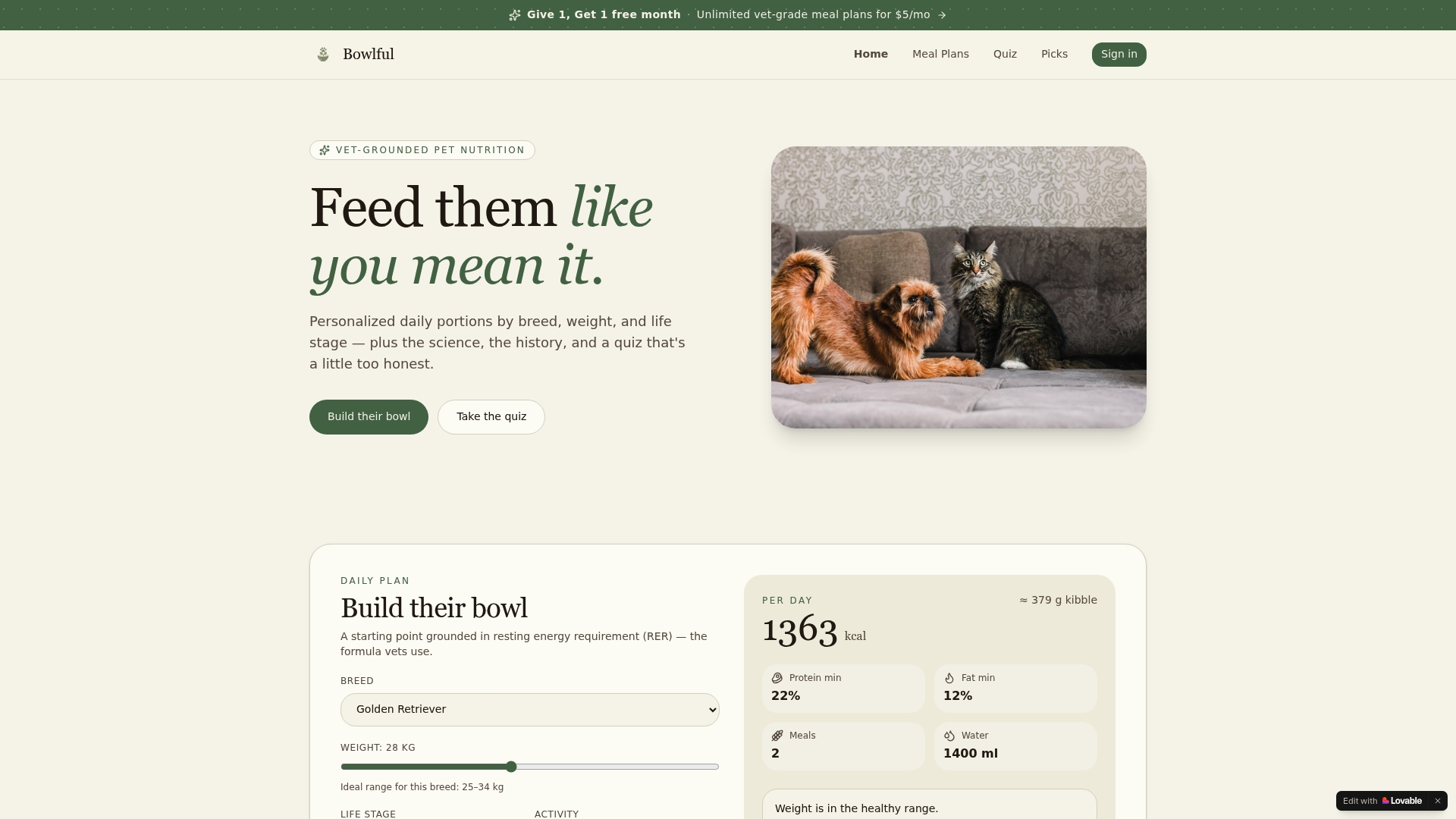
Bowlful builds feeding plans around that exact reality. Using the same Resting Energy Requirement (RER) formula that veterinarians rely on, Bowlful calculates your puppy's actual caloric needs and delivers a customized plan based on breed, current weight, and life stage. There's no guesswork, no generic charts, and no one-size-fits-all kibble recommendation. Start with the Bowlful nutrition quiz and get a plan tailored to your dog's specific growth window. It takes less than five minutes and gives you a foundation built on veterinary science rather than marketing.
FAQ
What is puppy growth stage nutrition?
Puppy growth stage nutrition is the practice of adjusting your puppy's diet to match each phase of development from weaning to full maturity. Different stages demand different levels of protein, minerals, and calories to support healthy bone, muscle, and brain growth.
When should I switch my puppy to adult food?
The timing depends on breed size. Small and medium breeds transition at 12 to 15 months, large breeds at 15 to 18 months, and giant breeds at 18 to 24 months. Switching too early cuts off nutrients the puppy still needs.
How often should I feed my puppy?
Feed puppies 3 to 4 times daily from 8 weeks to 4 months, then 3 times daily until 6 months, then twice daily. Large breeds may benefit from staying at 3 meals through 12 to 16 months to support steady energy and growth.
Do large-breed puppies need a special formula?
Yes. Large and giant breeds need formulas with controlled calcium and phosphorus levels. Generic puppy food can deliver excess calcium, which causes rapid bone growth that outpaces structural development and leads to lasting joint problems.
Is grain-free puppy food a better choice?
Not necessarily. The FDA has been investigating a potential link between grain-free diets and heart disease in dogs since 2018. Veterinarians consistently recommend AAFCO-compliant foods backed by feeding trials over grain-free or boutique options with limited nutritional research.