
Vitamins are essential organic compounds that regulate the biochemical processes keeping your dog alive, healthy, and thriving. The role of vitamins in dog nutrition covers everything from bone development and immune defense to nerve signaling and skin health. Dogs require 12 essential vitamins, split between fat-soluble types (A, D, E, K) and water-soluble B-complex and C. Unlike calories from protein or fat, vitamins don't fuel your dog's body directly. They act more like switches, turning critical biological functions on and off. Get the balance wrong in either direction, and the consequences range from poor coat quality to organ failure.
What are the essential vitamins dogs need and their functions?
Dogs need a specific set of vitamins to function normally, and each one has a distinct job. Understanding canine vitamin needs helps you make smarter choices about what goes in your dog's bowl every day.
Here is what the core vitamins actually do:
- Vitamin A supports vision, immune function, and cell growth. The minimum safe intake is 5,000 IU/kg dry matter, with a safe upper limit of 250,000 IU/kg. That narrow window explains why precise formulation matters more than simply adding more.
- Vitamin D regulates calcium and phosphorus absorption, which drives bone growth and muscle function. Dogs cannot synthesize enough Vitamin D from sunlight the way humans can, so dietary sources are non-negotiable.
- Vitamin E protects cells from oxidative damage and supports immune health, muscle function, and liver health. A deficiency shows up as muscle weakness and a compromised immune response.
- Vitamin K is critical for blood coagulation. Deficiency is rare in dogs eating complete diets, and supplementation is almost never necessary without a veterinary diagnosis.
- B-complex vitamins (B1/thiamine, B2/riboflavin, B3/niacin, B6, B12, folate, biotin, pantothenic acid) collectively manage energy metabolism, red blood cell production, and nerve signaling. Unlike fat-soluble vitamins, B vitamins are not stored in the body, so daily intake through food is required.
- Vitamin C is one area where dogs differ from humans. Dogs synthesize Vitamin C in their liver, so dietary supplementation is rarely needed in healthy animals.
One detail most dog owners miss: bioavailability varies significantly by source. Vitamin A from animal liver is absorbed far more efficiently than beta-carotene from plant sources, because dogs convert beta-carotene to retinol poorly. This is why ingredient quality in commercial food matters as much as the nutrient list on the label.
Pro Tip: When reading a dog food label, look for named vitamin sources like "Vitamin E supplement" or "niacin supplement" rather than vague terms like "natural flavors." Named sources signal that the manufacturer is deliberately formulating to meet AAFCO standards.

What are the risks of vitamin deficiencies and toxicities in dogs?
Vitamin imbalance is a two-way problem. Too little causes deficiency diseases. Too much, particularly with fat-soluble vitamins, causes toxicity. Both outcomes are preventable with the right knowledge.
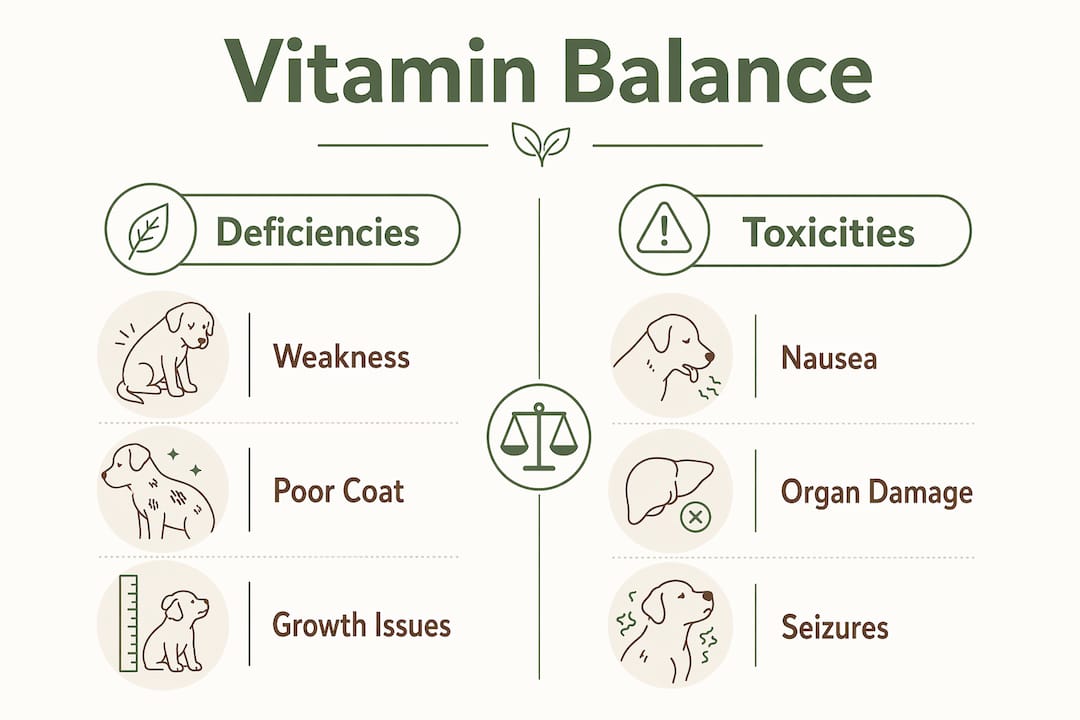
The most dangerous scenario involves fat-soluble vitamins because they accumulate in liver and fat tissue rather than being excreted. The FDA specifically warns that excess Vitamin D can cause kidney failure and death in dogs. This is not a theoretical risk. Cases of Vitamin D toxicity have been linked to over-supplementation and even to certain commercial dog food recalls where manufacturing errors led to excessive levels.
Here is a practical breakdown of what goes wrong at both extremes:
- Vitamin A deficiency causes night blindness, poor coat condition, and stunted growth in puppies. Excess Vitamin A leads to bone pain, joint stiffness, and liver damage over time.
- Vitamin D deficiency results in soft bones (rickets in puppies) and muscle weakness. Toxicity causes hypercalcemia, vomiting, lethargy, and ultimately kidney failure.
- Vitamin E deficiency produces muscle degeneration and a weakened immune system. Toxicity is rare but can interfere with Vitamin K activity and blood clotting.
- B vitamin deficiencies tend to show up as neurological symptoms, poor appetite, and skin lesions. Because B vitamins are water-soluble, toxicity is uncommon but not impossible with aggressive supplementation.
"Balanced vitamin intake is crucial. Both deficiency and over-supplementation cause significant health issues, and veterinary consultation before adding vitamins to the diet is the safest path forward." — Vetic Blog
The takeaway here is that "more is better" is a dangerous assumption with vitamins. A dog eating a nutritionally complete commercial diet is already receiving calibrated amounts. Adding supplements on top of that without a diagnosis is how toxicity happens.
How do a dog's life stage, breed, and health affect vitamin needs?
A one-size-fits-all approach to canine vitamin needs ignores the reality that a 10-week-old Labrador Retriever puppy and a 12-year-old Chihuahua have almost nothing in common nutritionally. Nutritional needs vary with life stage, breed, and health status, requiring tailored diets rather than generic formulas.
Here is how those differences play out practically:
- Puppies have elevated needs for Vitamin D and calcium to support rapid bone development, plus higher Vitamin A for immune system maturation. The nutrients puppies need during growth phases are substantially different from adult maintenance requirements. Feeding an adult formula to a growing puppy creates real gaps.
- Adult dogs in good health generally thrive on a complete commercial diet formulated to AAFCO standards. Their vitamin requirements stabilize, and supplementation is rarely warranted unless a specific deficiency is diagnosed.
- Senior dogs face reduced digestive efficiency, meaning they may absorb certain vitamins less effectively even when intake looks adequate on paper. B12 absorption in particular tends to decline with age, and some senior formulas compensate with higher concentrations.
- Large and giant breeds like Great Danes and Bernese Mountain Dogs are more sensitive to Vitamin D and calcium imbalances during growth, since excess amounts accelerate bone development in ways that increase the risk of orthopedic problems.
- Dogs recovering from illness or surgery may have temporarily elevated needs for antioxidant vitamins like E and C, but this should always be managed under veterinary supervision rather than through self-directed supplementation.
Understanding why dogs need different food amounts at different life stages is the foundation of getting vitamin intake right. The formula that works for your neighbor's dog may not work for yours.
Should you consider vitamin supplements for your dog?
The honest answer is: probably not, if your dog eats a complete commercial diet. Most dogs eating high-quality food do not need extra supplements, and adding them without a clinical reason creates more risk than benefit.
The circumstances where supplementation is genuinely warranted are specific. A dog diagnosed with a deficiency through bloodwork, a dog on a homemade diet that has not been formulated by a veterinary nutritionist, or a dog with a medical condition that impairs nutrient absorption all represent legitimate cases for targeted supplementation. Outside of those scenarios, the vitamins benefits for dogs come from food, not from adding products on top of it.
The danger with human supplements deserves particular attention. Human-grade supplements frequently contain additives that are toxic to dogs, including xylitol, caffeine, and doses of Vitamin D or A that far exceed safe canine limits. A multivitamin that is safe for a 150-pound adult human can be lethal for a 20-pound dog. This is not a minor risk to manage carefully. It is a category of product to avoid entirely.
Pro Tip: Before purchasing any supplement for your dog, ask your veterinarian for a blood panel to establish a baseline. Supplementing based on symptoms alone often misses the actual cause and can create new imbalances.
When you do need a supplement, choose products specifically formulated for dogs, verified by the National Animal Supplement Council (NASC), and ideally recommended by your vet rather than selected from a pet store shelf based on marketing claims.
How to choose a high-quality dog food that meets vitamin requirements
Selecting a food that genuinely delivers on its vitamin promises requires reading past the front-of-bag marketing. The AAFCO (Association of American Feed Control Officials) and NRC (National Research Council) set the standards that define nutritionally complete diets for dogs. Any food carrying the AAFCO nutritional adequacy statement has been formulated to meet minimum vitamin requirements for the stated life stage.
One issue that rarely gets discussed is what happens to vitamins during manufacturing. Heat-sensitive vitamins degrade during kibble production, and reputable manufacturers compensate by adding higher concentrations before cooking to hit the required levels at the time of feeding. This means a food that looks complete on paper may still vary in actual nutrient delivery depending on manufacturing quality and storage conditions.
| What to look for | What it signals |
|---|---|
| AAFCO nutritional adequacy statement | Formula meets minimum vitamin standards for the stated life stage |
| Named vitamin sources on ingredient list | Deliberate formulation rather than incidental nutrient content |
| Manufacturer feeding trials (not just formulation) | Real-world validation that the food performs as intended |
| Freshness date and proper storage guidance | Protects heat-sensitive vitamins from further degradation after purchase |
Freshness matters more than most owners realize. Vitamins, especially Vitamin E and the B-complex group, degrade over time once a bag is opened. Buying in smaller quantities and storing food in a sealed container away from heat and light preserves more of the nutritional content your dog actually receives.
Key takeaways
Vitamins regulate every major biological system in your dog's body, and getting the balance right through a complete, life-stage-appropriate diet is more effective and safer than supplementing without a diagnosis.
| Point | Details |
|---|---|
| 12 essential vitamins required | Dogs need both fat-soluble and water-soluble vitamins daily to support growth, immunity, and nerve function. |
| Fat-soluble vitamins carry toxicity risk | Vitamins A and D accumulate in tissue and can cause organ failure if over-supplemented. |
| Life stage changes vitamin needs | Puppies, adults, and seniors require different vitamin concentrations; use formulas matched to your dog's stage. |
| Complete diets usually suffice | Most dogs eating AAFCO-compliant food do not need additional supplements unless a deficiency is diagnosed. |
| Human supplements are dangerous | Products made for humans contain additives and doses that are toxic to dogs; only use vet-approved canine products. |
Why "just add a vitamin" is the wrong instinct
I've spoken with dozens of dog owners who reached for a supplement the moment their dog's coat looked dull or their energy dipped. It feels like a responsible response. It usually isn't.
What I've found, working through nutrition questions with pet owners over the years, is that impulse supplementation almost always bypasses the actual problem. A dull coat is more often a sign of inadequate fat intake or low-quality protein than a Vitamin E deficiency. Low energy in a senior dog is more likely a thyroid issue or pain than a B12 gap. Adding vitamins on top of an already complete diet doesn't fix those problems. It just adds cost and, in the case of fat-soluble vitamins, genuine risk.
The owners who get this right treat their vet as a partner, not a last resort. They run bloodwork before changing anything. They choose food based on AAFCO compliance and manufacturer transparency, not on the most appealing bag design. And they recognize that a dog eating a well-formulated, life-stage-appropriate diet is already getting what it needs.
The uncomfortable truth is that most of the vitamin products marketed to dog owners are solving a problem that doesn't exist for the majority of dogs eating complete commercial food. The real work is choosing the right food in the first place, not layering products on top of a poor foundation.
— Robert
Give your dog nutrition that's built around their actual needs
Understanding how vitamins affect dog nutrition is the first step. Putting that knowledge into practice means feeding a diet that's calibrated to your dog's specific breed, weight, and life stage, not a generic formula designed for the average dog.

Bowlful builds personalized meal plans using the same Resting Energy Requirement (RER) formula veterinarians use, so your dog gets the right nutrient balance from day one. Research shows lean-fed dogs may live up to 1.8 years longer, and that starts with getting the fundamentals right. Take Bowlful's interactive quiz and get a tailored feeding plan built around your dog's real nutritional needs, not a one-size-fits-all recommendation.
FAQ
What vitamins do dogs need every day?
Dogs require 12 essential vitamins daily, including fat-soluble vitamins A, D, E, and K, plus the full B-complex group. Most complete commercial diets formulated to AAFCO standards deliver all of these without additional supplementation.
Can too many vitamins harm a dog?
Yes. Fat-soluble vitamins like A and D accumulate in tissue and can reach toxic levels, with excess Vitamin D linked to kidney failure and death in dogs. Water-soluble vitamins carry lower risk but can still cause problems in large doses.
Do puppies need different vitamins than adult dogs?
Puppies have higher requirements for Vitamin D and Vitamin A to support rapid bone growth and immune development. Feeding a puppy-specific formula labeled for growth by AAFCO is the most reliable way to meet those elevated needs.
Are human vitamins safe for dogs?
Human vitamins are not safe for dogs. They frequently contain additives like xylitol and caffeine, and vitamin doses calibrated for adult humans can be lethal for dogs. Only use supplements specifically formulated for dogs and approved by your veterinarian.
How do I know if my dog's food has enough vitamins?
Look for the AAFCO nutritional adequacy statement on the packaging, which confirms the formula meets minimum vitamin standards for your dog's life stage. Named vitamin sources in the ingredient list and evidence of manufacturer feeding trials add further confidence.