
Neither wet nor dry pet food is universally better. Both formats can deliver complete, balanced nutrition when they carry an AAFCO nutritional adequacy statement. The right choice depends on your pet's health, life stage, hydration needs, and your own schedule.
Quick decision guide:
- Choose wet food when your pet needs extra hydration, has urinary or kidney issues, is a picky eater, struggles to chew, or needs help swallowing medication.
- Choose dry food when cost per calorie matters, you need long shelf life, or you use automatic feeders and enrichment toys.
- Combine both when you want the convenience of kibble plus the hydration and palatability of wet food. Just do the calorie math — a cup of wet food and a cup of dry food are not interchangeable portions.
- Always confirm the AAFCO statement on the label and use kcal-based portioning, not volume-for-volume swaps.
Table of Contents
- What is wet versus dry pet food, and how are they made?
- Benefits and downsides of wet pet food
- Benefits and downsides of dry pet food
- Why 1 cup wet food does not equal 1 cup dry food
- When do vets typically prefer wet or dry food?
- How to combine wet and dry food safely
- Storage, shelf life, and cost
- Wet vs. dry pet food: side-by-side comparison
- Applying RER to personalize your pet's calorie target
- Key Takeaways
- The format debate misses the real question
- How Bowlful takes the guesswork out of portioning
- Useful sources and further reading
What is wet versus dry pet food, and how are they made?
The physical difference between the two formats starts at the factory, and it shapes everything from nutrient concentration to how you store the bag.
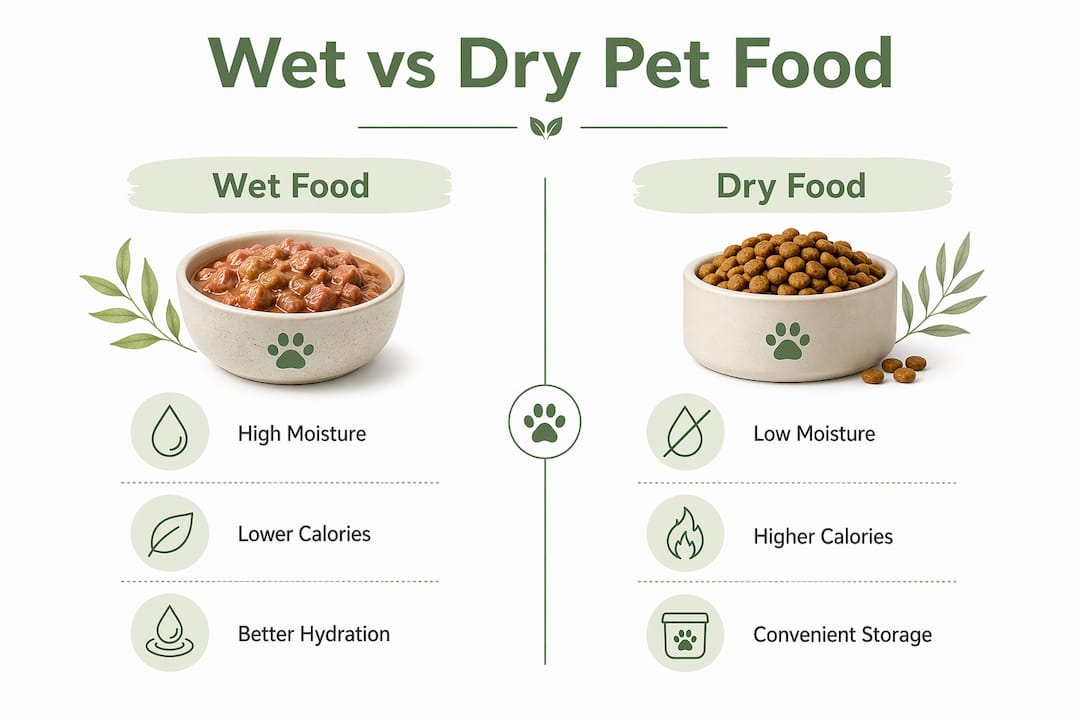
Wet (canned) food is made by grinding meat, fish, or poultry with water, broth, or gravy, then sealing the mixture in cans or pouches and cooking it under pressure to sterilize. That process locks in moisture. Wet foods typically contain 65%–85% moisture, which means a large share of what your pet eats is water.
Dry kibble follows a different path. Ingredients are ground, mixed into a dough, forced through a die under heat and pressure (extrusion), then dried and sprayed with fats or palatability coatings. Extrusion concentrates nutrients as moisture drops to about 8%–12%. The result is a shelf-stable product with about 90% dry matter.
Why moisture content changes how you read the label
Because wet food is mostly water, its guaranteed analysis percentages look lower for protein and fat than a dry food's. That comparison is misleading. To compare two foods fairly, you need the dry-matter basis (DMB): divide each nutrient percentage by the food's dry-matter percentage (100 minus moisture %). On a dry-matter basis, wet foods often show higher protein, phosphorus, sodium, and fat than their as-fed numbers suggest.
For U.S. pet food labels, look for two things: the AAFCO nutritional adequacy statement (which tells you the life stage the food is formulated for) and the kcal per can or kcal per cup figure. Those two numbers do more work than the guaranteed analysis alone. A deeper breakdown of what nutritional adequacy statements actually mean is worth reading before you buy.
Benefits and downsides of wet pet food
Wet food's biggest strength is its water content. Canned food typically contains a high percentage of water, which contributes meaningfully to a pet's daily fluid intake. For cats especially, who have a low thirst drive, that dietary water can make a real difference in urinary tract health.
Key benefits:
- Hydration support — useful for cats prone to urinary crystals or pets with early kidney disease.
- Higher palatability — the aroma and texture appeal to picky eaters and pets with reduced appetite due to illness or aging.
- Easier chewing — soft texture suits pets with dental pain, missing teeth, or jaw problems.
- Medication delivery — pills and powders mix easily into wet food without detection.
Key downsides:
- Higher cost per calorie — you're paying for water weight, so the cost per actual nutrient is steeper than dry food.
- Short open-can window — once opened, wet food should be refrigerated and used within 2–3 days; leaving it out at room temperature for more than a couple of hours raises spoilage risk.
- Stronger smell — not a problem for the pet, but noticeable for owners.
- No dental benefit — soft food does not scrape tartar from teeth.
Pro Tip: If your vet has flagged urinary or kidney concerns, wet food is often the first dietary recommendation because it increases fluid intake passively. Serve it in small, frequent portions to minimize waste and keep it refrigerated between meals.
For indoor cats specifically, the hydration and palatability benefits of wet food are particularly relevant since indoor cats tend to be less active and more prone to weight gain and urinary issues.

Benefits and downsides of dry pet food
Kibble's appeal is practical. It stores easily, costs less per calorie, and works with automatic feeders and puzzle toys that slow eating and provide mental stimulation.
Key benefits:
- Lower cost per calorie — dry food delivers more energy per dollar than wet food in most product tiers.
- Long shelf life — an unopened bag keeps for months; no refrigeration needed.
- Convenience — compatible with timed feeders, portion-control dispensers, and enrichment toys.
- Consistent portioning — measuring cups work reliably because the caloric density is stable across the bag.
Key downsides:
- Low moisture — kibble is not a hydration source. Pets eating only dry food need to drink adequate water separately, which some cats resist.
- Higher carbohydrate concentration — the extrusion process typically requires starch binders, so dry foods tend to carry more carbohydrates on an as-fed basis than wet foods.
- Limited dental cleaning — this one deserves a direct correction.
The kibble-cleans-teeth myth
The idea that crunching kibble scrapes plaque off teeth is widely repeated and largely overstated. Most kibble shatters before it reaches the gum line, where periodontal disease actually starts. Dental disease in dogs and cats requires active management: daily tooth brushing, veterinary dental cleanings, and diets specifically formulated and tested for dental efficacy (look for the Veterinary Oral Health Council seal). Standard kibble, on its own, does not substitute for any of those. Practical dental care guidance for dogs reinforces this point well.
Why 1 cup wet food does not equal 1 cup dry food
This is the portioning mistake that causes the most overfeeding and underfeeding. Comparing foods by volume is misleading because wet food is mostly water. One cup of wet food might deliver 150–250 kcal; one cup of dry kibble typically delivers 300–450 kcal. Swapping cup-for-cup in either direction gets the calories badly wrong.
Typical moisture and calorie ranges
| Format | Moisture | Dry Matter | Typical kcal/cup or kcal/can |
|---|---|---|---|
| Wet / canned | 65%–85% | 15%–35% | 150–250 kcal per 5.5 oz can |
| Dry / kibble | 8%–12% | about 90% | 300–450 kcal per cup |
Ranges vary by brand, protein source, and life-stage formula. Always use the kcal figure on your specific product label.
A worked portioning example
Say your dog needs 600 kcal per day. You want to split that between a wet food (200 kcal per 5.5 oz can) and a dry food (350 kcal per cup).
- Decide the split: 50% wet, 50% dry = 300 kcal each.
- Wet portion: 300 ÷ 200 = 1.5 cans per day.
- Dry portion: 300 ÷ 350 = 0.86 cups (roughly ⅞ cup) per day.
Kcal-per-can and kcal-per-cup are the numbers that matter; the guaranteed analysis alone will not get you there without a dry-matter conversion first.
When do vets typically prefer wet or dry food?
Most veterinarians and nutrition experts agree there is no single correct answer — the format should match the individual pet. That said, clinical patterns do exist.
Wet food is commonly preferred for:
- Cats with lower urinary tract disease, urinary crystals, or early chronic kidney disease (the added water intake matters).
- Pets with reduced appetite due to illness, chemotherapy, or aging.
- Dogs and cats with dental pain, missing teeth, or post-oral-surgery recovery.
- Pets who need to gain weight or maintain weight during illness.
Dry food is commonly preferred for:
- Weight management in otherwise healthy pets, where precise portion control and lower calorie density per volume help prevent overeating.
- Pets who do well on free-feeding schedules (though this is not recommended for all pets).
- Multi-pet households where food is left out for extended periods.
Life-stage notes:
- Puppies and kittens need growth-formulated food. Both wet and dry options exist; confirm the AAFCO statement says "growth" or "all life stages."
- Adult maintenance is the most flexible stage for format choice.
- Seniors often benefit from wet food's softer texture and hydration support, especially if dental disease or reduced kidney function is present.
For therapeutic or prescription diets (renal, hydrolyzed protein, weight-loss), always follow your veterinarian's recommendation. Those diets are formulated for specific conditions and the format is part of the prescription.
How to combine wet and dry food safely
Combination feeding is a well-supported approach that gives you kibble's convenience alongside wet food's hydration and palatability. The catch: you must account for calories from both sources or you will overfeed.
7–10 day transition plan (for switching foods or introducing combination feeding):
- Days 1–2: 75% old food, 25% new food. Watch stool consistency and appetite.
- Days 3–4: 50% old, 50% new. A slightly looser stool is normal; persistent diarrhea or vomiting means slow down.
- Days 5–6: 25% old, 75% new. Most pets clear this stage without issue.
- Days 7–10: 100% new food or your target wet/dry ratio.
- Troubleshooting: If your pet refuses the new food, try warming the wet portion slightly to increase aroma. If GI upset persists beyond 48 hours, return to the previous ratio and consult your vet. Adding a probiotic or digestive enzyme supplement during the transition can help sensitive stomachs adjust.
Calorie math for combination feeding: Take your pet's daily kcal target, decide what percentage comes from each format, then divide each portion by that food's kcal-per-serving figure. Treats and chews count toward the daily total — a good rule of thumb is keeping treats to no more than 10% of daily calories.
Storage, shelf life, and cost
Storage rules at a glance
- Unopened wet food: Shelf-stable for 1–4 years depending on the manufacturer's best-by date. Store in a cool, dry place.
- Opened wet food: Refrigerate immediately; use within 2–3 days. Cover the can or transfer to a sealed container.
- Wet food left out: Discard after 2–4 hours at room temperature. Bacterial growth accelerates quickly in high-moisture food.
- Unopened dry food: Shelf-stable for 12–18 months typically; check the best-by date.
- Opened dry food: Buy bag sizes you can finish within 4–6 weeks after opening. Oxidation degrades fats and reduces palatability even before the food looks or smells off. Store in the original bag inside an airtight container; the bag's inner lining helps preserve freshness.
- Dented or bulging cans: Discard without opening. A compromised seal is a contamination risk.
Cost-per-calorie formula
To compare formats honestly, use this:
Cost per kcal = price per package ÷ total kcal per package
Dry food generally offers a lower cost per calorie compared to wet food, though premium wet foods and budget kibbles can narrow that gap. Pet size amplifies the difference: a 90-pound dog eating wet food exclusively would cost several times more per month than the same dog on kibble.

Wet vs. dry pet food: side-by-side comparison
| Dimension | Wet / Canned | Dry / Kibble |
|---|---|---|
| Moisture content | 65%–85% | 8%–12% |
| Processing | Grinding, cooking, pressure sterilization | Extrusion, drying, fat coating |
| Calories & portioning | 150–250 kcal per 5.5 oz can; use kcal/can | 300–450 kcal per cup; use kcal/cup |
| Hydration | Contributes dietary water; supports urinary health | Minimal; pet must drink separately |
| Dental effects | No mechanical cleaning benefit | Minimal unless VOHC-certified dental formula |
| Shelf life & storage | Unopened: years; opened: 2–3 days refrigerated | Unopened: 12–18 months; opened: use within 4–6 weeks |
| Cost per calorie | Higher | Lower |
| Best for | Urinary/renal issues, picky eaters, seniors, post-dental surgery | Weight management, convenience, multi-pet households |
| Mixing guidance | Combine using kcal math; transition over 7–10 days | Same; account for all calories including treats |
Applying RER to personalize your pet's calorie target
Format choice only matters once you know how many calories your pet actually needs. Veterinarians use the Resting Energy Requirement (RER) formula as the starting point:
RER = 70 × (body weight in kg)^0.75
For a 10 kg (22 lb) dog: RER = 70 × (10)^0.75 = 70 × 5.62 ≈ 394 kcal/day at rest.
That number is then multiplied by a life-stage or activity factor to get the Maintenance Energy Requirement (MER). A typical neutered adult dog uses a factor of around 1.6, giving roughly 630 kcal/day. A lactating dog might use 2.0–3.0. The WSAVA calorie guidelines for healthy adult dogs provide a full factor table.
Once you have the MER, split it between formats using the kcal-per-package values from your labels. For the 630 kcal/day dog eating 50% wet and 50% dry: 315 kcal from wet (about 1.5 cans at 200 kcal/can) and 315 kcal from dry (about 0.9 cups at 350 kcal/cup).
Bowlful's dog calorie calculator applies this RER/MER method directly and outputs a personalized daily target you can split across formats. The daily calories guide walks through the math step by step if you prefer to do it manually.
Pro Tip: If your vet has diagnosed a condition like chronic kidney disease, hyperthyroidism, or food allergy, the RER calculation is still the right starting point — but the food itself should be a therapeutic or prescription diet chosen with your vet, not a standard commercial formula.
Key Takeaways
Both wet and dry pet foods can be nutritionally complete; the format that serves your pet best depends on health status, hydration needs, life stage, and your feeding routine.
| Point | Details |
|---|---|
| AAFCO statement first | Always confirm the label carries an AAFCO nutritional adequacy statement for your pet's life stage before buying. |
| Use kcal, not volume | One cup of wet food and one cup of dry food are not equivalent portions; always portion by kcal per can or kcal per cup. |
| Wet food for hydration and health conditions | Wet food's high moisture makes it the preferred format for urinary, renal, and low-appetite cases. |
| Dry food for cost and convenience | Kibble delivers more calories per dollar and stores for months unopened; buy bag sizes you can finish within several weeks of opening. |
| Bowlful for personalized targets | Bowlful's RER-based calculator and meal plans give you a precise daily kcal target so you can portion any format correctly. |
The format debate misses the real question
The wet-versus-dry conversation tends to get stuck on the wrong variable. Owners spend time debating format when the question that actually determines their pet's health is: how much is the right amount, and is this food formulated well?
Format is a delivery mechanism. What matters is whether the food meets your pet's calorie needs, carries a tested AAFCO statement, and comes from a manufacturer with real quality controls. A mediocre wet food does not beat a well-formulated kibble just because it has more moisture. And a premium kibble does not protect a cat from urinary disease if that cat never drinks enough water.
The other thing most format guides skip: calorie math is not optional. Overfeeding a pet by even 10%–15% consistently leads to weight gain, and excess weight shortens life. The RER formula exists precisely because "follow the bag guidelines" is a starting point written for an average pet, not your pet. Breed, neuter status, activity level, and age all shift the number meaningfully.
My recommendation is to treat format as a tool, not a philosophy. Use wet food where hydration or palatability is the clinical need. Use dry food where cost and convenience are the priority. Combine them when that serves the pet. Then get the calories right, because that part is non-negotiable regardless of what's in the bowl.
How Bowlful takes the guesswork out of portioning
Knowing the difference between wet and dry food is step one. Knowing exactly how much of either to feed your specific pet is where most owners get stuck.
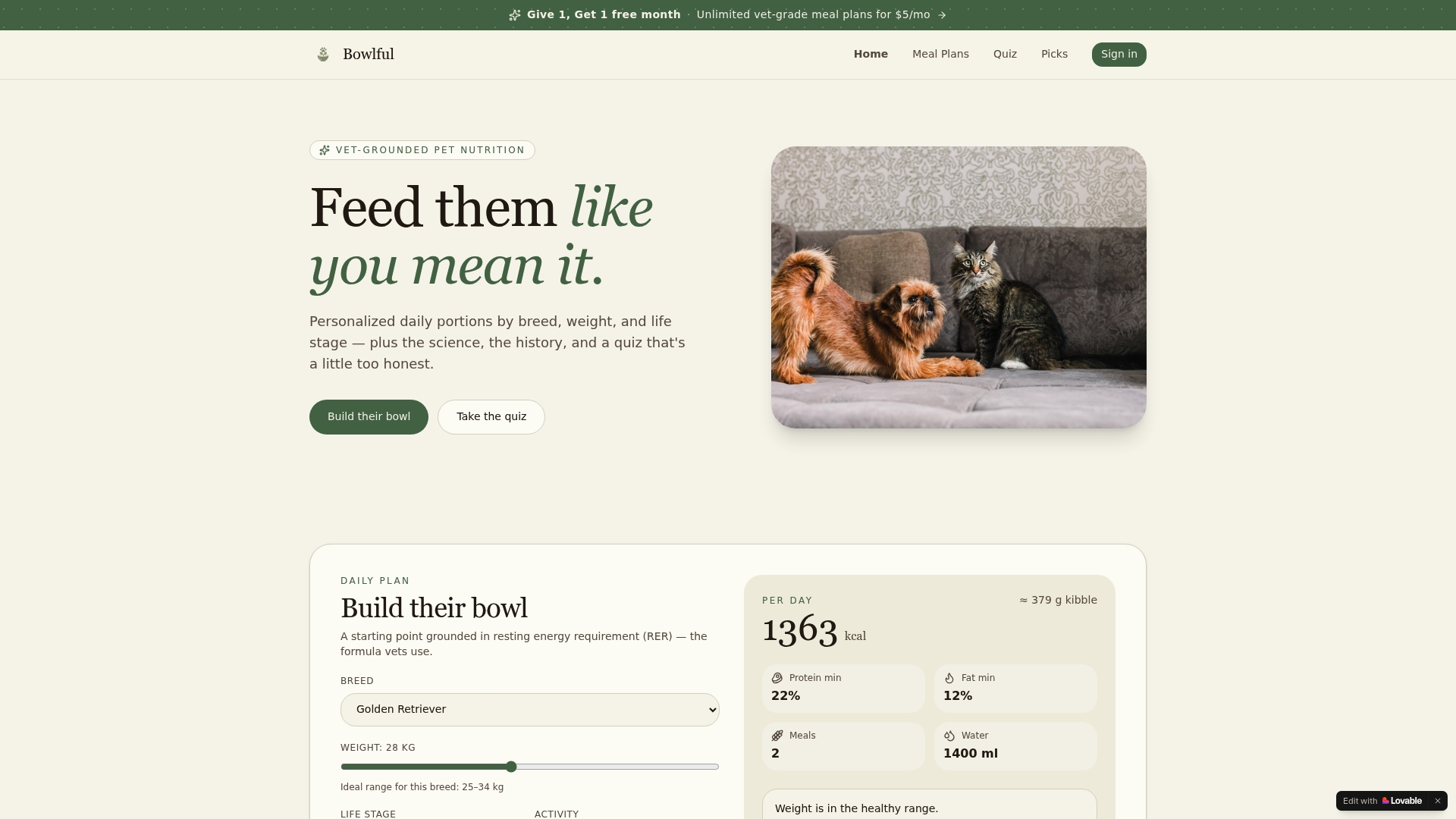
Bowlful builds personalized meal plans using the same RER/MER formulas your veterinarian uses, adjusted for your pet's breed, weight, age, and activity level. You take a short interactive quiz, and Bowlful generates a downloadable meal plan with a precise daily calorie target you can apply to any food format — wet, dry, or a combination. The plan also includes curated product recommendations and guidance on reading labels so you can verify the kcal figures yourself. Bowlful does not push one format over another; it gives you the number and lets the food choice follow from your pet's actual needs.
Start your personalized pet feeding plan at Bowlful and get a calorie target built around your pet, not a generic average.
Useful sources and further reading
The claims in this article draw on the following authoritative sources. For therapeutic or prescription diet guidance, consult your veterinarian directly.
- FDA — Complete and Balanced Pet Food
- AAFCO — Selecting the Right Pet Food
- MSD Veterinary Manual — Dog and Cat Foods
- Purina Institute — Differences in Pet Food Forms
- Zoetis Petcare — Should You Feed Your Pet Wet or Dry Food?
- VCA Animal Hospitals — Dry, Canned, or Semi-Moist Food Choices for Dogs
- PetMD — Dry vs. Wet Dog Food, or Both?
- WSAVA — Calorie Needs for Healthy Adult Dogs
- Tufts University — Dental Disease in Cats and Dogs
- Ohio State University Veterinary Medical Center — Myths and Misconceptions Surrounding Pet Foods