
A dog calorie calculator estimates the exact daily calories your dog needs to maintain a healthy weight and meet nutritional demands. The standard behind this tool is the Resting Energy Requirement (RER) formula, endorsed by veterinary bodies including the NRC and WSAVA as the gold standard for canine nutrition. Generic feeding guidelines on food bags frequently overestimate needs, especially for neutered or low-activity dogs. Getting the math right is the difference between a dog that thrives and one that slowly gains weight year after year.
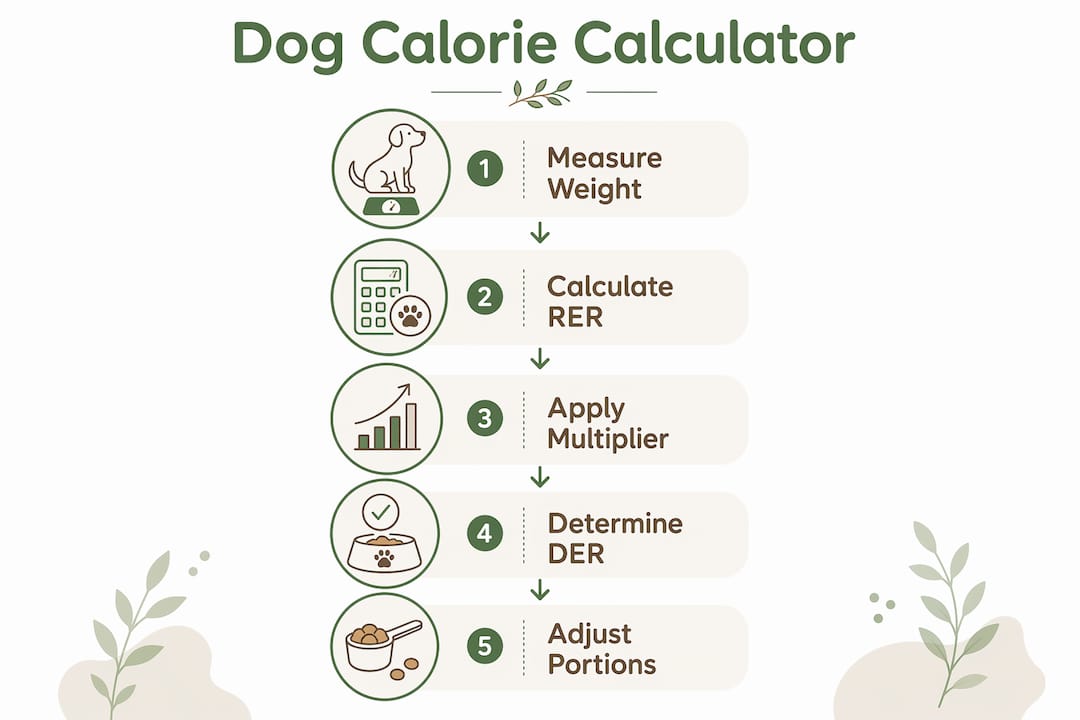
How does a dog calorie calculator work?
A dog calorie calculator uses two core values: RER and DER. RER is the baseline energy your dog burns at rest. DER is the actual daily target, calculated by multiplying RER by a life-stage factor.
The RER formula is: RER = 70 × body weight in kg^0.75. Veterinary nutrition guidelines favor this formula over simple per-pound calculations because it accounts for metabolic body size. That matters because a 60-pound dog does not need twice the calories of a 30-pound dog. Metabolic scaling means larger dogs need proportionally fewer calories per pound.

Once you have RER, you multiply it by a life-stage multiplier to get DER. The multiplier reflects your dog's activity level, reproductive status, and age. The table below shows the most common multipliers used in veterinary practice.
| Life stage / activity level | DER multiplier |
|---|---|
| Neutered adult (typical indoor dog) | 1.6 |
| Intact adult | 1.8 |
| Puppy under 4 months | 3.0 |
| Puppy 4 months to adult | 2.0 |
| Active or working dog | 4.0+ |
| Weight loss (supervised) | 1.0 |
Example: A neutered adult dog weighing 10 kg has an RER of 70 × 10^0.75 = approximately 394 kcal/day. Multiply by 1.6 and the DER is about 630 kcal/day. That is the daily calorie target you feed toward.
Pro Tip: Use a scientific calculator or a pet nutrition calculator online to compute the 0.75 exponent accurately. Rounding this step introduces errors that compound over weeks of feeding.
What inputs do you need to calculate your dog's daily calories?
Accurate inputs produce accurate results. Two measurements matter most: your dog's current weight and their Body Condition Score (BCS).
Weighing your dog correctly
Weigh your dog on a flat digital scale. For small dogs, weigh yourself first, then hold your dog and subtract the difference. For large dogs, a veterinary scale gives the most reliable reading. Convert pounds to kilograms by dividing by 2.205. A 22-pound dog weighs 10 kg. That conversion step is required because the RER formula uses kilograms.
Reading the Body Condition Score
BCS is assessed on a 1–9 scale where 4–5 represents ideal body condition. A score of 6 means overweight; scores of 7–9 indicate obesity. More than 50% of US dogs are classified as overweight or obese. That statistic means most dogs you see at the dog park are eating more than they should.
Veterinarians use BCS as a feedback tool to adjust feeding plans beyond the initial calorie calculation. A dog at BCS 6 needs a reduced calorie target, typically using the weight-loss multiplier of 1.0 applied to their ideal body weight, not their current weight. A dog at BCS 3 needs an increased target. Check your dog's healthy weight range to set a realistic goal before adjusting portions.
Pro Tip: Reassess BCS every 2–4 weeks. A dog's activity level and metabolism shift with seasons, age, and health changes. Waiting months between checks means small problems become big ones.
- Run your hands along your dog's ribs. You should feel them easily without pressing hard.
- Look at your dog from above. A visible waist tuck behind the ribs is a good sign.
- View from the side. A slight abdominal tuck upward toward the hindquarters indicates healthy weight.
- If ribs are invisible and the waist is absent, your dog is likely above BCS 5.
How do you convert calorie needs into actual feeding portions?
Knowing your dog's DER is only half the job. You still need to translate that calorie number into cups or grams of food. That requires one more piece of data: the calorie density of your specific dog food.
Calorie density is expressed as kcal per cup or kcal per kilogram and appears on the food label or the brand's website. Calorie density varies significantly between brands and formulas. A difference of just 100 kcal per cup, say 350 kcal/cup versus 450 kcal/cup, creates up to a 22% difference in portion size for the same calorie target. That gap is large enough to cause steady weight gain if you use the wrong number.
The math is straightforward. If your dog needs 630 kcal/day and your food contains 350 kcal/cup, divide 630 by 350 to get 1.8 cups per day. If the food contains 450 kcal/cup, the same dog needs only 1.4 cups. Never estimate calorie density from memory or a previous bag. Formulas change across production runs, and using an outdated number leads to feeding errors greater than 20%.
Standard bag guidelines make this problem worse. Feeding guidelines on packaging typically assume an average intact adult dog. They do not account for neuter status, actual activity level, or age. Most neutered indoor dogs following bag guidelines end up overfed.
Tips for reading food labels accurately:
- Look for the "caloric content" statement, not the guaranteed analysis panel.
- The statement appears as "X kcal/cup" or "X kcal/kg" and is required on US pet food labels.
- If the bag does not list kcal per cup, check the brand's website or call their customer service line.
- When switching foods, recalculate portions from scratch using the new food's calorie density.
- Measure portions with a kitchen scale in grams rather than a cup scoop for greater accuracy.
What are the most common mistakes when using a dog calorie calculator?
Even pet owners who use a calorie calculator make errors that undermine the results. These are the mistakes that show up most often.
-
Treating RER as the feeding target. RER is the baseline energy for a resting dog. Feeding RER without applying a life-stage multiplier underfeds active dogs and growing puppies significantly.
-
Ignoring neuter status. Neutered dogs have 10–20% lower metabolic rates than intact dogs. Using the intact adult multiplier of 1.8 instead of 1.6 for a neutered dog adds roughly 12% extra calories every day. That surplus accumulates into real weight gain over months.
-
Not updating calorie density when switching foods. Calorie density differs between brands and even between formulas from the same brand. Carrying over an old number is one of the most common sources of feeding error.
-
Skipping regular weight and BCS checks. Adjust feeding every 2–4 weeks based on BCS changes and activity shifts. A calculator gives a starting estimate, not a permanent prescription.
-
Forgetting treats. Treats count as calories. Treats should make up no more than 10% of your dog's daily calorie budget. A 630 kcal/day dog has a treat budget of about 63 kcal. That is roughly two or three small training treats, not a handful.
"Calorie calculators are starting points. Effective weight and nutrition management requires frequent monitoring of physical condition and consultation with a veterinarian." — Veterinary nutrition guidance
Refer to the feeding schedule by weight guide to see how these adjustments apply across different life stages and sizes.
Key Takeaways
A dog's daily calorie needs are calculated using the RER formula multiplied by a life-stage factor, then converted to portions using the food's actual calorie density.
| Point | Details |
|---|---|
| Use RER, not guesswork | Calculate RER as 70 × body weight in kg^0.75 before applying any multiplier. |
| Apply the right multiplier | Neutered adults use 1.6; puppies under 4 months use 3.0; always match the multiplier to your dog's actual status. |
| Check food calorie density | A 100 kcal/cup difference in food density changes portion size by up to 22%. |
| Monitor BCS every 2–4 weeks | BCS on a 1–9 scale tells you whether to increase, hold, or reduce portions. |
| Budget for treats | Treats should stay within 10% of daily calories to avoid unintentional overfeeding. |
Why I think most dog owners are solving the wrong problem
Most pet owners I talk to focus on finding the "right food." They spend hours comparing protein percentages and ingredient lists. That research is not wasted, but it addresses the wrong variable first. The bigger lever is portion size, and portion size depends entirely on accurate calorie math.
The RER/DER method is not complicated once you do it once. What surprises people is how different the result is from the bag guidelines. A neutered 10 kg dog following bag instructions often eats 15–20% more than they need. Over a year, that adds up to real body fat, not just a slightly chubby dog.
The other thing I have seen trip people up is treating the first calculation as permanent. Dogs age. They get spayed or neutered. They move from a house with a yard to an apartment. Each of those changes shifts the multiplier and the daily target. The calculation is a living number, not a one-time answer.
The best approach is to calculate, feed, monitor BCS every few weeks, and adjust. That cycle, repeated consistently, does more for a dog's long-term health than any premium ingredient. Lean-fed dogs live measurably longer. That is not a marketing claim. It is what the research shows.
— Robert
Bowlful makes the calculation work for your dog
Knowing the formula is one thing. Applying it correctly to your specific dog, with their breed, weight, life stage, and food, takes a few more steps.
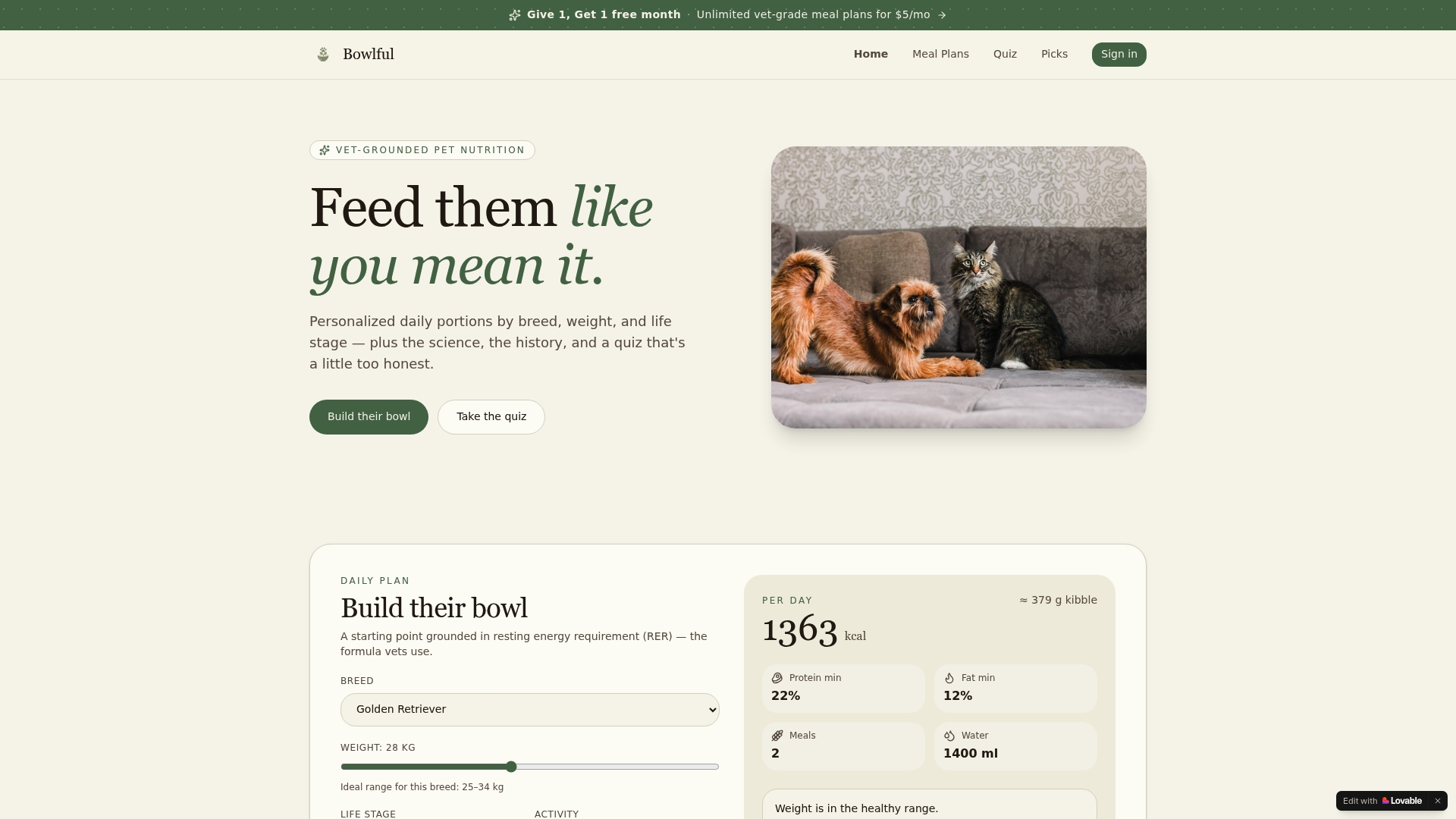
Bowlful builds personalized feeding plans using the same RER/DER formula veterinarians use. You answer a short quiz about your dog's breed, weight, age, and activity level. Bowlful then calculates your dog's daily calorie target and translates it into specific portion sizes based on your food's calorie density. The plan updates as your dog's needs change. For pet owners who want a personalized feeding plan without doing the math manually every few weeks, Bowlful handles the calculation and the adjustments in one place.
FAQ
What is the RER formula for dogs?
RER stands for Resting Energy Requirement and is calculated as 70 × body weight in kg^0.75. It represents the calories a dog needs at complete rest and is the foundation for all daily calorie calculations.
How many calories does my dog need per day?
Daily calorie needs equal RER multiplied by a life-stage multiplier. A neutered adult dog uses a multiplier of 1.6, while a puppy under 4 months uses 3.0. A 10 kg neutered adult needs approximately 630 kcal/day.
Why does neuter status affect calorie needs?
Neutered dogs have 10–20% lower metabolic rates than intact dogs. Using the wrong multiplier for a neutered dog adds roughly 12% extra calories daily, which causes gradual weight gain over time.
How do I use BCS to adjust my dog's food portions?
Assess your dog's BCS on a 1–9 scale every 2–4 weeks. If BCS rises above 5, reduce daily calories using the weight-loss multiplier of 1.0 applied to the dog's ideal body weight rather than current weight.
Do treats count toward my dog's daily calorie total?
Treats count as calories and should represent no more than 10% of your dog's daily calorie budget. For a dog with a 630 kcal/day target, that means roughly 63 kcal from treats per day.