
A dog's daily caloric requirement is calculated using the veterinary-standard Resting Energy Requirement (RER) formula: 70 multiplied by the dog's body weight in kilograms raised to the power of 0.75. This figure is then adjusted by a life-stage multiplier to produce the Daily Energy Requirement (DER), which is the actual number of calories your dog needs each day. Using a daily calories for dogs calculator without understanding these two steps leads to chronic overfeeding or underfeeding. Studies show that overweight dogs are widespread in the United States, making accurate calorie tracking one of the most practical things you can do for your dog's long-term health.
How is a dog's daily caloric need calculated?
The RER formula is the foundation of every reliable dog calorie needs calculator. You calculate it as: RER = 70 × (weight in kg)^0.75. The exponent 0.75 is not arbitrary. It accounts for the fact that metabolic rate scales non-linearly with body size. A flat calories-per-pound approach overfeeds large breeds and underfeeds small ones. The 0.75 exponent corrects for this across every breed.
RER gives you the calories a dog needs at complete rest. To get the DER, the number your dog actually needs to live its daily life, you multiply RER by a life-stage factor. These multipliers reflect real metabolic differences between dogs at different life stages and activity levels.

| Life stage or status | Multiplier |
|---|---|
| Neutered adult | 1.6 |
| Intact adult | 1.8 |
| Senior dog | 1.2 |
| Puppy (4–12 months) | 2.0 |
| Puppy (under 4 months) | 3.0 |
| Active or working dog | 2.0–5.0 |
| Weight loss (supervised) | 1.0 |
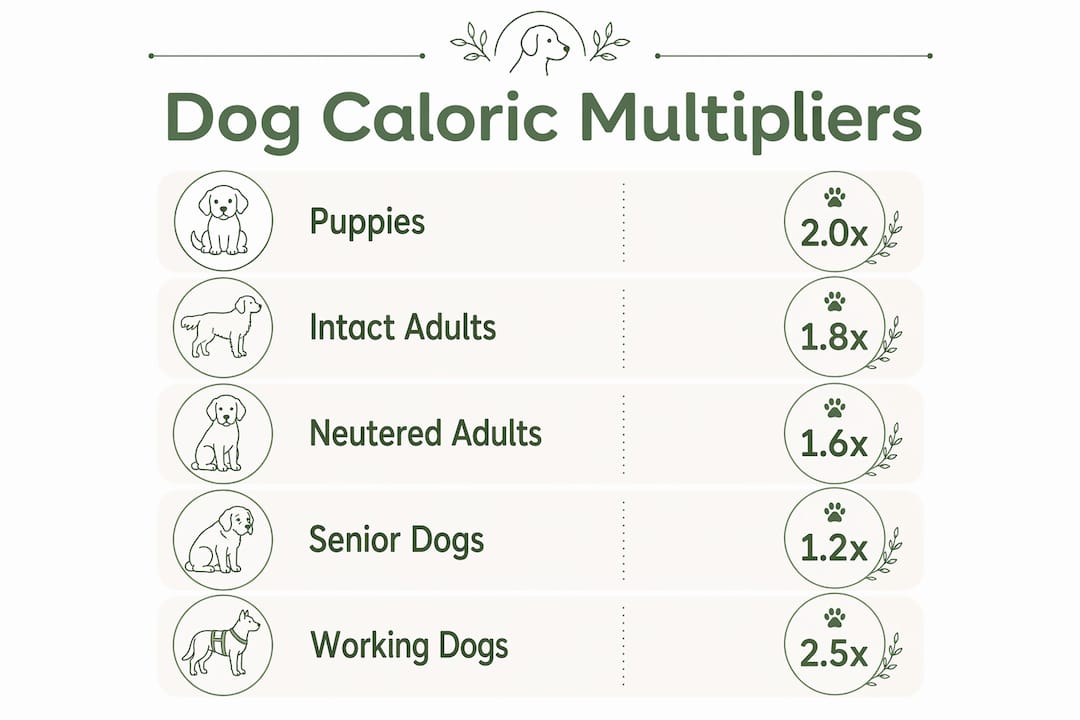
Neutered dogs require 10–25% fewer calories than intact dogs. That difference shows up directly in the multiplier: 1.6 for neutered adults versus 1.8 for intact adults. Skipping this adjustment after spaying or neutering is one of the most common reasons dogs gain weight in the year following surgery.
Puppies under 4 months need roughly 3.0 times their RER to support rapid skeletal and organ growth. That drops to 2.0 between 4 and 12 months. Feeding a young puppy on adult multipliers stunts growth. Feeding an adult dog on puppy multipliers causes obesity.
Pro Tip: If your dog is a working breed like a Siberian Husky or Belgian Malinois in active training, the multiplier can reach 5.0. Always recalculate when your dog's activity level changes significantly.
What information do you need to use a dog calorie calculator effectively?
Accurate inputs produce accurate outputs. Before you use any calculator for daily caloric intake for dogs, gather the following:
- Current weight in kilograms. Weigh your dog on a bathroom scale by weighing yourself first, then holding the dog and subtracting. For large dogs, a veterinary scale gives the most reliable reading.
- Ideal or target weight. For overweight dogs, use the target weight, not the current weight, when entering data. Calculating calories based on current overweight weight prevents effective weight loss because it sets the calorie ceiling too high.
- Life stage. Puppy, adult, or senior. Most veterinarians classify dogs over 7 years as senior, though giant breeds may qualify earlier.
- Neuter or spay status. This directly determines which multiplier applies.
- Activity level. Sedentary, moderately active, or highly active. A dog that walks 20 minutes a day has different needs than one that runs trails for two hours.
- Health conditions. Pregnancy, lactation, and certain diseases each require specific multiplier adjustments. Consult your veterinarian for these cases.
Once you have your calorie target, you need the energy density of your dog's food. Energy density on food packaging is listed as kilocalories per cup or per kilogram. Incorrect assumptions about energy density can skew portion sizes by 15% or more. That error compounds daily and leads to meaningful weight change over weeks.
Monitoring body condition score (BCS) on a 1–9 scale is the physical check that confirms your math is working. An ideal BCS sits at 4–5. A score of 6 or above signals overweight status. You should be able to feel your dog's ribs without pressing hard, and see a visible waist from above.
Pro Tip: Take a photo of your dog from above and from the side every four weeks. Visual comparison is often more telling than the scale alone, especially for dogs with thick coats.
Step-by-step guide to calculating your dog's daily calorie needs
Follow these steps to convert the formula into an actual feeding plan.
- Convert your dog's weight to kilograms. Divide pounds by 2.205. A 44-pound dog weighs 20 kg.
- Calculate RER. Raise 20 to the power of 0.75. That equals approximately 9.46. Multiply by 70. RER = 662 kcal per day.
- Select the correct multiplier. A neutered adult dog at moderate activity uses 1.6. DER = 662 × 1.6 = 1,059 kcal per day.
- Budget for treats. Treats must stay at or below 10% of the daily calorie total. For this dog, that is 106 kcal from treats. Subtract treat calories from the meal portion. Do not add them on top.
- Find the food's energy density. Check the bag or can for kcal per cup. If your food provides 350 kcal per cup, this dog needs approximately 2.7 cups of food per day, minus any treat adjustment.
- Divide into meals. Adult dogs do well on two meals per day. Puppies under 6 months need three to four smaller meals to support stable blood sugar and digestion.
A few practical notes on feeding frequency:
- Puppies under 6 months: 3–4 meals per day
- Puppies 6–12 months: 2–3 meals per day
- Adult dogs: 2 meals per day
- Senior dogs with digestive sensitivity: 2–3 smaller meals per day
Understanding why dogs need different food amounts at each life stage helps you apply these splits with confidence rather than guesswork.
Common mistakes when using a dog calorie calculator
Most feeding errors come from a small set of repeated mistakes. Knowing them in advance saves your dog from months of incorrect intake.
- Using current weight for an overweight dog. This is the most consequential error. If your dog weighs 60 pounds but should weigh 50, calculate calories for 50 pounds. Using the actual weight sets calories too high and prevents any weight loss.
- Not adjusting after neutering or spaying. The metabolic change is real and immediate. A dog that needed 1,200 kcal per day as an intact adult may only need 960 kcal after neutering. Failing to recalculate causes steady weight gain.
- Underestimating treat calories. Treats often carry higher energy density than regular kibble. A single dental chew can contain 70–100 kcal. Three of those per day can push a small dog well over its DER without the owner realizing it.
- Feeding by volume instead of energy density. One cup of a high-fat performance kibble can contain 500 kcal. One cup of a weight-management formula may contain 280 kcal. Volume tells you nothing without the kcal figure.
- Never rechecking the calculation. A dog's needs change with age, activity, and health status. Recalculate every time your dog's weight shifts by more than 5%, or at least every 2–4 weeks during a weight loss program.
"The calculator gives you a starting point, not a permanent prescription. The dog's body tells you whether the number is right."
A pet nutrition assessment can help you identify which of these errors may already be affecting your dog's weight trajectory.
Key takeaways
Accurate daily calorie calculation for dogs requires the RER formula, the correct life-stage multiplier, and consistent monitoring of body condition score every 2–4 weeks.
| Point | Details |
|---|---|
| Use the RER formula | Calculate 70 × (weight in kg)^0.75 before applying any life-stage multiplier. |
| Apply the right multiplier | Neutered adults need 1.6x RER; puppies under 4 months need 3.0x RER. |
| Use target weight for overweight dogs | Basing calories on current overweight weight prevents the calorie deficit needed for weight loss. |
| Cap treats at 10% | Subtract treat calories from the meal portion; never add them on top of the daily total. |
| Check BCS every 2–4 weeks | An ideal body condition score is 4–5 on the 1–9 scale; adjust calories if the score shifts. |
What I've learned from watching owners use calorie calculators
Most dog owners who come to me with a weight problem have been doing one of two things: feeding by the bag's serving suggestion, or using a calculator once and never revisiting it. Both approaches treat a living animal's metabolism as a fixed constant. It is not.
The bag's feeding guide is a sales document as much as a nutrition guide. It is calibrated for an average intact adult dog at moderate activity. Your dog is almost certainly not that dog. A neutered, sedentary Labrador Retriever following the bag's recommendation will gain weight steadily over months.
What actually works is treating the calorie calculation as a monthly check-in, not a one-time setup. I have seen dogs lose meaningful weight simply because their owner started recalculating every four weeks and adjusting portions by small amounts. No special food. No expensive supplements. Just math applied consistently.
The BCS scale is underused by most owners. Learning to assess it takes about ten minutes and a short video from a veterinary school. Once you can do it reliably, you have a physical feedback loop that no scale can replace. A dog can be at its target weight but still carry too much fat if muscle mass is low. BCS catches that. The scale does not.
Calculators are tools. They give you a number to start with. Your dog's body tells you whether that number is right. Use both.
— Robert
Bowlful's feeding tools for your dog's nutrition
Knowing the formula is the first step. Applying it consistently, across your dog's changing life stages and activity levels, is where most owners need support.
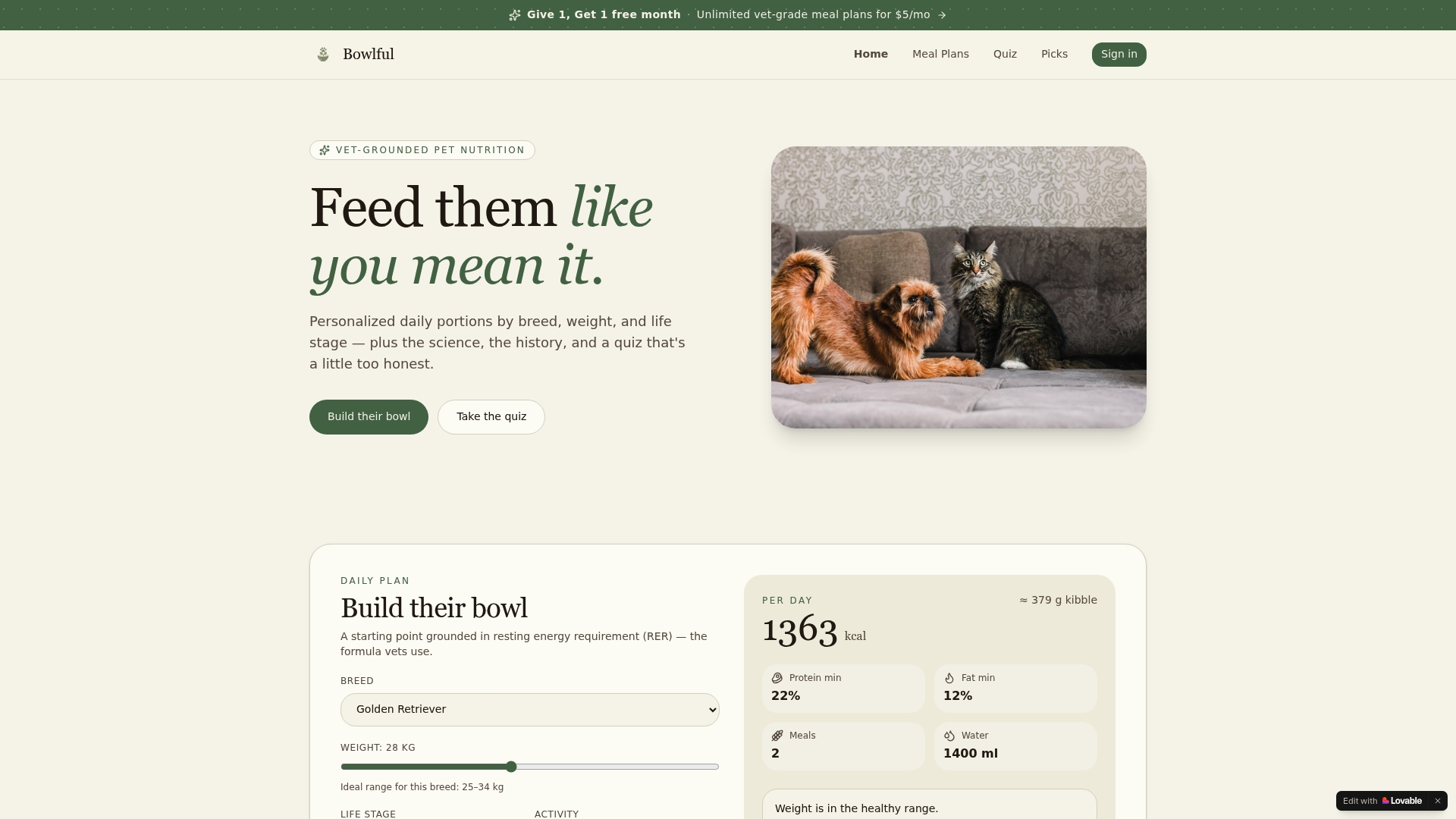
Bowlful builds personalized feeding plans using the same RER formula veterinarians use, adjusted for your dog's specific breed, weight, life stage, and neuter status. The interactive quiz takes your dog's profile and returns a calorie target with a matching meal plan, removing the manual calculation entirely. Bowlful also publishes guides on feeding schedules by weight and obesity prevention to help you stay ahead of weight changes before they become health problems. Start with your dog's personalized nutrition plan and take the math off your plate.
FAQ
What is the RER formula for dogs?
RER stands for Resting Energy Requirement and is calculated as 70 × (body weight in kg)^0.75. It represents the calories a dog needs at complete rest, before adjusting for activity or life stage.
How many calories does a neutered adult dog need per day?
A neutered adult dog needs approximately 1.6 times its RER per day. Neutered dogs require 10–25% fewer calories than intact dogs due to metabolic changes following surgery.
Should I use my dog's current weight or target weight in a calorie calculator?
Use the target weight for overweight dogs. Calculating calories based on current overweight weight sets the daily total too high and prevents the calorie deficit needed for weight loss.
How do I convert calorie targets into food portions?
Find the kilocalorie-per-cup figure on your dog food's packaging, then divide your dog's daily calorie target by that number. Incorrect energy density assumptions can skew portions by 15% or more.
How often should I recalculate my dog's daily calorie needs?
Recalculate every 2–4 weeks during a weight loss program, or any time your dog's weight changes by more than 5%. Life events like neutering, aging into senior status, or a shift in activity level also require a fresh calculation.