
A balanced dog diet is defined as one that meets AAFCO nutritional adequacy standards for a specific life stage, covering protein, fat, carbohydrates, fiber, vitamins, and minerals in the right proportions. Examples of balanced dog meal plans range from weekly rotation menus to homemade quadrant frameworks, each designed to deliver complete nutrition without guesswork. The difference between a truly balanced plan and a well-intentioned mix of chicken and rice is measurable. Get it right, and you support your dog's weight, energy, coat, and longevity. Get it wrong, and deficiencies build silently over months.
1. examples of balanced dog meal plans: core nutrient targets
Every balanced dog meal plan starts with the same five nutrient groups. Understanding what each one does makes it far easier to evaluate any recipe or commercial food you consider.
- Protein (18–25%): Muscle meat from chicken, beef, turkey, salmon, or eggs supplies amino acids for tissue repair and immune function.
- Fat (5–15%): Sources like fish oil, chicken fat, and flaxseed provide energy and support skin and coat health. Omega-3 fatty acids from small oily fish are especially valuable.
- Carbohydrates (30–50%): Brown rice, sweet potato, oats, and lentils supply glucose for energy and bulk for digestion.
- Fiber (2–4%): Vegetables like broccoli, zucchini, and green beans support gut motility and healthy stool consistency.
- Micronutrients: Calcium, phosphorus, zinc, and vitamins A, D, E, and B-complex are non-negotiable. Most homemade recipes fall short here without deliberate supplementation.
A complete and balanced food can serve as the sole diet without additional supplementation, provided it carries a valid AAFCO statement. That standard is the benchmark every meal plan should be measured against.
2. what AAFCO "complete and balanced" actually means
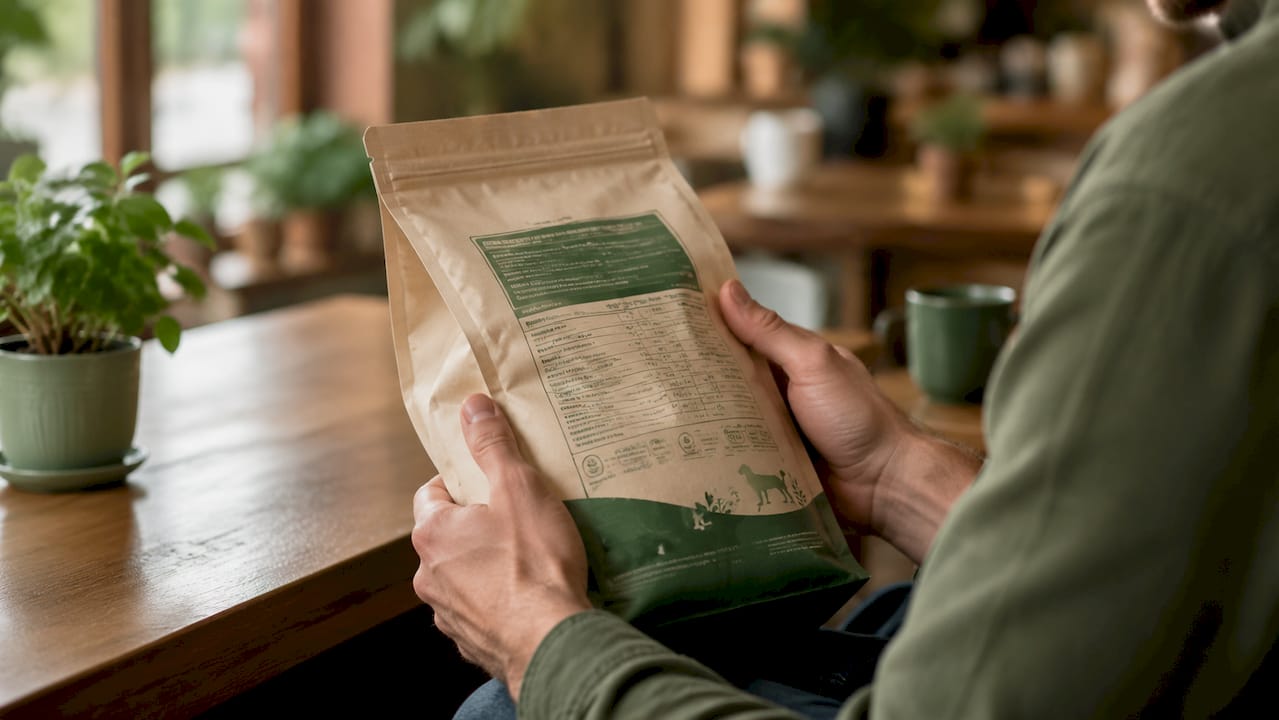
"Balanced" in dog nutrition is a regulatory concept, not a culinary one. The AAFCO nutritional adequacy statement on a dog food label confirms that the product meets minimum nutrient profiles for a stated life stage, either through formulation analysis or feeding trials. A food labeled "for all life stages" must meet the most demanding standard, which is growth and reproduction. This matters because a senior dog and a nursing mother have very different calcium and calorie needs. Mixing quality ingredients at home does not automatically produce an AAFCO-equivalent diet.
3. 7-day rotation meal plan for adult dogs
A weekly rotation plan is the most practical structure for most pet owners. It delivers variety, reduces the risk of single-ingredient overexposure, and keeps palatability high. The 7-day balanced plan below targets protein at 18–25%, fat at 5–15%, and carbohydrates at 30–50%, with fiber at 2–4%.
| Day | Protein | Carb | Vegetable | Supplement |
|---|---|---|---|---|
| Monday | Chicken breast | Brown rice | Broccoli | Fish oil |
| Tuesday | Ground turkey | Sweet potato | Zucchini | Calcium |
| Wednesday | Scrambled eggs | Oats | Spinach | Probiotic |
| Thursday | Lean beef | Lentils | Green beans | Fish oil |
| Friday | Salmon fillet | White rice | Carrots | Calcium |
| Saturday | Chicken thigh | Quinoa | Peas | Probiotic |
| Sunday | Canned sardines | Sweet potato | Kale | Fish oil |
Portion size depends on your dog's weight and activity level. A 35-pound active adult dog needs roughly 900 calories per day, split across two meals. Treats should stay under 10% of daily calories to avoid tipping the energy balance.
Pro Tip: Batch-cook proteins and carbs on Sunday for the week ahead. Store in labeled containers in the fridge for up to four days, and freeze the rest. This cuts daily prep time to under five minutes.
4. the quadrant model for homemade meals
The quadrant model is the most widely cited framework for building homemade dog food. It uses a 70-10-10-10 ratio: 70% muscle meat, 10% edible bone or calcium source, 10% liver and secreting organs, and 10% fiber from vegetables. Each quadrant serves a specific nutritional purpose.
| Quadrant | Percentage | Example Ingredients | Primary Nutrient |
|---|---|---|---|
| Muscle meat | 70% | Chicken breast, beef chuck, turkey thigh | Protein, amino acids |
| Bone or calcium | 10% | Raw chicken neck, ground eggshell, calcium carbonate | Calcium, phosphorus |
| Liver and organs | 10% | Beef liver, chicken liver, kidney | Vitamins A, B12, iron |
| Vegetables and fiber | 10% | Broccoli, zucchini, blueberries, pumpkin | Fiber, antioxidants |
The organ portion is where most home cooks under-deliver. Liver is the most nutrient-dense food in a dog's diet, but it must be capped at around 5% of total intake to avoid vitamin A toxicity. The remaining 5% of the organ quadrant should come from secreting organs like kidney or spleen.
Pro Tip: If you cannot source raw edible bone reliably, use finely ground eggshell powder as your calcium source. One teaspoon of dried eggshell powder provides roughly 2,000 mg of calcium, enough for a 40-pound dog's daily requirement.
5. raw diet ratios and the calcium-phosphorus rule
Raw feeding follows a similar structure to the quadrant model but adds one critical variable. A balanced raw diet includes 70% muscle meat, 10% raw edible bone, 5% liver, 5% other secreting organ, small oily fish for omega-3s, and low-glycemic vegetables for fiber. The calcium-to-phosphorus ratio must land between 1.1:1 and 1.3:1 to support bone health. Too much bone drives the ratio too high. Too little bone causes phosphorus to dominate, which pulls calcium from the skeleton over time. This is not a minor detail. Skeletal problems from incorrect calcium-phosphorus balance are well-documented in veterinary literature and represent the single most common structural failure in raw diets.
Small oily fish like sardines or mackerel are the most efficient way to deliver omega-3s in a raw plan. Two to three sardines per week for a medium-sized dog covers the baseline requirement without adding significant calories.
6. meal planning for weight management
Weight management requires the same nutrient balance as a standard plan, but with tighter calorie control. The key levers are portion size, feeding frequency, and the calorie density of ingredients.
- Calorie targets by size: A 20-pound sedentary dog needs roughly 400–500 calories per day. A 60-pound active dog needs 1,200–1,400. Use your vet's body condition score assessment to set the starting point.
- Feeding frequency: Two meals per day is the standard recommendation for adult dogs. Splitting calories across two sittings reduces hunger and supports stable blood sugar.
- Kibble with toppers: A measured kibble base with a tablespoon of cooked chicken, a soft-boiled egg, or steamed vegetables adds nutrition and palatability without significant calorie additions.
- Supplements on rotation: Fish oil supports joint health and coat condition. Probiotics support gut health. Neither adds meaningful calories.
- Monitoring: Weigh your dog every two weeks. Adjust portions by 10% if weight trends in the wrong direction. Do not wait for a vet visit to make small corrections.
A feeding schedule by weight removes the guesswork from portioning and gives you a reliable starting point for any size dog.
7. common pitfalls in homemade balanced dog meal plans
Good intentions do not guarantee good nutrition. A study of 100 popular homemade recipes found that most lacked sufficient calcium and zinc, with abnormal calcium-to-phosphorus ratios in the majority of cases. The most dangerous failure mode is nutrient drift. Small substitutions made over weeks, such as switching from chicken thigh to chicken breast, or swapping one vegetable for another, shift the nutrient profile without the owner noticing. Over months, those shifts accumulate into real deficiencies.
"Good nutrition in homemade diets requires formulation analysis or work with board-certified veterinary nutritionists. Good intentions alone don't guarantee balance." — Veterinary Practice News
The AAFCO statement on commercial food packaging exists precisely because intuitive mixing is unreliable. A board-certified veterinary nutritionist can run a full formulation analysis on your home recipe and identify gaps before they become health problems. Services like BalanceIT and the American College of Veterinary Nutrition's referral network connect pet owners with qualified professionals. Skipping this step is the most common mistake in home-prepared feeding.
Key takeaways
A balanced dog meal plan requires verified nutrient ratios, consistent supplementation, and regular monitoring. Ingredient quality alone does not make a diet complete.
| Point | Details |
|---|---|
| AAFCO is the benchmark | Only foods with an AAFCO adequacy statement are proven safe as a sole long-term diet. |
| Calcium-phosphorus ratio is critical | Target a 1.1:1 to 1.3:1 ratio in raw and homemade plans to protect bone health. |
| Rotation reduces risk | A 7-day protein and carb rotation delivers broader nutrition and better palatability. |
| Nutrient drift is the hidden danger | Small recipe changes accumulate into deficiencies over time without formulation checks. |
| Vet nutritionist guidance is non-negotiable | Board-certified veterinary nutritionists catch gaps that visual recipe checks miss entirely. |
What i've learned after years of watching dog diets go wrong
Most pet owners who switch to homemade feeding do so for the right reasons. They want to know exactly what their dog is eating. The problem is that the gap between a thoughtfully assembled meal and a nutritionally complete one is wider than it looks. I've seen dogs on beautiful-sounding diets, rotating proteins, fresh vegetables, quality fats, develop joint issues and coat problems within a year because the calcium source was inconsistent.
My honest recommendation: start with a commercial food that carries a valid AAFCO statement for your dog's life stage, then use whole-food toppers to add variety and nutrition. If you want to go fully homemade, work with a veterinary nutritionist from day one. Do not wait until something goes wrong. The vitamins and minerals that are hardest to source from whole foods are also the ones most likely to cause silent, cumulative damage.
Flexibility matters too. Your dog's needs at age two are not the same as at age nine. Build a plan that you can adjust as your dog ages, gains or loses weight, or develops a health condition. The best meal plan is one you can maintain accurately over years, not one that looks perfect on paper for a single week.
— Robert
How Bowlful builds balanced meal plans around your dog
Bowlful takes the guesswork out of dog nutrition by using the same Resting Energy Requirement formula that veterinarians rely on to calculate precise daily calorie targets for your dog. You answer a short quiz covering your dog's breed, weight, age, and activity level, and Bowlful generates a personalized feeding plan built around those numbers.
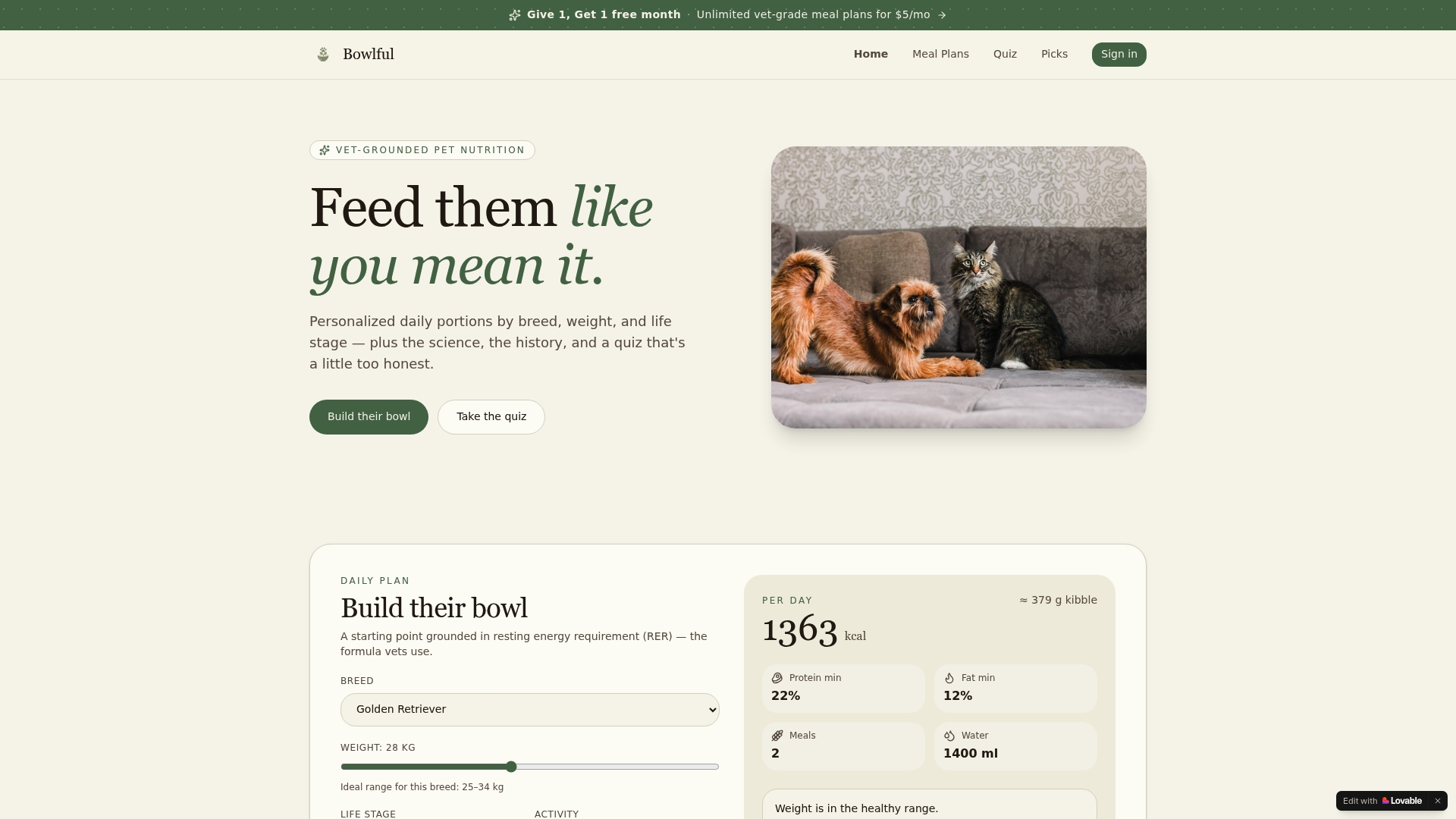
Every plan is grounded in verified nutritional guidelines, not generic portion suggestions. Whether you feed commercial kibble, a mixed diet, or want to explore home-prepared options, Bowlful gives you a tailored nutrition plan that fits your dog's actual needs. Lean-fed dogs live measurably longer. Bowlful exists to help you get there with confidence.
FAQ
What makes a dog meal plan truly balanced?
A balanced dog meal plan meets AAFCO nutritional adequacy standards for the dog's life stage, covering protein, fat, carbohydrates, fiber, and all essential micronutrients in verified proportions. Ingredient quality matters, but ratio accuracy and supplementation are what make a plan complete.
Can i feed my dog homemade food every day?
Yes, but only if the recipe has been formulated by a board-certified veterinary nutritionist and includes all required supplements. Most homemade recipes found online lack sufficient calcium and zinc without precise formulation.
What is the 70-10-10-10 rule for dog food?
The 70-10-10-10 rule is a homemade meal framework using 70% muscle meat, 10% edible bone or calcium source, 10% liver and organs, and 10% vegetables. It provides a starting structure, but supplementation and formulation review are still required for long-term use.
How many calories does my dog need per day?
Calorie needs depend on weight, age, and activity level. A 35-pound active adult dog needs roughly 900 calories per day, while a 20-pound sedentary dog needs closer to 400–500. Your vet's body condition score assessment gives you the most accurate starting point.
How often should i change my dog's meal plan?
Review your dog's meal plan every three to six months, or whenever weight, energy, or coat condition changes noticeably. Dogs' nutritional needs shift with age, activity, and health status, so a plan that worked at age three may need adjustment by age seven.