
Beagle overeating is defined as a breed-specific pattern of compulsive food-seeking that, without structured intervention, leads directly to obesity and shortened lifespan. Beagles rank among the breeds with the highest obesity prevalence, and the root cause is not a lack of willpower on your dog's part. It is genetics. Their food drive is hardwired, which means free feeding is not just ineffective for Beagles. It is actively harmful. The solution is controlled portion feeding, dietary composition tuned for satiety, and environmental management that accounts for their natural behavior.
Why do Beagles overeat so much?
Beagles were bred as scent hounds, and their extraordinary nose was designed to track prey across miles of terrain. That same sensory wiring now locks onto the smell of food in your kitchen, your trash can, and your neighbor's yard. Their food motivation is evolutionarily ingrained, making ad libitum, or free-choice, feeding completely unsuited to the breed.
Most dogs stop eating when they feel full because their bodies send clear satiety signals. Beagles have a weaker version of this feedback loop. They will eat past the point of fullness, then seek more food within the hour. This is not bad behavior. It is the breed operating exactly as nature designed it.
"A Beagle's appetite is not a behavior problem to correct. It is a biological trait to manage. Owners who treat it as disobedience will always lose. Owners who build systems around it will succeed."
The metabolic picture compounds the problem. Beagles tend to have a lower resting metabolic rate relative to their body size compared with higher-energy breeds like Border Collies or Vizslas. They burn fewer calories at rest, yet their appetite signals push them to eat as if they were working dogs. That gap between intake and expenditure is where obesity takes hold.
Key behavioral traits that drive overeating in Beagles:
- Scent-triggered eating: The smell of food activates persistent food-seeking, even after a full meal.
- Gorging tendency: Without portion limits, Beagles eat rapidly and in large quantities.
- Scavenging instinct: They will raid trash, counters, and other pets' bowls without hesitation.
- Boredom eating: Understimulated Beagles redirect their scent drive toward finding and consuming food.
- Slow satiety response: Their brain takes longer to register fullness, so rapid eating bypasses the signal entirely.
Understanding these traits is not just reassuring. It is the foundation of every effective feeding strategy.
What should a Beagle eat to feel full on fewer calories?

The right diet for a Beagle targets satiety, not just calorie reduction. Cutting calories without addressing hunger creates a miserable dog and an owner who caves to begging. The goal is a food that fills the stomach, supports muscle, and delivers balanced nutrition within a controlled calorie budget.
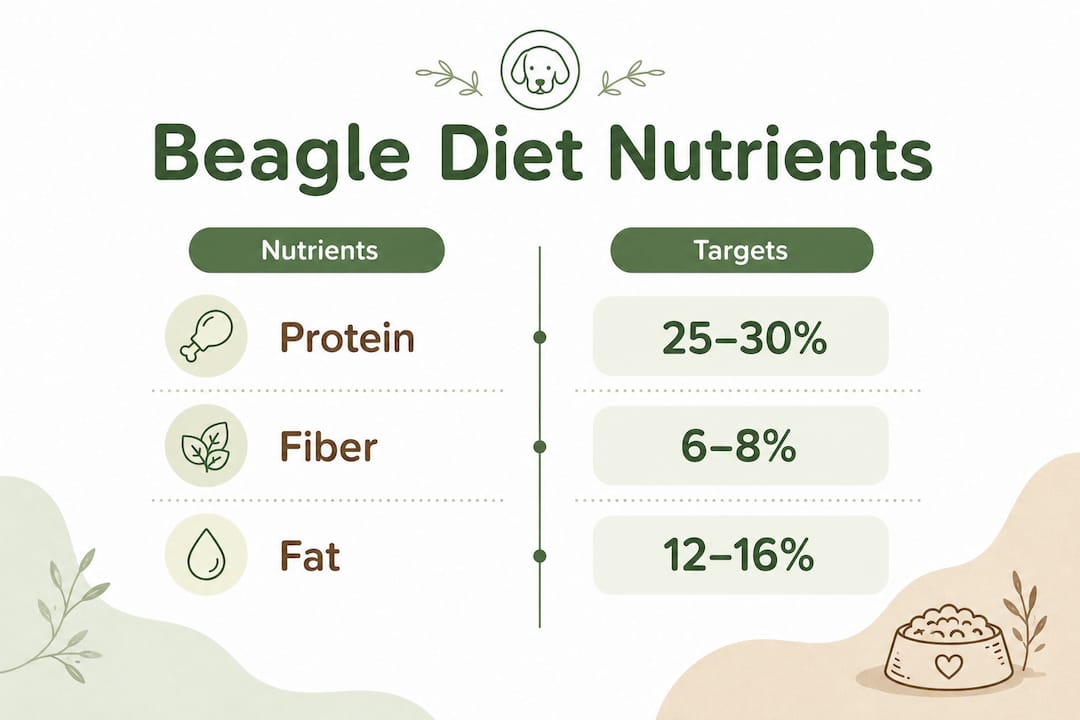
Protein is the anchor nutrient. Protein at 25–30% dry matter supports muscle retention during weight control, which matters because rapid weight loss without adequate protein strips muscle alongside fat. Muscle loss slows metabolism further, making future weight management harder.
Fiber is the satiety tool. Dietary fiber at 6–8% dry matter stimulates stomach stretch receptors, which send fullness signals to the brain. Higher-fiber foods physically expand in the stomach, giving your Beagle the sensation of a full meal without the calorie load.
Fat needs to stay moderate. The target range is 12–16% dry matter. Fat is calorie-dense at 9 calories per gram versus 4 calories per gram for protein and carbohydrates. Foods with fat above 16% DM push daily calorie totals up quickly, even in small portions.
| Nutrient | Target (Dry Matter) | Why It Matters |
|---|---|---|
| Protein | 25–30% | Preserves muscle during calorie restriction |
| Fiber | 6–8% | Activates stretch receptors for satiety |
| Fat | 12–16% | Provides energy without excess calories |
Volumetric feeding is one of the most practical beagle diet tips available. Replacing 20–25% of kibble volume with low-calorie vegetables like carrots, green beans, or blueberries reduces daily calories by 15–20% while keeping the bowl looking full. Beagles are highly motivated by the act of eating a full bowl. Volumetric feeding satisfies that psychological need while cutting the calorie count.
Always choose foods carrying AAFCO (Association of American Feed Control Officials) approval. AAFCO certification confirms the food meets minimum nutritional standards for your dog's life stage. Weight management foods without this label may cut calories by cutting essential nutrients, which creates a different set of health problems.
Pro Tip: Check the guaranteed analysis panel on your dog's food bag. If fiber is listed below 4% and fat above 18%, that food is not suited for a Beagle prone to weight gain. Swap before you start portion control.
How to prevent Beagle overeating with a daily feeding plan
Structured feeding is the single most effective tool for controlling Beagle weight. [Meal feeding with measured portions](https://vcahospitals.com/know-your-pet/feeding-a-canine-glutton#:~:text=Meal feeding with portion control) prevents obesity far more reliably than free feeding, and the evidence behind this recommendation is consistent across veterinary literature.
Here is a practical daily feeding plan:
- Weigh every meal on a kitchen scale. Measuring cups are inaccurate by up to 20% depending on kibble size and how tightly you pack them. A digital kitchen scale eliminates that error entirely.
- Feed two to three meals per day at fixed times. A consistent beagle feeding schedule reduces anxiety-driven food-seeking and helps your dog's digestive system regulate. Morning and evening meals work well for most households.
- Use a slow-feeder bowl or puzzle feeder. Slow-feeder bowls extend mealtime and give satiety signals time to engage before your Beagle finishes eating. The best slow feeders for dogs can triple the time it takes to finish a meal.
- Never leave food out between meals. Pick up the bowl after 15 minutes whether your Beagle has finished or not. This removes the option to graze and reinforces meal structure.
- Cap treats at 10% of daily calories. Treats above 10% of daily intake negate dietary restrictions in overweight Beagles. Swap high-calorie commercial treats for carrot sticks or apple slices. These count as healthy treats for Beagles and cost almost nothing.
- Mix kibble with low-calorie vegetables. Add green beans or steamed carrots to the bowl to increase volume without increasing calories. This is volumetric feeding in practice.
- Secure all food sources. Beagles are skilled scavengers. Use latching trash cans, keep counters clear, and feed other pets in separate rooms with closed doors.
- Check body condition monthly. The Body Condition Score scale runs from 1 to 9, with 4–5 being ideal. Run your hands along your Beagle's ribs. You should feel them without pressing hard, but not see them from across the room.
Pro Tip: If your Beagle finishes meals in under 30 seconds, the food is gone before any satiety signal can register. A puzzle feeder or lick mat used alongside the bowl adds 3–5 minutes to mealtime and meaningfully reduces post-meal begging.
Does exercise help with Beagle weight control?
Exercise supports weight management, but it cannot replace dietary control. A Beagle that eats 20% more than it needs will not walk that surplus off without a significant daily commitment. Exercise and diet work together, and neither alone is sufficient.
Start with short daily walks and build gradually toward 60–90 minutes of activity per day. Beagles with excess weight carry extra stress on their joints, so starting slow protects them from injury. Swimming is a low-impact option that burns calories without joint strain, useful for Beagles already carrying significant extra weight.
Scent work mentally tires Beagles more efficiently than long walks alone. Hiding small amounts of their daily food ration around the yard or in snuffle mats turns mealtime into a mental workout. This channels their natural scent drive productively and reduces boredom-driven food-seeking.
Behavioral training also plays a direct role in how to prevent Beagle overeating. Teaching a reliable "leave it" command gives you control in the moments your Beagle locks onto dropped food, another dog's bowl, or a scent trail leading to the trash. Food distraction techniques, where you redirect attention to a toy or a command, interrupt the food-seeking loop before it escalates.
Signs your Beagle is exercising at the right intensity:
- Breathing returns to normal within 10 minutes of stopping.
- No limping or stiffness the following morning.
- Energy levels are steady, not crashing mid-afternoon.
- Food-seeking behavior decreases noticeably on active days.
Avoid high-impact activities like jumping or long runs until your Beagle reaches a healthy weight. Overweight dogs are at higher risk for ligament injuries, and a setback from injury will halt progress for weeks.
Key Takeaways
Controlling Beagle overeating requires structured meal feeding, a high-fiber and moderate-fat diet, and environmental management that accounts for the breed's hardwired food drive.
| Point | Details |
|---|---|
| Breed biology drives overeating | Beagles lack strong satiety signals and require external portion control, not willpower. |
| Diet composition matters | Target 25–30% protein, 6–8% fiber, and 12–16% fat (dry matter) for satiety and muscle retention. |
| Meal feeding beats free feeding | Feed two to three measured meals daily and remove the bowl after 15 minutes. |
| Volumetric feeding cuts calories | Replace 20–25% of kibble with low-calorie vegetables to reduce calories while keeping the bowl full. |
| Exercise and scent work complement diet | Scent-based activities tire Beagles mentally and reduce food-seeking behavior between meals. |
What I've learned from watching Beagle owners get this wrong
Most Beagle owners I've spoken with make the same mistake at the start. They cut portions, their dog begs relentlessly, and they give in within two weeks. The problem is not the owner's commitment. It is that cutting calories without addressing hunger is a losing strategy from day one.
The owners who succeed do two things differently. They change the food composition first, moving to a higher-fiber option before they reduce the amount. And they add volumetric feeding immediately, so the bowl still looks full. Their Beagle's begging drops within a week because the dog is actually less hungry, not just eating less.
The other thing I'd push back on is the idea that exercise will solve the problem. Beagles are scent hounds, not endurance athletes. A 30-minute walk burns far fewer calories than most owners assume. The real value of exercise for an overweight Beagle is mental. Scent work, snuffle mats, and nose games redirect the food-seeking drive and reduce the obsessive begging that wears owners down. Think of it as managing the behavior, not burning the calories.
One more thing worth saying directly: if your Beagle is gaining weight despite strict portion control, ask your vet to check thyroid function. Hypothyroidism is more common in Beagles than in many other breeds, and it causes weight gain that no diet alone will fix. A simple blood panel rules it out and gives you a clear path forward.
Celebrate the small wins. A Beagle that drops half a pound in a month is making real progress. Gradual weight loss protects muscle mass and is far more sustainable than aggressive calorie cuts that leave your dog miserable and you exhausted.
— Robert
Bowlful can help you build the right feeding plan
Beagle weight management works best when the feeding plan is built around your specific dog's weight, age, and activity level, not a generic bag label.
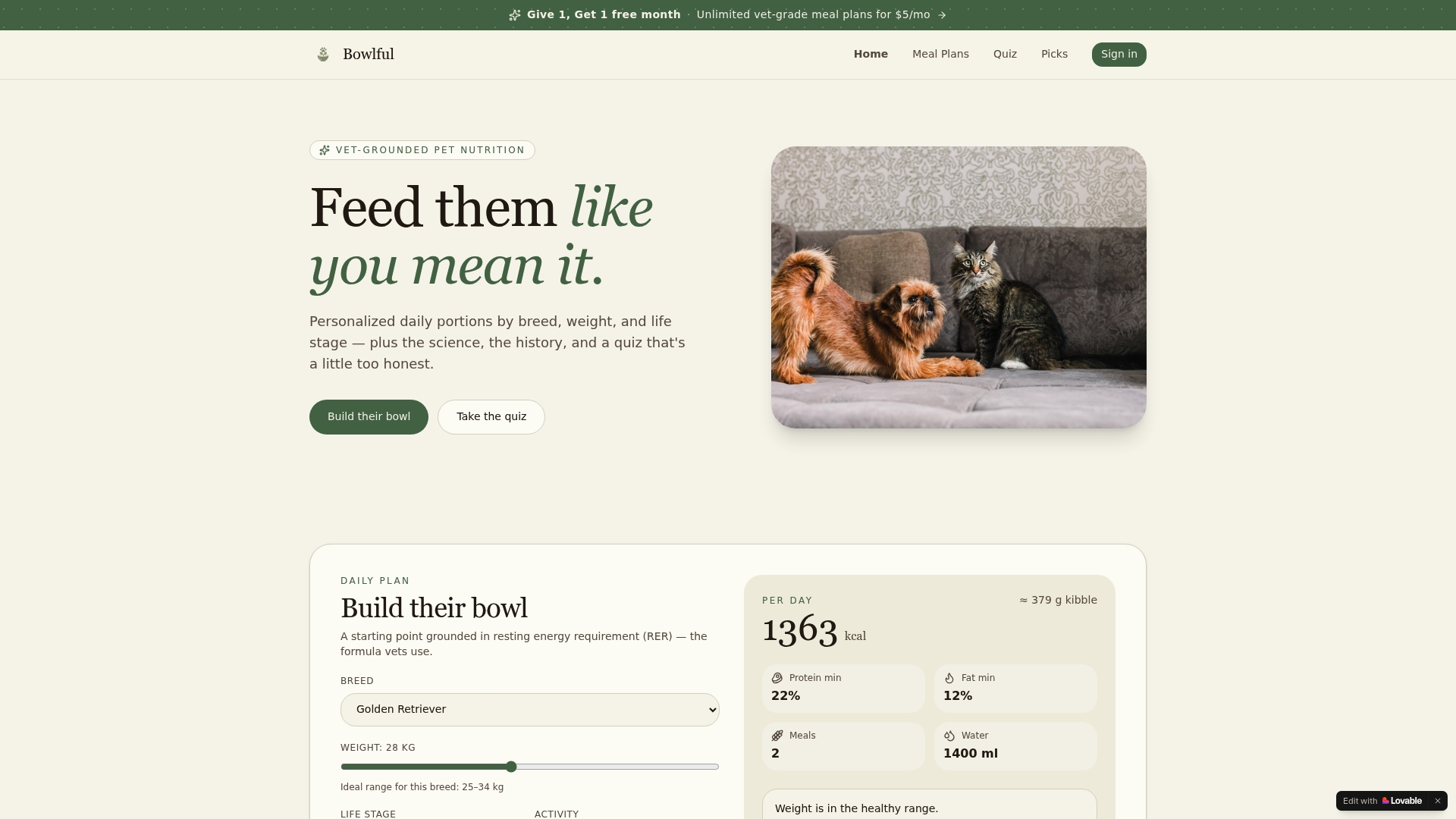
Bowlful uses the Resting Energy Requirement (RER) formula, the same calculation veterinarians use, to build personalized meal plans for dogs like yours. Research shows that lean-fed dogs live longer, with calorie-restricted Beagles in the Kealy et al. study outliving their free-fed counterparts by 1.8 years. Bowlful's interactive quiz takes your Beagle's breed, current weight, and life stage into account to produce a feeding plan grounded in that science. For owners who want to go further, the dog food for overweight dogs guide on the Bowlful blog covers food selection in detail.
FAQ
Why does my Beagle act hungry all the time?
Beagles have a weaker satiety response than most breeds, meaning their brain is slower to register fullness. This is a genetic trait, not a sign that you are underfeeding them.
How many times a day should I feed my Beagle?
Feed your Beagle two to three measured meals per day at consistent times. Remove the bowl after 15 minutes and never leave food out between meals.
What are the best low-calorie treats for Beagles?
Carrots, green beans, and apple slices (without seeds) are the best healthy treats for Beagles. Keep all treats under 10% of your dog's daily calorie total.
How do I know if my Beagle is overweight?
Use the Body Condition Score method. Run your hands along your Beagle's ribs. A score of 4–5 out of 9 is ideal. You should feel the ribs easily but not see them visually from a distance.
Can a Beagle lose weight through exercise alone?
Exercise alone is not sufficient for Beagle weight loss. Dietary control must come first, with exercise added to support calorie burn and reduce food-seeking behavior through mental stimulation.