
Dogs eat when they're bored. They eat when they're anxious. They eat when their owner leaves the room. This isn't just opportunistic scavenging. It's emotional eating, and it's far more common than most pet owners realize. A 2018 study by researcher Isabel Luño surveying 1,099 dog owners found that 81.7% perceived their dogs as emotional eaters, with more than 40% rating the behavior as high intensity on a 0–4 scale. That's not a fringe phenomenon. That's the majority of companion dogs.
Emotional eating in pets describes food intake driven by emotional states rather than physical hunger. The animal isn't eating because its body needs fuel. It's eating because food provides a momentary shift away from discomfort, stress, or boredom. While most of the research centers on dogs, the behavior appears across companion animals broadly. Recognizing it early matters because unchecked, it feeds directly into obesity, anxiety cycles, and long-term health decline.
- Emotional eating functions as a coping mechanism for negative emotional states like stress, anxiety, and grief
- 81.7% of dog owners in Luño's study perceived this behavior in their pets
- The behavior is associated with specific feeding habits, including rewarding obedience with food and homemade feeding
- Stress eating in pets carries real clinical weight, with links to obesity and behavioral disorders
- No standardized diagnostic tool currently exists to confirm emotional eating in pets, making owner observation the primary diagnostic resource
How owners recognize emotional eating in dogs
Most owners don't use the phrase "emotional eating." They say their dog is "obsessed with food," "always begging," or "eats like it hasn't been fed in days." These descriptions often point to the same underlying pattern.
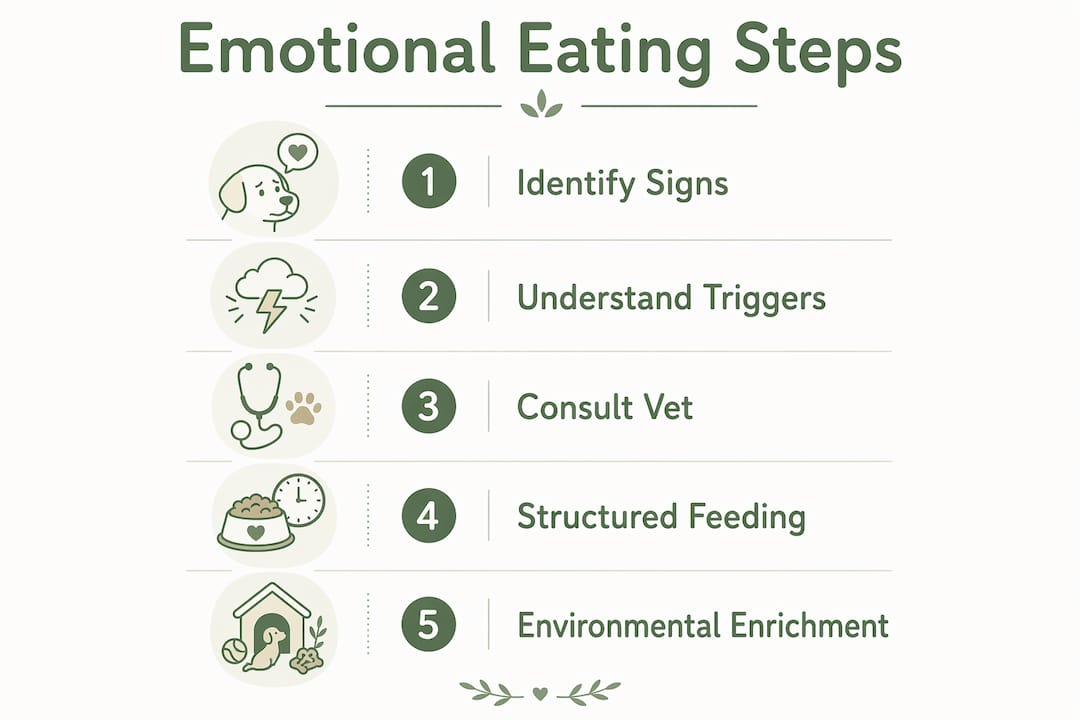
Luño's research identified specific feeding habits strongly associated with owner-perceived emotional eating: rewarding a dog with food for obedience and feeding homemade meals rather than commercial diets. Both practices increase the emotional salience of food. When a dog learns that sitting calmly earns a treat, or that the kitchen signals comfort and attention, food becomes tangled up with emotional reward rather than simple nutrition.
Common owner-reported signs include:
- Eating faster than usual or with unusual urgency
- Seeking food immediately after a stressful event, like a thunderstorm or a visitor leaving
- Persistent begging even shortly after a full meal
- Food obsession in pets that worsens during periods of change, like a new baby, a move, or an owner's schedule shift
- Temperament traits like dependency, clinginess, or low-level unhappiness correlating with heavier food-seeking
One thing worth separating out: excitement and emotional eating look similar on the surface. A dog that spins and barks at dinnertime is excited, not necessarily stress eating. The tell is context. Emotional eating tends to spike when the dog is unsettled, not just when it's happy and anticipating a meal.
Pro Tip: Keep a simple log for two weeks. Note when your dog eats outside of scheduled meals, what happened in the hour before, and your dog's general mood. Patterns emerge quickly, and that log becomes genuinely useful information for your vet.
What emotional states actually trigger stress eating in pets
The triggers aren't always obvious. Separation anxiety is the most commonly cited driver, but boredom, grief after losing a companion animal, household tension, and even a change in the owner's routine can all push a dog toward food as a comfort state. Dr. Kate at Kalmpets describes this as a biological shift: pets use food to move their nervous system from a threat state to a comfort state. It's not manipulation. It's physiology.
Temperament plays a real role here. Dogs rated as shy, excitable, or prone to aggression show stronger associations with emotional eating than calmer, more confident dogs. The Luño study found these temperament correlations meaningful enough to flag clinically. A nervous dog in an unpredictable environment is a dog at high risk for food obsession.
Research note: In Luño's 2018 study, emotional eating intensity correlated with specific emotional states and temperament traits, with dependency and unhappiness among the strongest predictors of high-intensity food-seeking behavior.
The spectrum matters too. Not every anxious pet overeats. Stress hormones like cortisol and adrenaline affect digestion differently across individuals. Some dogs eat compulsively under stress. Others go completely off food. Both responses belong to the same emotional eating framework, just at opposite ends.
- Separation anxiety frequently triggers food-seeking or food refusal
- Boredom, especially in under-stimulated dogs, drives bored dog eating habits that owners often misread as hunger
- Grief and household disruption can shift eating patterns within days
- Owner anthropomorphizing, reading human emotional logic into dog behavior, can cause owners to reward distress with food, reinforcing the cycle
Distinguishing medical from behavioral causes of appetite changes
Not every appetite change is emotional. This is where owners most often go wrong, and where a vet's input becomes non-negotiable.
The fight-or-flight response physically suppresses appetite in many anxious pets. When the sympathetic nervous system activates, blood flow shifts away from digestive organs. A dog that refuses treats when nervous isn't being stubborn. Its body is in a state where digestion is genuinely deprioritized. Behavioral anorexia, particularly in dogs with separation anxiety, follows this exact mechanism.
Medical conditions that mimic emotional eating include:
- Gastrointestinal disease, which can cause both increased appetite and food avoidance
- Metabolic disorders like hypothyroidism or Cushing's disease, which alter hunger signals
- Dental pain, which changes how and how much a dog eats
- Intestinal parasites, which can drive unusual food-seeking behavior
When appetite changes are sudden, extreme, or accompanied by vomiting, weight loss, lethargy, or changes in stool, the cause is medical until proven otherwise. Behavioral explanations come after a vet has ruled out physical ones.
For dogs with severe anxiety-driven appetite loss, veterinary treatment sometimes includes medications like fluoxetine or trazodone, used alongside behavior modification rather than as a standalone fix.
Pro Tip: If your dog's eating behavior shifts suddenly and you can't point to an obvious emotional trigger, book a vet appointment within a week, not a month. Metabolic conditions in particular can escalate fast, and early bloodwork catches them before they become serious.
Managing emotional eating through nutrition and environment
Structure is the most underrated tool here. Feeding on a schedule with controlled portions removes the ambiguity that emotional eaters exploit. When food appears at predictable times in predictable amounts, it stops being a variable the dog can seek out to self-soothe.

The harder habit to break is using food as the primary comfort or reward. Every time an owner hands a treat to a distressed dog, they reinforce the association between emotional discomfort and eating. Replacing food rewards with play, praise, or physical contact during stressful moments gradually weakens that link.
Environmental enrichment does the heavy lifting for boredom-driven eating. Puzzle feeders, sniff mats, and rotating toys give dogs a non-food outlet for mental energy. The goal is to make the dog's environment interesting enough that food stops being the default source of stimulation.
| Strategy | Best for | Notes |
|---|---|---|
| Scheduled meals, fixed portions | All pets prone to overeating | Removes opportunity for impulse eating |
| Puzzle feeders and sniff mats | Boredom-driven eaters | Extends mealtime, adds mental work |
| Non-food rewards for obedience | Dogs conditioned to food rewards | Requires consistency over several weeks |
| Secure, predictable home environment | Anxiety-driven eaters | Reduces the threat state that triggers food-seeking |
| Veterinary behaviorist consultation | Severe or persistent cases | Combines behavior modification with possible medication |
Bowlful's approach to this starts at the nutrition foundation. Using the Resting Energy Requirement (RER) formula—the same calculation veterinarians use—Bowlful builds personalized feeding plans calibrated to a dog's breed, weight, and life stage. That matters for emotional eaters specifically because overfeeding driven by emotional responses compounds quickly into obesity risk. Getting the baseline right gives owners a clear reference point for what "enough" actually looks like.
A structured feeding routine also reduces the anxiety that comes from unpredictability. Dogs that know when food is coming are less likely to fixate on it between meals.
Pro Tip: Per Dr. Kate at Kalmpets, creating a genuinely secure home environment, consistent routines, calm departures and arrivals, and a predictable daily rhythm, reduces the nervous system activation that drives food-seeking in the first place. The feeding schedule matters, but the emotional climate around it matters just as much.
How breed and age shape emotional eating tendencies
Breed wiring and life stage both influence how likely a dog is to develop food-based coping patterns. Food-motivated breeds, Labrador Retrievers, Beagles, and Pugs among them, have a genetic predisposition toward food-seeking that makes emotional eating harder to distinguish and easier to accidentally reinforce. These dogs aren't more emotionally fragile. They're just wired to prioritize food signals more intensely, which means emotional eating can escalate faster when stress enters the picture.
Age adds another layer. Puppies are in a developmental window where habits form quickly. A puppy that receives food during stressful moments, like a thunderstorm or a vet visit, learns that association early and carries it forward. Senior dogs face a different dynamic: cognitive decline, pain, and reduced sensory acuity can all alter appetite and create behaviors that look like emotional eating but have a physical root. Adolescent dogs, roughly 6–18 months, often show heightened reactivity and impulsivity, which can amplify stress-driven food-seeking during that window.
Knowing your dog's breed tendencies and current life stage helps you calibrate your response. A Labrador puppy begging after a stressful event needs a different intervention than a 12-year-old mixed breed that suddenly stops eating.
Long-term health consequences of emotional eating in pets
Chronic emotional eating doesn't stay a behavioral problem. It becomes a physical one. The most direct consequence is obesity, and obesity in dogs is linked to joint disease, diabetes, heart disease, reduced immune function, and shortened lifespan. Research cited by Bowlful shows lean-fed dogs may live up to 1.8 years longer than their overweight counterparts. That gap is meaningful.

Beyond weight, the anxiety cycle that drives emotional eating tends to self-reinforce. A dog that uses food to cope with stress doesn't resolve the stress. It just gets temporary relief, and the underlying anxiety remains or worsens. Over time, this can deepen into compulsive food-seeking, resource guarding, or other behavioral disorders that are significantly harder to treat than the original stress response.
Gut health is another casualty. Irregular eating patterns, alternating between gorging and food refusal, disrupt the digestive microbiome and can contribute to chronic gastrointestinal issues. The physical and emotional health of a dog are genuinely interconnected, and emotional eating sits at that intersection.
When to bring in a veterinarian or behaviorist
The threshold for professional help is lower than most owners think. If your dog's eating behavior has changed noticeably over two weeks or more, that's enough reason to call your vet. You don't need a crisis.
Specific situations that warrant prompt attention:
- Sudden appetite loss or gain with no clear environmental trigger
- Food-seeking that has escalated to resource guarding or aggression
- Eating behavior that persists despite consistent schedule and enrichment changes
- Signs of separation anxiety alongside appetite changes, including destructive behavior, excessive vocalization, or house-soiling when alone
- Any appetite change in a senior dog, given the higher likelihood of an underlying medical cause
A veterinary behaviorist, not just a general practitioner, is the right referral for complex cases. These specialists combine medical and behavioral training and can design a treatment plan that addresses both the emotional root and the physical consequences. Certified applied animal behaviorists (CAABs) are another strong option, particularly when the vet has already ruled out medical causes.
No standardized clinical tool currently exists to diagnose emotional eating in pets definitively. The assessment relies on your observations, your vet's physical exam, and behavioral history. That's why the log mentioned earlier, tracking when and why your dog eats outside of meals, becomes genuinely clinical information in the right hands.
Real patterns that look like emotional eating in dogs
Consider a dog that starts eating frantically every time its owner picks up car keys. The owner assumes the dog is just excited. But the dog has learned that keys mean departure, departure means aloneness, and aloneness is threatening. Food becomes the immediate response to that threat signal. This is a textbook example of anxiety before departure driving food-seeking behavior, not excitement.
Another common pattern: a dog in a household with a new baby starts eating its food faster and begging more aggressively. The household routine has shifted, the owner's attention has redistributed, and the dog is experiencing genuine stress. Food is the one consistent comfort it can access. Without intervention, this escalates into weight gain and entrenched begging behavior that owners then struggle to reverse.
A third scenario involves grief. When a companion dog or cat dies, surviving pets frequently show appetite changes in both directions. Some stop eating for days. Others eat compulsively. Both responses reflect the same emotional disruption, and both deserve attention rather than a "wait and see" approach.
These aren't edge cases. They're the kinds of situations that veterinary behaviorists and trainers encounter regularly, and they illustrate why understanding the emotional context around eating is as important as understanding the nutrition itself.
Key Takeaways
Emotional eating in pets is a widespread, clinically significant behavior driven by emotional states rather than hunger, and it requires both nutritional structure and environmental management to address effectively.
| Point | Details |
|---|---|
| Prevalence is high | 81.7% of dog owners in Luño's study perceived emotional eating in their pets, with more than 40% rating the behavior as high intensity. |
| Triggers vary widely | Stress, separation anxiety, boredom, and grief all drive food-seeking; some pets overeat while others lose appetite entirely. |
| Medical causes come first | Sudden appetite changes require veterinary evaluation before attributing them to emotional or behavioral causes. |
| Structure reduces the behavior | Scheduled meals, fixed portions, and non-food rewards consistently lower emotional eating over time. |
| Professional help has a low threshold | Two weeks of changed eating behavior, especially alongside anxiety signs, is enough reason to consult a vet or behaviorist. |