
FEDIAF sets voluntary nutritional guidelines for Europe and updates them annually. AAFCO writes model regulations that only take legal effect once individual U.S. states adopt them, and it requires labels to disclose whether a "complete and balanced" claim rests on formulation or an actual feeding trial. For owners, that disclosure statement on the bag is the fastest, most reliable label check you can run. For manufacturers, it means designing to the stricter of two nutrient tables, not picking a side.
TL;DR:
- Manufacturers should formulate to the strictest nutrient levels from both FEDIAF and AAFCO standards when targeting multiple markets, using NRC data as a scientific tie-breaker.
- Compliance verification involves checking for explicit feeding trial labels and matching the product's validation statement and nutrient basis to the applicable regulation.
- FEDIAF updates its guidelines annually with faster scientific integration, while AAFCO's slower, state-by-state adoption creates jurisdictional compliance gaps.
- AAFCO's label requirements are enforceable once adopted by a U.S. state, whereas FEDIAF's guidelines are voluntary and rely on market trust.
- Pet owners should verify the presence of a validation statement, the correct life stage, guaranteed analysis, calorie content, and explicitly named feeding trials on the label.
Table of Contents
- FEDIAF vs AAFCO: Understanding Europe's Voluntary Guidelines
- What Is AAFCO? Model Regulations and the State-by-State Puzzle
- FEDIAF vs AAFCO Differences: Legal Force, Speed, and Enforcement
- Formulation vs Feeding Trials: How "Complete and Balanced" Gets Proven
- Reading the Label: Naming Rules, Percentages, and a Quick Checklist
- Selling in Both Markets: A Practical Reconciliation Strategy
- What Pet Owners Should Actually Check on the Bag
- Neither Standard Guarantees Quality, Just a Floor
- Where to Verify These Standards Yourself
- Sources
FEDIAF vs AAFCO: Understanding Europe's Voluntary Guidelines
FEDIAF, the European Pet Food Industry Federation, represents national pet food associations across the continent and publishes the Nutritional Guidelines that most European manufacturers formulate against. Nobody is legally forced to follow them, but retailers, veterinarians, and export partners treat compliance as the baseline expectation. Ignore them and you'll struggle to sell.
The guidelines get revised every year through a Nutrition Working Group, with an independent Scientific Advisory Board reviewing the science before anything changes. That structure lets FEDIAF's 2024/2025 Nutritional Guidelines incorporate new research faster than a body that has to push regulatory language through 50 separate state legislatures.
What's actually inside the document:
- Minimum and maximum recommended levels for macronutrients, vitamins, and minerals, broken out by life stage
- Energy requirement tables and annexes covering body condition scoring
- Notes on digestibility and how it factors into formulation
- Separate guidance for complete diets versus complementary foods, so a topper or treat isn't held to the same bar as a full meal
This annual review cadence is one of the more underappreciated parts of FEDIAF's self-regulatory model: it can react to a new digestibility study within a single revision cycle instead of waiting years for consensus.
What Is AAFCO? Model Regulations and the State-by-State Puzzle
AAFCO, the Association of American Feed Control Officials, doesn't regulate anything directly. It writes model regulations and label language in its Official Publication, and individual states decide whether to adopt that language into their own feed laws. AAFCO is a template-writer, not an enforcer.
Actual enforcement and food safety oversight fall to state feed control officials and the FDA, which handles safety and misbranding under federal law. That layered structure explains why label requirements can vary slightly from Nevada to New York, even though nearly every state has adopted the bulk of AAFCO's model language.
What manufacturers actually use:
- The AAFCO labeling and labeling requirements guide, which spells out product-naming rules and includes label checklists
- The Official Publication, containing the full model bills and definitions states can adopt
- Nutrient profile tables for dogs and cats at different life stages, the U.S. equivalent of FEDIAF's min/max charts
- Guidance documents from AAFCO's publications page covering everything from ingredient definitions to feeding-trial protocols
If you're selling pet food in the U.S., these documents are the ones your regulatory team should have open, not a generic labeling primer aimed at some other consumer category.
FEDIAF vs AAFCO Differences: Legal Force, Speed, and Enforcement
The single biggest practical gap between these two systems isn't nutrient math. It's enforceability. FEDIAF guidelines carry no legal weight on their own; a manufacturer can technically ignore them and still sell a product in most EU markets, though doing so would tank buyer and retailer trust fast. AAFCO's model regulations only bite once a state legislature or agency adopts them, at which point deviation becomes a genuine legal violation, not just a reputational risk.
Update speed follows the same pattern. FEDIAF revises its guidelines yearly through the Nutrition Working Group and Scientific Advisory Board. AAFCO's model regulation process runs through committee review, public comment, and eventual state-by-state adoption, a multi-step chain that moves considerably slower by design.
Here's what that means in practice for anyone selling across both markets:
- Compliance is jurisdiction-specific, not universal. A product legal in France under FEDIAF-aligned formulation isn't automatically compliant in Ohio, and vice versa.
- State adoption timing creates gaps. A state that hasn't updated its feed code yet may still be enforcing an older AAFCO nutrient profile, so a nationally "compliant" product can still trip up in a lagging state.
- Cross-border sellers need dual documentation. Export paperwork should reference both the FEDIAF guideline version and the applicable AAFCO Official Publication year, since auditors on either side will ask.
Pro Tip: Keep a running compliance log that notes which guideline version (FEDIAF year, AAFCO Official Publication edition) your formula was validated against. Guidelines change annually, and "compliant when we launched" isn't the same as "compliant today."
Formulation vs Feeding Trials: How "Complete and Balanced" Gets Proven
Both systems recognize two paths to a "complete and balanced" claim: calculating nutrient content against a published table (formulation) or feeding the actual diet to animals and watching for signs of deficiency (a feeding trial). Formulation is cheaper and faster. Feeding trials cost more and take longer, but they catch problems a spreadsheet can't, like poor ingredient bioavailability.
AAFCO is the stricter of the two on transparency here: it requires the label to state outright which method validated the claim, and its feeding trial protocols typically run a minimum of six months, with animals monitored for weight, blood values, and overall condition. FEDIAF allows both approaches too, but doesn't mandate the same explicit disclosure line on European packaging.
Where the numbers get tricky: FEDIAF often expresses nutrient minimums per 1,000 kcal of metabolizable energy, while AAFCO nutrient profiles are commonly presented on a dry matter basis. Compare the wrong two columns and you'll think a formula is deficient when it isn't.
Reconciling all this for a multi-market product usually comes down to a few concrete steps:
- Convert every nutrient value to the same basis (dry matter or per 1,000 kcal) before comparing anything
- Cross-reference against NRC nutrient requirements, which both FEDIAF and AAFCO treat as a shared scientific foundation
- Formulate to the highest minimum and lowest maximum across all three sources, a strategy PetfoodIndustry's nutrient comparison recommends specifically to avoid market-by-market reformulation
Our guide on what a balanced pet diet actually means walks through how to read those nutrient tables without a calculator degree.
Reading the Label: Naming Rules, Percentages, and a Quick Checklist
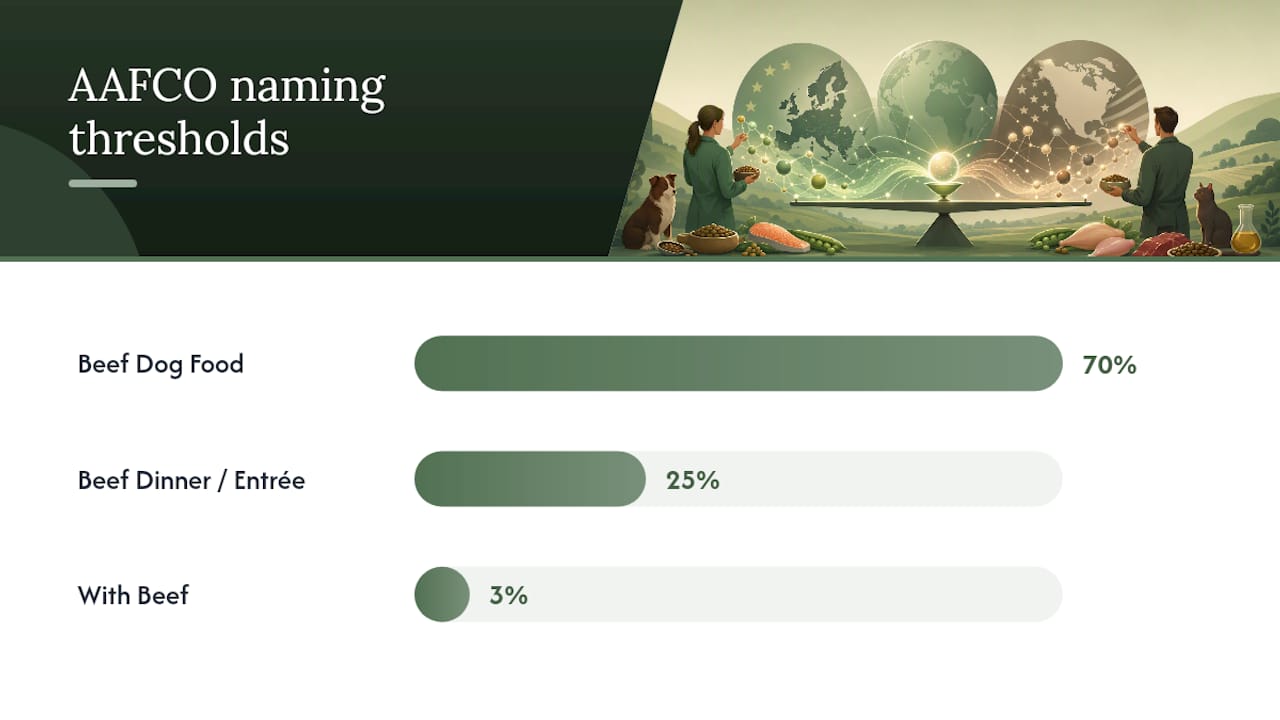
AAFCO's naming conventions are oddly specific and worth knowing cold. A product called "Beef Dog Food" needs at least 70% beef (the "95% rule" territory). "Beef Dinner" or "Beef Entrée" only requires 25% beef. "With Beef" drops the threshold to just 3%, and "Beef Flavor" requires no minimum beef content at all, just enough to be detectable. European labeling doesn't use this same percentage-tier system; FEDIAF guidance focuses more on nutrient adequacy and ingredient listing order than on naming thresholds.
Run through this in under a minute the next time you're standing in the pet aisle:
- Find the nutritional adequacy or validation statement (formulation or feeding trial) — our breakdown of reading an AAFCO statement shows exactly where to look
- Confirm the life stage claim (growth, adult maintenance, all life stages) matches your pet's actual age
- Check the guaranteed analysis for protein, fat, fiber, and moisture minimums or maximums
- Look for a calorie statement, since not every label includes one
- Note whether a feeding trial is mentioned by name, not just implied
Selling in Both Markets: A Practical Reconciliation Strategy
Manufacturers targeting both the EU and U.S. shouldn't pick a standard to follow. They should formulate to whichever number is stricter on every single nutrient, then layer NRC data in as the scientific tiebreaker when FEDIAF and AAFCO disagree.
That looks like:
- Building a master nutrient spreadsheet with FEDIAF, AAFCO, and NRC values side by side, converted to one common basis
- Setting your formulation minimums at the highest of the three and your maximums at the lowest of the three
- Running feeding trials for flagship products where long-term efficacy claims matter to buyers, then disclosing the method plainly on every label, not just where legally mandated
- Auditing labels separately for each market, since AAFCO's naming percentage rules and FEDIAF's adequacy language aren't interchangeable
Pro Tip: Don't treat NRC values as a "safe middle ground." NRC often sets lower minimums than both FEDIAF and AAFCO because it reflects baseline physiological requirements, not commercial safety margins. Use it to settle disputes, not to undercut either standard.
What Pet Owners Should Actually Check on the Bag
You don't need a nutrition degree to vet a label in under two minutes. Look for the validation statement, confirm the life stage matches your pet, scan the guaranteed analysis, and check for a calorie count. WSAVA's Global Nutrition Guidelines specifically recommend weighting whether a brand ran feeding trials over how the marketing copy reads.
- Validation statement present? Formulation or feeding trial?
- Life stage matches your pet's actual age and size
- Guaranteed analysis lists protein, fat, fiber, moisture
- Calorie content stated per cup or per kilogram
- Feeding trial explicitly named, not just implied by "vet recommended"
Bowlful's calorie formulas and feeding guides turn those numbers into an actual daily amount for your specific dog or cat, once you know the label is telling you the truth.
Neither Standard Guarantees Quality, Just a Floor
Regulation, whether it's FEDIAF or AAFCO, sets a safety floor. It doesn't guarantee ingredient quality, digestibility, or that a food low in carbs but heavy in fillers is actually the right fit for your dog. I'd rather see a manufacturer publish real feeding-trial data than lean on a formulation calculation that technically clears both bars. Owners deserve that transparency, and feeding calculators can help translate guideline minimums into a plan built around your own pet's breed, age, and activity level.
— Robert
Where to Verify These Standards Yourself
For formulation work, go straight to the FEDIAF Nutritional Guidelines. For U.S. label rules, use AAFCO's labeling guide and its publications library. For veterinary-grade feeding advice, check the WSAVA Global Nutrition Guidelines, and for real-world feeding schedule documentation, our partner's guide on pet feeding schedule paperwork is a solid practical reference.
Sources
- Labeling & labeling requirements | AAFCO
- Which petfood nutrient values should you follow? | PetfoodIndustry
- WSAVA Global Nutrition Guidelines