
The Nutritional Adequacy Statement tells you, in one sentence, whether a pet food is formulated to serve as your pet's complete diet for a specific life stage, and whether the manufacturer used an AAFCO nutrient profile or an actual feeding trial to back that claim. According to AAFCO's consumer label guidance, it is the single most important line on the package for matching a product to your pet's needs.
- Where to find it: Usually on the back or side panel, near the Pet Nutrition Facts box or feeding directions. On very small packages, it may appear on the bottom.
- First action: Match the life stage named in the statement to your pet's actual life stage before reading anything else.
If the statement names your pet's life stage and lists a recognized substantiation method, you can use the food as a sole diet. If it says "for supplemental or intermittent feeding only," it is not a complete diet and should not replace a balanced meal.
Key Takeaways
The Nutritional Adequacy Statement is the one label element that tells you whether a pet food is complete, which life stage it covers, and how the manufacturer proved it.
| Point | Details |
|---|---|
| Nutritional Adequacy Statement first | Find it on the back panel; it outranks every front-panel claim for nutritional decisions. |
| Two substantiation methods | "Formulated to meet AAFCO profiles" (calculation) or "substantiated by AAFCO feeding trials" (real-world testing). |
| Life-stage match is non-negotiable | "All life stages," "adult maintenance," and "growth" are not interchangeable; mismatch compounds over months. |
| Calories in familiar units | Use the kcal-per-cup or kcal-per-can figure, not the feeding chart alone, to size portions for your individual pet. |
| Bowlful for personalized portioning | Bowlful applies NRC/AAFCO calorie math to your pet's breed, age, and weight to generate a tailored daily feeding plan. |
Table of Contents
- Reading the AAFCO statement on pet food: purpose vs. nutritional adequacy
- How manufacturers substantiate "complete and balanced"
- What life-stage and purpose phrases actually mean
- What the Pet Nutrition Facts box and calorie statement tell you
- How to read the ingredient list and Guaranteed Analysis
- Which label claims are regulated and which are marketing
- Who actually enforces pet food labeling rules
- A practical checklist for applying what you have read
- Why label literacy is the foundation of good feeding
- Bowlful turns label reading into a personalized feeding plan
- Sources
Reading the AAFCO statement on pet food: purpose vs. nutritional adequacy
Two distinct label elements carry nutritional claims, and mixing them up is one of the most common mistakes pet owners make.
The Purpose Statement lives on the Principal Display Panel (PDP), the front face of the bag or can. AAFCO requires verbatim Purpose Statement language that names the species and the product's intended purpose. You will see phrases like "Complete food for adult dogs" or "Complete cat food for all life stages" printed near the product name. The wording is not marketing copy; manufacturers must choose from AAFCO-approved options.
The Nutritional Adequacy Statement is the formal, longer claim, typically on the back or side panel. It states that the product "is formulated to meet the nutritional levels established by the AAFCO Dog (or Cat) Food Nutrient Profiles" for a named life stage, or that it has been "substantiated by AAFCO feeding trials." This is the statement you use to verify the front-panel claim. Per AAFCO's labeling requirements, U.S. pet food labels must include the product name, species, net quantity, ingredient list, guaranteed analysis, nutritional adequacy statement, feeding directions, and calorie content.
A product without a Nutritional Adequacy Statement, or one that only says "for supplemental or intermittent feeding," is not designed to be a complete diet. That distinction matters whether you are buying kibble, a raw topper, or a freeze-dried mixer.
How manufacturers substantiate "complete and balanced"
There are exactly two AAFCO-recognized methods, and the label will tell you which one was used.
Method 1: AAFCO Nutrient Profile
The manufacturer formulates the product to meet the minimum (and in some cases maximum) nutrient levels set in the AAFCO Dog or Cat Food Nutrient Profiles. The label phrase reads something like: "formulated to meet the nutritional levels established by the AAFCO Dog Food Nutrient Profiles for adult maintenance." This is a calculation-based approach. It confirms the recipe hits the targets on paper, but does not confirm how well the nutrients are absorbed by a living animal.

Method 2: AAFCO-Recognized Feeding Trial
The manufacturer feeds the product to a group of animals following an AAFCO-recognized protocol and measures health markers over a defined period. The label phrase reads: "Animal feeding tests using AAFCO procedures substantiate that [Product Name] provides complete and balanced nutrition for [life stage]." Feeding trials add a layer of real-world evidence that formulation alone cannot provide, particularly for growth and reproduction diets where nutrient bioavailability matters most.
As AAFCO's FAQ confirms, there is no central public list of products that conform to AAFCO standards. You must check each product's own Nutritional Adequacy Statement.
- Profile-based label phrase: "formulated to meet the nutritional levels established by the AAFCO [species] Food Nutrient Profiles for [life stage]"
- Feeding-trial label phrase: "Animal feeding tests using AAFCO procedures substantiate that [product] provides complete and balanced nutrition for [life stage]"
- Not complete and balanced: "for supplemental or intermittent feeding only" or no Nutritional Adequacy Statement present
What life-stage and purpose phrases actually mean
The life-stage language in both the Purpose Statement and the Nutritional Adequacy Statement follows AAFCO-defined categories. Here is what each phrase signals in plain terms.
| Label phrase | What it means | Sole diet? |
|---|---|---|
| All life stages | Meets requirements for growth, reproduction, and adult maintenance | Yes |
| Adult maintenance | Formulated for healthy adult animals only; not adequate for puppies, kittens, or pregnant/nursing animals | Yes, for adults |
| Growth (puppies/kittens) | Meets higher nutrient levels required for young, growing animals | Yes, for young animals |
| Growth and reproduction | Covers gestation, lactation, and growth; the most nutrient-dense category | Yes, for breeding/young |
| Supplemental or intermittent feeding | Not nutritionally complete; intended as a topper, treat, or mixer | No |
| Veterinary diet / therapeutic diet | Formulated for a specific medical condition; requires vet supervision | Only under vet guidance |
"All life stages" sounds like the most flexible choice, and it is, but it is also formulated to meet the highest nutrient demands (growth and reproduction). For a sedentary adult dog, that can mean excess calories or minerals. "Adult maintenance" is often the leaner, more appropriate choice for healthy adult pets.
Treats, chews, and toppers almost always carry the "supplemental or intermittent feeding" qualifier. A product labeled "dog treat" with no Nutritional Adequacy Statement is not a meal replacement, regardless of how nutritious the front panel makes it sound.
What the Pet Nutrition Facts box and calorie statement tell you
The Pet Nutrition Facts box, introduced under AAFCO's Pet Food Label Modernization (PFLM) initiative, standardizes how calorie and nutrient information is presented. AAFCO's model regulations require calorie content to be declared in metabolizable energy (ME), expressed as kcal per kilogram and in a familiar household unit: per cup, per can, per biscuit, or per ounce.
You will often see a parenthetical like "(calculated)" or "(fed)" next to the calorie figure. "Calculated" means the manufacturer used the Modified Atwater method to estimate ME from the guaranteed analysis. "Fed" means calories were measured directly through a feeding trial. Neither is inherently better for your purposes; both are valid. What matters is that you use the per-cup or per-can figure when portioning.
Quick example: A dry kibble lists 380 kcal per cup. Your 20-pound adult dog needs roughly 550–600 kcal per day (a typical maintenance range for that weight). That works out to about 1.5 cups daily as a starting point, split across two meals. Feeding directions on the bag give you a similar estimate, but AAFCO is clear that those directions are minimum guidelines, not a fixed prescription. Individual metabolism, activity level, and body condition all require adjustment.
Statistic to watch: Feeding directions are calculated for an average animal of a given weight. A dog that is already overweight, or one that is highly active, can need 20–30% fewer or more calories than the bag suggests.
How to read the ingredient list and Guaranteed Analysis
The ingredient list runs in descending order by weight as formulated, before cooking. That means a fresh chicken listed first may weigh less than the grain listed third once moisture is removed during processing. It is not a trick; it is simply how the rule works, and knowing it prevents misreading "chicken" as the dominant nutrient source when it may not be after drying.
The Guaranteed Analysis panel reports four required values: crude protein (minimum), crude fat (minimum), crude fiber (maximum), and moisture (maximum). Some labels also list ash (maximum) and specific nutrients. "Crude" refers to the measurement method, not quality. Crude protein, for instance, measures total nitrogen and converts it to a protein estimate; it does not distinguish between highly digestible animal protein and lower-quality plant protein.
Moisture is the biggest variable when comparing foods. To compare them fairly, you need to convert both to a dry-matter basis by dividing the nutrient percentage by (100 minus the moisture percentage).
Pro Tip: *To convert crude protein to dry-matter basis, divide the as-fed protein percentage by (100 minus the moisture percentage), then multiply by 100.
Ingredient naming conventions also matter. "Chicken meal" is dehydrated chicken with most moisture removed, so it is actually a more concentrated protein source than fresh chicken by weight. "Poultry by-product meal" is legal and nutritious but less specific about the source. Neither is inherently dangerous; specificity is what you are evaluating.
Which label claims are regulated and which are marketing
Not every word on a pet food bag carries regulatory weight. AAFCO's Pet Food Labeling Guide distinguishes between claims that trigger specific requirements and those that are largely marketing language.
Regulated or defined claims:
- "Natural" has an AAFCO definition: ingredients derived solely from plant, animal, or mined sources without chemically synthetic processing. A product with synthetic vitamins or minerals cannot use "natural" without a qualifier like "with added vitamins and minerals."
- "Organic" must comply with USDA National Organic Program rules, not just AAFCO standards.
- "Human grade" requires that every ingredient and the manufacturing facility meet human food standards. It is not enough for ingredients to be sourced from human-grade suppliers if the facility is not human-food-compliant.
- Nutrient content claims (e.g., "high protein," "low fat") must be backed by a corresponding guarantee in the Guaranteed Analysis.
Mostly marketing:
- "Vet recommended," "vet approved," and similar phrases have no AAFCO-defined standard. They may reflect a paid endorsement, a survey of a handful of veterinarians, or nothing verifiable at all.
- "Made in USA" applies to manufacturing location but does not restrict ingredient sourcing. Ingredients may be imported.
- "Premium," "gourmet," and "artisan" carry no regulatory definition.
Red flags worth scrutinizing: a "complete" claim on the front panel with no Nutritional Adequacy Statement on the back; missing feeding directions; vague ingredient names like "meat" or "animal digest" with no species specified; and a calorie statement absent from the label entirely.
Who actually enforces pet food labeling rules
AAFCO does not approve, certify, or endorse specific pet foods. It is a non-profit association that develops model regulations and nutrient profiles, which states then adopt into their own feed laws. AAFCO's own consumer materials are explicit on this point: there is no AAFCO-approved product list, and no seal from AAFCO guarantees a product has been reviewed.
Enforcement is primarily the responsibility of state feed control officials, typically housed within state departments of agriculture. Each state adopts AAFCO model regulations independently, which means label approval and enforcement can vary across state lines. The FDA oversees pet food safety under the Federal Food, Drug, and Cosmetic Act, focusing on adulteration, contamination, and certain labeling areas, complementary to state-level enforcement.
If you suspect a pet food label is misleading or mislabeled, here is how to report it:
- Document the issue. Photograph the label, note the product name, brand, lot number, and best-by date, and write down exactly what you believe is incorrect or misleading.
- Contact your state feed control official. Find your state's contact through the AAFCO member directory. State officials handle label compliance for products sold in their state.
- File a report with the FDA. Use the FDA's Safety Reporting Portal for concerns about contamination, illness, or serious labeling violations. The FDA coordinates with states on significant cases.
- Keep the product. Do not discard the food or packaging until the complaint is resolved; regulators may request a sample.
A practical checklist for applying what you have read
Knowing the rules is one thing. Using them at the store or at home is another. Here is a short sequence that covers the essentials.
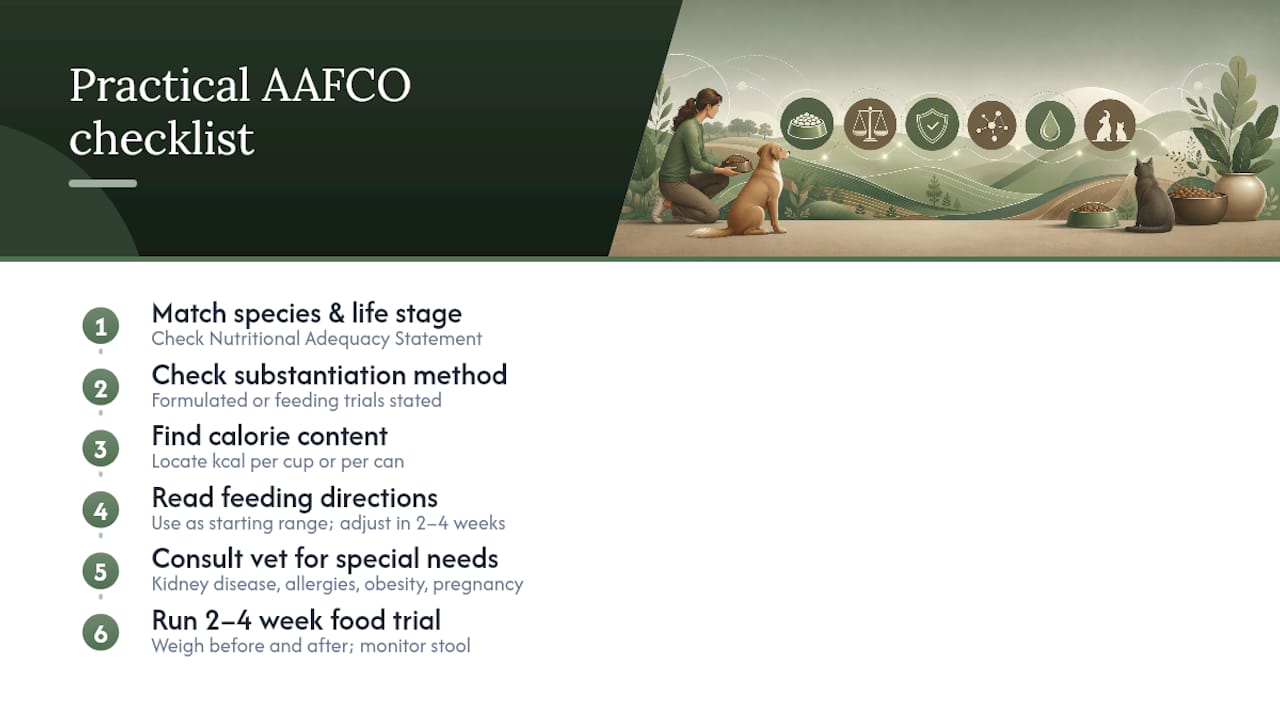
Step 1: Match species and life stage. Find the Nutritional Adequacy Statement on the back panel. Confirm it names your pet's species (dog or cat) and the correct life stage. A kitten food for "growth" is not appropriate for a 5-year-old neutered cat.
Step 2: Check the substantiation method. Does the statement say "formulated to meet AAFCO nutrient profiles" or "substantiated by AAFCO feeding trials"? Either is acceptable; feeding trials add real-world evidence for growth and reproduction diets in particular.
Step 3: Find the calorie content. Locate the kcal-per-cup or kcal-per-can figure in the Pet Nutrition Facts box. Use it to estimate a starting daily portion based on your pet's weight and activity level. A pet nutrition assessment can help you refine that estimate.
Step 4: Read feeding directions as a starting range. The bag's chart gives you a reasonable starting point, but it is a population average. Adjust up or down based on your pet's body condition score over 2–4 weeks.
Step 5: Consult a vet for special needs. Kidney disease, food allergies, obesity, and pregnancy all require more than a label check. A vet-backed nutrition review is the right next step for any pet with a diagnosed condition.
Pro Tip: Run a 2–4 week pilot when switching foods. Weigh your pet at the start and end of the trial, and monitor stool consistency. Check the signs your pet needs a feeding adjustment for a quick reference.
Why label literacy is the foundation of good feeding
Most pet owners spend more time reading the front of a bag than the back. That is understandable; the front is designed to sell. But the front panel is largely marketing. The Nutritional Adequacy Statement, the Guaranteed Analysis, and the calorie content are the parts that carry actual regulatory weight, and they are almost always on the back in small print.
What strikes me about the AAFCO framework is how much it does when you actually use it. The life-stage matching alone eliminates a huge category of feeding errors. Giving a puppy an adult maintenance food, or feeding a senior cat a kitten formula, are mistakes that compound quietly over months. The label has the answer; most people just do not know where to look.
The other thing worth saying: "AAFCO-compliant" is not a ceiling. It is a floor. A product that meets AAFCO nutrient profiles is nutritionally adequate by definition, but adequacy and optimization are different targets. Ingredient quality, digestibility, and calorie density all matter beyond the minimum. Label literacy gets you past the marketing. What you do with that information, how you match it to your specific pet's weight, age, and health status, is where the real work happens.
Bowlful turns label reading into a personalized feeding plan
Reading the label correctly is step one. Translating those numbers into the right daily portion for your specific pet is where most owners get stuck.
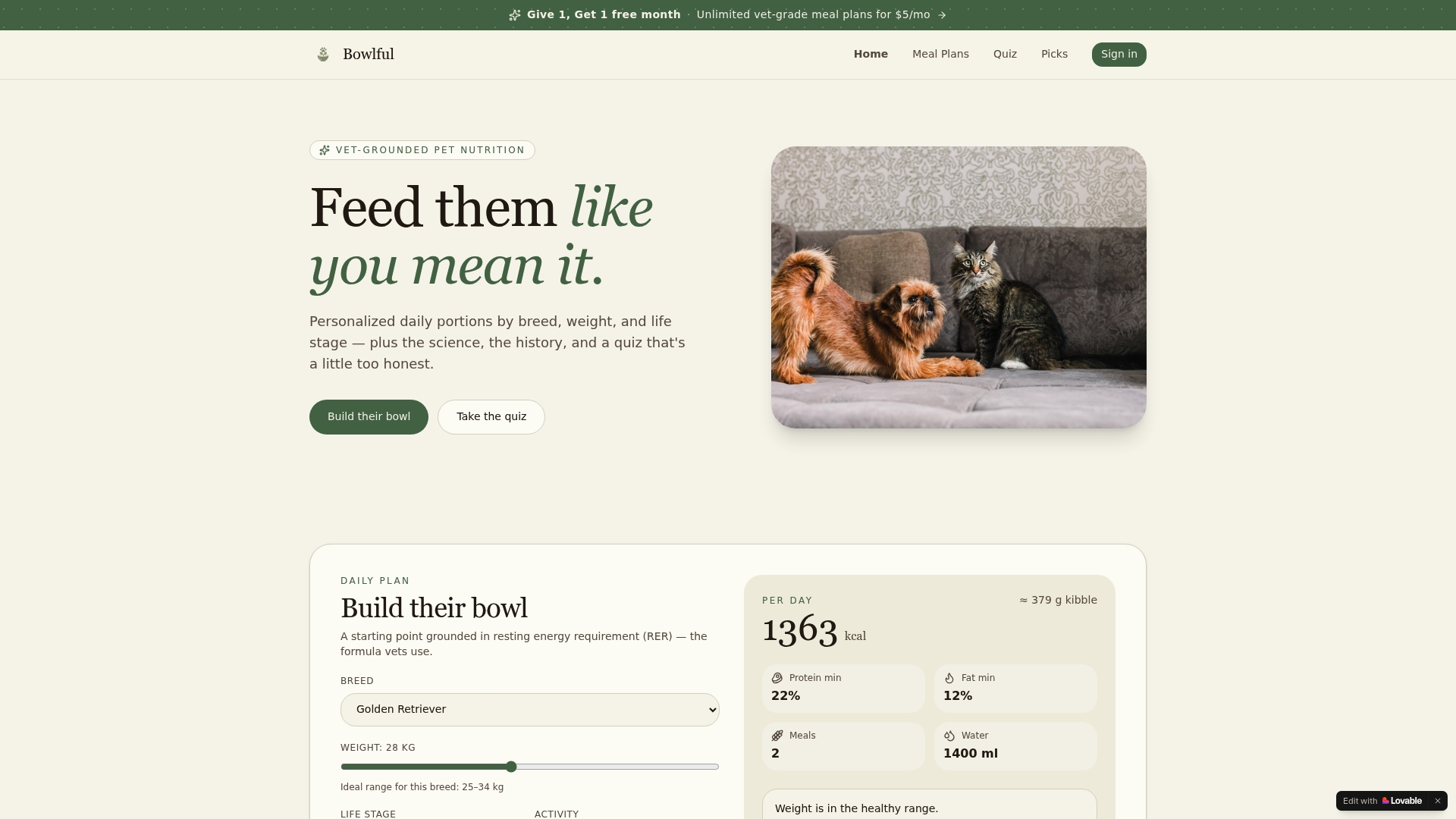
Bowlful uses the same NRC and AAFCO calorie formulas shown in this guide, combined with your pet's breed, age, weight, and activity level, to generate a precise starting portion and a downloadable meal-plan PDF. There are no brand affiliations and no paid placements steering the recommendations. You get the math done for you, grounded in the same vet-standard RER/MER calculations your veterinarian would use.
If the checklist in this article raised questions about your pet's current food, the right next step is a personalized plan rather than another bag of kibble chosen by front-panel claims. Build your pet's feeding plan at Bowlful and start with numbers that actually fit your animal.
Sources
The sources below are the primary references for everything covered in this guide.