
A balanced pet diet means every nutrient your pet needs is present in the right amounts and the right ratios for their life stage. The phrase you'll see on labels is "complete and balanced," a standard defined by AAFCO and enforced through FDA oversight. "Complete" means all required nutrients are there. "Balanced" means they're in the correct proportions, not just present.
Three things to check right away:
- The nutritional adequacy statement. Look for it on every bag or can. It tells you the life stage the food is formulated for and whether the claim is based on feeding trials or a nutrient profile calculation.
- Body Condition Score (BCS) and Muscle Condition Score (MCS). The label is a starting point. How your pet actually looks and feels over time is the real test, per AAHA's 2021 Nutrition and Weight Management Guidelines.
- A veterinarian or board-certified veterinary nutritionist (ACVN). If you're considering a homemade diet, managing a chronic condition, or feeding a growing large-breed puppy, professional guidance isn't optional.
Key Takeaways
A balanced pet diet requires every essential nutrient in the right ratios for the pet's life stage, validated by an AAFCO nutritional adequacy statement and confirmed over time through BCS and MCS monitoring.
| Point | Details |
|---|---|
| Check the adequacy statement | Every complete and balanced food must carry an AAFCO nutritional adequacy statement naming the life stage it covers. |
| Monitor BCS and MCS | AAHA recommends assessing body and muscle condition at every exam; these scores are the real-world test of whether a diet is working. |
| Match food to life stage | "All life stages" foods meet the stricter growth profile and may oversupply nutrients for sedentary adults; choose the label that fits your pet. |
| Limit treats and supplements | Treats dilute nutrient balance; adding supplements to an already complete commercial diet risks toxicity, especially fat-soluble vitamins. |
| Bowlful for personalized plans | Bowlful's RER/MER-based feeding plans translate vet-standard calorie math into specific daily portions for your pet's breed, age, and activity level. |
This article is general information, not a substitute for advice from a qualified doctor. Consult a qualified healthcare professional about your own circumstances before acting on anything here.
Table of Contents
- What does "complete and balanced" mean on a pet food label?
- What essential nutrients does a balanced diet actually supply?
- Why do life stage and energy needs change what "balanced" looks like?
- How to read a pet food label and confirm it's balanced
- How can you tell if your pet's diet is actually working?
- What are the real risks of homemade diets and supplements?
- Simple steps you can take today to support a balanced diet
- When should you schedule a nutrition-focused vet visit?
- The case for outcomes over ingredient hype
- Bowlful builds the math your pet's diet actually needs
- Sources
What does "complete and balanced" mean on a pet food label?
The phrase "complete and balanced" is not marketing language. It's a regulated claim with a specific legal meaning under FDA guidance, and a food must earn it one of two ways.
Nutrient profiles vs. feeding trials. AAFCO publishes nutrient profiles for two life stages: growth/reproduction and adult maintenance. A manufacturer can formulate a food to meet those profiles on paper, or it can run AAFCO-sanctioned feeding trials where real animals eat the food for a set period and are monitored for health outcomes. Feeding trials are the stronger standard because they test real-world absorption, not just calculated composition. The nutritional adequacy statement on the label tells you which method was used. A statement reading "formulated to meet the nutritional levels established by AAFCO" means the food was calculated to hit the numbers. A statement referencing "feeding tests" or "feeding trials" means animals actually ate it under controlled conditions.
Life-stage categories and what "all life stages" actually requires. AAFCO recognizes growth/reproduction and adult maintenance as its two primary profiles. A food labeled "all life stages" must meet the stricter growth/reproduction profile, because that standard covers the highest nutrient demands. That sounds reassuring, but it also means an "all life stages" food may deliver more calories and nutrients than a sedentary adult dog or cat actually needs. Match the life-stage claim to your pet's actual situation.
A sample adequacy statement looks like this: "[Product name] is formulated to meet the nutritional levels established by the AAFCO Dog Food Nutrient Profiles for all life stages including the growth of large-size dogs (70 lbs. or more as an adult)." Every word in that sentence carries meaning. "Formulated to meet" tells you it's a profile claim, not a feeding trial. "All life stages including large-size dogs" tells you it passed the most demanding growth benchmark.
One warning: seals from humane organizations, sustainability certifications, or "natural" endorsements are not nutritional adequacy statements. They measure something else entirely. A bag can carry a dozen third-party logos and still lack a valid adequacy statement. For deeper reading on interpreting label claims, Bowlful's guide breaks down the exact language to look for.
What essential nutrients does a balanced diet actually supply?
Nutrients, not ingredients, determine whether a diet is adequate. A food made from premium whole-food ingredients can still be deficient; a food with a less glamorous ingredient list can be perfectly complete. Here's what each nutrient group does and where it typically comes from:
- Protein and amino acids. Protein builds and repairs muscle, supports immune function, and provides the amino acid building blocks pets can't synthesize on their own. Dogs require 10 essential amino acids; cats require 11, including taurine, which is critical for cardiac health. Common sources: poultry, beef, fish, eggs, legumes.
- Fats and fatty acids. Fat is the most calorie-dense macronutrient and the primary carrier for fat-soluble vitamins (A, D, E, K). Omega-3 and omega-6 fatty acids support skin, coat, and inflammation response. Common sources: fish oil, chicken fat, flaxseed.
- Carbohydrates and fiber. Carbohydrates supply readily available energy. Fiber, specifically, feeds gut bacteria, supports stool quality, and slows glucose absorption. Common sources: brown rice, oats, sweet potato, peas.
- Vitamins. Fat-soluble vitamins (A, D, E, K) and water-soluble B vitamins each serve distinct roles in vision, bone metabolism, energy production, and cell function. Commercial diets are typically fortified to hit minimum levels.
- Minerals. Calcium and phosphorus must be present in the right ratio for bone development and maintenance, particularly in growing animals. Zinc, iron, copper, and selenium support immune function, oxygen transport, and antioxidant activity. Excess or deficiency of any single mineral can disrupt the others.
- Water. Often overlooked as a nutrient, water drives every metabolic process. Cats in particular have a low thirst drive and can become chronically dehydrated on dry-only diets.
One point the Merck Veterinary Manual makes clearly: detecting a nutrient in a lab analysis doesn't mean the animal can absorb it. Bioavailability depends on ingredient quality, processing temperature, and the interaction between nutrients. Two foods with identical guaranteed analyses can perform very differently in a living animal. The FEDIAF 2024 Nutritional Guidelines address this by building safety margins into minimum nutrient recommendations, a practice that acknowledges real-world variability in absorption.
Why do life stage and energy needs change what "balanced" looks like?
A balanced diet for a 10-week-old Labrador puppy and a balanced diet for a 7-year-old neutered Labrador are not the same thing. The nutrient ratios that support rapid bone growth and immune development in a puppy would overshoot the needs of a dog whose job is simply to maintain healthy body weight and muscle mass.
AAFCO's life-stage framework. AAFCO defines growth/reproduction and adult maintenance as its core profiles. Growth diets carry higher minimums for protein, fat, calcium, and phosphorus to fuel development. Adult maintenance diets are calibrated for a lower metabolic rate. "All life stages" foods, as noted above, must clear the growth bar.
Energy needs: RER and MER. Resting Energy Requirement (RER) is the baseline calorie need for basic physiological function at rest. Maintenance Energy Requirement (MER) multiplies RER by an activity factor that accounts for age, reproductive status, breed, and lifestyle. A food's caloric density directly affects how much of it a pet needs to eat to hit their MER, and that portion size determines how much of every other nutrient they actually receive. A calorie-dense food fed in smaller portions can deliver the same nutrients as a less dense food fed in larger portions, but only if the math is done correctly.
Large-breed puppies are a specific case. According to VCA Hospitals, small-to-medium puppies typically transition to adult food around 10–12 months. Large and giant breeds often need to stay on growth formulas until 18–24 months. Switching too early, or feeding a calcium-heavy adult formula during the growth phase, raises the risk of developmental orthopedic disease.
| Life Stage | Main Nutrient Considerations | Feeding Notes |
|---|---|---|
| Growth/Reproduction | Higher protein, fat, calcium, phosphorus; taurine for cats | Match food to species and breed size; large breeds need extended growth phase |
| Adult Maintenance | Moderate protein and fat; controlled calorie density | Adjust portions using BCS/MCS; avoid overfeeding calorie-dense foods |
| Senior | Varies; often lower calorie, higher protein to preserve muscle | Monitor MCS closely; bloodwork may guide adjustments |
| All Life Stages | Must meet growth/reproduction minimums | May oversupply nutrients for sedentary adults; monitor BCS |
Monitoring BCS and MCS over time, as AAHA recommends, is how you confirm the math is working in practice. A pet holding a healthy BCS of 4–5 out of 9 and a normal MCS is getting what they need. A pet drifting in either direction signals a portion or formula adjustment.
How to read a pet food label and confirm it's balanced
Labels pack a lot of information into a small space, and manufacturers know which claims catch the eye. Here's a step-by-step approach to cutting through the noise.
Step-by-step label checklist:
- Find the nutritional adequacy statement. It's usually on the back or side panel. If it's missing, the food has not been validated as complete and balanced for any life stage.
- Confirm the life stage. Does it match your pet's current stage? "Adult maintenance" for a puppy is a mismatch. "All life stages" for a senior cat may deliver more calories than needed.
- Check the basis of the claim. "Formulated to meet" means a paper calculation. "Feeding tests" or "feeding trials" means real-animal validation. Both are legitimate; feeding trials are the stronger standard.
- Review the guaranteed analysis. This shows minimum crude protein, minimum crude fat, maximum crude fiber, and maximum moisture. These are minimums and maximums, not exact values, and they say nothing about bioavailability.
- Find the caloric density. Usually listed as kcal/cup or kcal/kg. Compare this to your pet's estimated MER to calculate the correct daily portion. Package feeding guidelines are manufacturer starting points; AAHA notes they are not standardized across brands and should be adjusted using BCS/MCS.
- Compare feeding guidelines to your pet's MER. If the package suggests 2 cups for a 30-pound dog and your MER estimate suggests 1.5 cups, start at 1.5 and monitor weight weekly.
What the guaranteed analysis doesn't tell you:
- Actual digestibility or bioavailability of any nutrient
- The quality of ingredient sources
- Whether the calcium-to-phosphorus ratio is appropriate for your pet's life stage
Marketing language to be skeptical of:
- "Human-grade" has no regulatory definition in pet food
- "Natural" means minimally processed but does not indicate nutritional completeness
- Vague proprietary blends listed without quantities
Pro Tip: Treats and table scraps are typically not nutritionally complete. The FDA advises keeping extras small enough that the primary diet still supplies all required nutrients. A treat-heavy day is a day your pet's diet is no longer balanced, even if the main food is excellent.
How can you tell if your pet's diet is actually working?
The label tells you what went into the bag. BCS and MCS tell you what's happening inside your pet.

Body Condition Score (BCS) is a 9-point scale (some vets use a 5-point version) that assesses fat coverage over the ribs, waist definition, and abdominal tuck. A score of 4–5 out of 9 is ideal for most dogs and cats. You should be able to feel ribs without pressing hard, but not see them. AAHA's guidelines recommend assessing BCS at every veterinary exam and tracking it between visits at home.
Muscle Condition Score (MCS) evaluates muscle mass over the spine, scapulae, skull, and pelvis. A pet can hold a normal BCS while losing muscle, particularly in seniors or animals with chronic illness. MCS catches that loss early. A pet with normal BCS but low MCS may need more dietary protein, not fewer calories.
Other signs a diet is working well: steady weight over weeks and months, a coat that's shiny and doesn't shed excessively, consistent energy appropriate to the pet's age, and stools that are firm, well-formed, and produced once or twice daily.
Red flags that warrant a vet call:
- Unexplained weight loss or gain over 2–4 weeks
- Chronic loose stools or vomiting not linked to a known cause
- Dull, brittle coat or persistent skin irritation
- Muscle wasting visible at the spine or hips
- Abnormal gait, weakness, or reluctance to move
For a fast reference on what changes to watch for, Bowlful's signs your pet needs a feeding adjustment checklist covers the most common triggers.
A practical tracking habit: weigh your pet monthly on the same scale, take a photo from above and from the side every two weeks, and note stool quality daily for the first month on any new food. This gives your vet useful data at the next exam.
What are the real risks of homemade diets and supplements?
Home-cooked diets can be safe, but only when formulated by a board-certified veterinary nutritionist and followed precisely. The Merck Veterinary Manual is direct on this point: DIY recipes from unverified sources are a common cause of long-term deficiencies or toxicities, and the problems often don't show up for months.
The most frequent errors in home recipes:
- Calcium imbalances. Recipes without a calibrated calcium source (typically a supplement, not just bone broth) are almost always deficient. Excess calcium in large-breed puppies raises orthopedic disease risk.
- Vitamin A toxicity. Liver is a common home-diet ingredient. Fed too frequently, it can push vitamin A to toxic levels over time.
- Iodine deficiency. Home diets that don't include iodized salt or a complete supplement often fall short on iodine, which affects thyroid function.
- Incomplete amino acid profiles. Single-protein recipes frequently miss one or more essential amino acids, particularly taurine in cats.
Bioavailability compounds the problem. Even a recipe that looks complete on paper may not deliver what it promises. Processing temperature, ingredient interactions, and the form of a nutrient all affect how much the animal actually absorbs. The Merck Veterinary Manual flags this as a consistent pitfall.
Supplement mistakes on commercial diets are equally common. According to PetMD, commercial diets are already fortified to meet vitamin and mineral requirements. Adding a multivitamin on top of a complete diet doesn't improve nutrition; it creates the risk of excess. Fat-soluble vitamins (A, D, E, K) accumulate in tissue and can reach toxic levels. Single-nutrient supplements (calcium tablets, fish oil capsules) should only be added when a specific deficiency is confirmed by bloodwork, not as a precaution.
When to consult a professional before changing the diet:
- Pregnancy or lactation
- Growth phase of a large or giant breed puppy
- Any chronic disease (renal, hepatic, cardiac, diabetes)
- Planned exclusive homemade feeding
- Restrictive diets for allergies or intolerances
For guidance on supplements specifically for older dogs, Bowlful's vet-backed supplement guide for aging dogs covers what's supported by evidence and what isn't.
Pro Tip: When evaluating a homemade diet recipe, look for the credential DACVN (Diplomate of the American College of Veterinary Nutrition) after the formulator's name. That's the board-certification credential for veterinary nutritionists in the U.S., and it's the clearest signal that the recipe was built to a clinical standard.
Simple steps you can take today to support a balanced diet
Knowing the theory is useful. Having a short list of actions is better.
- Calculate your pet's MER. Use RER (70 × body weight in kg^0.75) as the base, then multiply by the appropriate activity factor. Bowlful's feeding schedule by weight walks through this calculation with practical examples.
- Confirm the nutritional adequacy statement. Pull out the current food bag or check the brand's website. If there's no adequacy statement, the food hasn't been validated as complete and balanced.
- Measure portions. Use a kitchen scale or a calibrated measuring cup. Eyeballing portions is the single most common cause of gradual weight gain in pets.
- Monitor BCS weekly for the first month on any new food, then monthly once stable. A simple photo log from above and from the side is enough to track trends.
- Keep treats to a small share of daily calories. The FDA recommends keeping extras small enough that the primary diet still supplies all required nutrients. A useful rule of thumb is to account for treat calories before filling the food bowl, not after.
- Transition new foods over 7–10 days. Start with roughly 75% old food and 25% new, then shift the ratio every 2–3 days. Abrupt switches are the most common trigger for digestive upset.
- Call your vet if BCS or MCS changes noticeably, coat quality drops, or stool quality is consistently abnormal for more than a week.
Rotating between formats (kibble, canned, lightly cooked) occasionally builds food flexibility and reduces the risk of a pet refusing to eat during illness or travel when their usual food isn't available. It also provides variety in moisture content, which supports hydration, particularly in cats.
When should you schedule a nutrition-focused vet visit?
Most pet owners don't need a specialist for routine feeding questions. A primary care veterinarian can assess BCS and MCS, review the current diet, and flag obvious gaps. But some situations call for more.
Who to contact:
- Primary care veterinarian: first stop for any nutrition question, weight change, or label confusion. They can run bloodwork, assess body condition, and refer you if needed.
- Board-certified veterinary nutritionist (ACVN/DACVN): appropriate for homemade diet formulation, therapeutic diets for chronic disease, or any situation where the stakes of getting it wrong are high.
What to bring to the appointment:
- Current food labels (bag, can, or a photo of the label including the adequacy statement)
- Feeding amounts and schedule (how much, how often, who feeds)
- Weight records from the past 3–6 months if available
- Photos showing body condition from above and from the side
- A complete list of treats, supplements, and table scraps
- Relevant medical records, especially for pets with chronic conditions
What to expect: your vet will likely do a physical exam, assess BCS and MCS, and calculate or confirm calorie targets. For complex cases, they may recommend bloodwork to check nutrient-related markers (vitamin D, B12, taurine in cats) or refer to an ACVN for a formal diet plan. For pets on therapeutic diets, periodic bloodwork is standard practice to monitor for nutrient-related side effects over time.
For a broader look at what a nutritional assessment covers, Bowlful's pet nutrition assessment guide explains what vets evaluate and how to prepare.
The case for outcomes over ingredient hype
Most pet food marketing is built around ingredients. "Real salmon," "farm-raised chicken," "ancient grains." These claims are not meaningless, but they answer the wrong question. The question that matters is whether the diet produces a healthy animal over time, and the answer to that question lives in BCS, MCS, coat quality, energy, and bloodwork, not in the ingredient panel.
The recommendations in this article follow AAFCO and FDA label standards, AAHA's 2021 clinical guidelines, and Merck Veterinary Manual guidance on bioavailability and homemade diet risks. Bowlful's feeding plans use the same RER/MER formulas veterinarians apply in practice, adjusted for breed, life stage, and activity level, because calorie math is where label claims meet real-world outcomes.
Bowlful builds the math your pet's diet actually needs
Most pet owners know their dog or cat should eat a "balanced" diet. Fewer know how to calculate whether the portion they're serving actually delivers it. Bowlful's personalized feeding plans close that gap using the same RER/MER calorie formulas veterinarians use, adjusted for your pet's breed, age, weight, and activity level.
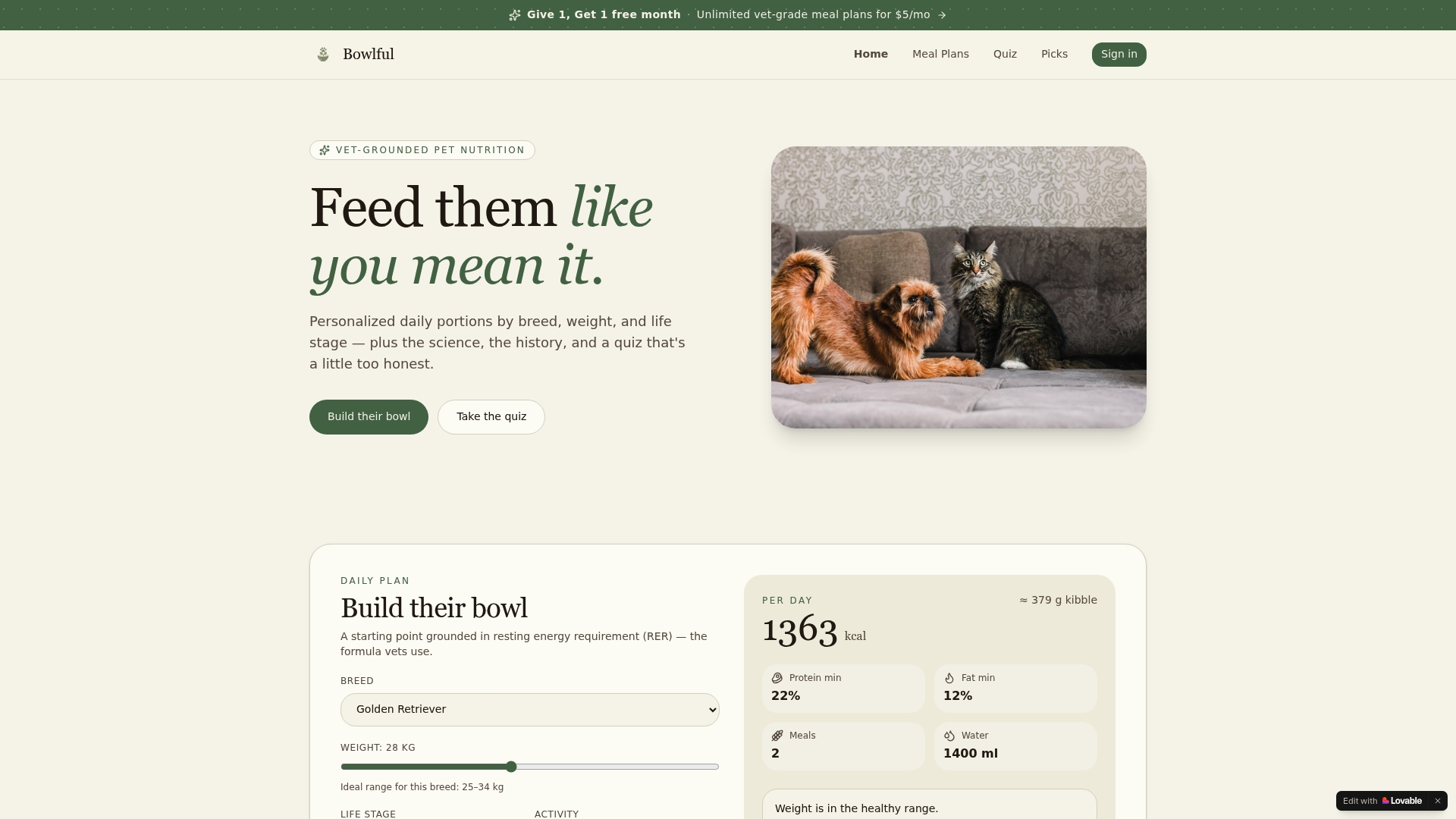
A Bowlful plan gives you a downloadable meal plan with specific portion sizes, life-stage guidance, and curated food recommendations, all built around your pet's individual profile. It's not a replacement for a clinical nutrition consult with an ACVN, and for pets with chronic disease or complex medical needs, that consult is still the right call. But for the majority of healthy dogs and cats, Bowlful gives you the precision of vet-standard calorie math without a clinic visit. Get your personalized feeding plan and know exactly what your pet needs, today.
Sources
- Selecting the Right Pet Food | AAFCO
- “Complete and Balanced” Pet Food | FDA
- 2021 AAHA Nutrition and Weight Management Guidelines
- Dog and cat foods | Merck Veterinary Manual