
A healthy weight loss plan for cats is a structured, gradual reduction in daily calories combined with dietary improvements and increased activity to safely reduce body fat without triggering life-threatening complications. 60% of domestic cats in the U.S. are overweight or obese, and obese cats face a four times higher risk of developing diabetes. That statistic means millions of pet owners are unknowingly shortening their cat's life with every overfilled bowl. The good news is that cat weight management works when you follow a plan built on science, not guesswork.
What does a healthy weight loss plan for cats actually look like?
A safe feline weight loss plan targets a loss of 0.5% to 2% of body weight per week, never more. Exceeding that rate puts cats at serious risk of hepatic lipidosis, a potentially fatal liver condition. Weight loss in cats is significantly slower than in dogs, which means patience is not optional. It is the strategy.
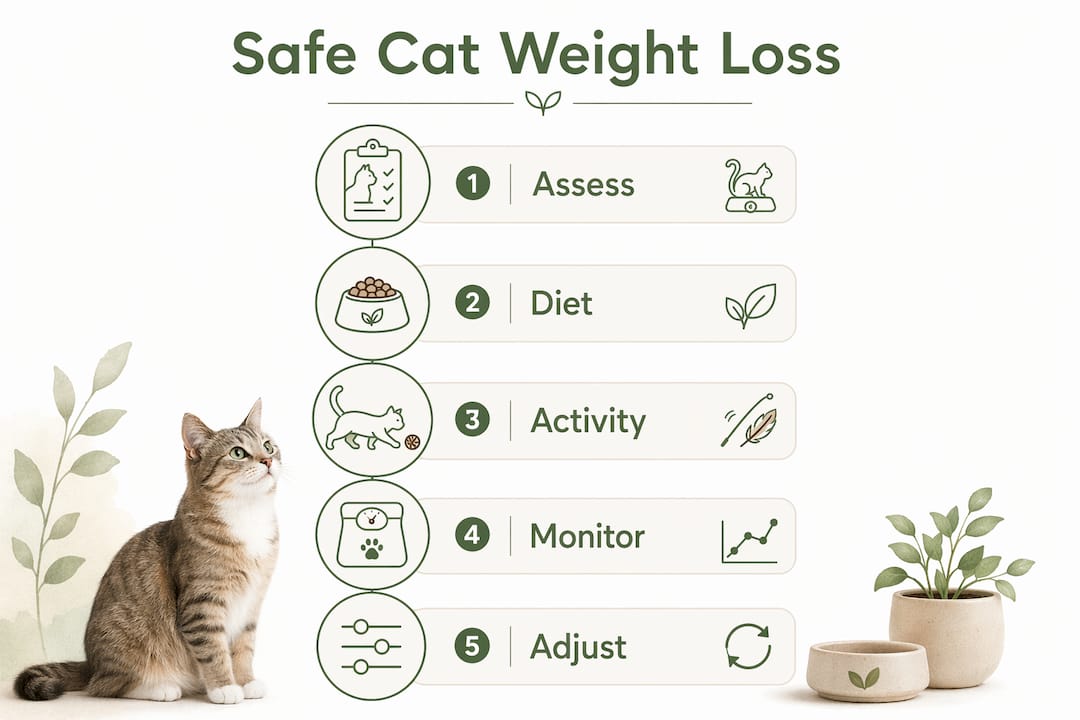
The plan has four core components: accurate weight assessment, dietary changes, increased activity, and consistent monitoring. Each one depends on the others. Cutting calories without increasing protein, for example, causes muscle loss rather than fat loss. Increasing activity without adjusting food intake produces minimal results. You need all four working together.

Veterinary guidance is non-negotiable at the start. Your vet will establish a baseline body weight, run bloodwork to rule out thyroid or metabolic issues, and calculate a target calorie range. This is where senior cat weight loss requires extra care, since older cats have different metabolic needs and muscle preservation becomes even more critical.
How to assess your cat's weight and set realistic goals
The number on a scale tells only part of the story. Veterinarians use the Body Condition Score (BCS), a 9-point scale that evaluates fat deposits over the ribs, spine, and abdomen. A cat scoring 6 or above is considered overweight. A score of 8 or 9 indicates obesity. You can learn to assess BCS at home by running your fingers along your cat's ribcage. If you cannot feel individual ribs without pressing firmly, your cat is carrying excess weight.
Once you have a BCS reading and a scale weight, your vet can calculate a realistic target weight. For most overweight cats, the goal is to reach a BCS of 4 or 5. The timeline to get there depends on how much weight needs to be lost, but expect the process to take several months, not weeks.
Portion control becomes complicated in multi-cat households. Cats are competitive eaters, and a dieting cat will often steal food from a housemate's bowl. Microchip feeders solve this problem directly by opening only for the cat whose microchip is registered. This technology removes the guesswork and prevents the most common reason multi-cat weight loss plans fail.
- Weigh your cat on the same scale, at the same time of day, weekly
- Record BCS alongside weight to track fat loss versus muscle loss
- Use a microchip feeder or separate feeding rooms if you have multiple cats
- Ask your vet for a printed target weight range, not just a single number
Pro Tip: Weigh your cat by stepping on a human scale while holding them, then subtract your own weight. It is accurate enough for weekly tracking and requires no special equipment.
What dietary changes actually work for cat weight loss?
The single most effective dietary shift for a healthy cat diet plan is switching from dry kibble to high-moisture canned food. Wet food contains 70% to 80% moisture compared to dry food's 10%, which means cats feel fuller consuming fewer calories. This is not a minor difference. It directly addresses the satiety gap that makes free-fed kibble cats chronically overeat.
The best weight loss food for cats is high in protein and low in carbohydrates. Cats are obligate carnivores. Their metabolism is not designed to process grain-heavy kibble efficiently, and excess carbohydrates convert to fat. Look for canned foods where a named protein source (chicken, turkey, salmon) appears as the first ingredient, with carbohydrate content below 10% of dry matter.
Calorie reduction should start at approximately 20% below your cat's current daily intake, then adjust based on weekly weigh-ins. This gradual approach keeps weight loss within the safe 1% to 2% weekly range. Never cut calories by more than 20% at once, and never skip meals entirely. Cats can develop hepatic lipidosis within 48 to 72 hours of significant food restriction, which is why crash dieting is genuinely dangerous for this species.
Here is a practical step-by-step approach to restructuring your cat's diet:
- Calculate current daily intake. Weigh the food you currently serve over three days and find the average.
- Reduce by 20%. Use a digital kitchen scale, not a measuring cup. Measuring by weight is significantly more accurate than measuring by volume.
- Transition to wet food over 2 to 3 weeks. Gradual diet transition prevents gastrointestinal upset and keeps your cat eating consistently.
- Divide daily food into 2 to 3 meals. Structured feeding windows improve metabolism and reduce begging behavior.
- Cap treats at under 10% of daily calories. Treats above this threshold consistently undermine weight loss progress.
Pro Tip: Freeze-dried meat treats like plain chicken or turkey are among the lowest-calorie options available. A single piece often contains fewer than 2 calories, making them a safe reward without derailing the plan.
Understanding your cat's feeding schedule by weight is one of the most underused tools in cat weight management. Structured meal timing, rather than free feeding, gives you precise control over daily calorie intake.
How to increase your cat's activity safely
Exercise alone will not produce meaningful weight loss in cats, but it plays a real supporting role. Puzzle feeders increase daily energy expenditure by 10% to 30%, which adds up over weeks and months. That is a meaningful contribution without requiring your cat to do anything they would not naturally enjoy.
The key is mimicking natural hunting behavior. Cats in the wild spend significant energy stalking, chasing, and capturing prey. Indoor cats lose almost all of that activity. You can reintroduce it through structured play and environmental design.
- Use wand toys like Da Bird or Cat Dancer for 10 to 15 minutes of active play before each meal, which mimics the hunt-eat cycle
- Place food-dispensing toys like the Doc & Phoebe Indoor Hunting Feeder around the home so cats move to find their meals
- Install cat trees, wall-mounted shelves, or window perches to encourage climbing and vertical movement
- Rotate toys every few days to maintain novelty and prevent boredom-driven inactivity
Even indoor cats benefit significantly from environmental enrichment. A cat that climbs, jumps, and hunts for food burns more calories and experiences less stress-related overeating. Outdoor cats naturally get more movement, but they still benefit from structured play sessions and puzzle feeders during the weight loss period.
How to monitor progress and avoid common mistakes
Weigh your cat every seven days and record the result alongside their food intake for that week. This gives you a direct feedback loop. If your cat loses more than 2% of body weight in a single week, increase food by 10% the following week. If there is no loss after two weeks, reduce intake by another 10%. Adjust in small increments only.
| Warning sign | What it means | What to do |
|---|---|---|
| Loss over 2% body weight per week | Risk of hepatic lipidosis | Increase daily calories by 10% immediately |
| No weight change after 3 weeks | Calorie intake too high or food stealing | Recheck portions, consider microchip feeder |
| Vomiting or lethargy | Possible dietary intolerance or illness | Contact your vet before continuing |
| Excessive begging or aggression | Hunger from insufficient protein | Switch to higher-protein wet food |
Owners consistently underestimate treat calories, which is one of the most common reasons weight loss stalls. A single commercial cat treat can contain 5 to 10 calories. Four treats a day adds 40 calories, which is a significant portion of a small cat's daily budget.
"The most dangerous mistake in feline weight loss is moving too fast. Cats are not small dogs. Their liver responds to calorie restriction differently, and what looks like dedication from an owner can become a medical emergency within days."
Managing hunger and begging is a behavioral challenge as much as a nutritional one. Feeding windows help. When your cat knows food arrives at set times, begging between meals decreases within one to two weeks. Read more about why feeding windows matter for your cat's metabolic health and hunger regulation.
Key takeaways
A successful feline weight loss plan requires gradual calorie reduction, high-protein wet food, structured feeding, and weekly monitoring to stay within the safe 0.5% to 2% weekly loss rate.
| Point | Details |
|---|---|
| Safe loss rate | Target 0.5% to 2% of body weight per week to avoid hepatic lipidosis. |
| Dietary foundation | Switch to high-protein, high-moisture wet food and measure portions by weight, not volume. |
| Calorie reduction | Start at 20% below current intake and adjust in 10% increments based on weekly results. |
| Activity support | Use puzzle feeders and structured play to increase daily energy expenditure by up to 30%. |
| Treat management | Keep treats below 10% of daily calories and choose low-calorie options like freeze-dried meat. |
Why patience is the most underrated tool in feline weight loss
I have seen more cat weight loss plans fail from impatience than from bad nutrition advice. Owners cut calories aggressively because they want results, and within two weeks their cat is sick, not slim. The biology here is unforgiving. A cat's liver mobilizes fat differently than a human's or a dog's, and the margin between "effective restriction" and "medical emergency" is narrower than most people realize.
What actually works, in my experience, is treating this like a long project with weekly check-ins rather than a crash program with a deadline. The cats that reach a healthy weight and stay there are the ones whose owners weighed food on a kitchen scale from day one, transitioned to wet food slowly, and added play sessions before meals without expecting overnight transformation.
The other thing I would push back on is the idea that this is purely a feeding problem. A bored, sedentary cat overeats partly because there is nothing else to do. Environmental enrichment is not a nice-to-have. It is part of the treatment. A cat that hunts for its food, climbs to a window perch, and gets 15 minutes of wand toy play before dinner is a fundamentally different animal than one that sits next to an always-full bowl.
Work with your vet. Track the numbers. And give it time.
— Robert
Start your cat's weight loss plan with Bowlful

Bowlful builds personalized feeding plans using the same Resting Energy Requirement (RER) formula veterinarians use to calculate precise daily calorie targets. Instead of guessing how much to reduce your cat's food, you get a plan calibrated to your cat's specific breed, current weight, and life stage. Research shows lean-fed cats may live up to 1.8 years longer, and Bowlful's data-driven approach is designed to get your cat there safely. Take the Bowlful nutrition quiz to get a tailored meal plan that removes the guesswork from your cat's weight loss journey.
FAQ
What is a safe rate of weight loss for cats?
Safe weight loss for cats is 0.5% to 2% of body weight per week. Losing weight faster than this risks hepatic lipidosis, a serious liver condition that can develop within 48 to 72 hours of significant calorie restriction.
Is wet food better than dry food for overweight cats?
Wet food is significantly better for weight loss because it contains 70% to 80% moisture compared to dry food's 10%, helping cats feel full on fewer calories. High-moisture food also supports kidney health, which is a secondary benefit for cats on a reduced-calorie plan.
How do I stop my cat from stealing food in a multi-cat household?
Microchip-activated feeders open only for the registered cat, preventing food stealing entirely. Alternatively, feed cats in separate rooms with closed doors and remove bowls immediately after each meal.
How many treats can I give my cat during weight loss?
Treats should make up less than 10% of your cat's total daily calorie intake. Choose low-calorie options like small pieces of freeze-dried chicken or turkey, and count them as part of the daily food budget rather than extras.
How long does it take for a cat to reach a healthy weight?
Most overweight cats take three to six months to reach their target weight when losing at the recommended rate of 1% to 2% per week. Cats with significant obesity may take longer, and the timeline should always be guided by weekly weigh-ins rather than a fixed end date.