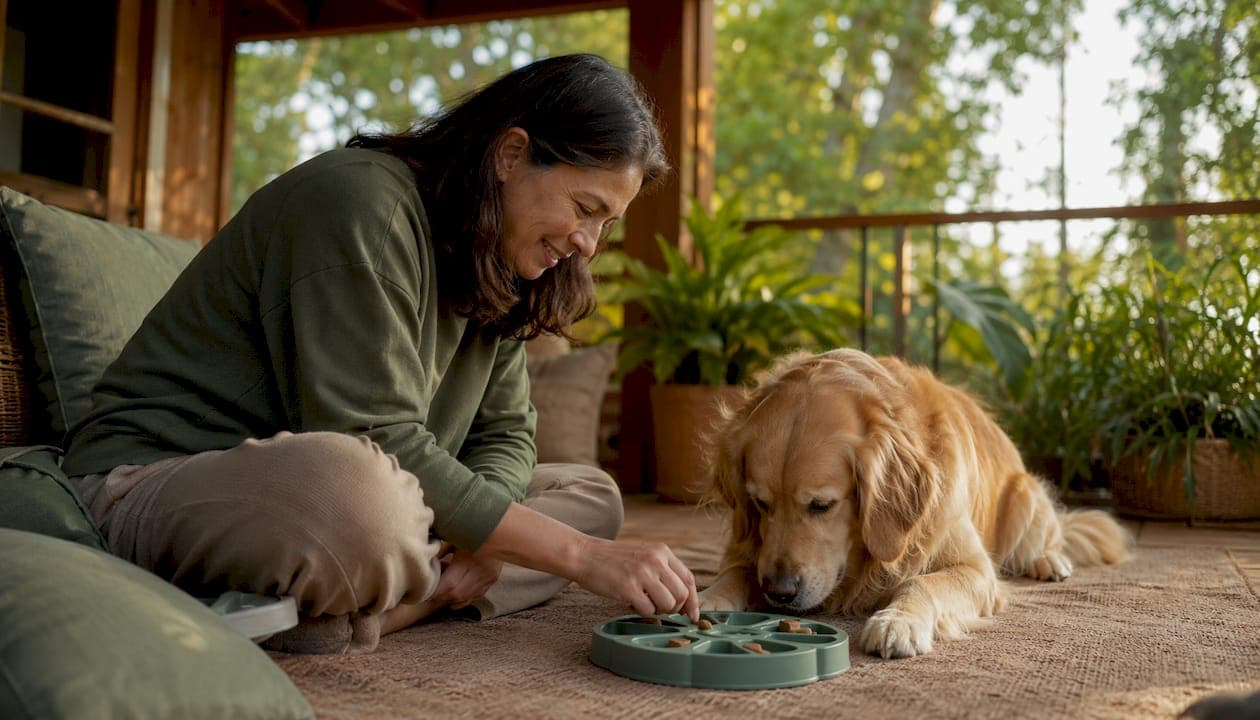
Why indoor mental stimulation is a neurobiological necessity for your dog
Mental stimulation for indoor dogs means deliberately engaging your dog's cognitive, sensory, and social faculties within the home. Think puzzle feeders, scent games, training sessions, and interactive play. Not entertainment. Not a bonus. Research from Puppy Longevity confirms that mental enrichment produces structural brain changes including increased dendritic branching, elevated BDNF, and greater synaptic density.
What that means practically: a dog lacking sufficient cognitive engagement is at risk of brain health decline. Its brain is being deprived of the stimulation it needs to stay healthy.
Key reasons mental stimulation matters indoors:
- Reduces chronic stress behaviors like pacing and repetitive barking, per Purdue University's enrichment research
- Slows cognitive decline in senior dogs through hippocampal neurogenesis
- Builds problem-solving skills and emotional resilience
- Supports behavioral flexibility and social confidence
- Breed and age shape how much stimulation a dog needs and what kind works best
Table of Contents
- The most effective types of indoor activities for dog brain games
- What science says about mental stimulation and your dog's brain
- How to build an effective indoor mental stimulation routine
- Choosing the right mental activities for your dog's health and lifestyle
- Signs your dog isn't getting enough mental stimulation
- Safety considerations for indoor mental activities
- Age and breed-specific mental stimulation needs
- Key Takeaways
The most effective types of indoor activities for dog brain games
Not all indoor activities are equal. A pilot study on enrichment activities for assistance dogs found that social and interactive activities produce greater behavioral improvements than food-based toys alone. That's worth sitting with: the Kong on the floor isn't doing as much as you think.
Here's what actually works, and why:
- Scent work and nose games. Olfactory tasks engage specialized brain regions tied to memory and cognition. Hide treats in muffin tins covered with tennis balls, scatter kibble in grass or a snuffle mat, or run a simple box-search game. These are low-cost and high-impact.
- Training new commands. Teaching a dog something it hasn't learned before requires sustained attention and working memory. Even five minutes of clicker training counts as serious cognitive work.
- Interactive play with you. Tug, fetch variations, and hide-and-seek with the owner activate social cognition in ways solo toys can't replicate.
- DIY dog puzzles. Muffin tin puzzles, cardboard box searches, and layered treat containers are easy to build and rotate. Novelty is the key variable; once a dog solves the same puzzle repeatedly, the cognitive benefit drops.
- Social enrichment. Purdue's research distinguishes social enrichment from basic socialization. It means ongoing, facilitated contact with humans and other dogs, not just occasional exposure.
- Environmental variety. Rotating surfaces (yoga mats, bubble wrap, textured rugs), introducing new sounds at low volume, and rearranging furniture occasionally all count as sensory enrichment.
- Long-lasting chews. During periods of social isolation, chews reduce stress and promote positive emotional states more effectively than food puzzles or smart feeders. They're not a replacement for active enrichment, but they serve a real function.
Pro Tip: Rotate your dog's puzzle toys on a weekly cycle. A toy that's been sitting out for three days has already lost most of its novelty value.
What science says about mental stimulation and your dog's brain
The neurobiological case for enrichment is solid. Mental challenges trigger measurable changes in brain structure, not just behavior. Elevated BDNF supports neuron survival. Increased synaptic density improves information processing. Hippocampal neurogenesis, the growth of new neurons in the memory center, has been documented in enriched animals across multiple species.
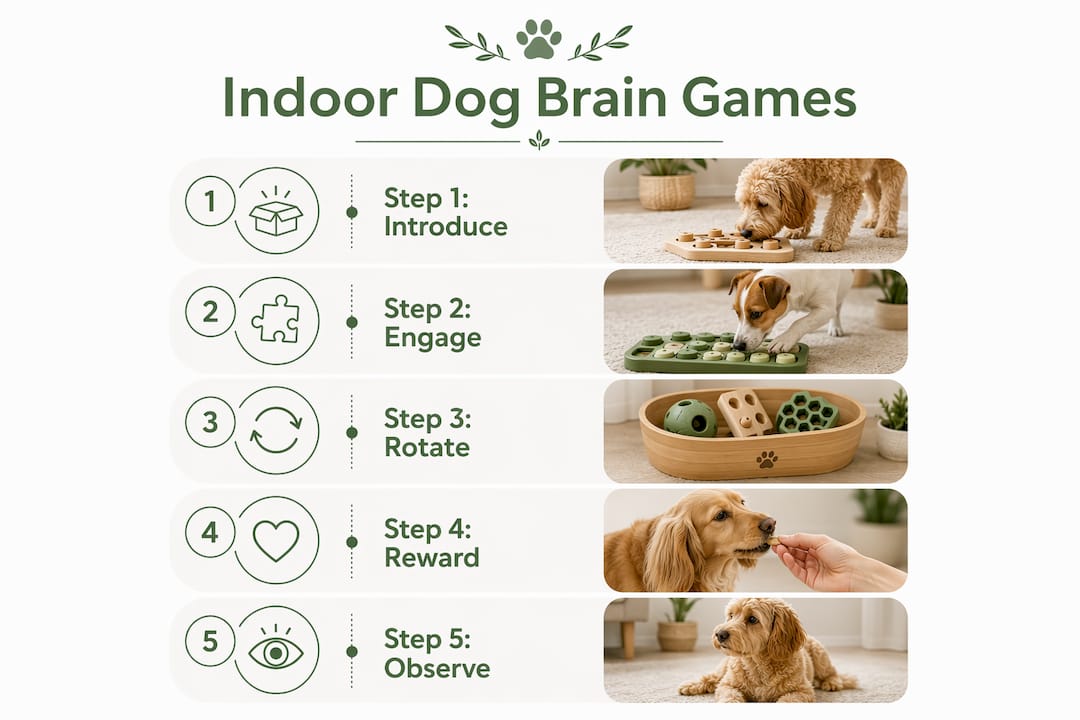
For aging dogs, the stakes are higher. Cognitive enrichment and human interaction show stronger neuroprotective effects than dog-to-dog socialization alone. Dogs that were regularly walked and trained scored better on cognitive function assessments than those with primarily canine social contact.
Behavioral benefits are equally well-documented:
- Reduced pacing, spinning, and other stereotypic behaviors
- Lower anxiety and improved stress coping
- Greater engagement with novel objects and environments
- Improved social behavior, particularly in dogs around age eight
Research published in Frontiers in Veterinary Science by Lugosi et al. (2026) found that lifetime sports engagement and joint activities with the owner had the strongest negative association with canine cognitive decline scores. Dogs engaged in lifetime sports and joint owner activities show notably better cognitive health than less active domestic dogs.
One more thing worth knowing: cognitive work tires dogs as much as physical exercise. A 20-minute training session can leave a high-drive dog as settled as a long run.
How to build an effective indoor mental stimulation routine
Structure matters more than intensity. Research supports daily mental enrichment broken into multiple short sessions rather than one long block. A dog's attention and motivation fluctuate, and shorter bursts keep engagement high.
A practical daily framework:
- Morning: Scatter feed breakfast instead of bowl-feeding. Takes two minutes to set up, engages foraging instincts immediately.
- Midday: 10-minute training session on a new or partially learned command.
- Afternoon: Puzzle toy or scent game. Rotate which one.
- Evening: Interactive play with you, tug or a hide-and-seek variation.
For senior dogs, simplify the complexity of puzzles and use higher-value food rewards to maintain motivation despite sensory or mobility changes. Neuroplasticity persists with age, but the approach needs to adapt. Shorter sessions, easier puzzles, and more owner involvement keep older dogs engaged without frustrating them.
Watch your dog's voluntary engagement. A dog that walks away from a puzzle isn't being stubborn. It's telling you something about the activity, the reward, or its current energy level. If avoidance or stress signals appear, stop and modify the approach rather than pushing through.
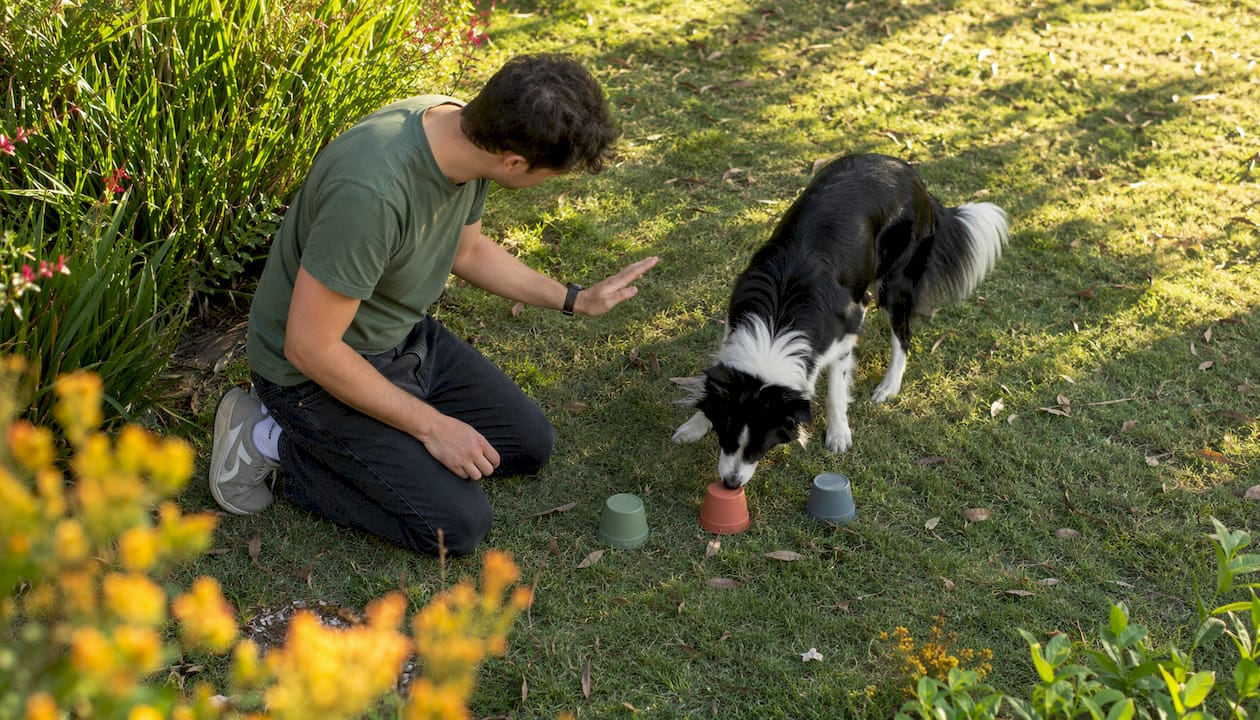
Pro Tip: Pair a cognitive task with a sensory element. Run a nose-work game right after a short training session. The combination of mental effort and olfactory engagement hits more brain systems simultaneously than either activity alone.
Choosing the right mental activities for your dog's health and lifestyle
Enrichment isn't one-size-fits-all, and health-conscious owners know that. The same logic that drives personalized nutrition applies here. A Border Collie needs different mental challenges than a Cavalier King Charles Spaniel, and a two-year-old dog has different needs than a ten-year-old.
Start by assessing your dog's personality and breed tendencies. Working breeds benefit from physical and mental challenges combined, while toy breeds and mixed breeds gain the most from owner-directed joint activities. If you have a working breed at home, the indoor behavior guide for working breeds is worth reading alongside this one.
Practical selection criteria:
- Match activity complexity to your dog's current skill level, not its breed reputation
- Integrate enrichment with feeding routines to distinguish hunger from boredom-driven behavior
- Use multi-sensory activities combining scent, touch, and social elements for the broadest cognitive benefit
- Adjust based on response: disinterest after repeated exposure means it's time to rotate, not repeat
- If your dog shows chronic stress, avoidance, or behavioral regression, consult a vet or certified behaviorist before adding more stimulation
Bowlful's approach to personalized nutrition, built on the veterinary RER formula, reflects the same principle: what works for one dog's body may not work for another's. Mental enrichment deserves the same individualized thinking. If you've noticed your dog eating out of boredom rather than hunger, bored dog eating habits often trace back to insufficient cognitive engagement during the day.
Signs your dog isn't getting enough mental stimulation
Behavioral problems are often misread as disobedience. Many of them are actually symptoms of cognitive deprivation. Purdue University's research is direct on this: limited mental exercise leads to frustration, chronic stress, and abnormal behaviors.
Watch for these signals:
- Destructive chewing on furniture, shoes, or household items, especially when the dog has access to its own toys
- Excessive barking or whining without an obvious trigger
- Pacing, spinning, or circling, which are classic stereotypic behaviors linked to unmet behavioral needs
- Attention-seeking that escalates, including nudging, pawing, or following you from room to room
- Hyperactivity indoors that doesn't resolve with physical exercise alone
- Overeating or food obsession that goes beyond normal hunger cues
A dog displaying several of these consistently isn't a "bad dog." It's a dog whose brain has more capacity than its environment is using.
Safety considerations for indoor mental activities
Mental enrichment done carelessly can cause stress rather than relieve it. A few non-negotiable precautions:
- Supervise chew use. Long-lasting chews are effective, but unsupervised access to certain types can cause choking or intestinal obstruction. Match chew size and hardness to your dog's size and chewing style.
- Never force engagement. If your dog avoids an activity or shows whale eye, lip licking, or yawning during a session, those are stress signals. Stop, give the dog space, and try a different activity another time.
- Avoid overstimulation. More enrichment isn't always better. A dog that's been through multiple high-intensity sessions in one day may show irritability or shutdown behavior. Watch for signs of fatigue.
- Check toy integrity regularly. Puzzle toys and DIY setups can develop sharp edges or small detachable parts. Inspect before each use.
- Adapt for health conditions. Dogs with vision loss, joint pain, or cognitive dysfunction syndrome need modified activities. A vet consultation before starting a new enrichment program is worth the time for any dog with a known health condition.
Age and breed-specific mental stimulation needs
Age and breed aren't just background details. They're the two variables that most directly shape what kind of enrichment actually works.
Puppies (under 12 months): Short sessions of 5–10 minutes maximum. Focus on socialization, basic command training, and novel object exposure. Cognitive circuits are still developing; overstimulation is a real risk.
Adult dogs (1–7 years): This is the window for the most varied and challenging enrichment. Scent work, advanced training, agility indoors, and complex puzzle rotations all fit here. High-drive working breeds need more daily volume than companion breeds.
Senior dogs (7+ years): Lugosi et al. (2026) found that joint activities with the owner had an especially strong protective effect against cognitive decline in toy breeds and mixed breeds as they aged. Simplify puzzle complexity, increase reward value, and prioritize owner interaction over solo enrichment. For nutritional support alongside cognitive care, aging dog supplement guidance covers what the research actually supports.
For holistic dog care that integrates mental, physical, and nutritional health, the principle is consistent: personalize the approach to the individual dog, not the breed stereotype.
Key Takeaways
Mental stimulation is a neurobiological requirement for dogs of every age, and the right indoor activities, matched to breed and life stage, produce measurable improvements in brain structure, behavior, and cognitive longevity.
| Point | Details |
|---|---|
| Mental enrichment changes brain structure | Enrichment increases dendritic branching, synaptic density, and BDNF, supporting long-term cognitive health. |
| Social and interactive activities outperform food toys | Social and interactive activities, particularly owner-led and playhouse enrichment, produce greater behavioral improvements than food-based toys alone. |
| — | Short, varied sessions across the day sustain engagement better than one long block. |
| Breed and age determine what works | Working breeds need physical and mental challenges combined; toy and mixed breeds benefit most from owner interaction. |
| Stress signals mean stop, not push | Avoidance or stress during enrichment is a signal to modify the activity, not repeat it. |