
How to calculate your Labrador's daily calorie needs
A Labrador calorie calculator runs on one foundational formula used by veterinary nutritionists: RER = 70 × (weight in kg)^0.75. That gives you the Resting Energy Requirement, the calories your dog burns just keeping organs running. From there, a multiplier scales up for real life.
Here's what the math looks like for a typical adult Lab. A 60-pound (27.2 kg) neutered dog has an RER of roughly 400–700 calories at rest. Multiply by 1.6 for a neutered adult at moderate activity to estimate daily calorie needs. That number covers everything: bowl, treats, dental chews, the cheese around pill time.
Multipliers by life stage and activity:
- Puppy under 4 months: 3.0× RER
- Puppy 4–12 months: 2.0× RER
- Neutered adult (moderate): 1.6× RER
- Intact adult (moderate): 1.8× RER
- Active or sporting Lab: 2.0–2.5× RER
- Senior (8+ years): 1.1–1.4× RER
- Weight loss target: 1.0× RER (sized to ideal weight)
Pro Tip: Convert your dog's weight to kilograms first (pounds ÷ 2.205) before running the formula. A small error here compounds through every multiplier.
Why weight and body condition score both matter

Raw weight alone doesn't tell the full story. A 70-pound Lab who's lean and muscular has different calorie needs than a 70-pound Lab carrying extra fat, even though the scale reads the same. That's where Body Condition Score (BCS) comes in.
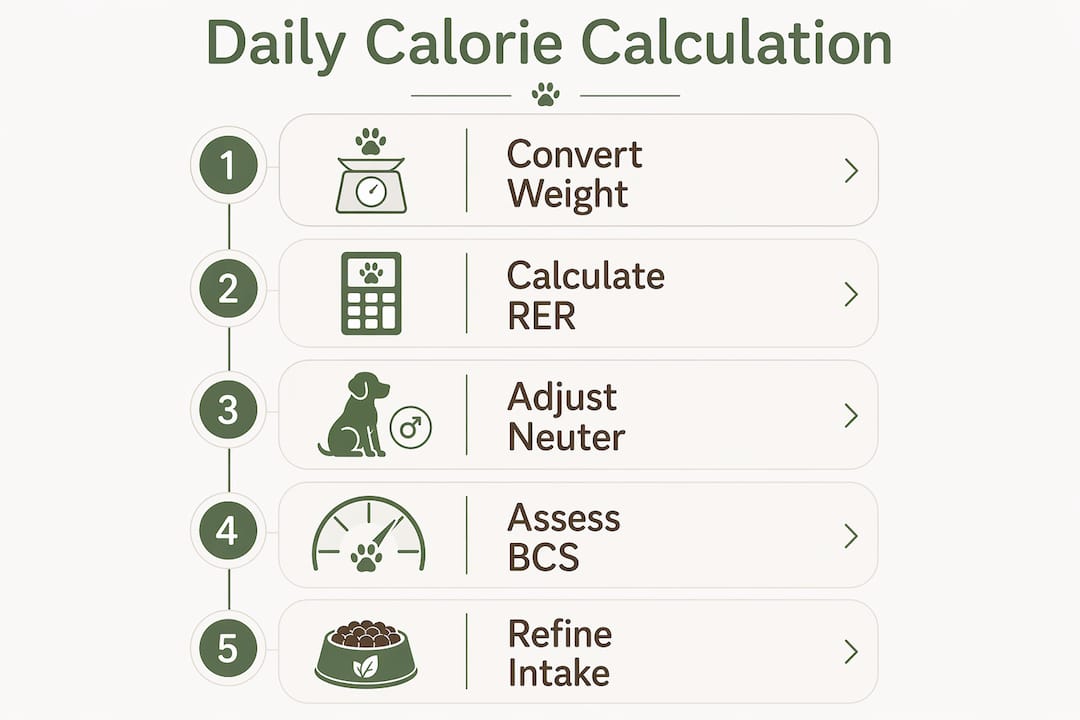
BCS runs on a 1–9 scale. A score of 4–5 is ideal: you can feel the ribs with light pressure, and the dog shows a visible waist from above. At BCS 6 or higher, the dog is already overweight, and feeding maintenance calories will hold the wrong weight in place. At BCS 3 or below, the dog needs more food, not less.
How to assess BCS at home:
- Run your hands along the ribcage. You should feel ribs without pressing hard.
- Look down at your dog from above. A visible waist tuck behind the ribs is a good sign.
- View from the side. A slight abdominal tuck (belly rising toward the hind legs) is normal.
- Monthly weigh-ins catch drift early, before it becomes a problem.
Labs carry a documented POMC gene variant that makes them unusually food-motivated and prone to weight gain. Measuring portions matters more for this breed than for most.
How neutering changes your Lab's calorie needs
Spaying or neutering reduces a dog's metabolic rate, and the calorie difference is real. Neutered dogs typically need 10–25% fewer calories than intact dogs of the same size and activity level. Veterinary guidelines reflect this with specific multipliers: 1.6× RER for neutered adults, 1.8× RER for intact adults.
Veterinary note: A neutered 60-pound Lab eating at the intact multiplier (1.8×) would consume roughly 170 extra calories daily. Over a year, that adds up to meaningful, preventable weight gain.
Skipping neuter status in a dog nutrition calculator is one of the most common reasons feeding estimates run high. Always input the correct status before trusting the output.
How to interpret your calculator results and adjust over time

A calorie number from any calculator is a starting point, not a prescription. Individual needs can vary 30–50% from calculated values due to metabolism, muscle mass, and breed traits. The number tells you where to begin; your dog's body tells you whether it's working.
Practical steps for adjusting feeding:
- Start with the calculated daily target and feed it consistently for 4–6 weeks.
- Cap treats at 10% of total daily calories. That's about 134 calories on a 1,335-calorie day, roughly one mid-size training treat plus a small snack.
- Reassess BCS monthly. If the score rises, reduce the bowl by 10%. If it drops below 4, add a small amount back.
- Always use the kcal-per-cup number on your food bag, not the bag's feeding chart. Charts don't account for your dog's body condition or neuter status.
- For Labs at BCS 6+, size calories to the target weight, not today's weight.
Lean-fed dogs tend to live longer. Research cited by Bowlful shows lean-fed pets may live 1.8 years longer on average, which puts the effort of accurate portioning in clear perspective.
Bowlful's approach to personalized Labrador nutrition
Bowlful builds feeding plans on the same RER formula veterinarians use, then layers in breed, weight, neuter status, life stage, and activity level through an interactive quiz. The result is a personalized daily calorie target, not a generic bag chart.
| Factor | How Bowlful uses it |
|---|---|
| Weight (kg) | Base for RER calculation |
| Neuter status | Adjusts multiplier (1.6 vs. 1.8) |
| Life stage | Puppy, adult, or senior multiplier |
| Activity level | Scales from sedentary to working |
| BCS | Flags weight-loss vs. maintenance goal |
Pro Tip: Use Bowlful's quiz before your next vet visit. Arriving with a calculated daily target and your dog's current BCS gives your vet a concrete starting point for any feeding conversation.
Bowlful also draws on puppy nutrition research to calibrate life-stage multipliers, so the plan adjusts as your Lab moves from rapid growth into adulthood and eventually into the senior years.
Key Takeaways
Accurate Labrador calorie management starts with the RER formula, then adjusts for neuter status, life stage, BCS, and activity level over time.
| Point | Details |
|---|---|
| RER formula | Calculate 70 × (weight in kg)^0.75, then multiply by the right life-stage factor. |
| Neuter status matters | Neutered Labs need 10–25% fewer calories; use a 1.6× multiplier, not 1.8×. |
| BCS over the scale | Monthly BCS checks tell you whether to adjust the bowl up or down. |
| Treat budget | Cap treats at 10% of daily calories to keep the rest of the diet balanced. |
| Bowlful | Bowlful's interactive quiz builds a personalized feeding plan using the veterinary RER formula. |
Bowlful gives your Lab a feeding plan built for them
Generic bag charts were written for an average dog. Your Lab isn't average. Bowlful's personalized feeding plans are built on the same RER formula veterinary nutritionists use, then refined by your dog's actual weight, neuter status, life stage, and activity level. The result is a daily calorie target your dog can actually thrive on, not a rough estimate that ignores half the variables.
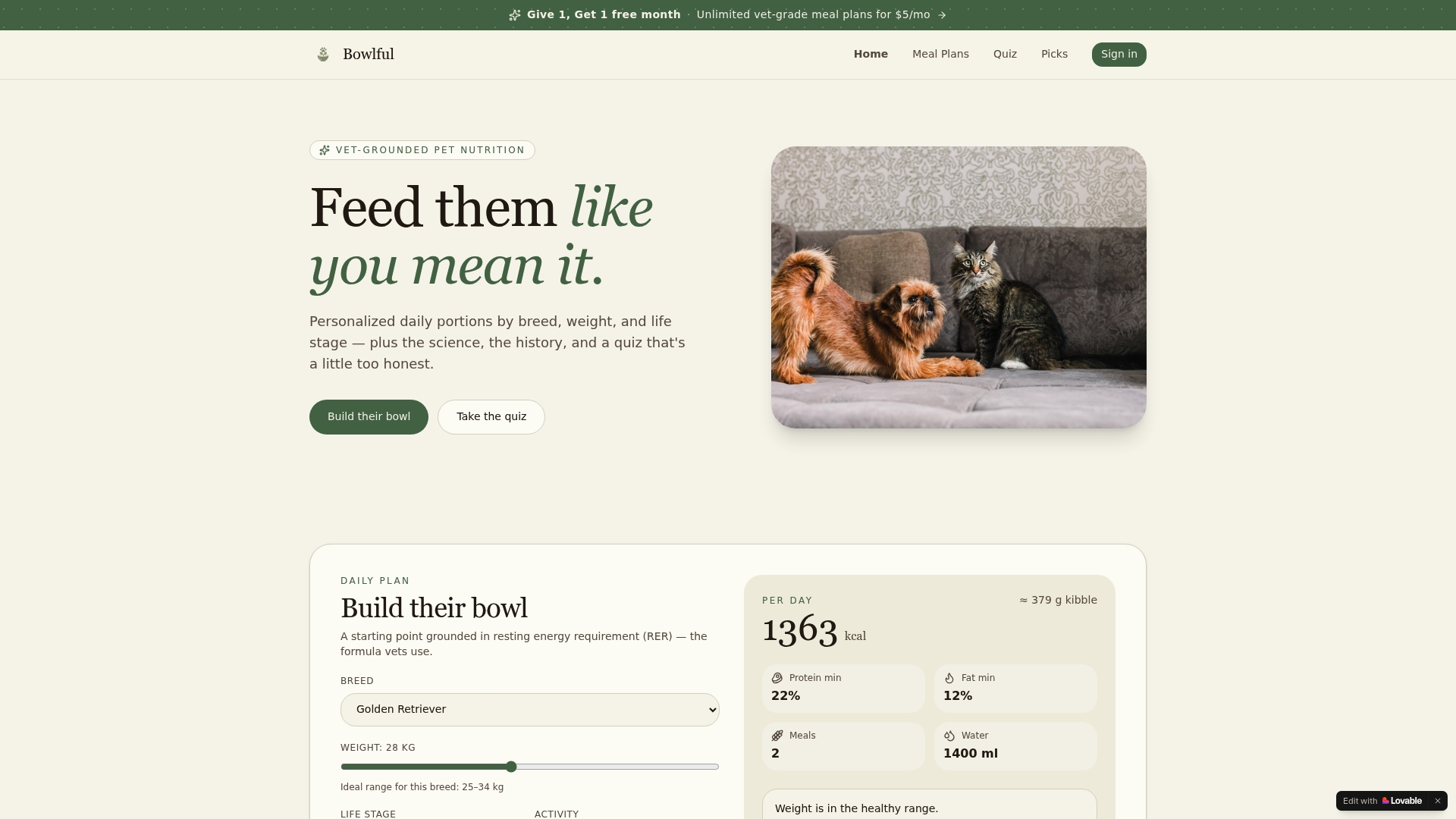
Labs are prone to weight gain in ways most breeds aren't. Getting the numbers right from the start is the single most effective thing you can do for your dog's long-term health. Take Bowlful's personalized nutrition quiz and get a feeding plan your Lab's body will thank you for.