
A puppy growth calculator predicts your dog's adult size by analyzing current weight, age, breed size category, and optionally parent weights using veterinary-validated growth curves. This is not a guessing tool. It applies the same size-based growth curve methods that veterinarians use to estimate where your puppy is headed, giving you a weight range rather than a single number. That range helps you plan nutrition, set exercise expectations, and catch growth problems early. The standard industry term for this approach is "growth curve modeling," and the calculator is simply the owner-friendly version of it.
What inputs does a puppy growth calculator need?
The accuracy of any puppy weight calculator depends entirely on the quality of data you put in. Four core inputs drive the prediction: current age in weeks, current weight, breed size category (toy, small, medium, large, or giant), and optionally the weights of both parents. Each input narrows the confidence band around the final estimate.
The four essential inputs are:
- Current age in weeks. Use exact weeks, not months. A 10-week-old puppy and a 12-week-old puppy are at very different growth stages.
- Current weight. Weigh your puppy on a consistent scale right before a meal for the most reliable reading.
- Breed size category. This is the single biggest driver of the growth curve shape. Toy breeds follow a steep early curve; giant breeds grow slowly over a much longer window.
- Parent weights (optional but valuable). Multi-method growth prediction incorporating AKC breed standards, vet-measured growth curves, and parent weights improves accuracy notably over single-formula methods.
Timing matters as much as the inputs themselves. Predictions are most accurate between 8–20 weeks for toy, small, and medium breeds, and between 12–26 weeks for large and giant breeds. Outside those windows, confidence bands widen considerably. A puppy younger than 8 weeks or one with unknown mixed-breed parentage will produce a wider range, and that is honest math, not a calculator flaw.
Pro Tip: If your puppy is a mixed breed, enter the size category of the larger parent breed. This tends to produce a more conservative, safer upper-bound estimate for planning purposes.
How do you interpret growth calculator results?
Calculator outputs are best treated as planning ranges, not precise targets. Growth calculators emphasize a weight range rather than a single number, and that range reflects real biological variation between individual dogs of the same breed. A Labrador Retriever predicted to reach 60–75 lbs is not a broken estimate. It is an honest reflection of how much variation exists even within a single breed.
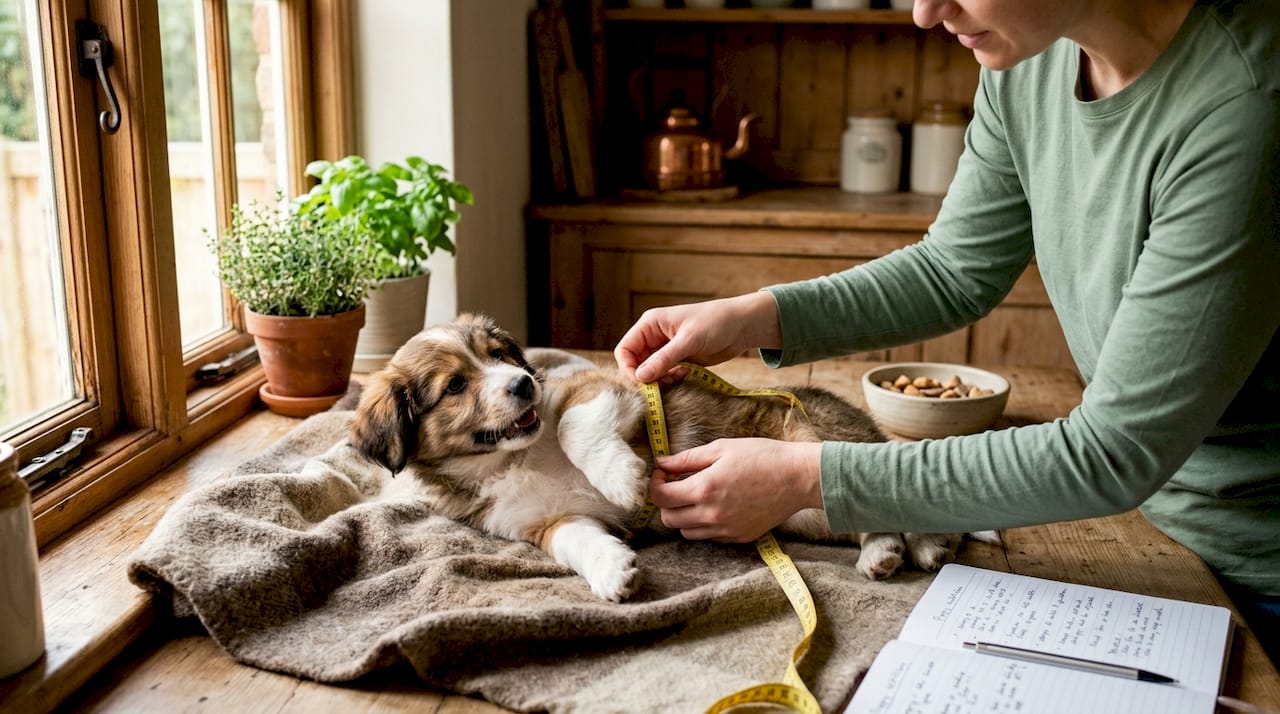
Physical growth signs give you a second layer of information that no calculator can provide. The body condition score (BCS), a 9-point veterinary scale, measures fat coverage over the ribs and spine. A puppy at a healthy BCS of 4–5 out of 9 has ribs you can feel but not see, a visible waist from above, and an abdominal tuck from the side. Weight alone does not tell you that.
Physical indicators to watch alongside your weight tracker:
- Paw size relative to body. Oversized paws on a young puppy often signal more growth ahead, though the "big paws" theory is unreliable as a standalone predictor.
- Body proportion. A puppy that looks leggy and uncoordinated is often in an active growth phase. Proportions even out as muscle mass develops.
- Weight plateaus. A brief plateau followed by a growth spurt is normal. A plateau lasting more than two weeks in a young puppy warrants a vet check.
Tracking body condition score alongside weight prevents two common problems: overconditioning (too much fat) and undernutrition. Both are easier to correct early than after they become established patterns.
Pro Tip: Take a photo of your puppy from above and from the side every two weeks. Visual documentation catches body shape changes that a number on a scale can miss.
How to measure and track your puppy's growth step by step
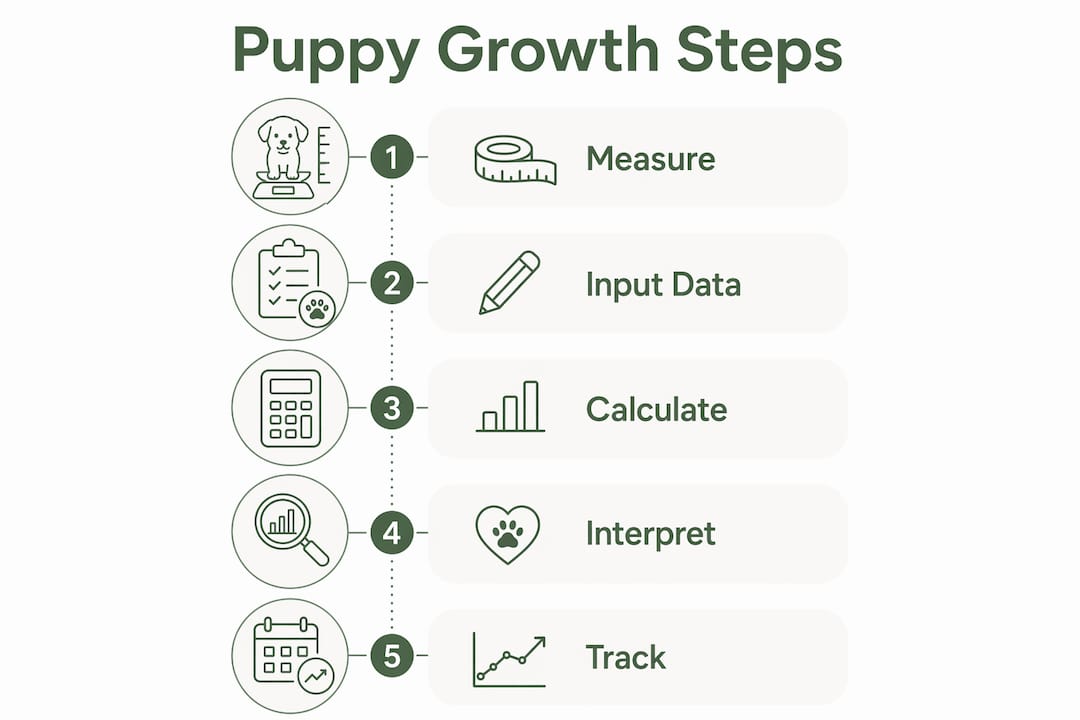
Consistent measurement technique matters more than the precision of any single reading. Trend analysis is more critical than any one data point, which means your goal is a reliable series of numbers, not a perfect single measurement.
- Choose the right scale. Use a gram-precision kitchen scale for neonates and toy breeds. For medium and large breeds, a bathroom scale works: weigh yourself, then weigh yourself holding the puppy, and subtract.
- Weigh at the same time every day or week. Morning, before the first meal, is the most consistent window. Food and water weight can add meaningful variance in small puppies.
- Log every measurement. A simple spreadsheet with date, weight, and a notes column (vaccinations, diet changes, illness) gives you a growth trend you can actually read.
- Apply the right frequency. Weigh neonates daily for the first two weeks. Move to weekly measurements from week 3 onward. Monthly checks are sufficient after 6 months for most breeds.
- Calculate daily gain percentage for young puppies. Divide the weight gained by the starting weight, then multiply by 100. Healthy puppies gain 5–10% of body weight daily in the first two weeks and should double their birth weight by day 10.
Stat to know: Daily weight gain tapers to 1–3% between weeks 4–8. A puppy consistently below that range in the first two weeks needs veterinary attention promptly.
That 5–10% daily gain benchmark is the most important number in early puppy care. Missing it for two or more consecutive days is a clinical signal, not a minor variation.
Pro Tip: Color-code your spreadsheet. Green for on-track gain, yellow for borderline, red for below threshold. You will spot problems at a glance instead of doing mental math at 6 AM.
Common mistakes when using a puppy size predictor
The most common error is relying on a single measurement or a simple rule of thumb. The "double weight at 4 months" formula is widely repeated but consistently unreperforms with large and giant breeds. The most accurate predictions combine breed-specific growth curves, linear extrapolation, and parent weight data. Single-rule methods often produce errors large enough to affect feeding plans.
A second mistake is treating a wide confidence band as a failure. Veterinary experts recommend using growth prediction as a flexible guide rather than a rigid forecast, with wide ranges reflecting biological variability. If a calculator tells you your puppy will weigh 55–80 lbs as an adult, that is useful planning information. It tells you to buy a large-breed crate, feed a large-breed formula, and budget for large-breed vet costs.
"Seek veterinary advice if your puppy shows persistent weight loss exceeding 10% of body weight, or if growth deviates significantly from the expected range for its breed size category. Early intervention prevents small problems from becoming serious ones."
Watch for these specific pitfalls:
- Skipping the breed size category input. Using "medium" for a breed that is actually large will shift the growth curve and produce an underestimate.
- Weighing inconsistently. Switching between a kitchen scale and a bathroom scale mid-tracking introduces errors that distort your trend line.
- Overfeeding large breeds to "help them grow." Excessive rapid growth in large and giant breeds increases the risk of orthopedic disease, including hip dysplasia and osteochondrosis. Controlled nutrition guided by growth monitoring is the safer path.
Growth completion timelines also vary more than most owners expect. Toy breeds finish growing around 9–10 months, medium breeds around 12–15 months, and giant breeds not until 18–24 months. Feeding a giant-breed puppy an adult formula at 12 months is premature. The puppy growth stage nutrition requirements shift significantly across those windows.
Key Takeaways
A puppy growth calculator gives you the most reliable adult size estimate when you combine breed-specific growth curves, consistent weight tracking, and physical condition scoring across the full growth window.
| Point | Details |
|---|---|
| Use the right age window | Predictions are most accurate between 8–20 weeks for small breeds and 12–26 weeks for large breeds. |
| Add parent weights when possible | Multi-method inputs including parent weights improve accuracy over single-formula approaches. |
| Track trends, not single readings | Daily gain of 5–10% in the first two weeks is the key benchmark; consistent logging reveals problems early. |
| Read results as a range | Wide confidence bands reflect real biological variation, not calculator error. Plan around the full range. |
| Watch body condition score | BCS alongside weight prevents overconditioning and undernutrition, especially in large and giant breeds. |
What I've learned from watching owners use growth data
Most new puppy owners I talk to make the same mistake: they treat the calculator number as a verdict. They see "predicted adult weight: 65 lbs" and immediately start adjusting food portions to hit that exact target. That is the wrong way to use the tool.
The calculator is a compass, not a GPS. It tells you the general direction of your puppy's growth, not the exact destination. I have seen owners of Golden Retrievers panic when their puppy tracked toward the low end of the predicted range at 14 weeks, only to hit the midpoint perfectly by 6 months. Growth is not linear. It comes in spurts, plateaus, and occasional backslides after illness or stress.
What actually works is building a habit around the data. Weigh weekly, log it, and look at the trend over a month rather than reacting to each individual reading. Pair that with a monthly body condition score check, and you have a genuinely useful picture of your puppy's health. The dog weight chart by breed is a useful reference for understanding where your puppy sits relative to breed norms at each age.
The other thing I would tell every new owner: size anxiety is real, but it rarely helps the puppy. A puppy that is slightly smaller than predicted at 12 weeks is not necessarily unhealthy. A puppy that is consistently losing weight week over week is a problem. Learn to tell the difference, and you will spend a lot less time worrying and a lot more time enjoying the dog in front of you.
— Robert
Bowlful's tools for puppy feeding and growth planning
Tracking your puppy's growth is only half the picture. The other half is making sure the food you give actually matches where your puppy is in its development.
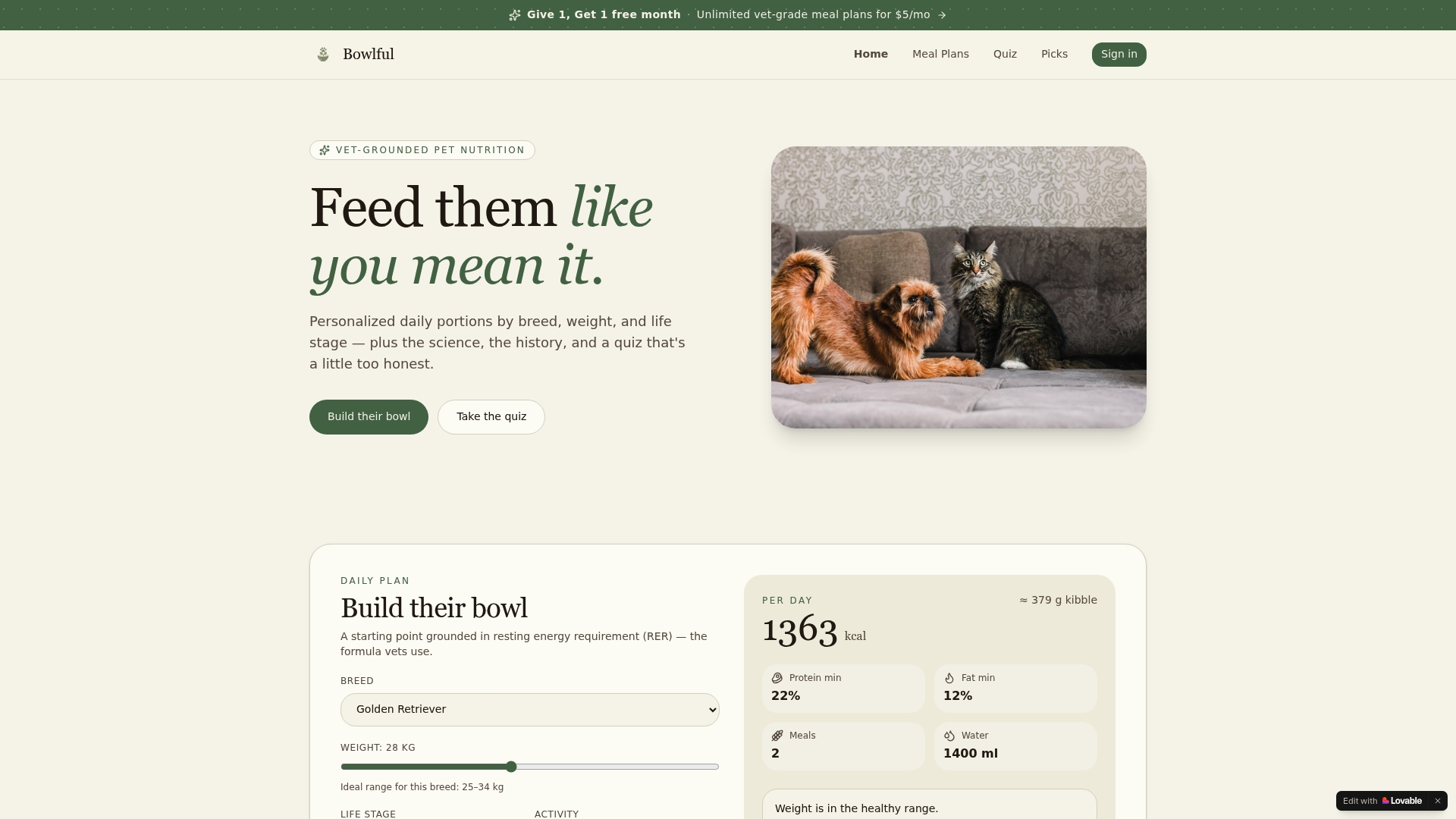
Bowlful builds feeding plans around the Resting Energy Requirement (RER) formula, the same calculation veterinarians use to determine how many calories a dog actually needs at a given weight and life stage. The puppy feeding calculator by breed on Bowlful's blog walks you through how breed size and age affect portion sizes in concrete terms. For owners who want to go deeper, the guide on essential nutrients for puppies covers what growing dogs need at each stage. Visit Bowlful.org to find the full suite of puppy care tools built around real veterinary science.
FAQ
What is a puppy growth calculator?
A puppy growth calculator is a tool that uses your puppy's current age, weight, and breed size category to estimate its adult weight using veterinary growth curves. It produces a weight range rather than a single number to reflect natural biological variation.
How accurate is a puppy weight calculator?
Predictions achieve roughly ±10–15% accuracy for known breeds when measurements are taken during the optimal age window of 8–20 weeks for small breeds and 12–26 weeks for large breeds. Mixed-breed puppies and those outside these windows have wider confidence bands.
When do puppies stop growing?
Toy breeds finish growing around 9–10 months, medium breeds around 12–15 months, and giant breeds not until 18–24 months. Feeding and exercise plans should reflect these different timelines.
Can I use a growth tracker for a mixed-breed puppy?
Yes, but expect a wider prediction range. Using the size category of the larger parent breed and adding parent weights when known improves the estimate. Continuous weight tracking matters more than the initial prediction for mixed breeds.
What daily weight gain is healthy for a newborn puppy?
Healthy newborn puppies gain 5–10% of their body weight daily in the first two weeks and should double their birth weight by day 10. Consistent gains below that range are a signal to contact a veterinarian.