
A puppy feeding calculator by breed is a tool that determines daily food portions based on your puppy's breed size, current weight, age, and the caloric density of their food. Generic bag instructions fail most puppies because a Chihuahua and a Great Dane have almost nothing in common nutritionally. Getting portions right from the start protects your puppy from obesity, skeletal problems, and dangerous blood sugar crashes. Bowlful's approach to this problem uses the Resting Energy Requirement (RER) formula, the same method veterinarians rely on, to build a feeding plan that fits your specific dog.
How does breed size affect puppy feeding recommendations?
Breed size is the single biggest variable in any puppy diet calculator. A toy breed puppy matures in 8–10 months, while a large breed puppy takes 18–24 months to reach full size. That difference in growth timeline changes everything: calorie targets, meal frequency, protein levels, and mineral ratios all shift depending on where your puppy falls on the size spectrum.
Meal frequency is the most urgent concern for small dogs. Toy breeds need 4–5 meals daily until 6 months old to prevent acute juvenile hypoglycemia, a genuine medical emergency caused by rapid glycogen depletion. Standard veterinary guidelines recommend four meals daily under 12 weeks, dropping to three meals from 3–6 months, then two meals after 6 months for most breeds.
Large breed puppies face the opposite risk. Overfeeding accelerates bone growth faster than joints can handle, leading to orthopedic diseases. Large breed puppies require calcium between 0.8–1.2% of dry matter, with a calcium-to-phosphorus ratio of 1.0–1.5:1. Excess calcium from supplements causes harm even when the base diet is balanced, so adding supplements without veterinary guidance is a mistake.
Here is a quick breakdown by breed size category:
- Toy breeds (under 10 lbs adult weight): 4–5 meals daily until 6 months; high calorie density per ounce; hypoglycemia prevention is the top priority
- Small breeds (10–25 lbs adult weight): 3–4 meals daily until 6 months; special food formulations support their faster metabolism
- Medium breeds (25–50 lbs adult weight): 3 meals daily until 6 months, then 2; standard puppy protein targets apply
- Large breeds (50–100 lbs adult weight): 3 meals daily until 6 months; controlled calcium and phosphorus ratios are non-negotiable
- Giant breeds (over 100 lbs adult weight): 3 meals daily for longer; growth-formulated food until 18–24 months
Pro Tip: Never supplement a large breed puppy's diet with extra calcium or phosphorus unless a veterinarian specifically prescribes it. Balanced large-breed puppy food already hits the correct mineral ratios.
What inputs should a puppy feeding calculator by breed include?
An accurate puppy diet calculator needs more than just your dog's weight. Missing even one variable produces a portion estimate that is too high or too low by a meaningful margin.
- Expected adult weight and breed size category. This determines whether your puppy follows a toy, small, medium, large, or giant breed feeding curve. If you have a mixed-breed puppy, use the average adult weight of the dominant breed or ask your vet for an estimate.
- Current weight and age. These two inputs together tell the calculator where your puppy sits in their growth curve. A 10-week-old and a 5-month-old of the same breed need very different calorie amounts even at the same current weight.
- Caloric density of the chosen food. Every puppy food has a different energy density, measured in kilocalories per cup or per kilogram. Feeding calculators adapt for differing food energy densities, so you must verify the exact figure from the food packaging, not a generic estimate.
- Activity level. A puppy attending daily training classes burns more calories than one resting after a neuter surgery. Activity multipliers applied to the base RER formula account for this difference.
- Individual metabolic rate. Two puppies of the same breed and weight can have meaningfully different metabolisms. Body condition scoring, done weekly, catches the puppies who need more or less than the calculator's starting estimate.
Puppies require protein between 22–32% of dry matter, with large breeds sitting toward the lower end of that range to support controlled, steady growth. Knowing your food's protein percentage helps you confirm the food matches your puppy's breed size needs before you even open the bag.
How to use a puppy feeding calculator step by step
Using a breed-specific feeding calculator correctly takes about five minutes the first time. The process becomes faster once you have your puppy's baseline numbers.
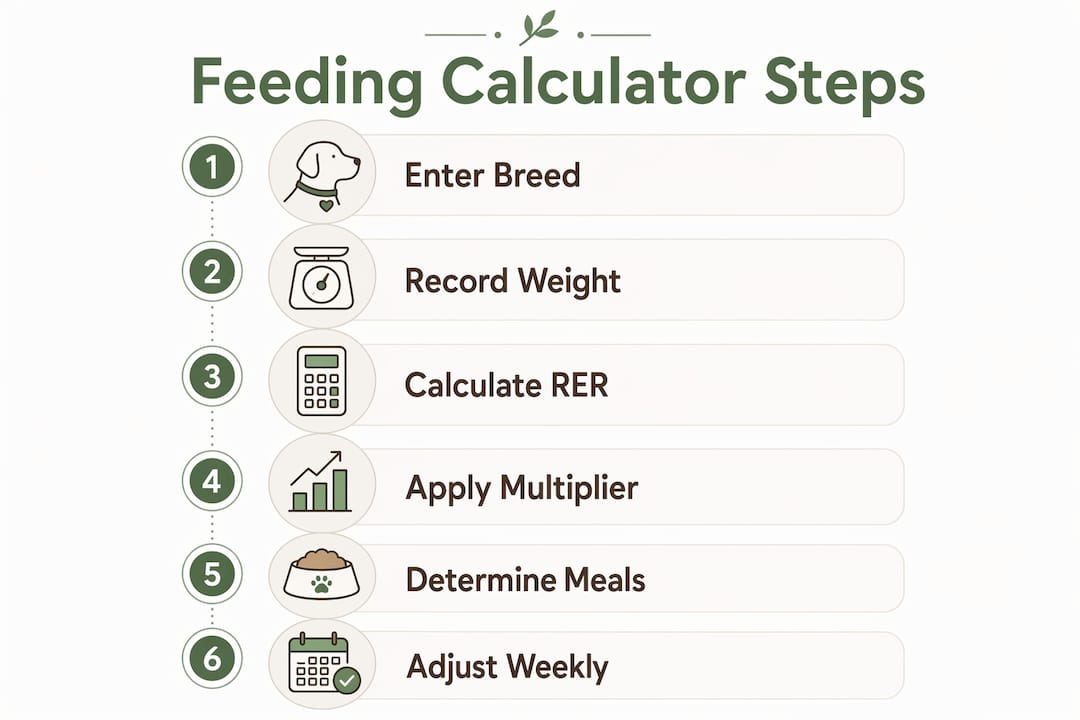
- Determine your puppy's expected adult weight. Check your breed's standard adult weight range from a reliable source like the American Kennel Club. For mixed breeds, estimate based on the size of both parents if known.
- Enter current weight and age. Weigh your puppy on a kitchen scale or at the vet. Use exact figures, not estimates. A half-pound difference at 8 weeks matters more than it sounds because the calculator uses this to place your puppy on the correct growth curve.
- Find the caloric density of your chosen food. Look for "kcal/cup" or "kcal/kg" on the food packaging or the manufacturer's website. This number varies widely between brands and even between formulas from the same brand.
- Run the RER calculation. The RER formula is: 70 × (body weight in kg)^0.75. The result is the base calorie need at rest. A growth multiplier, typically 2.0 for most puppies, is then applied to account for the energy demands of development.
- Divide daily calories into meals. Use the meal frequency appropriate for your puppy's breed size and age. A 10-week-old toy breed puppy gets that daily calorie total split across four or five small meals. A 7-month-old Labrador gets it split across two.
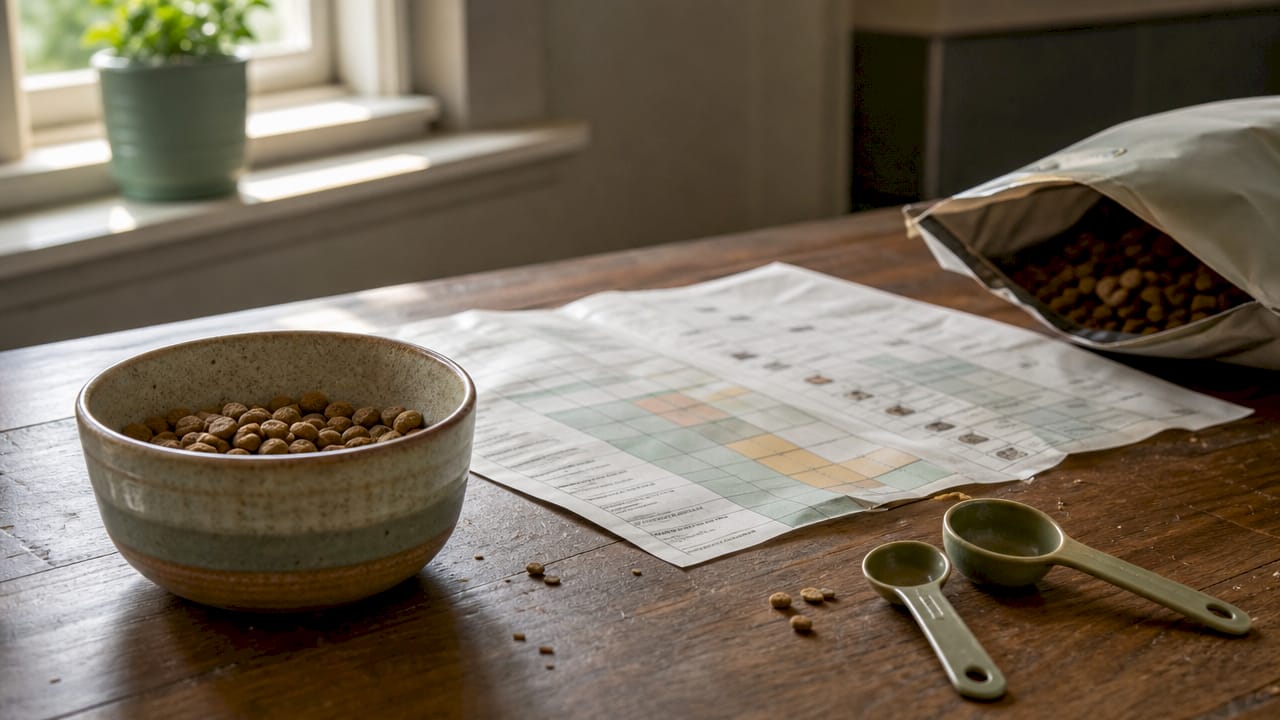
- Measure portions by weight, not volume. Cups are inconsistent. A loosely packed cup and a tightly packed cup of the same kibble can differ by 20% or more. A kitchen scale removes that error entirely.
Pro Tip: Weigh your puppy every week for the first six months and log the numbers. A growth curve that flattens or spikes tells you to adjust portions before a problem develops.
The puppy feeding amounts by age shift noticeably at 3 months, 6 months, and again at the point of maturity. Revisit your calculator inputs at each of those milestones rather than waiting for a vet visit to catch a mismatch.
Common mistakes when using a puppy feeding calculator
The most common error new owners make is treating the feeding chart on the food bag as a fixed rule. Bag charts are rough starting points, not personalized prescriptions. They are calibrated for an average dog at an average activity level, which describes almost no individual puppy accurately.
"Feeding charts on food packaging should be used as a base reference and adjusted by weekly body condition scoring. Regular adjustment is the key to healthy growth, especially during growth spurts." — Banfield Pet Hospital
Treats are a hidden source of overfeeding. Treats should not exceed 10% of a puppy's daily calorie intake. The practical fix is simple: subtract treat calories from the daily kibble portion. Use low-calorie training treats or pull pieces directly from the daily kibble allotment during training sessions.
Breed-specific risks also change how you feed, not just how much. Labrador obesity and German Shepherd bloat risk influence feeding method and food composition. Bloat-prone breeds benefit from slow-feeder bowls and smaller, more frequent meals rather than one large serving. Kibble size matters too: toy breed puppies can struggle with large kibble pieces designed for bigger dogs.
- Watch for these warning signs that portions need adjusting:
- Ribs that are impossible to feel under the coat (overfeeding)
- Ribs that are sharply visible with no fat cover (underfeeding)
- Sudden weight gain or loss between weekly weigh-ins
- Low energy or lethargy not explained by illness
- Loose stools persisting more than two days after a food transition
Call your veterinarian when body condition scoring shows consistent problems despite adjustments, when growth stalls, or when a toy breed puppy shows signs of hypoglycemia such as trembling or weakness. A veterinary nutritionist can build a fully customized plan when standard calculators fall short.
The dog feeding frequency guidelines are also worth reviewing as your puppy ages, since the transition from three meals to two is a common point where owners accidentally underfeed or overfeed by keeping the old total rather than recalculating.
Key takeaways
A breed-specific feeding calculator using the RER formula, combined with weekly body condition scoring, is the most reliable method for feeding a puppy correctly from week one through maturity.
| Point | Details |
|---|---|
| Breed size drives meal frequency | Toy breeds need 4–5 meals daily until 6 months; large breeds need 3 meals with controlled calcium. |
| RER formula is the foundation | Calculate 70 × (weight in kg)^0.75, then apply a growth multiplier to get daily calorie needs. |
| Bag charts are starting points | Adjust portions weekly based on body condition scoring, not just the food packaging estimate. |
| Treats count toward daily calories | Keep treats under 10% of daily intake and subtract them from the kibble portion. |
| Revisit inputs at key milestones | Recalculate at 3 months, 6 months, and breed maturity to keep portions accurate as your puppy grows. |
Why breed-specific feeding calculators changed how I think about puppy nutrition
Most new owners I talk with assume the bag tells them everything they need to know. That assumption is understandable. The bag is right there, the instructions look official, and nobody wants to do math when they have a new puppy demanding attention. But the bag was written for a statistical average dog, and your puppy is not average.
What I have seen repeatedly is that owners who use a breed-specific calculator from day one avoid the two most common problems: the pudgy Labrador at 9 months and the underweight toy breed that keeps having energy crashes. Both outcomes are preventable with the right starting numbers.
The part that surprises most people is how much the food itself changes the equation. Two puppy foods can have the same protein percentage but wildly different calorie densities. Switching brands without recalculating portions is one of the fastest ways to accidentally overfeed a puppy who was previously on track.
Body condition scoring is the skill I wish every new owner learned in week one. You do not need a vet visit to run it. You run your hands along your puppy's ribs and spine weekly. The feedback is immediate and honest in a way that a scale number alone is not. A calculator gives you the starting number. Body condition scoring tells you whether that number is working for your specific dog.
The puppy growth stage nutrition guide is a resource I point new owners toward because it connects the calculator outputs to the biological reality of what is happening inside a growing puppy. Numbers make more sense when you understand what they are supporting.
— Robert
Bowlful's feeding calculator is built for your puppy's breed
Bowlful uses the RER formula to build a personalized feeding plan based on your puppy's breed, current weight, and life stage. The process starts with a short interactive quiz that takes less than two minutes to complete.
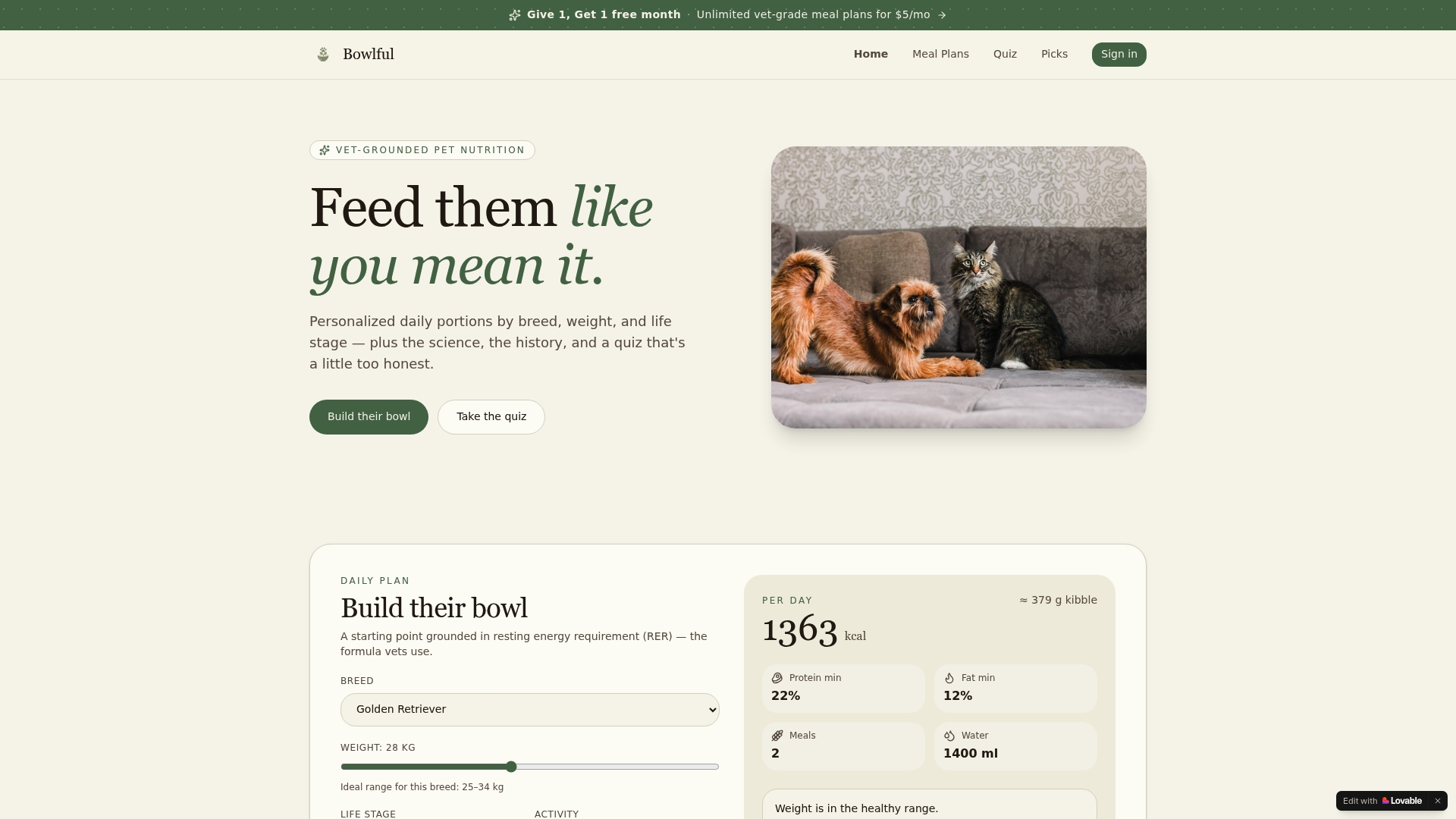
Every plan Bowlful generates accounts for breed-specific calorie targets, meal frequency by age, and the caloric density of your chosen food. Lean-fed pets may live 1.8 years longer, and that outcome starts with getting daily portions right from the beginning. Visit Bowlful's puppy feeding calculator to get a plan built around your puppy's actual needs, not a generic chart.
FAQ
How often should I feed my puppy by breed size?
Puppies under 12 weeks need four meals daily, dropping to three meals from 3–6 months, then two meals after 6 months. Toy breeds need 4–5 meals daily until 6 months to prevent hypoglycemia.
What is the RER formula used in puppy feeding calculators?
RER stands for Resting Energy Requirement, calculated as 70 × (body weight in kg)^0.75. A growth multiplier is then applied to this base figure to determine a puppy's total daily calorie needs.
Can I use the feeding chart on the food bag instead of a calculator?
Bag charts are rough estimates based on average dogs. Weekly body condition scoring and a breed-specific calculator give you a more accurate and adjustable starting point.
How much protein does my puppy need by breed?
Puppies generally need protein between 22–32% of dry matter. Large breed puppies sit toward the lower end of that range to support steady, controlled growth and reduce skeletal stress.
When should I switch my puppy from puppy food to adult food?
The American Kennel Club recommends keeping puppies on growth-formulated food slightly longer rather than switching early, since staying on puppy food longer ensures micronutrient needs are fully met during critical development phases.