Phosphorus keeps your cat's cells, bones, and muscles running, but too much of the wrong kind, especially highly soluble inorganic phosphorus, speeds up kidney damage in older cats. That's the whole story in one sentence, and it's the thing to act on before you read another word about the role of phosphorus in senior cat health.
If your cat is a healthy senior with no diagnosed kidney disease, the priority is avoiding diets loaded with cheap inorganic phosphate additives, not slashing total phosphorus. If your cat already has chronic kidney disease (CKD) at International Renal Interest Society (IRIS) stage 2 or higher, restricting dietary phosphorus is one of the best-supported interventions in feline nephrology, and it should be happening under veterinary guidance right now, not "eventually."
Three things to do this week:
- Pull the ingredient list and guaranteed analysis off your cat's current food and check for added inorganic phosphates.
- Ask your veterinarian for a serum phosphorus test at the next visit, especially if your cat is over 10.
- Watch appetite and body weight closely. A cat that stops eating from a diet change is worse off than one eating a slightly "wrong" food.
Key Takeaways
Phosphorus restriction clearly benefits cats at IRIS stage 2 or higher CKD, while healthy seniors need label awareness rather than strict limits, and appetite always comes first.
| Point | Details |
|---|---|
| Test before restricting | Get serum phosphorus checked starting around age 10, especially with any CKD risk factors. |
| Read labels for additives | Watch for sodium phosphate, phosphoric acid, and similar inorganic additives in ingredients. |
| Therapeutic diets help at stage 2+ | Renal prescription diets show clear benefit once IRIS staging reaches stage 2 or beyond. |
| Appetite outranks precision | A cat eating consistently beats one refusing a "perfect" low-phosphorus food. |
| Underweight cats need individualized plans | Consult a vet before restricting phosphorus in any cat losing weight or muscle. |
Table of Contents
- What Is Phosphorus's Role in Senior Cat Health, Physiologically?
- How Does Phosphorus Affect the Kidneys in Older Cats?
- What Do Feeding Studies Show About Dietary Phosphorus and Kidney Damage?
- How Do Vets Diagnose and Monitor High Phosphorus in Senior Cats?
- When Should You Restrict Phosphorus in a Senior Cat's Diet?
- How Can You Spot High-Phosphorus Ingredients on a Pet Food Label?
- Can Restricting Phosphorus Too Much Hurt Your Cat?
- What Does the Strongest Evidence Actually Support?
- When Should You See the Vet About Phosphorus and Kidney Concerns?
- Why Does Phosphorus Matter Beyond the Kidneys?
- How Does Phosphorus Interact With Calcium and Magnesium?
- Does Phosphorus Management Change Long-Term Quality of Life?
- Where Can You Learn More About Phosphorus and Feline Kidney Health?
- A Note From Bowlful
- Frequently Asked Questions
- Sources
What Is Phosphorus's Role in Senior Cat Health, Physiologically?
Phosphorus is a mineral your cat's body uses for nearly everything that requires energy. It's a structural component of ATP, the molecule cells burn for fuel, and it makes up roughly half of bone mineral content alongside calcium. It also helps regulate acid-base balance and is baked into every cell membrane as part of phospholipids.
In a healthy cat, phosphorus balance runs on a feedback loop. The intestines absorb phosphorus from food, the kidneys filter it out of the blood, and two hormones, parathyroid hormone (PTH) and fibroblast growth factor 23 (FGF-23), tell the kidneys how much to excrete versus retain. When phosphorus intake rises, FGF-23 rises first, signaling the kidneys to dump more into the urine. It's an elegant system, as long as the kidneys have enough functioning tissue to respond.
That's the catch for older cats. Roughly 35% of cats over age 12 referred to tertiary-care veterinary hospitals have conditions related to chronic kidney disease, and declining kidney function means fewer nephrons available to excrete the phosphorus load. The hormonal system compensates for a while, working harder to keep serum phosphorus normal, but that compensation itself carries a cost, which is where things start to go wrong.

How Does Phosphorus Affect the Kidneys in Older Cats?
The compensation mechanism is the problem. As nephrons decline, FGF-23 and PTH climb higher to force the remaining kidney tissue to excrete more phosphorus per unit of function. That elevated PTH doesn't just act on the kidneys, it also pulls calcium out of bone to keep blood calcium normal, a process that can contribute to bone demineralization over time. Persistently high FGF-23 has also been linked to soft-tissue and vascular calcification in mammals generally, adding stress to organs that are already struggling.
Not all dietary phosphorus behaves the same way once it hits the bloodstream. This distinction matters more than most owners realize:
- Organic phosphorus, the kind bound up in meat, fish, and whole-food ingredients, is absorbed slowly and incompletely, producing a gentler rise in blood phosphate after a meal.
- Inorganic (soluble) phosphorus, added to foods as preservatives, texture agents, or palatability enhancers, absorbs almost completely and fast, creating a sharp post-meal spike in serum phosphate.
- Those repeated spikes, meal after meal, year after year, are what feeding studies point to as the mechanism driving measurable kidney injury.
The clinical stakes are real. Feeding trials have shown that diets high in soluble phosphorus can induce measurable kidney injury in cats that started out perfectly healthy, and in cats that already have CKD, elevated serum phosphorus is associated with faster disease progression and shorter survival times. Mineral and bone disorder, the cluster of problems from chronically elevated PTH, and outright kidney injury are not two separate risks. They're the same feedback loop running in different directions.
What Do Feeding Studies Show About Dietary Phosphorus and Kidney Damage?
The evidence linking soluble phosphorus to kidney injury isn't theoretical. It comes from a handful of controlled feeding trials in cats, and the pattern across them is fairly consistent even though the exact thresholds vary by study design.
One trial found that diets exceeding 4.8 grams of phosphorus per 1,000 kcal, with 3.6 grams coming from soluble sources, produced measurable increases in creatinine and a decline in glomerular filtration rate within four weeks. That's a fast timeline for a mineral most owners never think to check.
Clinical reviews synthesizing this research come to a fairly unified conclusion: the risk sits mainly with soluble, highly bioavailable inorganic phosphate, and phosphorus restriction produces clear benefit once a cat reaches IRIS stage 2 or beyond. Where the evidence gets thinner is early-stage disease and healthy cats. Nobody has run a multi-year trial tracking whether moderate lifetime phosphorus intake in a healthy cat changes the age at which kidney disease eventually shows up. The feeding-study durations run weeks to months, not years, and commercial pet food labels rarely disclose what fraction of listed phosphorus is soluble versus organic. That's a real gap, and it's worth naming rather than glossing over.
How Do Vets Diagnose and Monitor High Phosphorus in Senior Cats?
A standard senior wellness panel for a cat over 10 should include several phosphorus-adjacent markers, not phosphorus alone. Each one tells your veterinarian something different:
- Serum phosphorus shows the current circulating level, but it can stay in the normal range even after significant kidney function is already lost.
- Creatinine reflects overall kidney filtration, though it doesn't rise until a large share of kidney function is gone.
- SDMA (symmetric dimethylarginine) tends to rise earlier than creatinine, catching kidney decline sooner.
- Calcium needs to be checked alongside phosphorus because the two minerals interact directly, and over-restricting one can push the other out of range.
- PTH and, where available, FGF-23 can flag phosphate retention before serum phosphorus itself becomes abnormal.
The IRIS staging system gives specific serum phosphorus targets by stage, and these targets are what most veterinary nephrology guidance is built around:
FGF-23 testing has an interesting use case here. It can flag phosphate overload in stage 1 or 2 cats even when serum phosphorus itself still looks normal, which gives vets a chance to intervene earlier than they otherwise could.
Pro Tip: Weigh your senior cat at home between vet visits, ideally on the same kitchen scale each time. A half-pound loss over a month in a 10-pound cat is a 5% body weight drop, and it's often the first sign of trouble long before lab values shift.
When Should You Restrict Phosphorus in a Senior Cat's Diet?
The dividing line is diagnosis, not age. A 14-year-old cat with clean bloodwork doesn't need a therapeutic renal diet. A 9-year-old cat at IRIS stage 3 does. Here's how the two situations actually differ in practice:
| Consideration | Healthy senior cat | Cat with IRIS stage 2+ CKD |
|---|---|---|
| Phosphorus goal | Avoid excess inorganic/soluble phosphate | Actively restrict total phosphorus per IRIS targets |
| Protein level | Moderate protein levels within a recommended range of dry matter content | Adjusted, often moderately reduced, per prescription diet |
| Diet type | Any complete, quality commercial diet | Veterinary therapeutic renal diet |
| Main risk to manage | Long-term additive exposure | Palatability and appetite loss during transition |
Healthy older cats should not have protein restricted, since protein is what preserves lean muscle mass as cats age. Therapeutic renal diets, by contrast, are formulated differently on purpose: lower phosphorus, often lower or adjusted protein, and added omega-3 fatty acids and B-vitamins to offset the increased urinary losses that come with CKD. Nutritionists tend to frame this as a package deal rather than a phosphorus-only fix: control phosphate, but also keep calories, quality protein, and antioxidants coming in, because a cat that stops eating loses more ground than one eating a food that's slightly higher in phosphorus than ideal.
Transitioning to a renal diet is where a lot of well-intentioned plans fall apart. Cats are notoriously particular, and a diet switch introduced badly can trigger a food aversion that lasts months. Veterinary guidance specifically warns against starting the new food during a hospital stay, since cats can associate the taste with feeling sick. Better approach: introduce it gradually at home, mixed with the old food at first, warmed slightly to boost aroma, with partial rotations if a full switch stalls. If a cat still refuses the new food after a patient transition, phosphate binders, medications that reduce intestinal phosphorus absorption, are a fallback your vet can discuss.
Pro Tip: Never introduce a therapeutic renal diet cold, straight-swap, on day one. Mix it in at 25% for a few days, then 50%, then 75%, watching the bowl each time. Rushing this step is the single most common reason cats reject renal diets permanently.
For a broader look at feeding strategies that support kidney health without sacrificing intake, Bowlful's senior cat health and nutrition guide walks through options in more depth.
How Can You Spot High-Phosphorus Ingredients on a Pet Food Label?
Phosphorus shows up in two places on a label, and they tell you different things. The ingredient list shows sources; the guaranteed analysis shows total phosphorus as a percentage, but it never distinguishes organic from inorganic, which is the actual risk factor.
Watch for these inorganic phosphate additives in the ingredient list:
- Sodium phosphate or sodium tripolyphosphate
- Calcium phosphate (dicalcium or monocalcium phosphate)
- Phosphoric acid
- Sodium hexametaphosphate
These additives are often used as preservatives, pH stabilizers, or texture enhancers, particularly in canned foods and some semi-moist treats. Processing differences matter too: some manufacturing methods for wet food rely more heavily on phosphate additives for texture than comparable dry formulations do, though this varies by brand and can't be assumed universally.
A quick store checklist: scan the first five ingredients for any phosphate additive name, check whether the food discloses a calcium-to-phosphorus ratio (diets with a higher Ca:P ratio have shown fewer adverse renal changes in feeding trials), and treat single-ingredient meat or fish treats as safer defaults over processed cat treats with long ingredient lists. Skip cheese, deli meat, and processed human snacks entirely. They're often loaded with sodium phosphate as a preservative.
Can Restricting Phosphorus Too Much Hurt Your Cat?
Yes, and this is the part of phosphorus management that gets skipped most often. Owners hear "phosphorus is bad for kidneys" and swing straight to elimination, which is its own problem.
Overly aggressive phosphorus restriction, especially in early-stage CKD or frail seniors, can trigger hypercalcemia. Some early-stage CKD cats develop elevated blood calcium after phosphate restriction, which brings its own set of complications including further kidney stress. Severe restriction can also tank palatability, and a cat that eats less because a food tastes "off" starts losing lean muscle mass fast, sometimes faster than the kidney disease itself was progressing.
Watch for these signs after any diet change:
- Reduced food intake for more than 24 to 48 hours
- Weight loss you can feel along the spine or ribs
- Increased thirst or urination beyond baseline
- Lethargy or hiding more than usual
If you see any of these, don't wait it out. Call your vet, mix the new food with a preferred old one temporarily, and get calcium checked alongside phosphorus at the next available appointment. The general rule clinicians favor is to protect calories and protein first, and only tighten phosphorus restriction under veterinary supervision, never the other way around.
Pro Tip: A cat that's eating a "slightly too high phosphorus" diet consistently beats a cat that's barely eating a "perfect" one. Appetite is not a secondary concern here, it's the foundation everything else depends on.
What Does the Strongest Evidence Actually Support?
Strip away the noise and a practical four-step framework emerges from the clinical literature:
- Screen: review your cat's current diet and lifestyle at every senior wellness visit, starting around age 10 to 11.
- Test: request serum phosphorus, and where available, FGF-23, particularly if your cat is at higher risk or already showing early kidney markers.
- Choose diet: match the diet to the stage, moderate awareness for healthy seniors, therapeutic restriction for IRIS stage 2 and above.
- Monitor: recheck labs every 4 to 6 weeks after any change until values stabilize, then extend the interval.
The evidence is strongest for one specific claim: phosphorus restriction clearly benefits cats already at IRIS stage 2 or higher. It's weaker, and genuinely unsettled, on whether moderate phosphorus differences in healthy cats change long-term kidney outcomes over a lifetime, since no trial has run that long. That gap is exactly why individualized planning with a vet, rather than a blanket rule copied from a CKD protocol, matters for cats that aren't yet sick.
| Point | Details |
|---|---|
| Screen early | Start reviewing diet and requesting phosphorus checks around age 10 to 11. |
| Test before restricting | Serum phosphorus and FGF-23 catch phosphate overload before symptoms appear. |
| Match diet to stage | Healthy seniors need additive awareness; IRIS stage 2+ needs therapeutic restriction. |
| Monitor after changes | Recheck labs every 4 to 6 weeks until values stabilize. |
When Should You See the Vet About Phosphorus and Kidney Concerns?
Certain signs mean the conversation needs to happen now, not at the next scheduled checkup: appetite loss lasting more than a day or two, unexplained weight loss, drinking or urinating noticeably more than usual, vomiting, or a sudden shift in behavior like hiding or unusual irritability.
Before the appointment, jot these into a phone note:
- Should we run serum phosphorus, creatinine, and SDMA this visit?
- Is FGF-23 testing appropriate given my cat's age and history?
- What are my cat's specific IRIS stage and target phosphorus range?
- If a diet change is needed, how should we transition without risking food aversion?
- How often should we recheck labs after any change?
Bringing a written list turns a rushed 15-minute appointment into a focused one, and it makes sure phosphorus doesn't get lost among the dozen other things a senior wellness visit typically covers.
Why Does Phosphorus Matter Beyond the Kidneys?
Kidney disease dominates the phosphorus conversation, but phosphorus is doing work throughout your cat's body every single day, independent of kidney status. It's a core structural component of bone, working alongside calcium to keep bone density up, which matters for senior cats prone to reduced mobility and fall risk. It's also embedded in every ATP molecule, meaning it's directly tied to muscle contraction and the energy availability that keeps a senior cat's muscles from wasting away.
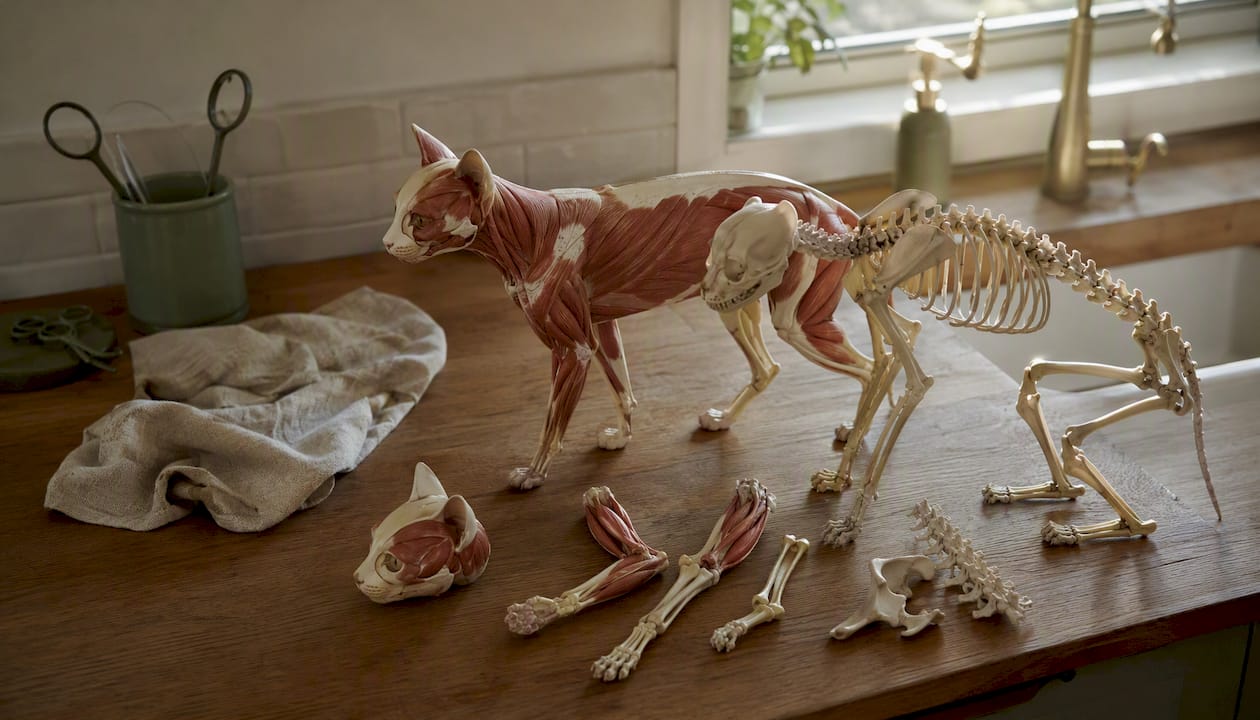
That's part of why blanket phosphorus restriction in a cat that doesn't need it can backfire quietly. Cut phosphorus too far in a cat that's already losing muscle from age-related sarcopenia, and you may be removing a building block that muscle tissue and bone turnover both depend on. The mineral isn't a villain that needs eliminating, it's a nutrient that needs the right amount for the right cat.
How Does Phosphorus Interact With Calcium and Magnesium?
Phosphorus doesn't operate alone. Calcium and phosphorus move together in a tightly linked seesaw, largely governed by PTH, and pushing one down too fast tends to pull the other out of range. That's precisely why hypercalcemia shows up as a side effect of aggressive phosphate restriction in some early-CKD cats rather than as an isolated coincidence.
The calcium-to-phosphorus ratio in a diet matters as much as the absolute phosphorus number. Feeding trials have shown that diets with a more favorable Ca:P ratio produced fewer adverse renal changes than those with lower ratios, even at similar total phosphorus levels. Magnesium plays a smaller but related role, interacting with both minerals in bone metabolism, which is one more reason single-nutrient thinking, obsessing over phosphorus alone, misses the bigger picture of how minerals work as a system.
Does Phosphorus Management Change Long-Term Quality of Life?
Beyond slowing CKD progression, well-managed phosphorus intake shows up in outcomes owners actually notice day to day: steadier energy, better appetite consistency, and less of the muscle wasting that makes a senior cat look frail seemingly overnight. Cats with poorly controlled phosphate overload and chronically elevated PTH tend to show more bone and joint discomfort over time, which affects mobility and willingness to jump, groom, or play, quality-of-life markers that matter just as much as a lab value.
The flip side matters equally. A cat kept alive on paper with tightly controlled phosphorus but suffering from food aversion and muscle loss isn't actually better off. The nutritionist consensus favors a holistic target: phosphate control paired with adequate calories, quality protein, and consistent intake, because longevity numbers on a chart don't capture whether a cat is still enjoying its dinner. For cats managing weight alongside kidney concerns, Bowlful's guide to safe weight management in senior cats covers how to protect lean mass through that balancing act.
Where Can You Learn More About Phosphorus and Feline Kidney Health?
For readers who want to go deeper or bring sources to a vet appointment, a few stand out. The PMC clinical review on dietary phosphorus and feline renal disease covers feeding-study thresholds and bioavailability in detail, useful if you want the actual numbers behind the recommendations. The Feline VMA's CKD hyperphosphatemia management guidance lays out IRIS staging targets and monitoring cadence in a format built for clinical use, and it's worth printing for a vet visit. The AAHA/AAFP feline life-stage guidelines cover broader nutrition and weight guidance for mature and senior cats, useful context beyond phosphorus alone.
A Note From Bowlful
We built Bowlful because pet nutrition advice online is either oversimplified or buried in academic language that's hard to act on. On phosphorus specifically, the evidence doesn't support a single blanket rule for every senior cat, it supports matching the approach to the individual animal's kidney status, appetite, and body condition. That's the lens we try to bring to every feeding recommendation we publish.
If you want a feeding plan built around your own cat's age, weight, and health status rather than a generic chart, Bowlful's personalized meal-planning tool uses the same RER and MER formulas veterinarians rely on to calculate calorie and nutrient targets. It's not a replacement for veterinary bloodwork or a prescription diet when one is medically necessary, and we'll say that plainly every time: work with your vet on phosphorus decisions, especially once CKD is on the table. Our job is to make the day-to-day feeding choices around that medical guidance easier to get right.
Frequently Asked Questions
What is the role of phosphorus in senior cat health?
Phosphorus supports bone strength, cellular energy production, and muscle function in senior cats, but excess intake, particularly from soluble inorganic sources, contributes to kidney damage and accelerates CKD progression in cats that already have reduced kidney function.
How does phosphorus affect kidney function in older cats?
Declining kidney function reduces the body's ability to excrete phosphorus, causing hormones like PTH and FGF-23 to work harder. That compensation contributes to bone changes and, over time, to further kidney stress, creating a cycle that speeds up disease progression.
Should healthy senior cats avoid all phosphorus?
No. Healthy senior cats need adequate phosphorus for normal bone and muscle function. The goal is avoiding excessive inorganic phosphate additives, not eliminating phosphorus, which is different from the therapeutic restriction needed for diagnosed CKD.
What foods are highest in inorganic phosphorus?
Foods and treats containing added sodium phosphate, phosphoric acid, or calcium phosphate as preservatives or texturizers carry the highest bioavailable phosphorus load. These additives show up more often in heavily processed treats and some canned products than in whole-ingredient diets.
How often should a senior cat's phosphorus be tested?
Testing at each senior wellness visit starting around age 10 to 11 is reasonable for healthy cats. Cats with diagnosed CKD typically need rechecks every 4 to 6 weeks after any diet or medication change, until phosphorus levels stabilize.
Sources
- Dietary phosphorus and renal disease in cats: where are we?
- CKD Hyperphosphatemia Management
- Nutrition and Weight: Mature Adult and Senior Cats - AAHA