
Pre-calculated portions stabilize your pet's daily calorie intake and make maintaining a healthy body condition far more reliable than eyeballing a scoop. The formulas behind them, Resting Energy Requirement (RER) and Maintenance Energy Requirement (MER, also called Daily Energy Requirement or DER), are the same ones veterinarians use, and they're grounded in AAFCO and NRC nutritional standards. Start today by weighing your pet, recording a Body Condition Score (BCS), and using that number as your baseline before changing anything else.
Key Takeaways
Pre-calculated portions work because they remove daily guesswork from calorie control, and the RER/DER framework gives every pet owner a repeatable, vet-aligned starting point.
| Point | Details |
|---|---|
| Calculate RER first | Use 70 × kg^0.75 or (30 × kg) + 70 for pets between 2 and 45 kg as your calorie baseline. |
| Apply a life-stage multiplier | Multiply RER by the correct DER factor (e.g., — for a neutered adult dog) to get daily calories. |
| Convert to grams, not cups | Divide daily DER by the food's kcal per 100 g for repeatable, scale-verified portions. |
| Monitor BCS monthly | Body Condition Score tells you whether the math is working; adjust portions by 10–15% increments when the trend calls for it. |
| Bowlful simplifies the process | Bowlful's RER/MER calculators and Meal Plan Pro PDFs convert your pet's data into labeled, per-meal portions ready to use. |
Table of Contents
- Why portion sizes in pet care are so easy to misjudge
- How to calculate the right pre-calculated portion for your pet
- How pre-calculated portions support weight management and health
- Practical habits that make pre-calculated portions stick
- How to switch to pre-calculated portions and fix common problems
- What the evidence actually says about portioned meals
- When pre-calculated portions are the right tool and when they're not
- Bowlful makes the math and the meal plan easy
- Sources
Why portion sizes in pet care are so easy to misjudge
The problem usually starts with a scoop. Most owners use whatever cup came with the bag, but kibble density varies enough that the same cup can hold meaningfully different weights depending on the brand or formula. A loosely filled cup of one kibble might weigh 90 grams; a packed cup of a denser formula could hit 130 grams. That gap adds up fast over weeks.
Bag feeding guides make this worse. Feeding guides on pet food bags are calibrated for an average, intact adult animal at a moderate activity level. They don't account for your dog being neutered, your cat being sedentary, or either pet carrying extra weight already. Following the bag guide without adjusting for those factors often means overfeeding by a meaningful margin.
Multi-feeder households add another layer. When two people share feeding duties without a clear system, portions get doubled or topped off "just in case." Free-feeding compounds this further, since pets with continuous access to food tend to consume more than they need across the day.
- Scoop volume is not the same as weight; density varies by formula.
- Bag guides assume an average animal and don't adjust for neuter status, age, or BCS.
- Multiple feeders without a shared system commonly add extra calories without anyone noticing.
- Visual cues (a "full bowl") are unreliable proxies for actual caloric content.
Pro Tip: Switch from a scoop to a kitchen scale. Weighing in grams takes ten seconds and eliminates the single biggest source of portion measurement error in home feeding.
How to calculate the right pre-calculated portion for your pet
The workflow runs in three steps: calculate RER, apply a life-stage multiplier to get DER, then convert daily calories into grams or cups using the food's calorie density.
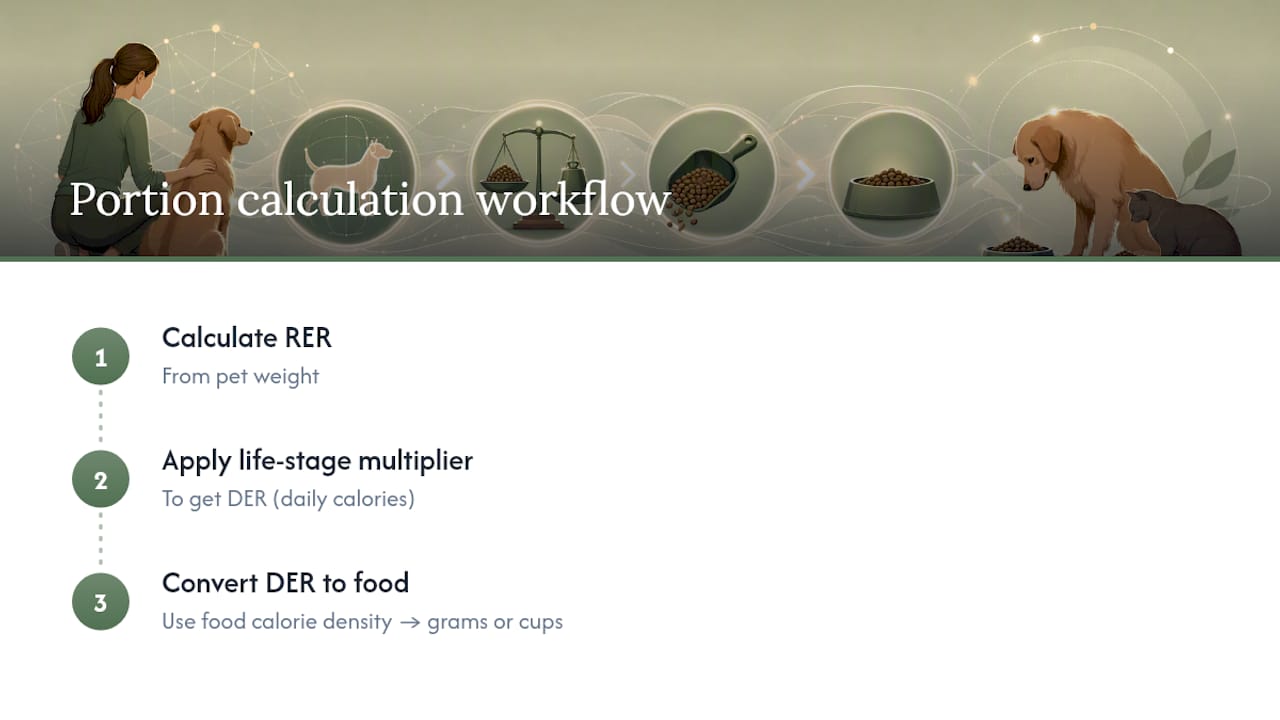
Step 1: Resting Energy Requirement (RER)
RER is the number of calories your pet needs at complete rest to maintain basic body functions. There are two formulas:
- Precise formula: RER = 70 × (body weight in kg)^0.75 — use this for any weight.
- Simplified formula: RER = (30 × kg) + 70 — reliable for pets between 2 and 45 kg and easier to calculate without a calculator.
A 10 kg dog: RER = (30 × 10) + 70 equals the resting energy requirement calculated by this formula.
Step 2: Daily Energy Requirement (DER)
DER multiplies RER by a life-stage or activity factor. KibbleLab's veterinary-aligned guidance lists the most commonly used multipliers:
Step 3: Convert calories to grams or cups
Divide the daily DER by the food's calorie density. You'll find kcal per cup or kcal per 100 g on the label or the manufacturer's website. Dry kibble typically ranges from about 300 to 500 kcal per cup; wet food runs considerably lower per gram. A pet food calculator can automate this conversion and show per-meal splits.
Example: dividing daily calories by kcal per cup gives the daily cups needed, which can then be split into meals.
Warning: For pets with kidney disease, diabetes, pancreatitis, or other metabolic conditions, use these formulas only as a starting point and confirm targets with your veterinarian. For cats on a weight-loss plan, avoid losses greater than 1–2% of body weight per week; faster loss raises the risk of hepatic lipidosis.
How pre-calculated portions support weight management and health
Consistent daily calories are the core benefit. When you serve the same measured amount every day, you remove the random variation that makes weight trends hard to read. If your pet gains weight over three weeks despite eating the same portion, you know the portion needs adjusting, not that feeding was inconsistent.
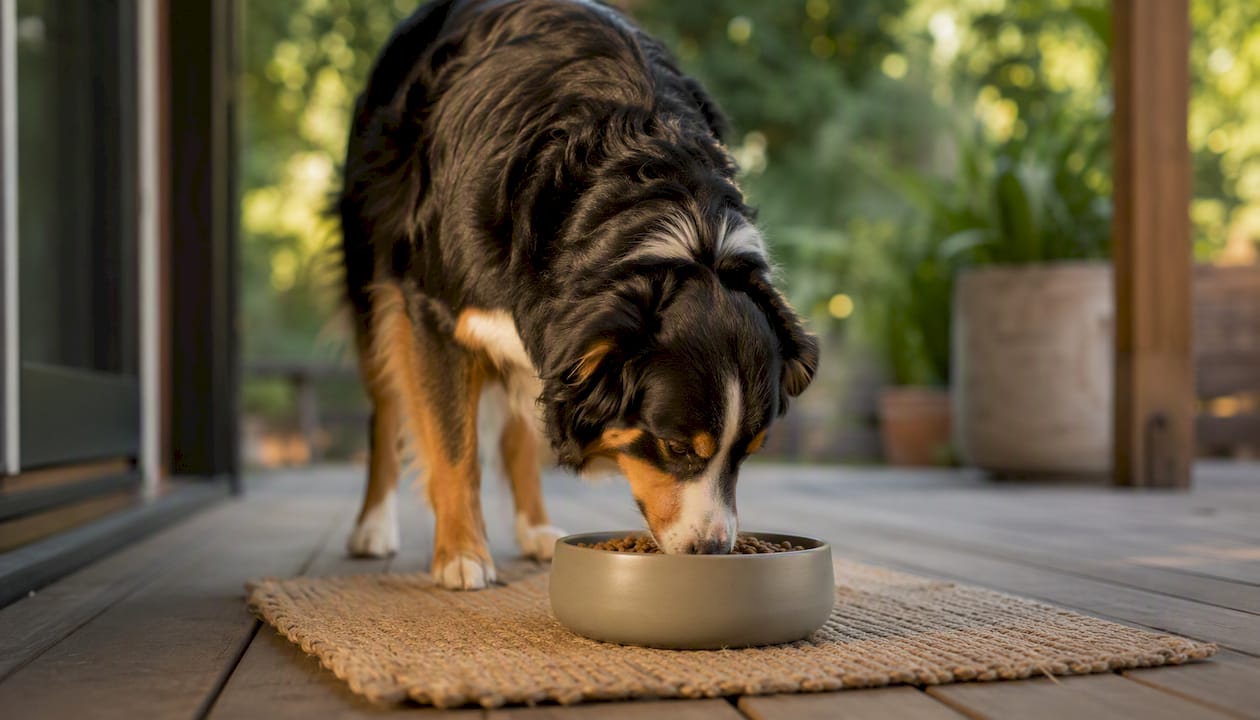
Pre-portioned meals also make treat budgeting concrete. Instead of treating as a separate, uncounted activity, you reserve a fixed percentage of the daily DER for treats and training rewards, then subtract that from the main meal. That single habit closes one of the most common calorie gaps in home feeding.
Benefits of pre-calculated portions:
- Stable daily calorie intake regardless of who feeds the pet.
- Easier to detect weight trends because the feeding variable is controlled.
- Supports therapeutic or prescription feeding plans by giving a measurable baseline.
- Simplifies multi-pet households when each pet has a labeled container.
Limits to keep in mind:
- Portions must be matched to the food's actual calorie density; switching brands without recalculating breaks the system.
- AAFCO nutritional adequacy statements confirm a diet is complete, but they don't guarantee the right calorie level for your specific pet.
- Pre-calculated portions only work if you measure consistently, monitor BCS regularly, and adjust when the trend calls for it.
A systematic review found that portion size and energy density independently and additively affect energy intake, and that serving smaller pre-portioned amounts reduces intake in adults. The practical translation: match your pet's daily calorie target to the food's energy density, and the portion size does the work of limiting intake without requiring willpower from anyone.
Practical habits that make pre-calculated portions stick
Measuring tools matter more than most owners expect. A digital kitchen scale accurate to 1 gram is the most reliable option. Calibrated scoops can work, but only if you verify the weight they deliver with your specific food. Labeled airtight containers for two to three days of portions at a time make the routine faster on busy mornings.
Meal frequency is worth setting deliberately. Most adult dogs do well on two meals per day; cats often prefer two to three smaller meals, though some do fine with two. Scheduled feeding, rather than free-feeding, pairs naturally with pre-calculated portions because it creates a clear start and end to each meal. A consistent feeding routine also helps you notice appetite changes early, which is one of the first signs something is off.
Treat budgeting is the habit most owners skip. If your dog's DER is 600 kcal, that's 60 kcal for treats, which is easy to track once you check the treat package for kcal per piece.
Pro Tip: Portion three to five days of meals into labeled containers on a Sunday. Write the pet's name, the date, and the kcal per container on each lid. It takes about ten minutes and removes the daily decision entirely, which is where most routines break down.
How to switch to pre-calculated portions and fix common problems
Transition protocol
Introduce the new portion size gradually over 7–14 days rather than switching all at once. Monitor stool consistency and appetite throughout; loose stools or refusal to eat are signals to slow the transition. A feeding schedule by weight can help you set the right starting point.
Troubleshooting checklist
- Recount treats. Training sessions and table scraps are the most common hidden calorie source. Log every treat for three days.
- Verify the scale vs. scoop. Weigh what your scoop actually delivers and compare it to the target gram weight.
- Check for multiple feeders. Confirm everyone in the household is using the same labeled container, not adding extra.
- Re-read the calorie density. If you switched food brands, recalculate DER with the new food's kcal/cup figure.
- Reassess BCS. If weight hasn't moved after three to four weeks of accurate portioning, adjust the portion by 10–15% and recheck in two weeks. A pet nutrition assessment can walk you through BCS scoring step by step.
Red flags that need a vet visit
Contact your veterinarian promptly if you see rapid unexplained weight change in either direction, persistent vomiting, complete loss of appetite lasting more than 24–48 hours, or any sign of lethargy alongside weight loss. In cats specifically, anorexia lasting more than 48–72 hours raises the risk of hepatic lipidosis and warrants same-day veterinary attention. The AVMA recommends veterinary involvement whenever a health condition affects diet.
What the evidence actually says about portioned meals
The human research base on portion control is substantial, and its core finding translates directly to pet feeding. A systematic review concluded that portion size and energy density act as independent and additive drivers of energy intake. Larger portions increase intake; smaller, pre-portioned amounts decrease it. The evidence was graded moderate to strong.
The Dietary Guidelines Advisory Committee reinforces this with a practical recommendation: use pre-portioned foods and meal prepping to reduce intake of energy-dense foods, and choose smaller package sizes as a structural strategy. The parallel for pet owners is direct: pre-portion into labeled containers, match the portion to the food's calorie density, and the behavior change is built into the routine rather than relying on daily judgment.
Pet-specific guidance from WSAVA's global nutrition guidelines endorses Body Condition Scoring as the primary monitoring tool for adjusting portions over time. BCS gives you a physical signal that the math is working or needs revision, which is something a scale alone can't tell you. AAFCO label guidance and NRC standards confirm that nutritional adequacy is a separate question from caloric adequacy; a diet can meet AAFCO standards and still overfeed or underfeed a specific animal.
When pre-calculated portions are the right tool and when they're not
Pre-calculated portions are the most practical tool available to most pet owners for everyday weight management. For healthy adult dogs and cats at maintenance or on a supervised weight-loss plan, the RER/DER framework paired with BCS monitoring covers the vast majority of feeding decisions without requiring a vet visit for every adjustment.
Where this approach reaches its limits is in medical feeding. Pets with kidney disease, diabetes, pancreatitis, food allergies, or post-surgical recovery needs require a prescription diet and a vet-supervised calorie target. The formulas still apply, but the food choice and the acceptable weight-change rate are clinical decisions, not owner-managed ones.
For multi-person households, the pre-calculated approach is especially valuable because it removes ambiguity. A labeled container with the kcal written on the lid answers the "did you feed the dog?" question before it becomes a problem. Regular BCS checks, ideally monthly for pets at a stable weight and every two weeks during active weight loss, give you the feedback loop that keeps the system honest.
Bowlful makes the math and the meal plan easy
Knowing the formulas is one thing. Having a tool that runs RER and DER calculations for your specific pet's breed, age, weight, and activity level, then converts the result into a daily gram or cup target, is what turns the math into a routine you'll actually follow.
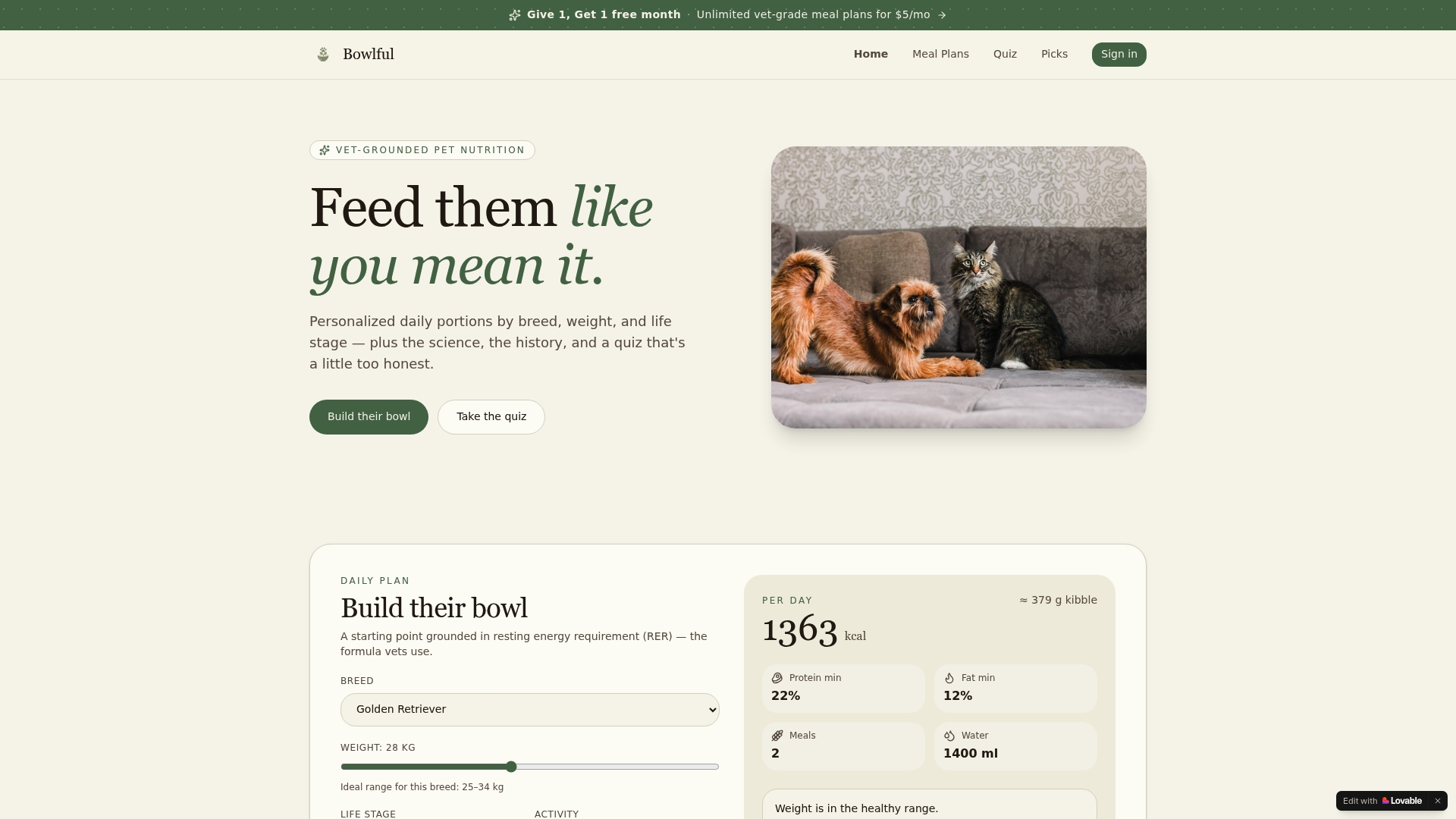
Bowlful's feeding calculators use the same vet-standard RER/MER formulas described in this article, adjusted for life stage and body condition. The Meal Plan Pro subscription generates a downloadable, printable meal plan PDF with per-meal portions, treat budgets, and labeled container quantities, so you can set up a week of pre-portioned meals in one sitting. Every recommendation is built on AAFCO and NRC nutritional standards, with no brand affiliations influencing the output. For pets with medical conditions, Bowlful's guidance is a starting point; your veterinarian makes the final call on therapeutic diets. Get your pet's personalized feeding plan at Bowlful.
Sources
- Portion Size and Energy Intake: A Systematic Review - NCBI Bookshelf
- Dietaryguidelines
- Portion control — Mayo Clinic
- Pet Food Calculator | Calcipedia
This article is general information, not a substitute for advice from a qualified doctor. Consult a qualified healthcare professional about your own circumstances before acting on anything here.