
If your dog or cat is gaining or losing weight, showing GI upset, or acting lethargic without a clear cause, the feeding amount or diet composition is the first thing to check. These are not vague concerns — they are measurable signals, and most of them resolve with a calculated, gradual adjustment.
The four most reliable signs to watch for:
- Unexplained weight change (gain or loss) over a few weeks
- Persistent loose stool, vomiting, or gas that is not linked to illness
- Dull coat, excessive shedding, or visible muscle loss
- Sudden increase or decrease in appetite lasting more than a couple of days
Immediate action checklist:
- Weigh your pet today and record it.
- Measure every meal in grams or by calories, not by eye.
- Stop all treats and table scraps for 48–72 hours to isolate the variable.
- Switch to scheduled meals if you are currently free-feeding.
- If you see blood in stool, repeated vomiting, or collapse, skip the checklist and call your vet now.
For urgent red flags, jump to the "When to call the vet" section below.
Table of Contents
- What signs tell you the feeding amount or diet is wrong?
- How do you confirm the problem with short-term monitoring?
- How do you calculate a safe feeding adjustment?
- How do you safely change portions or switch diets?
- When should you call the vet instead of adjusting feeding yourself?
- When does a personalized feeding plan make more sense than a label?
- Key Takeaways
- The part most owners get wrong
- Bowlful gives you the math, not just the guidelines
- Useful sources
What signs tell you the feeding amount or diet is wrong?
Weight change is the clearest signal. Pets that gain or lose more than 5% of body weight in a month need a feeding review and possible medical investigation. Track percentage change, not absolute pounds, because small dogs and cats hit that threshold fast.
Physical and body condition signs
Visible ribs without any pressure, a waist that disappears when viewed from above, or a belly that sags are all body condition score (BCS) red flags. The standard BCS scale runs 1–9, with 4–5 being ideal. You should be able to feel your pet's ribs with light pressure but not see them. Hip bones that protrude or a spine that is easy to count vertebra by vertebra suggest underfeeding or a diet that is not meeting caloric needs.

Muscle wasting is a separate issue from fat loss. A pet can look "normal weight" while losing lean muscle, especially older dogs and cats. Run your hands along the spine and hindquarters monthly.
Gastrointestinal signs
Ongoing loose stool, gas, or vomiting that has lasted more than 48–72 hours points to a diet problem until proven otherwise. Single-episode vomiting after a meal change is common. Three days of soft stool is a pattern. Note the frequency, consistency, and whether there is any blood or mucus.
Coat, energy, and behavior signals
A dull, brittle coat or excessive shedding often reflects a fat or protein deficiency. Sudden drops in energy, reluctance to play, or increased begging can all indicate the pet is not getting enough calories, or that the calorie source is wrong for their life stage. Increased thirst is worth flagging too, since it can signal either overfeeding of dry, high-sodium food or an underlying condition.

Appetite changes
Pets do not reliably self-regulate to avoid unhealthy food, so appetite changes are often the earliest sign of illness rather than a preference. One skipped meal is not a pattern. Refusing food for two or more consecutive days, or suddenly eating everything in sight after months of normal intake, is worth investigating.
Contextual clues matter here. A dog that gets three dental chews, a handful of training treats, and table scraps daily may be eating less at meals because the treat load is filling the caloric budget. Free-feeding in multi-pet homes hides these patterns entirely.
How do you confirm the problem with short-term monitoring?
About one to three weeks of consistent tracking is usually enough to see whether a pattern is real or coincidental. The goal is to separate a feeding problem from a medical one before making changes.
Step-by-step monitoring routine
- Weigh your pet weekly on the same scale, at the same time of day, before a meal. Daily weighing creates noise; weekly gives a trend.
- Self-assess BCS every two weeks. Stand above your pet and look for a visible waist. Run your fingers along the ribs. Check the base of the tail for fat deposits.
- Measure every meal using a kitchen scale in grams or by converting to calories. Label feeding guides vary widely in calories per cup across brands, so cups alone are unreliable.
- Log treat calories separately. Check the package for kcal per treat and add them to the daily total.
- Record stool quality using a simple 1–5 scale (1 = hard, 3 = ideal, 5 = liquid).
Sample tracking table:
| Date | Weight (lbs) | Food (grams) | Treats (kcal) | Stool (1–5) | Notes |
|---|---|---|---|---|---|
| Day 1 | — | — | — | 3 | Normal |
| Day 7 | — | — | — | 3 | Slight loose |
| Day 14 | — | — | — | 4 | Loose, 2x/day |
Copy this table into a notes app or print it. After 14 days, a downward weight trend plus loose stool with no other changes points directly to a diet or portion issue. A pet nutrition assessment can help you interpret what the numbers mean.
When to pause monitoring and call the vet: significant weight loss over a short period, blood in stool, or any sign of pain.
How do you calculate a safe feeding adjustment?
Start with what you are currently feeding, measured in calories or grams, not cups. That is your baseline. The food label's feeding guide is a starting point only. Eyeballing portions often leads to overfeeding, and label amounts are calculated for an average, unaltered adult animal, which describes very few actual pets.
RER and MER: the formulas behind the math
Resting Energy Requirement (RER) is the calories a pet needs at complete rest, calculated as 70 × (body weight in kg)^0.75. Multiply RER by a life-stage factor to get Maintenance Energy Requirement (MER). A neutered adult dog uses a factor of roughly 1.6; an intact adult uses 1.8; a senior or obese-prone pet uses 1.4. These are the same formulas veterinarians use, and tools like Bowlful's dog calorie calculator apply them automatically so you do not have to do the algebra.
Worked example: a 25-lb dog
- Weight: 25 lbs = 11.3 kg
- RER: 70 × (11.3)^0.75 ≈ 70 × 5.6 ≈ 392 kcal/day
- MER (neutered adult, factor 1.6): 392 × 1.6 = 627 kcal/day
- Current intake (measured): 700 kcal/day from food + 80 kcal from treats = 780 kcal/day total
- Excess: 780 − 627 = 153 kcal/day over target
A moderate reduction in total daily calories is a practical starting range for gradual weight loss. For this dog, a 15% cut brings the target to roughly 663 kcal/day. Reduce food first, then treats. Treats should stay below 10% of total daily calories — for this dog, that is about 63 kcal, or roughly two small training treats.
Comparison: label guidance vs. calculated approach
| Method | Basis | Accounts for neuter status? | Accounts for BCS? | Accuracy |
|---|---|---|---|---|
| Food label | Average adult | No | No | Low |
| RER/MER calculation | Individual weight | Yes | With adjustment | High |
| Personalized plan (Bowlful) | Weight + BCS + life stage + activity | Yes | Yes | Highest |
Pro Tip: Re-check and recalculate after two to four weeks, or any time your pet's weight shifts by 5% in either direction. Calorie targets change as body weight changes.
How do you safely change portions or switch diets?
The standard transition timeline is 7–10 days. Sensitive pets, those with a history of GI issues, or pets switching from a very different formula may need four to six weeks. Choose the longer timeline when your pet has had loose stool on previous food changes, is a kitten or puppy, or is switching from dry to wet (or vice versa).
Stepwise transition plan
- Days 1–3: 25% new food, 75% current food. Keep total daily calories identical to what you were feeding before.
- Days 4–6: 50% new, 50% current. Watch stool consistency daily.
- Days 7–9: 75% new, 25% current. Any loose stool here means slow down, not stop.
- Day 10+: 100% new food.
This stepwise schedule works for both a diet swap and a portion reduction. When reducing calories, keep the ratio the same but lower the total gram amount at each stage.
The 7–7–7 rule
The 7–7–7 approach extends this logic: seven days to introduce, seven days to expose consistently, seven days to confirm tolerance. It is most useful for pets with a history of food sensitivity or for owners switching to a novel protein diet as part of a diagnostic trial.
Rollback instructions
If your pet shows persistent vomiting or diarrhea during the transition, return to the previous diet for one week, then retry starting at 10–15% new food instead of 25%. Persistent GI signs after a careful transition may mean the new food is simply a poor fit, not just a sensitive stomach reacting to change.
Call the vet immediately if: vomiting or diarrhea continues for more than 48 hours after returning to the old food, or if you see blood in the stool at any point.
When should you call the vet instead of adjusting feeding yourself?
Some signs look like feeding problems but are actually medical emergencies. Knowing the difference saves time and, sometimes, a pet's life.
Urgent — call a vet or emergency clinic now:
- Repeated vomiting (three or more times in 24 hours)
- Blood in stool or vomit
- Severe lethargy or collapse
- Rapid weight loss (more than 5% in under two weeks)
- Signs of abdominal pain (hunching, reluctance to move, crying when touched)
Concerning but not an emergency — schedule an appointment within a few days:
- Gradual weight loss over four or more weeks with no diet change
- Persistent GI upset lasting several days
- Poor appetite for three or more consecutive days
- Severe skin or coat problems that do not improve with diet change
Medical conditions that mimic feeding problems include dental disease (pain makes eating difficult), hypothyroidism or hyperthyroidism, diabetes, inflammatory bowel disease, and kidney disease. A vet can rule these out with bloodwork and a physical exam.
When you go, bring your monitoring log: weight trend, daily food and treat amounts, stool quality notes, and photos if the coat or skin changes are visible. That data cuts the diagnostic time significantly.
When does a personalized feeding plan make more sense than a label?
Food labels give a population average. They do not know your pet's BCS, activity level, neuter status, or whether they are a 7-year-old Labrador with a tendency to gain weight or a 2-year-old Border Collie burning calories at twice the rate. Personalization using exact weight, BCS, and RER/MER yields more accurate feeding plans than any label can provide.
A vet-standard personalized plan typically includes:
- A daily calorie target based on RER/MER, life stage, and activity
- Portion sizes in both grams and cups for the specific food being fed
- A treat budget (in kcal) that keeps treats under 10% of daily intake
- A transition schedule with day-by-day ratios
- Monitoring prompts and a timeline for reassessment
When a personalized plan is worth using:
- Persistent weight issues despite following label instructions
- Senior pets, growing puppies or kittens, or pregnant/nursing animals
- Multi-pet households where intake is hard to track individually
- Managing a health condition alongside veterinary treatment
- Owners who want precise tracking rather than rough estimates
A personalized feeding plan is not a substitute for veterinary diagnosis. If your pet has a medical condition driving the weight or appetite change, the plan works alongside your vet's treatment, not instead of it. AAFCO and NRC nutrient standards define the minimum requirements a complete diet must meet; a personalized plan built on RER/MER formulas tells you how much of that diet to feed. Both matter.
Bowlful builds plans using the same RER/MER formulas veterinarians use, adjusted for breed, age, and activity level. The Bowlful feeding tools translate that math into practical cup and gram amounts, a treat budget, and a downloadable PDF you can keep on your fridge.
Key Takeaways
Catching the signs your pet needs a feeding adjustment early, then acting with a measured, gradual approach, resolves most diet-related problems without a vet visit.
| Point | Details |
|---|---|
| Weight change threshold | A gain or loss of more than 5% of body weight in a month warrants a feeding review. |
| Measure in grams or calories | Cup measurements vary widely between brands; use a kitchen scale or calorie count for accuracy. |
| Treat calories count | Treats should generally be limited to less than 10% of total daily calories to avoid masking excess intake. |
| Transition gradually | A standard 7–10 day stepwise schedule (25/50/75/100%) prevents GI upset during diet changes. |
| Bowlful for precision | Bowlful's RER/MER-based plans translate calorie targets into exact gram and cup amounts with a treat budget. |
The part most owners get wrong
Most feeding problems are not dramatic. They creep in over weeks: a little more treat here, a slightly generous scoop there, a switch to a denser kibble without recalculating. By the time the weight change is obvious, the habit is months old.
The conventional advice is to "follow the bag." That is fine as a starting point, but it assumes your pet is an average, intact adult with moderate activity. Most pets are none of those things. A spayed, middle-aged Beagle with a slow metabolism needs meaningfully fewer calories than the label suggests, and the gap between "bag says 1.5 cups" and "pet actually needs 1 cup" adds up to real weight gain over a year.
What I find underappreciated is how much the treat load distorts the picture. Owners track meals carefully and then add dental chews, snacks, and training treats without counting calories. Those extras can constitute a substantial portion of a small dog's daily calorie intake. The meal looks right on paper; the total intake is not.
The other thing worth saying plainly: free-feeding is a monitoring blind spot. You cannot tell if your cat ate less today because she is sick, bored, or just full from yesterday. Scheduled meals with measured portions turn feeding into a diagnostic tool. Two days of a half-eaten bowl tells you something. A self-feeder that is always topped off tells you nothing.
Most owners who switch to measured, scheduled feeding and track treats for two weeks are surprised by what they find. The math is not complicated. The discipline to do it consistently is the actual challenge.
Bowlful gives you the math, not just the guidelines
Knowing the signs is step one. Knowing exactly how many grams to put in the bowl is where most owners get stuck.
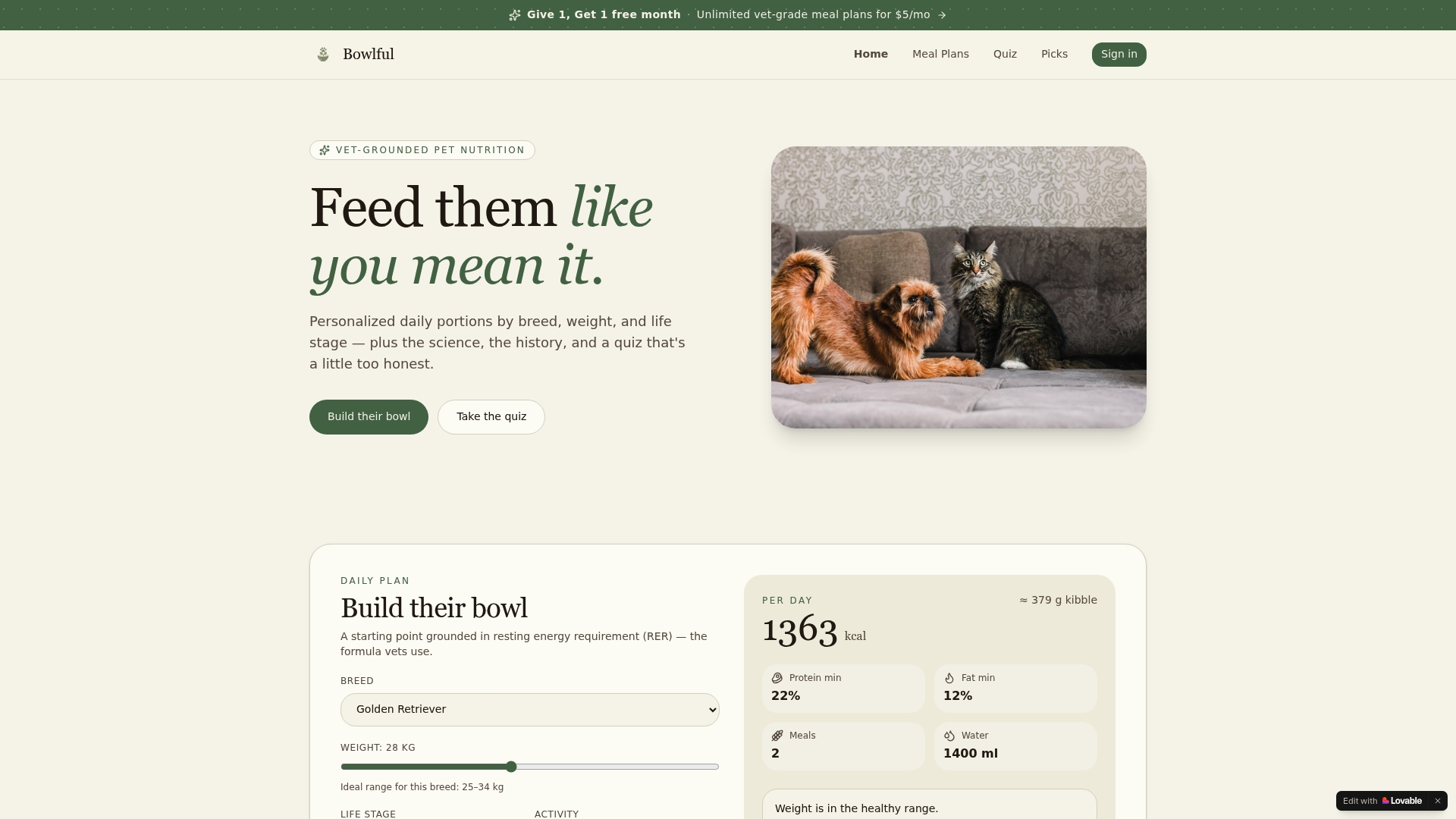
Bowlful builds personalized feeding plans using the same RER/MER formulas your vet uses, adjusted for your pet's breed, age, weight, and activity level. You get a daily calorie target, portion sizes in grams and cups for the food you are already feeding, a treat budget, and a transition schedule, all in a downloadable PDF. No generic label math, no guessing.
Important: Bowlful's plans are a nutrition tool, not a medical diagnosis. If your pet has a health condition driving the weight or appetite change, work with your veterinarian first and use the plan alongside that care.
Ready to get a number you can actually trust? Start with Bowlful's personalized feeding plan and have your pet's current weight, activity level, and treat habits ready.
Useful sources
- Tufts Petfoodology — How do I switch my pet's food? Covers transition timelines, rollback instructions, and why cups-to-calories conversion matters. Supports the transition and calculation sections of this guide.
- AAHA — 5 Ways to Know How Much to Feed Your Pet Explains the limits of label feeding and the case for RER/MER personalization. Supports the calculation and personalized plan sections.
- Merck Veterinary Manual — Nutrition in disease management in small animals Covers treat calorie limits, diagnostic food trial rules, and clinical nutrition standards. Supports the treat budget and when-to-seek-vet sections.
- University of Wisconsin School of Veterinary Medicine — Expert Q&A: Understanding Pet Food Addresses appetite changes as early illness indicators and the problems with free-feeding. Supports the diagnostic signs and monitoring sections.
- AAFCO — Understanding Pet Food Explains nutrient standards and what "complete and balanced" means on a label. Useful background for understanding why label guidance has limits.
- Bowlful — Personalized feeding plans and calorie calculators RER/MER-based tools that translate calorie targets into practical gram and cup amounts for dogs and cats.