
Taurine is a dietary-essential amino acid that cats must obtain from food every single day to survive. Unlike dogs or humans, cats cannot synthesize sufficient taurine due to critically low enzyme activity in the pathways that convert methionine and cysteine. This biological limitation makes taurine unique among nutrients: it is not optional, not a supplement, and not something your cat's body can compensate for over time. The role of taurine in cat nutrition spans heart function, vision, digestion, immune defense, and reproduction. Without it, the consequences are serious and sometimes permanent.
What biological functions does taurine support in cats?
Taurine operates at the cellular level across multiple organ systems simultaneously. That is what makes deficiency so dangerous. A cat can appear healthy for months while taurine levels quietly decline, and by the time symptoms appear, some damage may already be irreversible.
Here is what taurine actively does inside your cat's body:
- Heart muscle contraction: Taurine regulates calcium movement in cardiac cells, which directly controls how forcefully and rhythmically the heart beats. Without adequate taurine, the heart muscle weakens and dilates, a condition called dilated cardiomyopathy (DCM).
- Retinal health: The retina contains some of the highest taurine concentrations in the body. Taurine protects photoreceptor cells from oxidative damage. Depletion leads to feline central retinal degeneration, which causes progressive and irreversible vision loss.
- Bile salt conjugation: Cats rely on taurine, not glycine, to form bile salts used in fat digestion. This is a metabolic quirk unique to obligate carnivores. When taurine is low, fat absorption becomes inefficient, which affects energy and nutrient uptake across the board.
- Immune function: Taurine acts as an antioxidant, neutralizing free radicals and reducing inflammation in immune cells. This keeps your cat's defenses responsive without triggering chronic inflammation.
- Reproduction and fetal development: Pregnant and nursing cats have significantly higher taurine demands. Deficiency during gestation leads to fetal resorption, stillbirths, and developmental abnormalities in kittens.
Pro Tip: If your cat is pregnant or nursing, do not assume a standard adult formula covers her needs. Taurine requirements nearly double during these life stages, and the margin for error is narrow.
What are the daily taurine requirements and dietary sources for cats?
AAFCO sets minimum taurine levels at 0.1% dry matter for adult cats and 0.2% for kittens, pregnant cats, and nursing cats as of 2026. In practical terms, adult cats need approximately 200 to 500 mg of taurine daily, roughly 50 mg per kilogram of body weight. A 4 kg adult cat needs around 200 mg per day at minimum. A pregnant queen may need twice that amount.
Taurine content in common animal-based foods
The best natural sources of taurine are animal tissues, particularly organ meats and shellfish. Here is how common sources compare per 100 grams of raw weight:
| Food source | Taurine content (mg/100g) |
|---|---|
| Blue or green-lipped mussels | 655 to 827 mg |
| Raw chicken heart | 117 to 220 mg |
| Beef heart | 63 to 200 mg |
| Chicken breast (muscle meat) | 18 to 34 mg |
| Plant-based proteins | Negligible |
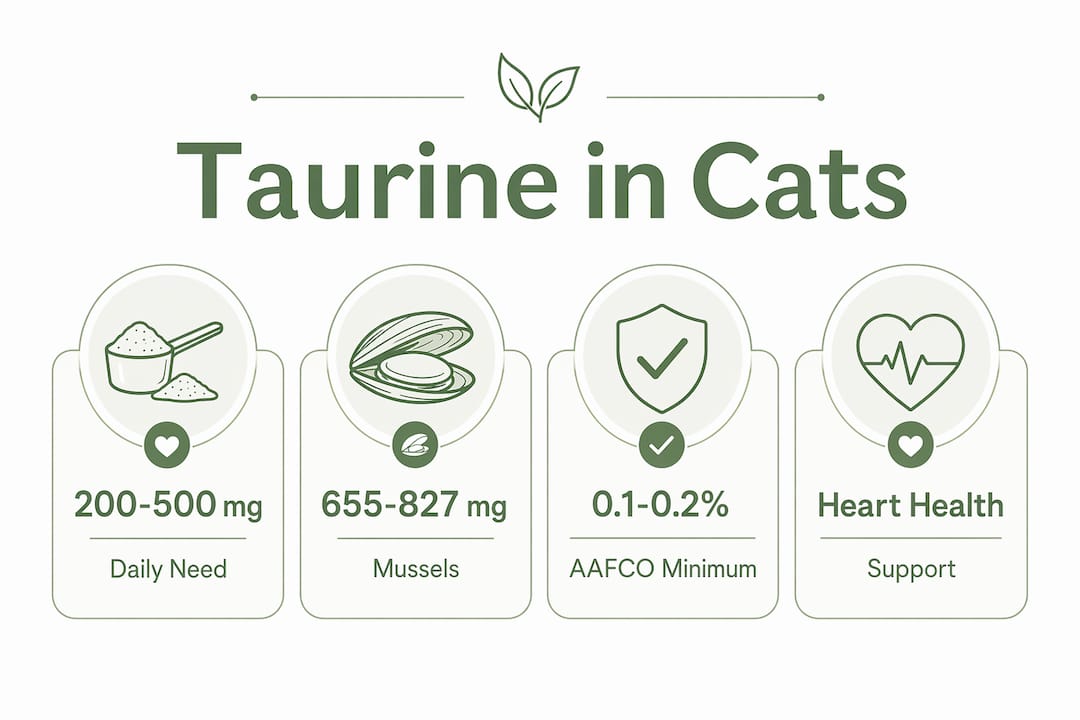
The gap between shellfish and plant proteins is not a minor difference. It is the difference between meeting your cat's needs and falling dangerously short. Plant-based proteins, regardless of how nutritionally complete they appear on paper, provide essentially no usable taurine for cats.
Processing matters as much as source. Heat processing and cooking degrade taurine significantly, and water-soluble taurine leaches into cooking liquids that are typically discarded. This means a chicken heart that starts with 180 mg of taurine per 100 grams may deliver considerably less after boiling. Raw and freeze-dried diets preserve taurine better than canned or cooked formats. Chunking meat rather than grinding it also retains more taurine, since grinding increases bacterial activity that degrades the amino acid before it reaches your cat.
Pro Tip: If you feed a raw diet using ground meat, do not assume the taurine content matches whole-cut values. Bacterial degradation during grinding reduces bioavailability significantly, so supplementation becomes necessary in ground raw feeding programs.
What are the risks and symptoms of taurine deficiency in cats?
Taurine deficiency in cats does not announce itself quickly. Deficiency symptoms can take months to develop, which means the damage accumulates silently before you notice anything is wrong. This delayed onset is one of the most clinically dangerous aspects of inadequate taurine intake.
The consequences fall into two categories: reversible and irreversible.
- Dilated cardiomyopathy (DCM): The heart muscle thins and loses contractile strength. Early-stage DCM may be reversible with prompt taurine supplementation and veterinary treatment. Late-stage DCM is life-threatening and far harder to manage.
- Feline central retinal degeneration: Vision loss from taurine deficiency is permanent. Once photoreceptor cells in the retina die, they do not regenerate. Early detection is the only way to prevent blindness.
- Digestive dysfunction: Impaired bile salt production reduces fat digestion efficiency, leading to weight loss, loose stools, and poor coat condition over time.
- Immune suppression: Reduced antioxidant capacity leaves cats more vulnerable to infections and slower to recover from illness.
- Reproductive failure: Queens with low taurine levels experience higher rates of fetal loss, premature births, and kittens born with neurological deficits.
"Early taurine deficiency symptoms may be subtle; vision loss is irreversible whereas heart disease may improve with treatment." This distinction matters enormously when deciding how urgently to act on a suspected deficiency.
Subclinical deficiency is particularly tricky because a cat can appear normal while organ damage progresses. Routine blood testing is the only reliable way to detect low taurine before irreversible damage occurs. Ask your veterinarian to include a plasma taurine panel as part of your cat's annual wellness exam, especially if you feed a homemade or raw diet.
How to ensure your cat gets enough taurine
Getting taurine right is not complicated, but it does require deliberate choices at every feeding decision.
-
Choose commercial foods that meet AAFCO standards. Most commercial cat foods since the mid-1980s include added taurine specifically to prevent deficiency diseases. Look for an AAFCO nutritional adequacy statement on the label. Understanding what pet food labels mean helps you verify that a product genuinely meets the 0.1% dry matter minimum for adults or 0.2% for kittens and breeding cats.
-
Be strategic with raw and homemade diets. Raw diets can be taurine-rich when built around whole-cut organ meats and shellfish. The risk comes from ground raw formulas and homemade recipes that rely on muscle meat alone. If you prepare your cat's food at home, include chicken hearts, beef hearts, or mussels as regular components, and consider working with a veterinary nutritionist to verify the diet's adequacy.
-
Minimize heat exposure during food preparation. If you cook for your cat, steam or lightly poach rather than boil. Avoid discarding cooking liquid, since taurine leaches into it. Freezing meat before use does not degrade taurine. Losses come from heat and liquid contact, not from cold storage.
-
Supplement when indicated. Supplementing taurine up to 250 mg per day is generally safe under veterinary guidance. Taurine is water-soluble and non-toxic at typical supplemental doses, meaning excess is excreted rather than stored. Supplementation is most appropriate for cats on homemade diets, ground raw diets, or cats diagnosed with DCM or retinal degeneration.
-
Adjust for life stage. Kittens, pregnant queens, and nursing cats need double the taurine of a healthy adult. Senior cats with reduced appetite or digestive efficiency may also absorb taurine less effectively. A pet nutrition assessment tailored to your cat's age, weight, and health status gives you a concrete baseline to work from.
-
Consult your veterinarian proactively. Do not wait for symptoms. If you have changed your cat's diet, introduced a homemade feeding plan, or noticed any changes in energy, vision, or coat quality, request a taurine panel. Early intervention is the difference between a reversible problem and a permanent one.
Pro Tip: When evaluating a new commercial cat food, check whether taurine is listed as an added ingredient rather than relying solely on the guaranteed analysis. Some formulas meet the minimum on paper but use processing methods that reduce actual taurine bioavailability.
Key takeaways
Taurine is a non-negotiable daily nutrient for cats, and the difference between adequate and deficient intake determines outcomes across heart health, vision, digestion, and reproduction.
| Point | Details |
|---|---|
| Taurine is dietary-essential for cats | Cats cannot synthesize enough taurine and must obtain it from animal-based food every day. |
| AAFCO sets clear minimums | Adults need 0.1% dry matter; kittens and breeding cats need 0.2% in commercial diets. |
| Cooking destroys taurine | Heat and liquid leaching reduce taurine content; raw, frozen, or lightly cooked whole-cut meats preserve it best. |
| Deficiency damage varies by organ | DCM may be reversible with early treatment; retinal degeneration from taurine loss is permanent. |
| Routine testing catches deficiency early | Annual plasma taurine panels detect subclinical deficiency before irreversible organ damage develops. |
What I've learned from watching owners get taurine wrong
Most cat owners I speak with assume that any commercial cat food automatically handles taurine. That assumption is mostly correct for mainstream brands, but it breaks down fast the moment someone switches to a boutique formula, a grain-free diet with unusual protein sources, or a homemade recipe they found online.
The misconception I see most often is that raw feeding is inherently taurine-rich. It can be. But ground raw diets, which are the most popular format for home feeders, lose meaningful taurine to bacterial degradation before the food ever reaches the bowl. Owners who make this switch without supplementing or testing are taking a real risk, and most do not find out until a veterinary exam reveals cardiac changes.
The other pattern I find concerning is the reluctance to test. Taurine panels are inexpensive relative to the cost of treating DCM or managing a blind cat. Yet many owners only request one after a problem surfaces. I would argue that any cat eating a non-standard diet, whether homemade, raw, or a niche commercial formula, should have a baseline taurine panel within the first three months of that diet and annually thereafter.
The good news is that taurine deficiency, when caught early, responds well to treatment. The heart can recover. The key is not waiting for the cat to show you something is wrong.
— Robert
Build a feeding plan your cat's body can actually use
Knowing the science behind taurine is the first step. Translating it into a daily feeding plan that accounts for your cat's breed, weight, life stage, and health history is where most owners need support.
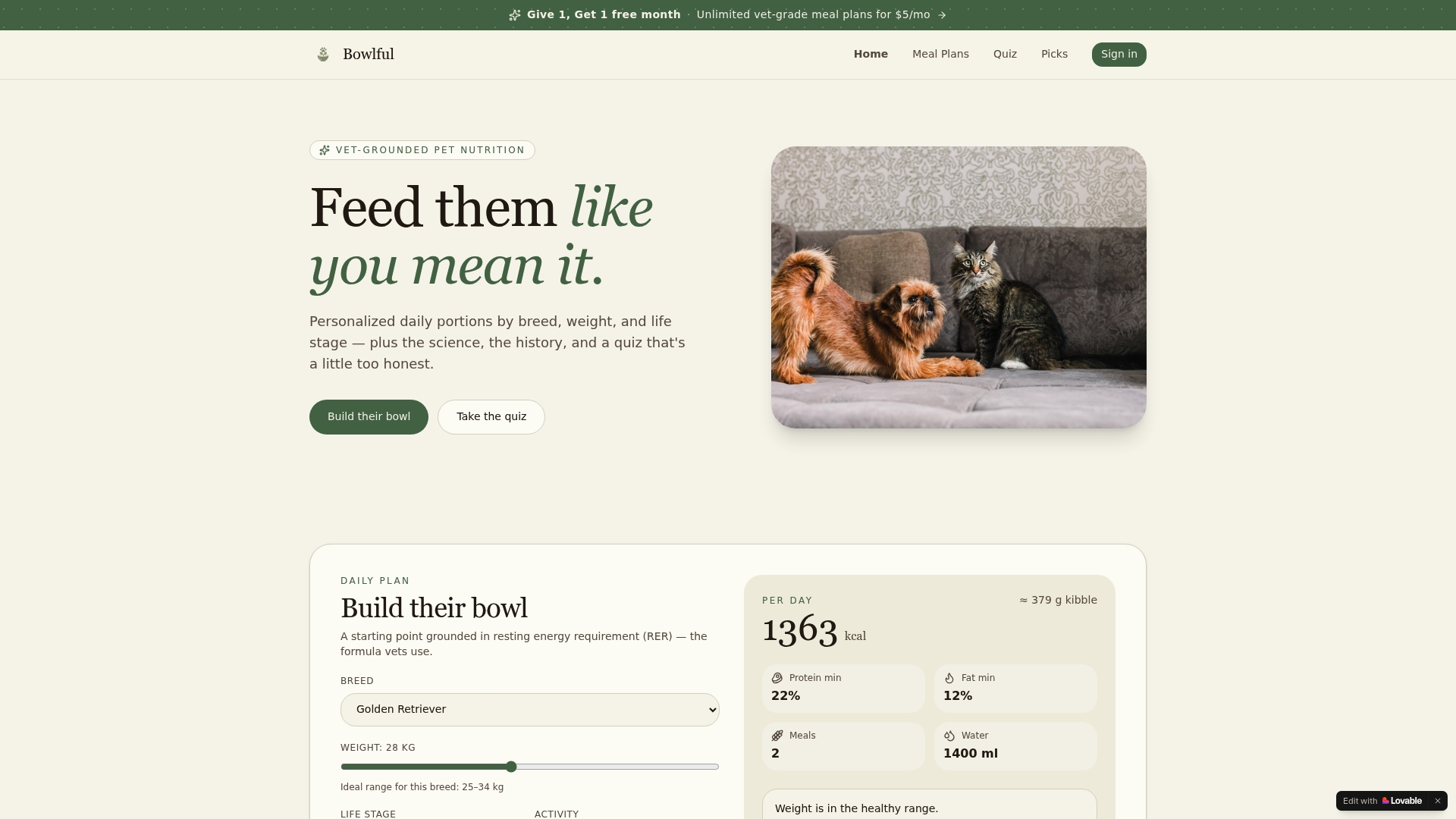
Bowlful builds personalized meal plans using the same Resting Energy Requirement (RER) formula veterinarians use in clinical practice. Rather than guessing at portion sizes or hoping a generic formula covers your cat's needs, you get a data-driven plan built around your specific animal. Bowlful's interactive quiz takes your cat's profile and returns a feeding recommendation grounded in current nutritional science. For cat owners who want to move beyond guesswork, start with Bowlful and get a plan that accounts for every life stage, including the ones where taurine demands are highest.
FAQ
What is taurine and why do cats need it?
Taurine is a sulfur-containing amino acid that cats cannot produce in sufficient quantities on their own. It is required daily for heart function, vision, digestion, immune defense, and reproduction.
How much taurine does a cat need per day?
Adult cats need approximately 200 to 500 mg of taurine daily, or about 50 mg per kilogram of body weight. Kittens and pregnant or nursing cats require higher amounts, reflected in the AAFCO standard of 0.2% dry matter for those life stages.
What foods are highest in taurine for cats?
Blue and green-lipped mussels contain 655 to 827 mg of taurine per 100 grams, making them the richest natural source. Raw chicken heart and beef heart are also strong sources, providing 63 to 220 mg per 100 grams depending on preparation method.
Can taurine deficiency be reversed?
Dilated cardiomyopathy caused by taurine deficiency may be partially reversible with early supplementation and veterinary care. Retinal degeneration from taurine loss is permanent and cannot be restored once photoreceptor cells are lost.
Is it safe to supplement taurine for cats?
Supplementing up to 250 mg of taurine per day is considered safe under veterinary guidance. Taurine is water-soluble, so excess amounts are excreted rather than accumulated, making toxicity from standard supplemental doses extremely unlikely.