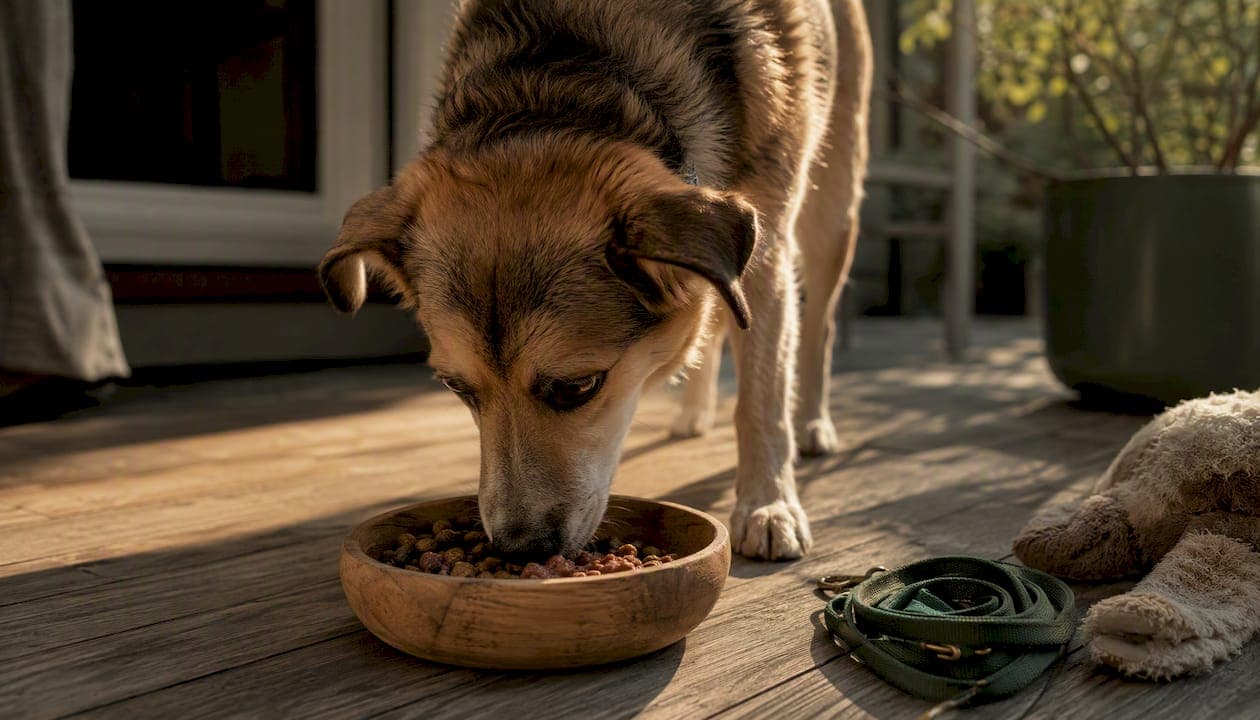
The safest way to transition a rescue dog to new food is a staged mix over 7 to 10 days: about 75% old food and 25% new for the first two or three days, then 50/50, then 25% old and 75% new, then fully switched. Sensitive dogs, or dogs with a completely unknown diet history, often need 10 to 14 days or longer. A faster 4-day version exists for dogs with strong stomachs, but rescue dogs rarely qualify for the fast track.
Call your vet immediately if you see repeated vomiting, watery diarrhea lasting more than 48 hours with signs of dehydration, severe lethargy, or a total refusal to eat for more than a day or two. These aren't "wait and see" symptoms.
- Standard pace: 7 to 10 days, staged in 25% increments
- Fast pace: 4 days, only for dogs with no GI sensitivity
- Slow pace: 10 to 14+ days for sensitive, stressed, or newly adopted dogs
- Stop and call the vet: persistent vomiting, dehydration, severe lethargy, or multi-day food refusal
Quick fact: AAFCO sets the nutritional adequacy standards most commercial dog foods must meet, and NRC feeding calculations underpin how vets estimate calorie needs. Neither organization dictates transition speed. That decision belongs to you and your vet, based on how the individual dog responds.
Key Takeaways
A safe rescue dog food transition combines a 7 to 10 day staged mix with daily monitoring of stool, appetite, and energy, extending the timeline whenever those signals dip.
| Point | Details |
|---|---|
| Start from a known baseline | Ask the shelter for the exact brand and schedule, or start bland if no history exists. |
| Follow a staged schedule | Move in 25% increments over 7 to 10 days, or 10 to 14+ days for sensitive dogs. |
| Track daily signals | Log stool score, appetite, and energy to decide whether to advance or hold. |
| Know the red flags | Repeated vomiting, dehydration, or food refusal past 48 hours means calling the vet. |
| Use vet-standard portioning | A personalized feeding plan from Bowlful applies RER/MER calorie formulas to set exact portions during and after the switch. |
Table of Contents
- How to Transition a Rescue Dog to New Food the Right Way
- How Do You Find Out What a Rescue Dog Was Eating?
- What Does a Safe Food Transition Schedule Look Like?
- What to Do When a Rescue Dog Won't Eat
- When Should You Call a Vet About a Diet Change?
- Do Puppies, Seniors, and Allergy Dogs Need a Different Plan?
- How Do You Track Progress During the Transition?
- What Do Vets Actually Recommend for Rescue Dog Diets?
- Get a Feeding Plan Built Around Your Rescue Dog
- Sources
How to Transition a Rescue Dog to New Food the Right Way
Rescue dogs don't read the bag instructions, and that's the whole point. A shelter dog arriving at your house has usually just lost its entire environment. New smells, new sounds, new humans, and often a new food all at once. That combination hits the gut just as hard as it hits the nervous system.
Stress alone can slow gut motility or speed it up, which shows up as constipation one day and loose stool the next. Add an unknown prior diet, recent deworming, or shelter food that rotates based on donations, and you've got a digestive system that's already working overtime before you introduce anything new.
Behavior complicates it further. A dog that guards its bowl, eats too fast out of anxiety, or refuses to eat in front of people isn't being difficult. It's reacting to weeks or months of instability. Veterinary practitioners note that bag timelines are a baseline, not a rule, and that stool quality, appetite, and energy should drive your pace, not the manufacturer's suggested schedule.
Pro Tip: If your rescue dog seems anxious around food, feed in a quiet room away from foot traffic for the first two weeks. Reducing sensory input around meals often does more for appetite than switching brands ever will.
How Do You Find Out What a Rescue Dog Was Eating?
You can't plan a transition without a starting point. Before you leave the shelter or rescue, ask specific questions rather than general ones.
- What brand and exact product was the dog eating, including flavor or formula?
- Was it dry kibble, canned, or a mix, and what portion size and schedule?
- Did staff notice any reactions, like loose stool, itching, or refusal to eat certain foods?
- When was the dog's last meal before you took custody?
If you get a partial bag or the shelter hands you leftover food, check the label yourself. The ingredient panel tells you the protein source, and the guaranteed analysis tells you fat and fiber content, both useful if your dog later shows sensitivity. The life-stage statement on the bag (puppy, adult maintenance, all life stages) also matters if you're unsure of the dog's age.
- Ask the shelter for the exact brand, format, and feeding schedule.
- Photograph the bag or take a sample if you can't get the full bag.
- Note the estimated age and any listed medical or dietary flags.
- If no information exists at all, start with a bland, low-fat, single-protein food and hold there for a few days before introducing anything new.
Many adoption guides suggest waiting 7 to 14 days after adoption before changing food at all, giving the dog time to decompress. If your current supply is running low and you can't wait, stretch the transition to 10 to 14 days instead of rushing it.
What Does a Safe Food Transition Schedule Look Like?
Once you know the starting food, or you've picked a bland substitute, the mixing itself follows a predictable pattern. Most sources recommend staged mixes completing in 5 to 10 days, moving in 25% increments.

For a dog with a rock-solid gut and no history of sensitivity, a 4-day version starting at 75% old and 25% new works fine. For a fearful or unwell dog, stretch each stage to 3 to 4 days instead of 1 to 2, pushing the full transition to 10 to 14 days or longer, and hold a ratio for an extra few days any time stool loosens.
A few mixing habits matter more than people expect. Measure portions with a scale or measuring cup rather than eyeballing them, since inconsistent quantities make it harder to tell whether a symptom is food-related. Warming food slightly can boost aroma and palatability for a nervous eater. And avoid introducing new treats or toppers during the transition window, since extras muddy the picture if a reaction shows up.
Pro Tip: Switching formats, like going from dry kibble to canned or raw, needs a slower approach than a same-format switch. Moisture and texture changes affect digestion differently than a simple ingredient swap, so add several extra days whenever the format itself changes.
What to Do When a Rescue Dog Won't Eat
A dog that skips one meal after a stressful move usually isn't in danger. A dog that skips several meals in a row needs a plan, not panic.
Start with safe, low-risk boosters: a splash of warm water or low-sodium broth mixed into the kibble, or a small spoonful of canned food matching the same protein already in the diet. What you want to avoid is constantly swapping in a different high-value food every time the dog turns its nose up, because that pattern teaches picky behavior fast and makes the eventual transition harder, not easier.
- Feed at the same time and place every day to build predictability.
- Offer smaller, more frequent portions rather than one or two large meals.
- Try hand feeding the first few bites if the dog seems unsure or fearful.
- Once appetite returns, phase out any topper gradually over 2 to 3 days rather than pulling it cold.
- Keep the feeding area calm and free of other pets during meals.
- Pick up uneaten food after 20 to 30 minutes rather than leaving it out all day.
- Watch for a pattern, not a single skipped meal, before adjusting anything.
If a dog refuses food entirely for more than a day or two, that crosses from "settling in" into a symptom worth a vet call, especially if it's paired with lethargy.
When Should You Call a Vet About a Diet Change?
Some symptoms during a transition are ordinary. Others need same-day attention. Knowing the difference protects your dog and saves you an unnecessary emergency visit.
Repeated vomiting, bloody stool, marked lethargy, visible dehydration (gums that feel dry or skin that doesn't spring back when gently pinched), or food refusal past 48 to 72 hours with visible weight loss are all signs that need a call today, not tomorrow. Mild, isolated diarrhea often resolves at home if you revert to a bland diet of boiled chicken and plain rice for a day or two, then resume the transition at a slower pace.
Before you call, jot down what you can. Note the transition timeline, the exact ratios you were using, a description of the stool, when appetite changed, and any medications or supplements the dog is on. That information cuts diagnostic time significantly and helps the vet rule out things unrelated to food.
Do Puppies, Seniors, and Allergy Dogs Need a Different Plan?
A one-size schedule doesn't fit every rescue. Age, health status, and known sensitivities all change the math.
- Puppies often need more frequent, smaller meals and may be more sensitive to abrupt changes, so lean toward the slower end of any schedule.
- Senior dogs sometimes need softer textures or dental-friendly formats, and a slower transition helps you catch any chewing or swallowing issues early.
- If a vet has prescribed a therapeutic diet for a medical condition, contact the clinic before making any switch. Prescription diets are formulated for a specific health problem, and mixing them incorrectly can undercut the treatment.
- For dogs with suspected food allergies or intolerances, consider a limited-ingredient or novel-protein formula and stretch the transition to 14 to 21 days, avoiding any other new protein sources during that window.
Rescue dogs frequently arrive with some degree of digestive stress from inconsistent prior meals or recent deworming, which is one reason a highly digestible, simple-ingredient diet tends to work better than an ambitious upgrade in the first few weeks. Save the grain-free boutique formula for later, once the gut has settled.
How Do You Track Progress During the Transition?
A daily log turns guesswork into pattern recognition, and it's the single easiest way to know whether to move forward, hold steady, or pull back.
Track five things each day: the date, the exact food ratio, an appetite rating (ate all, ate most, ate little, refused), a stool score, and whether vomiting occurred. Add a line for any medication and a note on energy or behavior.
| Stool Score | Description | Action |
|---|---|---|
| 1 to 2 | Hard, dry pellets | Watch for dehydration, may need more moisture |
| 3 to 4 | Firm, well-formed | Ideal range, proceed with the schedule |
| 5 to 6 | Soft, loses shape | Hold the current ratio for 2 to 3 days |
| 7 | Watery, liquid | Pause transition, revert to bland diet, monitor |
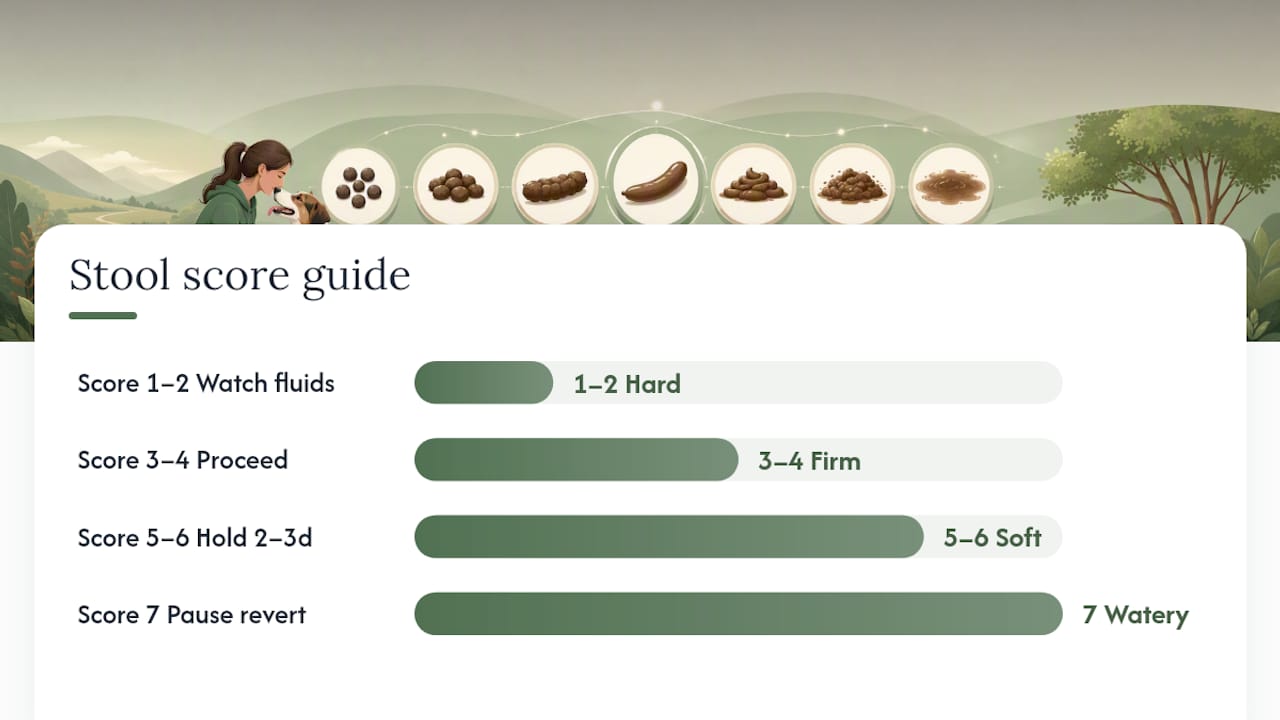
If stool drops to a 5 or 6, hold that ratio for two to three days before advancing again rather than pushing forward on schedule regardless of symptoms. That patience is often what separates a smooth transition from a week of repeated setbacks.
What Do Vets Actually Recommend for Rescue Dog Diets?
Ask five vets about transition timelines and you'll get five slightly different day counts, but the underlying advice is remarkably consistent: the bag is a starting point, not a mandate. Practitioners consistently emphasize adjusting the plan to the dog's actual stool quality, appetite, and energy level rather than sticking to a printed number of days.
The biological reason is straightforward. A dog's gut microbiome needs time to adjust its bacterial population to a new set of ingredients, and rushing that process is what causes most transition-related diarrhea. Appetite and energy are the dog's own feedback signals, arguably more reliable than any calendar.
- Adjust pace based on daily monitoring, not a fixed countdown.
- Favor digestible, simple formulas during the first few weeks.
- Recheck portion size once the new food is fully introduced, since calorie density varies between brands.
- Use a vet-standard calculation, like an RER/MER-based estimate, to confirm you're feeding the right amount once the switch is complete.
If you want the portion math handled for you, a personalized feeding plan built on the same calorie formulas vets use can remove that guesswork once the new food is locked in.
A Note on Patience From Robert
Owners email me constantly asking whether a loose stool on day three means they've done something wrong. Almost always, no. Rescue dogs carry weeks of instability in their gut and their nervous system, and a diet change is just one more variable layered on top of everything else they're adjusting to.

What I'd push back on is the instinct to treat any hiccup as a crisis that demands switching foods again. Constant switching is often worse than staying the course a little longer. If the schedule outlined here isn't landing at day seven, extend it. Extending a transition costs you nothing but a few extra days of measuring food. Ignoring a real red flag costs you a vet bill and a scared dog. Slow down when in doubt, and trust the pattern over any single bad day.
Get a Feeding Plan Built Around Your Rescue Dog
A generic bag instruction can't account for your dog's weight, activity level, or the fact that it's still adjusting to shelter life. Bowlful builds personalized feeding plans using the same RER and MER calorie formulas vets rely on, adjusted for breed, age, and activity, so the portions during your transition are actually right for your dog rather than a rough estimate on a label.
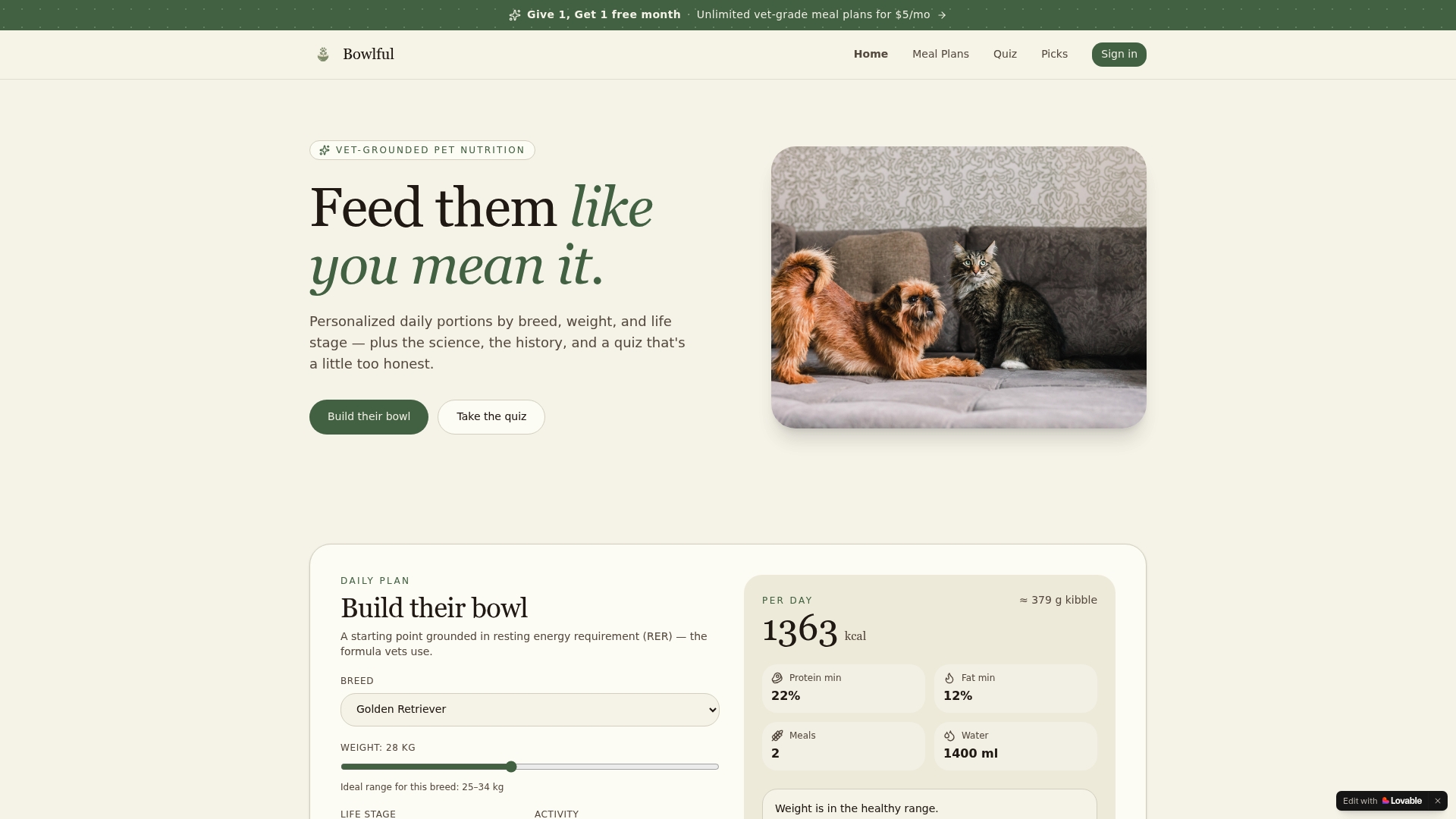
A paid Meal Plan Pro subscription adds a downloadable, printable schedule you can pin to the fridge during the mixing stages, plus ongoing adjustments as your dog's weight and energy settle after adoption. If you're not ready for a full plan, the free pet food transition timeline guide walks through the same staged approach covered here. Start with Bowlful's feeding plan tool to get exact portions for your rescue dog's new food today.
Sources
For readers who want to go deeper on any part of this transition process, these sources back the core guidance above.
- How to Switch Dog Foods: Transitioning Your Dog's Diet
- Re-evaluating your dog’s diet | Cornell University College of Veterinary Medicine
- How to Switch Dog Food
- Iheartdogs