
For most healthy dogs, a gradual 7-day mix-over is the baseline recommendation. Cats and sensitive pets often need 14 to 40 days, depending on individual tolerance and prior GI history. A small number of pets need an immediate vet-supervised switch with no mixing at all.
Here is what that looks like in practice:
- Standard healthy dog: 7-day gradual transition, starting at 25% new food per AAHA's guidelines
- Sensitive dogs, most cats, seniors: 14–40 day extended schedule with slower ratio increases
- Vet-prescribed immediate change: Skip the mix; offer only the new food under veterinary supervision
- First action right now: Check the calorie density (kcal per cup or can) on both the old and new food labels, calculate your pet's daily portion, and pre-measure three days of mixed meals before you start
AAFCO and NRC feeding standards both recognize that calorie density varies significantly between formulas. A cup of Hill's Science Diet Adult may carry a different calorie count than a cup of Purina Pro Plan or Nulo Freestyle, so swapping equal volumes without adjusting for density can accidentally over- or underfeed your pet during the change.
Pro Tip: Use Bowlful's pet nutrition assessment tool to calculate your pet's RER/MER-based daily calorie target before you start mixing. It takes the guesswork out of portion math.
Key Takeaways
A gradual 7-day transition starting at 25% new food is the baseline for healthy adult dogs, while cats and sensitive pets typically need 14 to 40 days to avoid GI upset and learned food aversion.
| Point | Details |
|---|---|
| Standard timeline | Begin at 25% new food; most healthy dogs complete the switch in 7 days. |
| Sensitive pets and cats | Extend to 14–40 days; stay at the last tolerated ratio until stool normalizes. |
| Red flags requiring vet contact | Bloody stool, vomiting more than once in 24 hours, or food refusal beyond 24 hours (dogs) or 12–24 hours (cats). |
| Calorie math matters | Keep total daily calories constant; adjust volume when the new food has a different calorie density. |
| Bowlful personalized plans | Bowlful's RER/MER-based meal plans calculate exact per-phase portions for your specific pet and foods. |
Table of Contents
- Why does switching food too fast cause problems?
- What is the standard 7-day pet food transition timeline?
- When do you need a slower 14–21+ day schedule?
- What is the quick-switch protocol for vet-directed changes?
- How do you monitor your pet's health during the transition?
- Practical tips for mixing wet and dry food, toppers, and palatability
- Special populations: puppies, seniors, and pets with health conditions
- Pre-transition checklist: what to have ready before day one
- How to calculate portion sizes during the transition
- Troubleshooting picky eating and food refusal
- Treats and snacks during the transition period
- The case for patience over speed
- Bowlful makes the transition math easy for you
- Sources
Why does switching food too fast cause problems?
Your pet's gut microbiome, digestive enzymes, and bile acid production are calibrated to the food they eat regularly. Introduce a new protein source, fat level, or fiber profile too quickly, and the digestive system simply cannot keep up. The result is loose stool, gas, or vomiting — not because the new food is bad, but because the gut needs time to adapt.
Common reasons owners change food include:
- Life-stage change: Puppy to adult, adult to senior, or kitten to adult formulas
- Health prescription: A vet recommends a therapeutic diet for kidney disease, allergies, or weight management
- Allergy elimination trial: Switching to a novel protein or hydrolyzed diet to identify triggers
- Supply or cost: The old food is discontinued or no longer affordable
- Palatability: The pet simply refuses the current food
Cats carry an extra risk. They can develop a learned food aversion after experiencing nausea, and AAHA notes that aversion can persist for up to 40 days following a nausea event. Forcing a change while a cat is already feeling unwell can lock in a refusal that outlasts the original illness by weeks.
What is the standard 7-day pet food transition timeline?
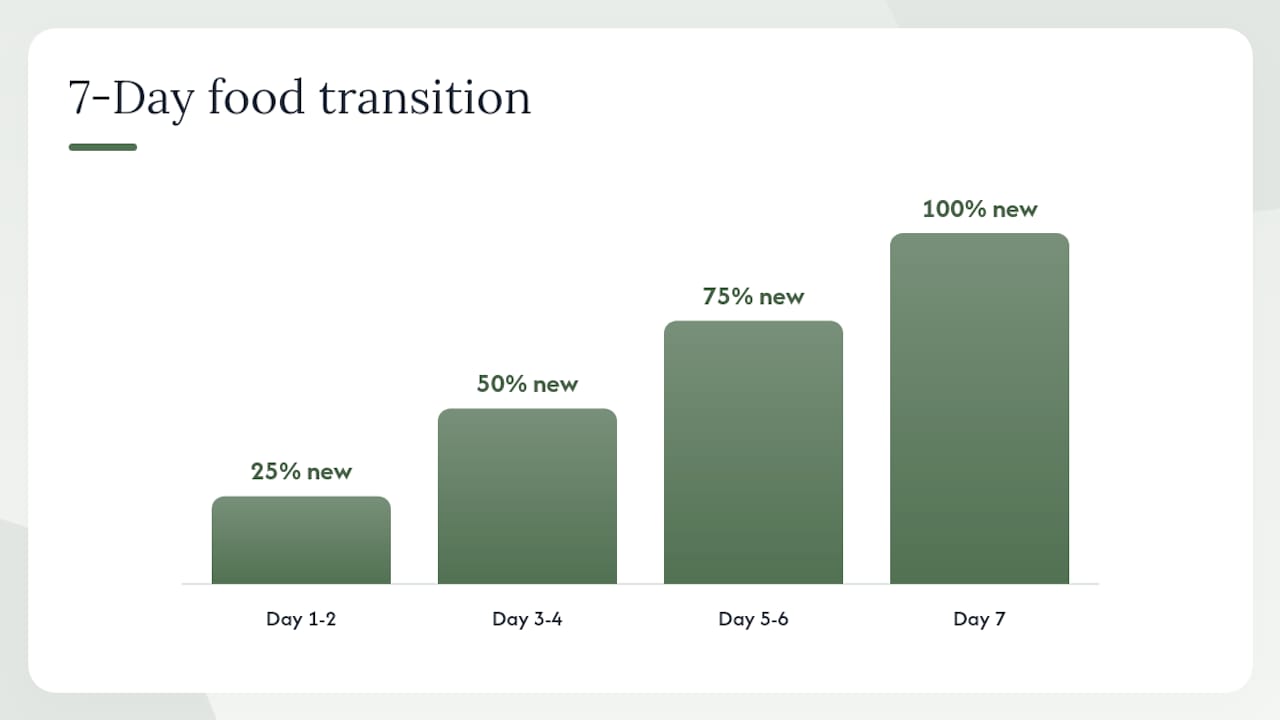
The 7-day schedule is the most widely recommended pet food transition timeline for healthy adult dogs. AKC's guidance uses a four-step ratio progression, and CityVet's one-week example maps it to daily percentages. Here is a practical version you can follow:
How to apply this to actual meals:
- Weigh or measure each food separately using a kitchen scale or dedicated measuring cup
- Check the kcal/cup on both bags; if the new food is more calorie-dense, reduce total volume slightly to keep daily calories stable
- Mix in the bowl right before feeding, not in bulk, to keep the old food fresh
If your dog shows mild loose stool on days 3–4, stay at the 50/50 ratio for an extra day or two before moving forward. PetMD recommends reverting to the last ratio that did not cause loose stool rather than pushing through.
Pro Tip: Label three small containers "Day 1–2," "Day 3–4," and "Day 5–6" with the pre-measured amounts for each phase. You will avoid accidental overfeeding and make the process nearly automatic.
When do you need a slower 14–21+ day schedule?
Tufts Petfoodology notes that some pets need 4–6 weeks to transition without GI upset. The 7-day plan is a starting point, not a universal rule.
Pets who commonly need a slower schedule:
- Cats (most of them, most of the time)
- Dogs with a history of inflammatory bowel disease, colitis, or chronic loose stool
- Pets recently on antibiotics, which disrupt the gut microbiome
- Senior pets with slower digestive motility
- Any pet currently showing GI symptoms
A practical 14-day version simply cuts each ratio step in half: spend 3–4 days at 25% new food, then 3–4 days at 50%, then 3–4 days at 75%, then complete the switch. A 21-day plan adds even smaller increments — moving in 10% steps every 2–3 days.
The core rule across all extended schedules: stay at the last tolerated ratio until stool returns to normal, then resume. Never push to the next ratio while your pet is still showing symptoms.
Pro Tip: For cats specifically, try changing the texture before the formula. If your cat eats pâté, introduce the new food as pâté first. Texture aversion is often stronger than flavor aversion in cats.
What is the quick-switch protocol for vet-directed changes?
Sometimes a gradual transition is not an option. A vet may prescribe an immediate switch for allergic reactions, acute gastroenteritis requiring a bland diet, or a therapeutic formula that cannot be mixed with the previous food without undermining the treatment.
The quick-switch approach works like this:
- Offer only the new food at the next scheduled meal
- Remove uneaten food after 20–30 minutes — do not leave it down
- Skip to the next meal if the pet refuses; a healthy adult dog or cat will not be harmed by missing one meal
- Offer again at the next scheduled time with no old food available
- Use a small, vet-approved topper (low-sodium broth, a few drops of tuna water for cats) to encourage acceptance if needed
AAHA's guidance supports using safe flavor enhancers to aid acceptance, but keep additives below roughly 10% of daily calories and confirm with your vet when the diet is therapeutic.
Call your vet if a healthy adult dog refuses to eat for more than 24 hours, or a cat for more than 12–24 hours. Cats are at risk for hepatic lipidosis (fatty liver disease) during prolonged food refusal, so the threshold is tighter.
Pro Tip: Warm the new food slightly — to just below body temperature — before offering it. Aroma is a primary driver of acceptance in both dogs and cats, and warming amplifies it.
How do you monitor your pet's health during the transition?
Stool quality is your clearest signal. Formed, moist stool that holds its shape is normal. Soft but formed stool is a mild sign to slow down. Watery stool, mucus, or blood means stop and call your vet.
Red flags that require a vet call:
- Vomiting more than once in a 24-hour period
- Bloody or black stool at any point
- Complete refusal to eat beyond 24 hours (dogs) or 12–24 hours (cats)
- Lethargy, bloating, or visible abdominal discomfort
- Diarrhea persisting more than 48 hours despite reverting to the old ratio
PetMD distinguishes between mild, transient gassiness — which is normal and expected — and the red-flag signs above, which signal something beyond normal adjustment.
Keep a simple log: date, ratio used, meal time, and a one-word stool description (formed, soft, watery). When you call your vet, that log tells them exactly where in the schedule the problem started. CityVet recommends this kind of short feeding record to speed diagnosis and improve the accuracy of vet advice.
Pro Tip: A notebook on the fridge works fine. So does a notes app on your phone. The format does not matter; the consistency does.
Practical tips for mixing wet and dry food, toppers, and palatability
Mixing wet and dry food during a transition is fine, but it changes the calorie math. Wet food is typically 70–80% water, so its calorie density per gram is much lower than dry kibble. Measure each component by weight when possible, or use the feeding guide on each package to calculate the fraction of a daily serving each component represents.
Safe ways to improve acceptance:
- Low-sodium chicken or beef broth poured over dry food (check the label — no onion, no garlic)
- Tuna water or clam juice for cats, in small amounts
- Plain canned pumpkin (not pie filling) as a fiber source if stool is loose; a teaspoon per meal is a common starting point after vet approval
- A vet-approved probiotic added to the transition meals if your pet has a history of GI sensitivity
Keep all toppers and extras below 10% of your pet's daily calorie target. More than that and you risk unbalancing the diet or masking the therapeutic effect of a prescription food. See Bowlful's guide on establishing a feeding routine for a practical framework on measuring and scheduling meals.
Special populations: puppies, seniors, and pets with health conditions
Puppies and kittens have higher calorie needs per pound of body weight and are more sensitive to calorie swings. Transition them on the same gradual schedule but weigh them weekly during the change to catch any unintended weight loss early.
Senior pets often have slower gut motility and reduced digestive enzyme output. A 14-day minimum is a reasonable starting point for dogs over 8 and cats over 10, but some may require up to 40 days depending on tolerance and prior GI issues. Pets with chronic kidney disease, liver disease, or pancreatitis should only transition under direct veterinary supervision, with possible bloodwork follow-up to confirm the new diet is being tolerated metabolically, not just digestively.
Food-allergy and GI-disease patients follow a different protocol entirely:
- Elimination trials require a strict single novel protein or hydrolyzed diet with zero cross-contamination from the old food
- No toppers, treats, or flavor enhancers unless they are part of the prescribed diet
- Reintroduction of old ingredients happens one at a time, with a 2-week observation window per ingredient
- Work with your vet or a board-certified veterinary nutritionist for diagnostics and reintroduction sequencing
For pets with chronic illness, Bowlful's resource on palliative nutrition covers tailored feeding approaches that go beyond standard transition timelines.
Pre-transition checklist: what to have ready before day one
Starting prepared prevents mid-transition scrambles. Gather these before you open the new bag:
- Measuring cups and a kitchen scale (scale is more accurate for calorie control)
- Labeled containers or zip bags for pre-measured daily portions
- Both foods in the forms you will use (wet, dry, or both)
- Low-sodium broth for palatability if needed
- Plain canned pumpkin (optional, for mild loose stool)
- A notebook or phone app for the feeding log
- Your vet's contact number and after-hours emergency clinic info
A new owner's nutrition checklist from Bowlful covers the broader feeding setup if you are starting from scratch.
How to calculate portion sizes during the transition
The safest approach is to keep total daily calories constant throughout the transition, adjusting only the ratio of old to new food. Here is the math:
- Find the kcal/cup (or kcal/can) on both food labels
- Calculate your pet's daily calorie target (use your vet's recommendation or a RER/MER-based calculator)
- At a 75/25 split, 75% of the daily calorie target comes from the old food and 25% from the new
- Convert each calorie amount to cups or grams using each food's density figure
If the new food is more calorie-dense, the total volume in the bowl will be smaller. That is correct — do not top it up with extra kibble to match the old volume.
Troubleshooting picky eating and food refusal
A pet that sniffs the bowl and walks away is not necessarily sick. Dogs and cats both notice texture, aroma, and temperature changes immediately.
Try these in order:
- Warm the food to just below body temperature (microwave 10–15 seconds, stir, check temperature)
- Reduce the new food ratio by one step and hold there for 3–4 extra days
- Add a small amount of low-sodium broth to improve aroma without adding significant calories
- Feed at a consistent time in a quiet location; stress suppresses appetite in both species
If a dog refuses food for more than 24 hours or a cat for more than 12 hours despite these adjustments, that crosses from picky eating into a medical concern. Bowlful's article on anxiety and appetite in dogs covers the behavioral side of food refusal in more depth.
Treats and snacks during the transition period
Treats count toward daily calories, and during a transition they can also introduce proteins or ingredients that complicate an allergy elimination trial or a therapeutic diet. The general rule: keep treats to no more than 10% of daily calorie intake, and choose treats made from the same protein source as the new food when possible.

During an elimination diet trial, treats must be eliminated entirely or replaced with single-ingredient treats that match the prescribed novel protein. A beef-based treat given during a rabbit-protein elimination trial invalidates the trial.
For standard transitions with no medical component, single-ingredient treats (freeze-dried chicken, plain cooked sweet potato) are the cleanest option. Avoid highly processed treats with long ingredient lists during the first two weeks of a new food, since they make it harder to identify the source of any GI reaction.
The case for patience over speed
Most transition problems come from moving too fast, not from the new food itself. The standard 7-day schedule works well for healthy adult dogs, but it is a minimum, not a target. If your dog is doing fine at day 4, there is no reason to rush to 100% by day 7.
The real cost of going too fast is a learned aversion, especially in cats. Once a cat associates a food with nausea, reversing that association can take weeks. Slowing down costs you a few extra days. Rushing costs you potentially months of feeding difficulty.
Bowlful makes the transition math easy for you
Figuring out the right calorie split at each ratio step is where most owners lose confidence. Bowlful removes that friction with personalized meal plans built on the same RER/MER formulas veterinarians use, calibrated to your pet's breed, age, weight, and activity level.
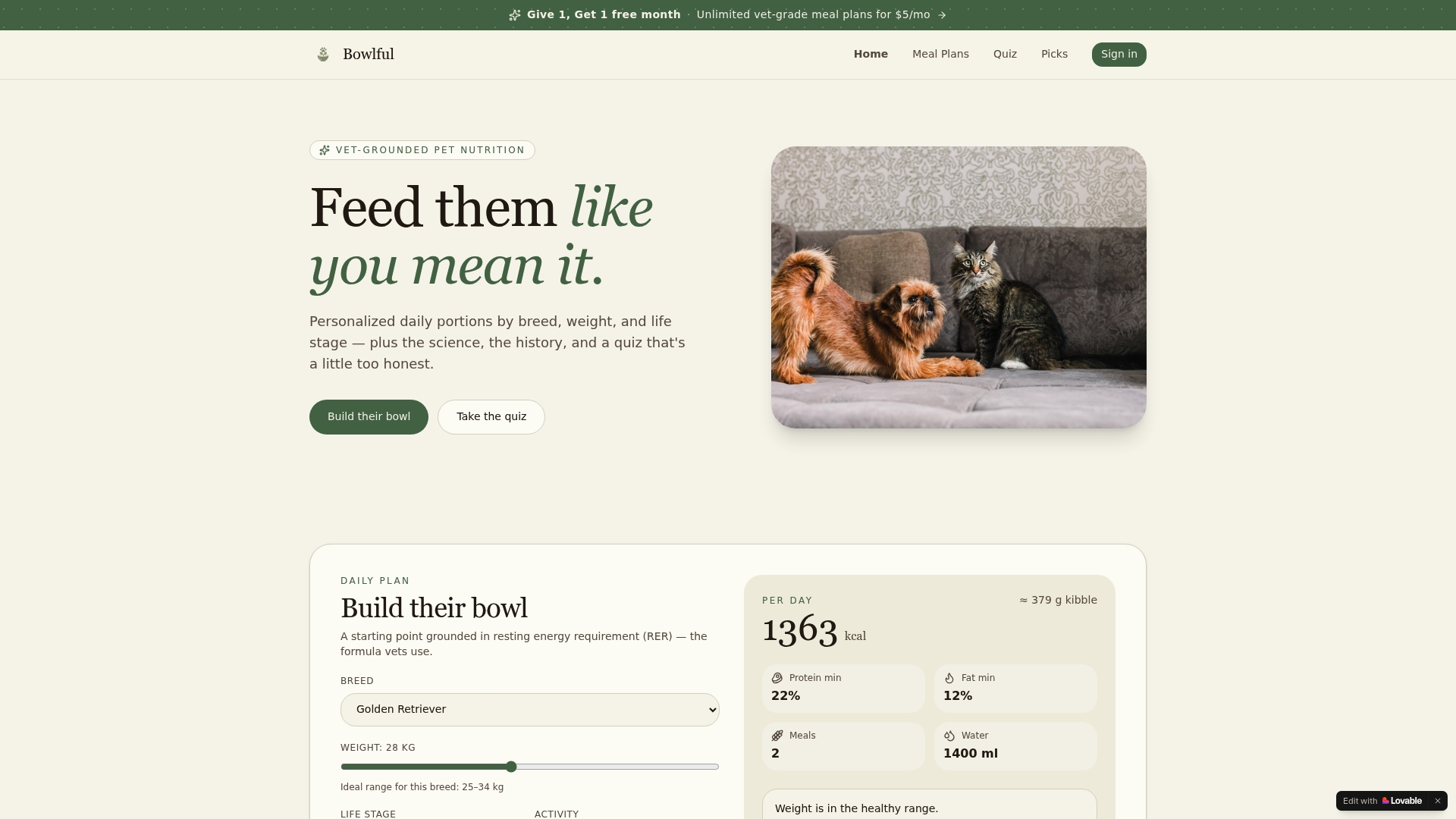
During a food transition, a Bowlful meal plan gives you the exact gram or cup amounts for each phase of the schedule, adjusted for the calorie density of the specific foods you are using. Sensitive pets get a slower schedule built in. The downloadable PDF means you have the day-by-day plan in your hand before you open the new bag, with no recalculating required. Get your pet's personalized transition plan at Bowlful and start the switch with the right numbers from day one.
Sources
- How do I switch my pet’s food? — Tufts Petfoodology
- Tips and timelines for transitioning your pet to a new food — AAHA
- How to switch your dog's food — PetMD
- The right way to switch dog foods — AKC
- Transitioning your pet to a new food — CityVet
This article is general information, not a substitute for advice from a qualified doctor. Consult a qualified healthcare professional about your own circumstances before acting on anything here.