
Balanced dog nutrition comes down to one core principle: feed a complete, AAFCO-compliant diet calibrated to your dog's life stage, body weight, and activity level, then monitor and adjust using Body Condition Score (BCS). That is the whole framework. Everything else, including label reading, treat math, and home-cooked diet safety, is execution detail.
Here is what to do right now:
- Pick a food with a clear AAFCO nutritional adequacy statement that matches your dog's life stage (growth, adult maintenance, or all life stages).
- Weigh your dog and assess BCS on the standard 1–9 scale. Ribs you can feel but not see = BCS 4–5, the healthy target.
- Estimate daily calories using the bag's feeding chart as a rough start, then refine with the RER formula (see Section 11).
- Log weight and BCS weekly for the first month after any diet change.
If your dog is losing or gaining weight unexpectedly, showing persistent GI signs, or has a diagnosed condition such as kidney disease or diabetes, consult your veterinarian before adjusting the diet on your own.
Pro Tip: Take a photo of your dog from above and from the side every two weeks. Visual records catch gradual weight changes that a scale alone can miss.

Table of Contents
- 1. The six essential nutrients your dog actually needs
- 2. How to read a dog food label and what AAFCO actually tells you
- 3. Feeding for puppies, adults, and seniors: what actually changes
- 4. How much to feed: calories, feeding charts, and Body Condition Score
- 5. How to switch diets safely without upsetting your dog's stomach
- 6. Treats, overfeeding mistakes, and a practical weight-management plan
- 7. Home-cooked and raw diets: real risks and how to do them safely
- 8. Food allergies, intolerances, and when prescription diets are the answer
- 9. Red flags for poor nutrition and when to call your vet
- 10. Personalizing feeding with RER: a worked example and monitoring plan
- Key Takeaways
- The part of dog feeding most guides get wrong
- Bowlful gives you a personalized feeding plan built on the same math your vet uses
- Useful sources for further reading
1. The six essential nutrients your dog actually needs
Dogs require six nutrient classes to survive and thrive: water, protein, fat, carbohydrates and fiber, vitamins, and minerals. No single food ingredient delivers all six, which is why "complete and balanced" formulation matters so much.
What each class does:
- Water: Regulates body temperature, transports nutrients, and supports every metabolic reaction. Dehydration sets in faster than most owners expect, especially in hot weather or after illness.
- Protein: Supplies the essential amino acids dogs cannot synthesize on their own. Muscle maintenance, immune function, enzyme production, and coat health all depend on adequate protein.
- Fat: Delivers essential fatty acids (linoleic acid, alpha-linolenic acid) and fat-soluble vitamins A, D, E, and K. Omega-3 fatty acids from fish oil also support skin, coat, and joint health.
- Carbohydrates and fiber: Provide a readily available energy source and support digestive health. Soluble fiber feeds beneficial gut bacteria; insoluble fiber promotes motility.
- Vitamins: Required in small amounts for metabolic processes, immune defense, and bone health. Fat-soluble vitamins (A, D, E, K) and water-soluble B vitamins each serve distinct roles.
- Minerals: Calcium and phosphorus build bone and teeth; zinc, iron, copper, and selenium support enzyme systems, oxygen transport, and antioxidant defense.
AAFCO/NRC nutrient minimums at a glance
The figures below reflect Merck Veterinary Manual summaries of AAFCO and NRC minimums on a dry-matter basis (DMB).

| Nutrient | Adult maintenance (DMB min.) | Growth/reproduction (DMB min.) | Common ingredient sources |
|---|---|---|---|
| Protein | 18% | 22% | Chicken, beef, salmon, eggs, legumes |
| Fat | 5% | 8% | Chicken fat, fish oil, flaxseed |
| Calcium | — | 1.0% | Bone meal, calcium carbonate |
| Phosphorus | — | — | Meat meals, dairy |
| Omega-3 (EPA+DHA) | Not set by AAFCO | Recommended for growth | Salmon oil, menhaden fish meal |
| Fiber | No minimum | No minimum | Beet pulp, pea fiber, brown rice |
Pro Tip: When comparing a canned food to a dry kibble, convert both to a dry-matter basis before judging protein or fat content. Canned food runs roughly 75% moisture; kibble runs roughly 10%. A canned food showing 9% protein on the label may actually deliver more protein per calorie than a kibble showing 25%, once moisture is removed from the equation.
2. How to read a dog food label and what AAFCO actually tells you
The nutritional adequacy statement is the single most important line on any pet food package. It tells you whether the food is complete and balanced, which life stage it covers, and how that claim was substantiated. Everything else on the label, including the front-panel photography and the ingredient list, is secondary.
The five label sections that matter:
- Nutritional adequacy statement: — Look for "complete and balanced for [life stage] as established by AAFCO." If this line is missing or says "for supplemental feeding only," the food is not a complete diet.
Feeding trial vs. formulation: why the distinction matters
"Formulated to meet the nutritional levels established by the AAFCO Dog Food Nutrient Profiles" means the recipe was checked against a nutrient spreadsheet. "Animal feeding tests using AAFCO procedures" means real dogs ate the food and showed no deficiency signs over a defined period. Feeding trials test how the diet actually performs in a living animal, not just on paper. Veterinary nutritionists generally prefer foods backed by feeding trials for this reason, though formulation-only foods from reputable manufacturers can still be nutritionally sound.
Three label myths worth correcting:
- "High protein" on the front panel means nothing without checking the guaranteed analysis and the calorie statement. Marketing copy is not regulated the same way the nutritional adequacy statement is.
- Grain-free does not mean healthier. The FDA investigated a potential link between grain-free diets and dilated cardiomyopathy in dogs; the science is still evolving, but grain-free is not a default upgrade.
- First ingredient = best food is an oversimplification. Ingredient splitting (listing pea protein, pea flour, and pea starch separately) can push a single ingredient source higher than its actual contribution warrants.
For a deeper walkthrough of nutritional adequacy statements, Bowlful's label guide covers the fine print most owners skip.
3. Feeding for puppies, adults, and seniors: what actually changes
Choose a food with the AAFCO life-stage statement that matches your dog's current phase. Then adjust calories, protein, and meal frequency to match growth, maintenance, or aging needs. The label statement is the floor; BCS monitoring is the ceiling.
Life-stage priorities
Puppies (growth):
- Higher protein and fat minimums (22% and 8% DMB respectively) to support rapid tissue growth.
- Calcium-to-phosphorus ratio matters more than absolute calcium content. Large-breed puppies are especially sensitive: excess calcium during growth can contribute to skeletal abnormalities, so large-breed-specific puppy foods with controlled Ca:P ratios are strongly preferred.
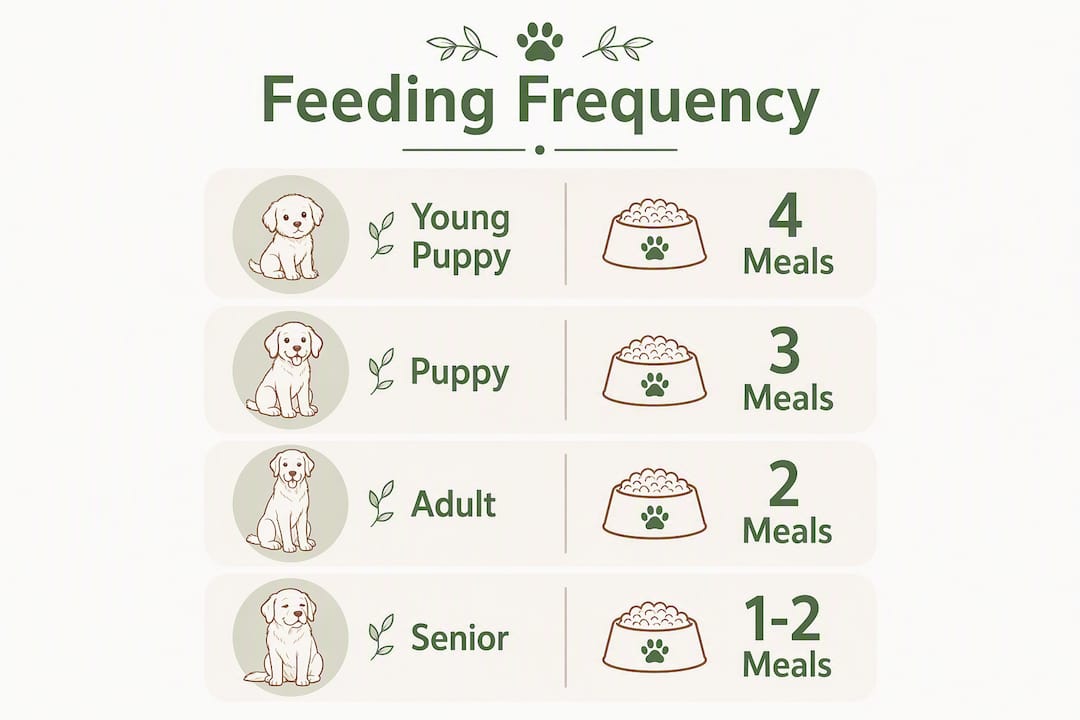
- Feed three to four meals per day until 6 months, then transition to twice daily.
Adult dogs (maintenance):
- AAFCO adult maintenance statement (18% protein, 5% fat DMB minimum).
- Two meals per day is the standard recommendation for most adult dogs.
- "All life stages" foods meet growth minimums, which means they often deliver more calories than a sedentary adult needs. Watch BCS closely if you use one.
Pregnant and lactating dogs:
- Energy needs increase substantially during late gestation and peak lactation. A growth-formula or all-life-stages food is appropriate; do not restrict calories during lactation.
Senior dogs:
- No universal AAFCO "senior" life-stage category exists. Most senior dogs do well on adult maintenance foods with BCS-guided portioning.
- Protein needs do not decrease with age; some evidence suggests older dogs benefit from slightly higher protein to maintain muscle mass.
- Monitor for conditions (kidney disease, diabetes, dental disease) that require diet modification.
Feeding frequency by life stage
| Life stage | Age bracket | Meals per day |
|---|---|---|
| Young puppy | 8–12 weeks | 4 |
| Puppy | 3–6 months | 3 |
| Puppy | 6–12 months | 2–3 |
| Adult | 1–7 years (varies by breed) | 2 |
| Senior | 7+ years (varies by breed) | 2 |
Pro Tip: Large breeds (over 50 lbs) reach adulthood later than small breeds, sometimes at 18–24 months. Keep a large-breed puppy on a growth formula until your vet confirms skeletal maturity, not just when the dog looks "grown."
For breed-specific puppy growth stage nutrition, Bowlful's puppy guide covers size-specific timing in detail.
4. How much to feed: calories, feeding charts, and Body Condition Score
Bag feeding charts are a starting point, not a prescription. Individual metabolic variation, activity level, spay/neuter status, and genetics all shift a dog's actual energy needs away from the chart's average. The practical method: use the chart to set an opening portion, then calculate or estimate RER and MER to personalize, and tune from there using BCS and weekly weight.
How to estimate daily calories
- Find the food's calorie density from the calorie statement on the label (kcal/cup or kcal/can).
- Estimate Resting Energy Requirement (RER): RER (kcal/day) = 70 × (body weight in kg)^0.75. For a 15 kg dog: 70 × (15)^0.75 ≈ 70 × 7.6 ≈ 532 kcal/day at rest.
- Apply a MER multiplier for life stage and activity: neutered adult = 1.6 × RER; intact adult = 1.8 × RER; weight loss = 1.0 × RER; active/working dog = 2.0–5.0 × RER.
- Subtract treat calories from the daily total before calculating food portions.
- Divide across meals (typically two for adults).
Using BCS to adjust portions
The Body Condition Score (BCS) scale is a practical monitoring tool available to owners without a body-composition scanner. Scores range from underweight to ideal to overweight, with guidance to adjust portions accordingly and consult a vet for high scores.
Tracking checklist:
- Weigh your dog on the same scale, same time of day, weekly.
- Photograph from above and from the side every two weeks.
- Score BCS at each weigh-in.
- Adjust portions in 10% increments, not larger, and wait two weeks before adjusting again.
For a practical breakdown of why dogs need different food amounts, Bowlful's owner guide explains the metabolic factors behind individual variation.
5. How to switch diets safely without upsetting your dog's stomach
A sudden diet switch is the most common cause of preventable GI upset in dogs. The fix is a gradual transition that gives gut bacteria time to adapt to new ingredients and fiber sources.
Standard 7–10 day transition schedule
- Days 1–2: 75% old food, 25% new food.
- Days 3–4: 50% old food, 50% new food.
- Days 5–6: 25% old food, 75% new food.
- Days 7–10: 100% new food.
For dogs with sensitive stomachs or a history of GI disease, extend the schedule to 14 days and slow down at any step that produces loose stool.
What to monitor during the transition
- Stool quality: — Loose stool for one or two days is common. Persistent diarrhea (more than 48 hours), blood in stool, or vomiting warrants a call to your vet.
Warning signs that require veterinary advice: bloody diarrhea, vomiting more than twice in 24 hours, signs of abdominal pain (hunching, guarding), or any neurological change.
One practical tip for owners who rotate proteins: keep a simple log (date, food, stool score 1–5, any symptoms). That record becomes invaluable when you need to identify which protein a dog tolerates best, or when a vet asks for a feeding history.
6. Treats, overfeeding mistakes, and a practical weight-management plan
Treats should account for no more than 10% of your dog's daily caloric intake. That sounds simple, but most owners underestimate how fast treat calories accumulate.
Calorie budget examples by size:
- Small dog (10 lbs, ~280 kcal/day): 10% = 28 kcal. One standard milk-bone biscuit runs 40 kcal. A single treat already blows the budget.
- Medium dog (30 lbs, ~600 kcal/day): 10% = 60 kcal. Two or three small training treats stay within range; a large rawhide chew can add 100+ kcal.
- Large dog (70 lbs, ~1,100 kcal/day): 10% = 110 kcal. Still easy to exceed with dental chews, which often run 70–150 kcal each.
Common overfeeding mistakes and quick fixes
- Free-feeding dry kibble: Leaves calorie intake completely untracked. Switch to measured, timed meals.
- Using a coffee mug or solo cup to measure: Volume varies wildly. Use a kitchen scale or a calibrated measuring cup.
- Table scraps as "just a little extra": Cooked fats and seasonings add calories and can cause pancreatitis. Stop entirely or substitute with a small piece of plain cooked chicken.
- Mismatched treat density: A "low-calorie" label on a treat bag is relative. Always check the kcal per treat, not just the marketing claim.
- Not counting training treats: Ten small training treats during a session can add 50–100 kcal. Count them.
Simple weight-loss action plan
- Calculate current daily intake (food + treats).
- Reduce total calories by roughly 20% to start, keeping treats within the 10% rule.
- Swap high-calorie treats for low-calorie alternatives: baby carrots, plain rice cakes, or commercial low-calorie training treats.
- Add 10–15 minutes of structured activity daily (leash walk, fetch, nose work).
- Weigh weekly and reassess BCS monthly. If no progress after four weeks, consult your vet.
Pro Tip: Swap half of your dog's treat budget for enrichment activities: sniff mats, food puzzles, and lick mats deliver mental stimulation without the calories. Many dogs find them more satisfying than a biscuit.
For small-breed-specific strategies, Bowlful's guide on preventing obesity in small breed dogs covers calorie density traps that catch small-dog owners off guard.
7. Home-cooked and raw diets: real risks and how to do them safely
Home-cooked and raw diets carry two distinct risks: foodborne pathogens and nutrient imbalance. Both are manageable, but neither is trivial, and both require professional formulation to address safely over the long term.
Raw diets increase exposure to Salmonella, Listeria, and Campylobacter, which can affect both the dog and the humans in the household. Home-cooked diets, even those built from high-quality whole foods, frequently fall short on calcium, zinc, iodine, and fat-soluble vitamins unless specifically formulated.
Risk checklist for home-cooked and raw feeding
- Pathogen exposure: Raw meat, poultry, and eggs carry bacterial contamination risk. Immunocompromised people, children, and elderly household members face the highest risk.
- Bone hazards: Cooked bones splinter and cause GI perforations. Raw bones carry fracture and choking risks. Neither is risk-free.
- Nutrient shortfalls: Calcium deficiency is the most common problem in home-cooked diets. Iodine, zinc, and vitamin D are also frequently inadequate.
- Caloric miscalculation: Whole-food ingredients vary in caloric density; without a formulation tool, portions are guesswork.
How to do it safely
- Consult a board-certified veterinary nutritionist (DACVN) before starting. The American College of Veterinary Nutrition maintains a directory at acvn.org.
- Request a written, complete recipe with specific ingredient weights, not volume measures.
- Use a calibrated kitchen scale for every ingredient, every meal.
- Source a veterinary-grade supplement blend formulated to complete the recipe, not a human multivitamin.
- Recheck the formulation annually or whenever your dog's weight, life stage, or health status changes.
When home-cooked diets are genuinely appropriate: dogs with multiple confirmed food allergies who cannot tolerate commercial novel-protein or hydrolyzed diets, or dogs with specific medical conditions where a custom recipe is the only way to hit precise nutrient targets. In both cases, veterinary nutritionist oversight is non-negotiable.
Pro Tip: Before your first nutrition consult, collect three weeks of feeding records: what you fed, how much, brand and lot numbers if commercial, and any supplements. A nutritionist can formulate a better plan with a complete history than with a blank slate.
8. Food allergies, intolerances, and when prescription diets are the answer
True food allergies in dogs are less common than owners assume. Skin and GI signs that look like food reactions are more often caused by environmental allergens, parasites, or other GI conditions. The only reliable way to confirm a food allergy is an elimination trial conducted under veterinary guidance.
How an elimination trial works
- Escalate if needed: — No improvement after 12 weeks suggests the primary cause is not dietary. Return to your vet for further diagnostics.
When prescription therapeutic diets are indicated
- Confirmed food allergy: Hydrolyzed or novel-protein prescription diets maintain allergen avoidance long-term.
- Chronic GI disease (IBD, EPI): Highly digestible or low-fat therapeutic diets reduce GI workload.
- Renal disease: Phosphorus-restricted, controlled-protein diets slow disease progression.
- Diabetes mellitus: High-fiber, controlled-carbohydrate diets support glycemic regulation.
Therapeutic diets require veterinary supervision because modifying nutrients to manage disease can create new deficiencies if not properly formulated. A board-certified veterinary nutritionist is the appropriate referral when a condition is complex or a commercial therapeutic diet is not achieving the desired clinical response.
9. Red flags for poor nutrition and when to call your vet
Most nutritional problems develop gradually, which is exactly why weekly monitoring matters. By the time a dog looks obviously unwell, the deficit or excess has usually been building for weeks or months.
Red-flag signs that warrant a veterinary visit:
- Rapid, unexplained weight loss or gain (more than 10% of body weight in four weeks)
- Persistent diarrhea or vomiting lasting more than 48 hours
- Dull, dry, or excessively flaky coat
- Lethargy or reduced exercise tolerance without an obvious cause
- Visible muscle wasting, especially over the hindquarters and spine
- Excessive thirst and urination (polyuria/polydipsia), which can signal kidney disease or diabetes
- Swollen abdomen
- Persistent scratching, hair loss, or recurrent skin infections
Each of these signs can have non-nutritional causes, but diet is always worth reviewing when they appear.
Vet-visit checklist: what to bring
- Current food brand, formula name, and lot number.
- Daily feeding amount (weighed, not estimated) and meal schedule.
- Complete treat list with approximate quantities per day.
- Any supplements or home-cooked additions.
- Weight and BCS records from the past 4–8 weeks.
- Photographs of body condition from above and from the side.
- Stool quality notes (consistency, frequency, any blood or mucus).
- Any flavored medications (heartworm prevention, dental chews).
Arriving with this information cuts the consultation time and gives your vet the data to make a specific recommendation rather than a general one.
10. Personalizing feeding with RER: a worked example and monitoring plan
Personalization starts with RER, applies a MER multiplier for life stage and activity, then uses BCS to fine-tune over time. Owners who use RER-based portioning and monitor BCS consistently achieve more stable weight control than those who rely on bag charts alone.
Worked example: 30 lb neutered adult dog
- Convert weight to kg: 30 lbs ÷ 2.2 = 13.6 kg.
- Calculate RER: 70 × (13.6)^0.75 = 70 × 6.8 ≈ 476 kcal/day.
- Apply MER multiplier: Neutered adult = 1.6 × 476 = 762 kcal/day.
- Subtract treat allowance (10%): 762 × 0.10 = 76 kcal for treats. Food budget = 686 kcal.
- Divide by food calorie density: If the kibble provides 350 kcal/cup, the dog needs approximately 2 cups per day, split across two meals (1 cup per meal).
Sample day meal plan (30 lb adult, 762 kcal/day)
| Meal | Food | Amount | Estimated kcal |
|---|---|---|---|
| Morning | Dry kibble (350 kcal/cup) | 1 cup | 350 |
| Evening | Dry kibble | — | — |
| Treats (throughout day) | Small training treats (~5 kcal each) | 15 treats | 75 |
Adjust upward or downward in 10% increments based on BCS at the four-week check-in.
Monitoring protocol
- Week 1–4: Weigh every seven days, same scale, same time.
- Week 4: Assess BCS. If BCS is 4–5 and weight is stable, hold the plan. If BCS is 6+, reduce food by 10%.
- Week 8: Photo comparison from above and side. Muscle mass assessment (feel over the spine and hindquarters).
- Ongoing: Recheck BCS monthly; recalculate RER if weight changes by more than 5%.
Pro Tip: Use a digital kitchen scale rather than a measuring cup for kibble. Cup volume varies by kibble shape and how tightly you pack it; weight is consistent. A 10% measuring error compounded daily adds up to meaningful calorie drift over a month.
Bowlful's pet feeding schedule by weight translates this RER framework into a practical schedule across weight ranges.
Canine obesity is one of the most prevalent nutritional problems in American dogs. Keeping your dog at BCS 4–5 through consistent monitoring is one of the most concrete steps you can take for long-term health.
Key Takeaways
Balanced dog nutrition requires an AAFCO-complete food matched to your dog's life stage, portioned using RER/MER calculations, and adjusted continuously through BCS monitoring and weekly weigh-ins.
| Point | Details |
|---|---|
| AAFCO statement first | Always verify the nutritional adequacy statement matches your dog's life stage before buying any food. |
| RER over bag charts | Calculate RER and apply a MER multiplier to set a personalized calorie target; bag charts are averages, not prescriptions. |
| BCS is your feedback loop | Score BCS on the 1–9 scale monthly and adjust portions in 10% increments; never wait for visible weight change to act. |
| Treats count | Keep treats at or below 10% of daily calories and weigh kibble portions with a kitchen scale to avoid cumulative drift. |
| Bowlful personalizes it for you | Bowlful's interactive quiz and RER-based meal plans translate these principles into a downloadable, vet-reviewed feeding plan for your specific dog. |
The part of dog feeding most guides get wrong
Most dog nutrition content treats the bag feeding chart as a minor caveat and then moves on. The reality is that the chart is the single biggest source of chronic overfeeding in American dogs, and the industry knows it. Charts are built for an average dog at an average activity level, which describes almost no individual dog accurately. A spayed, sedentary Labrador and an intact, working Border Collie of the same weight have energy needs that can differ by a factor of two or more.
What I find genuinely underappreciated is how forgiving the RER/MER framework is once owners actually use it. You do not need a veterinary degree to run the calculation. You need a kitchen scale, a calculator, and the willingness to check BCS once a month. The math takes five minutes. The payoff is a dog whose weight stays stable across years instead of creeping up by a pound or two every winter.
The other thing most guides understate is the treat problem. Owners who are meticulous about measuring kibble will hand out dental chews, training treats, and table scraps without a second thought, then wonder why their dog's weight keeps climbing despite "feeding the right amount." Treats are not a rounding error. For a small dog, a single large dental chew can represent 30–40% of daily caloric needs. That is not a minor detail.
The vet-backed approach Bowlful uses, grounding feeding plans in RER and BCS monitoring rather than generic charts, is not a premium add-on. It is just the correct method, applied consistently. The gap between knowing this and actually doing it is where most dogs' health outcomes are decided.
Bowlful gives you a personalized feeding plan built on the same math your vet uses
Generic feeding charts leave too much to chance. Bowlful builds your dog's daily calorie target from the RER formula used by veterinary clinicians, then layers in breed, life stage, activity level, and BCS to produce a meal plan that fits your actual dog, not a statistical average.
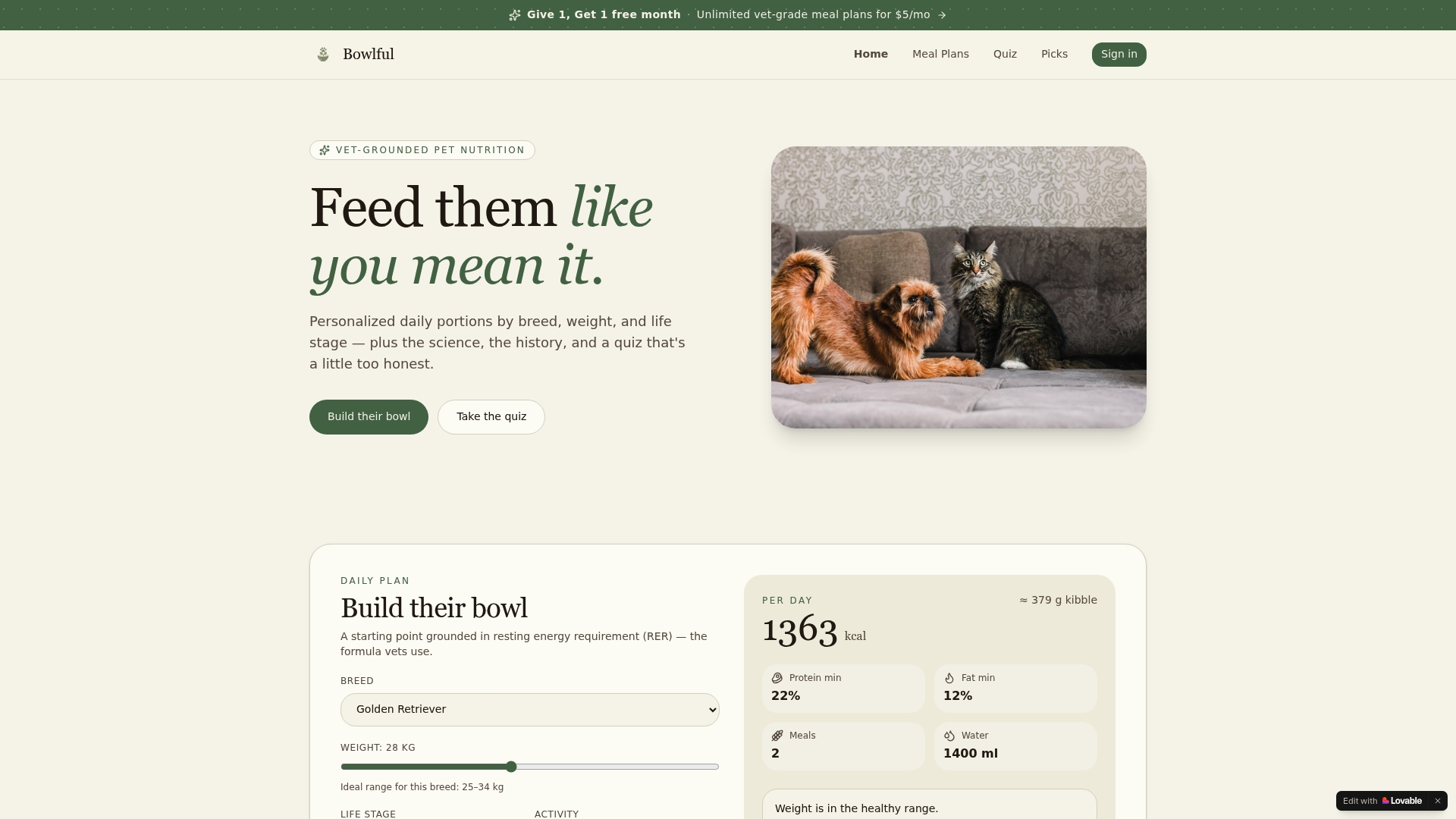
Here is what a Bowlful Meal Plan Pro subscription includes: a personalized daily calorie target calculated from RER and MER, a downloadable meal-plan PDF with portioned meals and treat allowances, a monitoring template for weekly weigh-ins and BCS tracking, and curated food and supplement recommendations aligned with AAFCO standards. The interactive quiz takes under five minutes and produces a plan you can start using the same day.
Start your personalized feeding plan at Bowlful and get the same RER-based framework your vet would use, without waiting for an appointment.
Useful sources for further reading
The sources below are the most authoritative references for dog nutrition in the United States. Bring the AAFCO label guide and the Merck Veterinary Manual entry to any veterinary nutrition appointment as a reference baseline.
-
National Research Council: Dog Nutrition: The NRC's foundational summary of nutrient requirements for dogs. Covers all six essential nutrient classes, recommended allowances, and safe upper limits. The primary scientific reference behind AAFCO's nutrient profiles.
-
AAFCO: Reading Labels: The official AAFCO consumer guide to pet food labels. Explains the nutritional adequacy statement, guaranteed analysis, ingredient list rules, and calorie statement requirements. The best single reference for label reading.
-
Merck Veterinary Manual: Nutritional Requirements of Small Animals: Detailed clinical reference for nutrient minimums, energy calculations, and life-stage feeding. Written for veterinarians but accessible to informed owners. Bring this to a nutrition consult to frame your questions.
-
VCA: Nutrition General Feeding Guidelines for Dogs: Practical owner-facing guidance on feeding amounts, BCS monitoring, treat limits, and raw diet risks. Well-suited as a starting reference before a vet appointment.
-
PetMD: Dog Food Nutrients: Accessible overview of balanced dog diets, therapeutic diet indications, and common nutritional conditions. Useful for owners managing a dog with a diagnosed health condition.
-
Cornell University Riney Canine Health Center: Re-evaluating Your Dog's Diet: Cornell's veterinary team covers when and how to reassess a dog's diet, including signs that a current diet may not be meeting needs. A strong resource for owners whose dog's health status has recently changed.
-
Tufts Veterinary Nutrition: Online Tools and Resources: Tufts Cummings School of Veterinary Medicine's nutrition service provides tools and guidance for owners and clinicians. Particularly useful for owners preparing for a formal veterinary nutrition consult.
| Source | Best used for |
|---|---|
| NRC Dog Nutrition pamphlet | Nutrient minimums and scientific background |
| AAFCO Reading Labels | Label interpretation and adequacy statement verification |
| Merck Veterinary Manual | Clinical nutrient requirements and energy calculations |
| VCA Feeding Guidelines | Practical portioning, BCS, and treat guidance |
| PetMD Dog Nutrients | Therapeutic diet conditions and general nutrition overview |
| Cornell Riney Center | Diet reassessment and health-change guidance |
| Tufts Nutrition Services | Nutrition consult preparation and clinical tools |
This article provides general nutritional information for educational purposes. It is not a substitute for professional veterinary advice. Confirm any dietary changes, especially for dogs with diagnosed health conditions, with your veterinarian or a board-certified veterinary nutritionist.