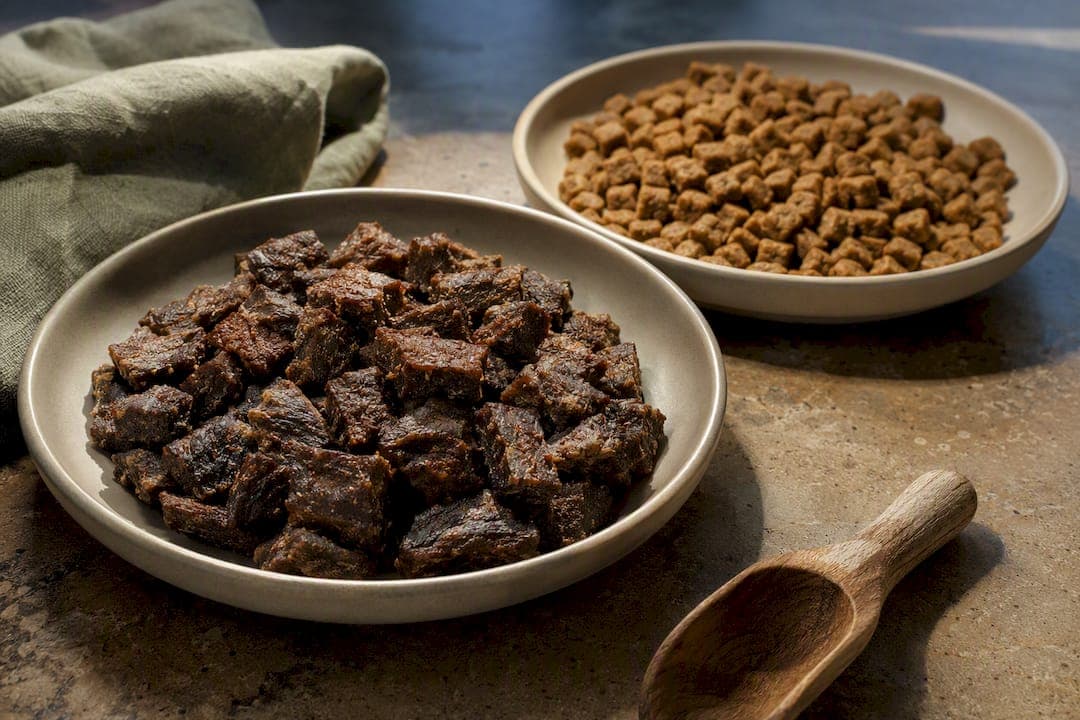
For picky eaters or dogs with digestive sensitivity, high-quality air-dried food often wins on palatability and nutrient retention. For most large dogs, multi-dog households, or budget-conscious owners, a vetted, AAFCO-complete kibble does the job just fine. The real trade-offs come down to nutrient retention, calorie density and cost, and food-safety handling, and the sections below walk through each one with the evidence behind it.
TL;DR:
- Air-dried food preserves more heat-sensitive nutrients and contains higher meat percentages, making it potentially better for dogs with sensitivities or weight issues.
- Kibble processing involves high temperatures that degrade some nutrients and rely heavily on starch fillers, resulting in lower protein quality and higher carbohydrate content.
- Air-dried food is more calorie-dense and concentrate, often leading to overfeeding if owners do not carefully convert portions from volume to calories.
- It has a higher retail cost per calorie and shorter shelf life once opened, but smaller packaging makes it more portable and easier to measure accurately.
- Proper handling and vet consultation are essential for immunocompromised pets or households with children due to residual bacterial risks in minimally processed foods.
Table of Contents
- Air Dried vs Kibble: How Processing Changes the Food
- Nutrition Face-Off: Retention, Calorie Density, and Reading the Label
- Bacterial Risk and Food Safety: What Vets Actually Say
- What Air Dried vs Kibble Actually Costs You Month to Month
- Choosing Between Air Dried and Kibble for Your Dog's Profile
- Portioning by Calories: How to Switch Formats Without Overfeeding
- How Bowlful Applies Vet-Standard Formulas to This Decision
- What's Actually in the Bag: Ingredient Quality Across Both Formats
- Environmental Impact: Comparing the Footprint of Each Format
- A Practical Read on Air Dried vs Kibble
- Get a Feeding Plan Built Around Your Dog, Not a Bag Label
- Sources
Air Dried vs Kibble: How Processing Changes the Food
Air-drying removes moisture from raw or lightly cooked meat using low, slow heat, generally staying under about 70°C. The gentle temperature keeps the protein structure closer to its raw state and protects heat-sensitive vitamins and amino acids that don't survive high-heat processing.
Kibble takes a different path entirely. It's made through extrusion, where a starch-heavy dough gets forced through a machine under intense pressure and heat, often hitting internal temperatures of 120 to 160°C. That heat cooks the food fast and creates the crunchy texture dogs recognize, but it also degrades some nutrients along the way, which is why many kibble formulas add synthetic vitamins back in after cooking.
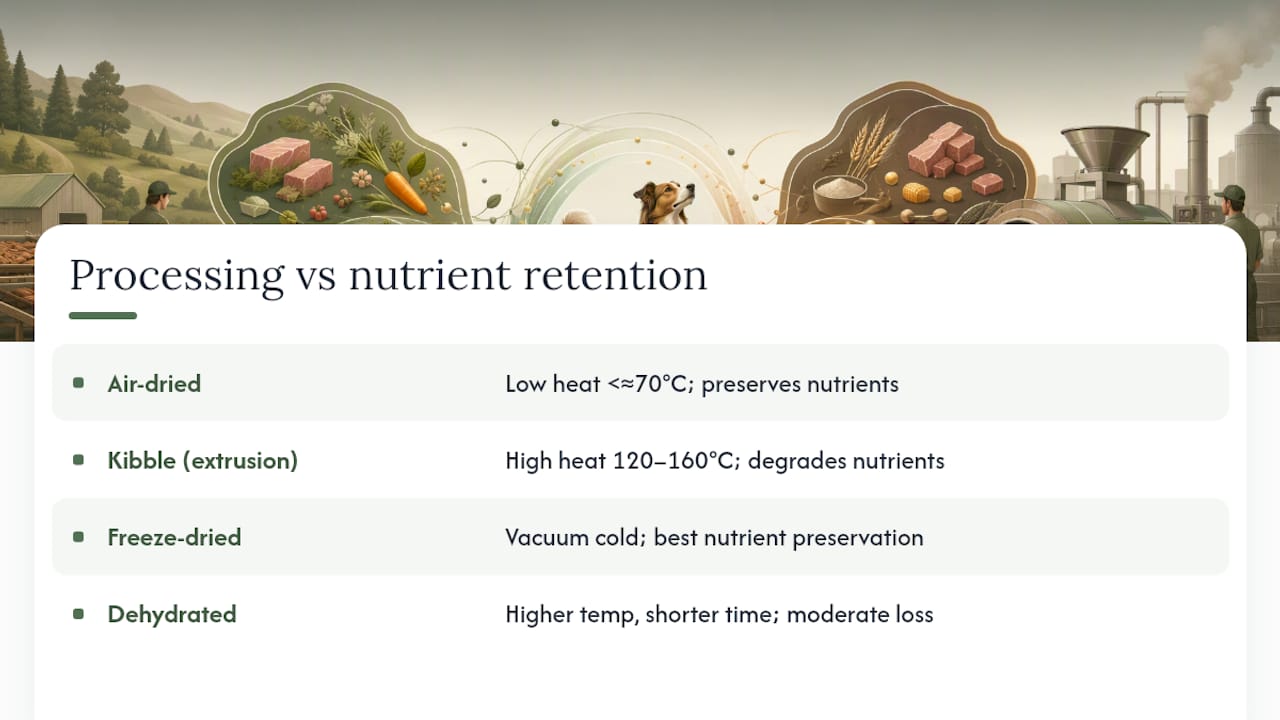
Freeze-dried and dehydrated foods sit nearby on this spectrum. Freeze-drying removes moisture through a vacuum-and-cold process rather than heat, preserving nutrients even more aggressively than air-drying. Dehydrating is similar to air-drying but sometimes uses slightly higher temperatures over a shorter window. All three (air-dried, freeze-dried, and dehydrated) fall under the broader "minimally processed" category that owners increasingly compare against kibble.
Nutrition Face-Off: Retention, Calorie Density, and Reading the Label
Lower processing temperatures generally mean better nutrient retention. Air-dried formulas tend to hold onto more of their original vitamin and amino acid content than extruded kibble, and they typically pack in a higher percentage of meat with less reliance on starch fillers, since kibble often runs 30 to 60% carbohydrates just to hold its shape through extrusion. That's a meaningful difference for dogs with weight issues or insulin sensitivity. Still, the direct research comparing air-dried nutritional outcomes to kibble is thin, and some nutrition experts caution against overstating air-dried's advantage until more peer-reviewed studies exist.
Calorie density is where owners get tripped up most. Because air-dried food loses most of its water weight, it's concentrated. You'll feed a much smaller volume by weight than you would with kibble, and eyeballing portions the way you might with a kibble scoop can lead to overfeeding fast.
Before buying any bag, check three things on the label:
- The AAFCO statement confirming the food is "complete and balanced" for your dog's life stage
- The guaranteed analysis for protein, fat, and fiber minimums and maximums
- The caloric content per 100g or per cup, since that's what you need to calculate an actual portion
Bacterial Risk and Food Safety: What Vets Actually Say
Air-drying reduces moisture, but it doesn't cook the food the way kibble extrusion or a wet diet does. Veterinary researchers at Cornell's Riney Canine Health Center caution that air-drying lowers bacterial risk without eliminating it, putting air-dried diets in a different risk category than fully cooked kibble.
That distinction matters most for a few specific households:
- Homes with immunocompromised pets or people
- Households with young children or elderly family members who handle pet food or bowls
- Multi-pet homes where cross-contamination between bowls is harder to control
If any of those apply, lean toward fully cooked kibble or a wet diet, or talk to your vet before switching.
Pro Tip: Store air-dried food in its original sealed bag inside an airtight container, wash your hands and any scoops after handling it, and wipe down feeding surfaces daily. Simple habits like this cut cross-contamination risk without sacrificing the format.

What Air Dried vs Kibble Actually Costs You Month to Month
Air-dried food almost always costs more per calorie, and there's a straightforward reason: removing water from meat takes more raw protein per finished pound, plus more production time, than extruding a starch-based kibble dough. You're paying for a more concentrated, less diluted product.
A few practical differences show up beyond the price tag:
- Shelf life: unopened kibble often lasts longer in original packaging; air-dried needs airtight storage after opening and shorter use windows
- Bag size and portability: kibble bags are bulkier but cheaper per pound; air-dried bags are smaller and easier to travel with, but you'll go through them faster relative to volume
- Portion control: because air-dried is calorie-dense, a little goes a long way, which sometimes offsets the higher sticker price
If the cost gap is the sticking point, use air-dried as a topper on kibble instead of a full switch. It's a common way owners get the palatability and nutrient density boost without paying for 100% of the diet.
Choosing Between Air Dried and Kibble for Your Dog's Profile
The right answer depends less on brand marketing and more on your dog's actual health profile and your household logistics. Here's how the choice tends to break down.
Air-dried tends to fit better when:
- Your dog is a picky eater who routinely walks away from kibble
- You're managing digestive sensitivity or want a lower-carbohydrate option
- You have a small or medium dog where the higher cost per pound is manageable given lower total volume
Kibble tends to fit better when:
- You're feeding a large breed or multiple dogs, where cost scales quickly
- Budget is a firm constraint
- Your dog needs extra hydration support built into wet or mixed meals, since air-dried is drier than a fresh or canned diet
Before deciding, run through this checklist: current weight, activity level, any diagnosed health conditions, and your vet's feeding history for the dog. Those four inputs, more than any marketing claim, should drive the decision.
Portioning by Calories: How to Switch Formats Without Overfeeding
The single biggest mistake owners make switching to air-dried is measuring by volume instead of calories. Air-dried is denser, so a cup-for-cup swap from kibble will overfeed your dog fast.

Start with your dog's Resting Energy Requirement (RER) and Maintenance Energy Requirement (MER), the same formulas veterinarians use, and convert your current kibble calories into grams of the new air-dried product using its kcal-per-100g label value. Bowlful's calorie calculators do this conversion for you if you'd rather skip the math.
Once you know the target amount, transition gradually:
- Days 1 to 3: 25% new food, 75% old food
- Days 4 to 6: 50/50 mix
- Days 7 to 9: 75% new food, 25% old food
- Day 10: 100% new food
Watch stool consistency, appetite, and energy levels through each stage. Loose stool or refusal to eat means slowing down the transition. Reweigh your dog after two to three weeks and adjust portions if you see unexpected weight change, and check in with your vet if anything seems off. A detailed day-by-day transition guide covers troubleshooting in more depth.
How Bowlful Applies Vet-Standard Formulas to This Decision
Bowlful builds every recommendation on the same RER and MER formulas veterinarians use, adjusted for your dog's life stage, breed size, and activity level. That's the backbone behind our pet feeding schedule tools, and it's exactly the kind of calculation that matters most when you're switching to a calorie-dense format like air-dried.
The most common mistake we see: owners keep feeding the same cup measurements after switching formats and end up overfeeding a dog on air-dried without realizing it. Our tools flag that risk directly instead of leaving you to guess.
To put this into practice:
- Run your dog's numbers through a free calorie calculator before switching formats
- Download a sample meal plan to see how a mixed or full air-dried diet gets structured day to day
- Reassess every few weeks if you're actively transitioning, not just once at the start
What's Actually in the Bag: Ingredient Quality Across Both Formats
Both formats lean on similar core ingredients, but the ratios and forms differ enough to matter. Muscle meat (chicken, beef, lamb, or fish) is the primary protein source in both, though air-dried formulas typically use a higher percentage of actual meat by weight, since the process doesn't require a starch base to hold a shape.
Kibble depends on carbohydrate sources like rice, oats, potato, or peas to bind the extruded dough. These aren't inherently bad ingredients. Dogs digest cooked starches reasonably well, and they provide usable energy. But they do dilute the overall meat content of the finished product, which is part of why kibble often lists a grain or legume among its first few ingredients while air-dried bags tend to lead with a named meat source.
Fat sources matter too. Both formats commonly add animal fats (like chicken fat) or fish oil for essential fatty acids and palatability, though the low-heat air-drying process may preserve omega-3 and omega-6 fatty acids slightly better than the higher heat of extrusion. Fiber sources, whether beet pulp, pumpkin, or chicory root, show up in both formats to support digestion.
Where the two often diverge most is in additives. Kibble formulas frequently include synthetic vitamin and mineral premixes added after processing to replace what extrusion heat destroyed. Air-dried products, needing less nutritional "repair," sometimes carry a shorter ingredient list overall. Neither approach is automatically superior. What matters is whether the finished product, however it got there, carries a valid AAFCO complete-and-balanced statement for your dog's life stage.
Environmental Impact: Comparing the Footprint of Each Format
Kibble production runs on high-volume manufacturing with established supply chains, which generally makes it more energy-efficient per unit produced. Large-batch extrusion lines process enormous quantities of food using shared equipment and infrastructure, spreading the energy cost across millions of bags.
Air-drying is a slower, lower-temperature process, but it typically runs in smaller batches with less automated infrastructure. That can mean more energy use relative to output, even though the process itself avoids the extreme heat and pressure of extrusion. The moisture-removal step also takes considerably longer, sometimes many hours compared to the minutes extrusion requires, which adds to production time and resource use per pound of finished food.
Packaging tells a mixed story. Air-dried bags are often smaller since the product is calorie-dense, meaning less packaging material per serving in some cases. But air-dried food generally requires more airtight, moisture-resistant packaging to preserve shelf stability once opened, which can offset that advantage.
Ingredient sourcing plays a role too. Air-dried formulas that lean heavily on named muscle meat can carry a heavier resource footprint per pound of finished food than plant-heavy kibble, since meat production generally demands more water, land, and feed input than grain or legume crops. A kibble with a significant plant-based ingredient share may have a smaller resource footprint pound for pound, even if it's less calorie-dense.
Neither format has a definitively lower environmental impact across every metric. The honest answer is that sourcing decisions, batch size, and packaging choices affect the footprint as much as the processing method itself, and full life-cycle data comparing the two formats directly remains limited.
A Practical Read on Air Dried vs Kibble
High-quality kibble is genuinely sufficient for most dogs, and there's no evidence-based reason to feel guilty about feeding it. Air-dried earns its place as a targeted upgrade, not a universal one, for dogs with real palatability or digestive issues. If you're on the fence, try air-dried as a topper before committing to a full switch. It's the lowest-risk way to see if your dog actually benefits.
Whichever format you land on, run the numbers through a proper calorie calculation before locking in portions. That single step prevents more feeding mistakes than any brand comparison ever will.
— Robert
Get a Feeding Plan Built Around Your Dog, Not a Bag Label
Switching formats without recalculating portions is the fastest way to accidentally overfeed a calorie-dense diet like air-dried. Bowlful's free calculator uses the same RER and MER formulas veterinarians rely on to translate any kibble or air-dried product into the exact daily amount your dog needs, based on weight, breed, age, and activity level.
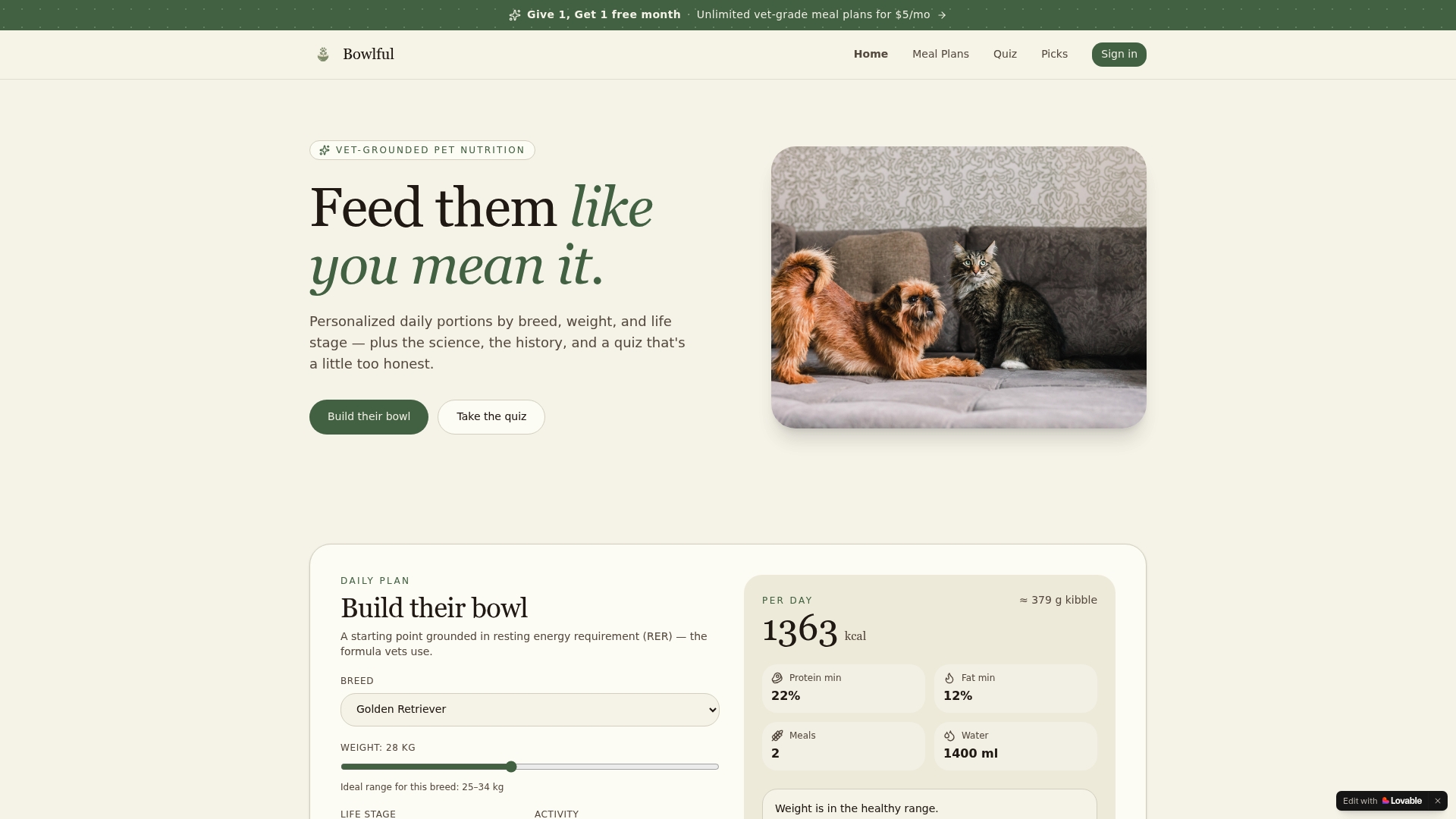
If you want more than a single number, Meal Plan Pro builds out a full personalized feeding plan, adjusted for life stage and any health conditions, with a downloadable PDF you can reference every time you buy food or switch brands. That's especially useful if you're mixing formats, transitioning gradually, or managing a dog with sensitivities where guesswork carries real risk. For owners exploring limited-ingredient options during a transition, single-protein formulas like Acana's lamb and apple recipe are worth a look too.
Head to Bowlful to run your dog's numbers and see what a calorie-based plan actually looks like for your household.
Sources
- Raw foods for dogs — evidence-based advice (Cornell Vet)
- Air Dried Dog Food: A Complete Vet-Approved Guide 2026