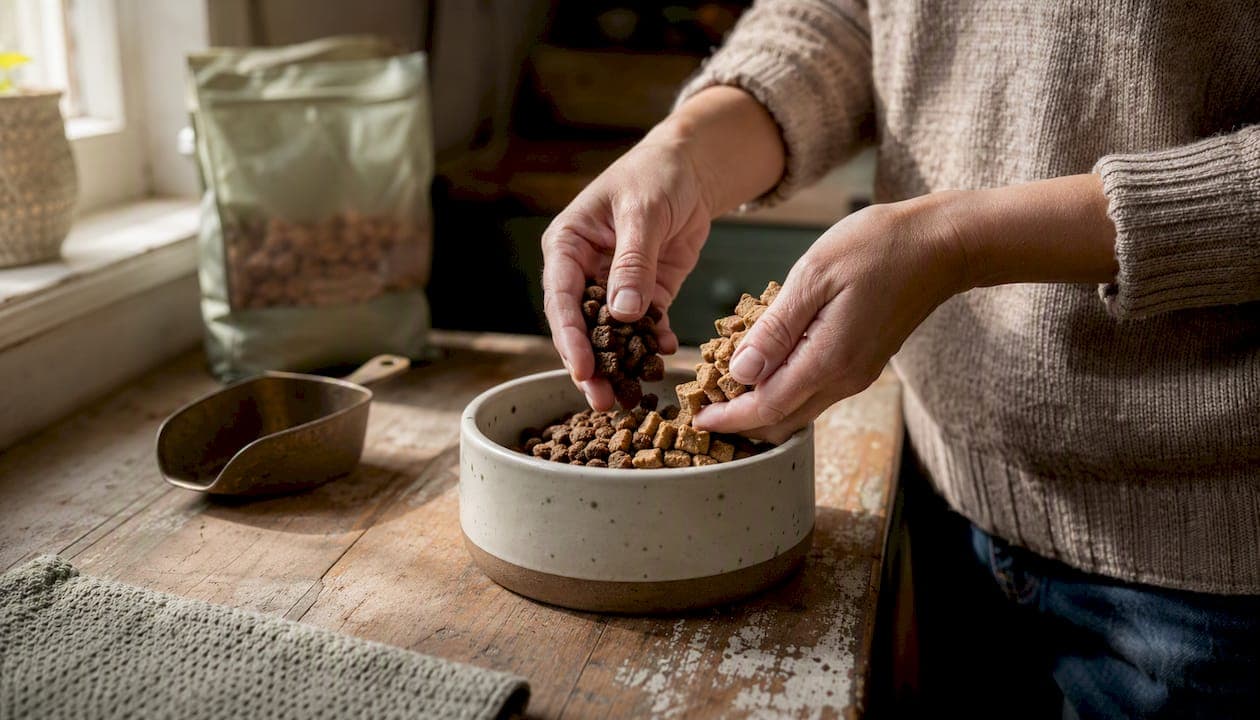
The safest way to switch your pet's food is to mix the new formula into the old one over 7–10 days, increasing the ratio every few days. Never swap cold turkey. A sudden change disrupts the gut microbiome and digestive enzymes, which almost always triggers vomiting, diarrhea, or outright food refusal.
Here's the basic starter plan most healthy adult dogs handle well:
- Days 1–2: 25% new food / 75% old food
- Days 3–5: 50% new / 50% old
- Days 6–7: 75% new / 25% old
- Days 8–10: 100% new food
Cats, sensitive stomachs, puppies, kittens, and seniors typically need a slower version of this plan. AAHA guidelines recommend starting at 25% new food and increasing gradually over roughly a week for dogs, while cats may need several weeks. AAFCO-compliant foods are formulated to be nutritionally complete, but even a switch between two high-quality formulas can upset a gut that hasn't had time to adjust. Bowlful's feeding calculators can help you track daily calorie intake throughout the switch so portions stay consistent.
Key Takeaways
| Point | Details |
|---|---|
| Use the 25–50–75–100 sequence | Most healthy adult dogs complete this over 7–10 days; cats and sensitive pets need 2–6 weeks. |
| Slow down at the first sign of upset | Revert to the previous ratio and resume at 10–15% increments after symptoms clear. |
| Track calories, not just ratios | Use RER/MER formulas to confirm your pet gets enough calories at every mixing stage. |
| Call a vet within 24–48 hours | Persistent vomiting, diarrhea, blood, or refusal to eat beyond 24 hours needs professional input. |
| Bowlful feeding calculators | Bowlful applies vet-standard RER/MER formulas to build personalized transition plans by breed and life stage. |
Table of Contents
- How to introduce new pet food gradually: quick, standard, and slow schedules
- Why does a gradual transition matter for your pet's gut?
- What signs should you watch for during the switch?
- Practical tips to help your pet accept the new food
- Special cases: puppies, seniors, multi-pet households, and recalls
- How to monitor weight and calories during the switch
- When should you call your veterinarian?
- Why you can trust this guidance
- A note on patience from the author
- Bowlful makes the calorie math easy during any transition
- Sources
How to introduce new pet food gradually: quick, standard, and slow schedules
Three pacing options cover most situations. Pick the one that fits your pet's age, species, and stomach history.
Quick plan: 7 days
Best for healthy adult dogs with no history of GI sensitivity and no recent illness or antibiotic use.
Purina's feeding guidance uses this same 25% → 50% → 75% → 100% structure as the baseline for healthy adult dogs.
Standard plan: 10–14 days
Recommended for most dogs and many cats. Slower increments give the gut more runway.
- Days 1–3: 25% new / 75% old
- Days 4–6: 50% new / 50% old
- Days 7–9: 75% new / 25% old
- Days 10–14: 100% new food
Watch stool consistency and appetite at each stage. If either changes noticeably, hold the current ratio for two more days before advancing.
Slow plan: 2–6 weeks
Use this for cats, picky eaters, pets recovering from illness, and any animal with a documented sensitive stomach. A pet food transition timeline guide can help you map out the specific days.
When to choose each plan:
- Quick (7 days): Healthy adult dog, no GI history, no recent medication
- Standard (10–14 days): Most dogs, adult cats, pets switching protein sources
- Slow (2–6 weeks): Cats, seniors, puppies/kittens, post-illness, history of IBD or food sensitivity
Why does a gradual transition matter for your pet's gut?
The short answer: the digestive system is not a passive tube. It runs on a specific microbial community and a set of enzymes calibrated to the nutrient profile your pet currently eats. Shift the protein, fat, or fiber content abruptly, and that system scrambles to catch up.
CityVet's veterinary team explains that slow transitions are a physiological requirement, not a behavioral preference. The gut needs time to produce the right enzymes and rebalance its microbial population for a new diet. This is why even switching between two premium, AAFCO-compliant foods can cause real GI distress if done too fast.
Pro Tip: If your pet has recently finished a course of antibiotics, their gut microbiome is already depleted. Give it two weeks to stabilize before starting any food transition, and use the slow plan when you do.
What signs should you watch for during the switch?
Stop or slow the transition at the first sign of persistent GI upset. One loose stool on day two is not a crisis. Repeated vomiting or watery diarrhea lasting more than 24–48 hours is.
Warning signs to watch:
- Vomiting (more than once in a 24-hour period)
- Watery or very soft stool
- Blood in stool or vomit
- Marked lethargy or hiding
- Refusal to eat for more than 12 hours (cats: act sooner)
- Bloating or visible abdominal discomfort
Troubleshooting steps:
- Revert to the previous food ratio immediately.
- Hold that ratio for 2–3 days until symptoms resolve.
- When resuming, drop back to 10–15% new food increments per PetMD's guidance.
- Consider adding a vet-approved probiotic to support microbiome recovery.
- For recalls or emergencies, use a bland-diet bridge (boiled chicken and plain white rice, roughly 1:3 ratio) for up to 7 days before resuming a gradual transition.
Cornell's veterinary specialists note that diarrhea from a quick switch is usually temporary, but symptoms persisting beyond a day or two warrant a vet call for supportive therapy.
Red flags that need same-day veterinary care: blood in vomit or stool, signs of dehydration (sunken eyes, dry gums, skin that doesn't spring back), or repeated vomiting with nothing coming up.
Practical tips to help your pet accept the new food
Small presentation changes make a real difference in acceptance, especially with cats and picky dogs.

Mixing methods: For dry-to-dry switches, mix thoroughly so the pet can't sort out the old kibble. For wet-over-dry transitions, spoon the new wet food on top of the familiar dry base. The familiar smell anchors the meal.
Temperature: Warming wet food to just above room temperature (not hot) releases aroma and often increases palatability. A few seconds in the microwave, stirred well, is enough.
Meal volume: Keep total volume constant throughout the transition. Owners often accidentally reduce calories by eyeballing the mix. Weigh portions when possible.
Scheduled feeding: Free-feeding makes it harder to monitor intake and stool output. Two scheduled meals a day give you a clear picture of how much your pet is actually eating.
Pro Tip: If your pet refuses the new mix, back off the ratio by one step and hold there for three days. Never force-feed or punish refusal. Forcing can create lasting food aversion that makes future transitions significantly harder, according to PetMD.
Special cases: puppies, seniors, multi-pet households, and recalls
Vulnerable pets need more time and closer monitoring. The standard 7–10 day plan is a floor, not a ceiling.
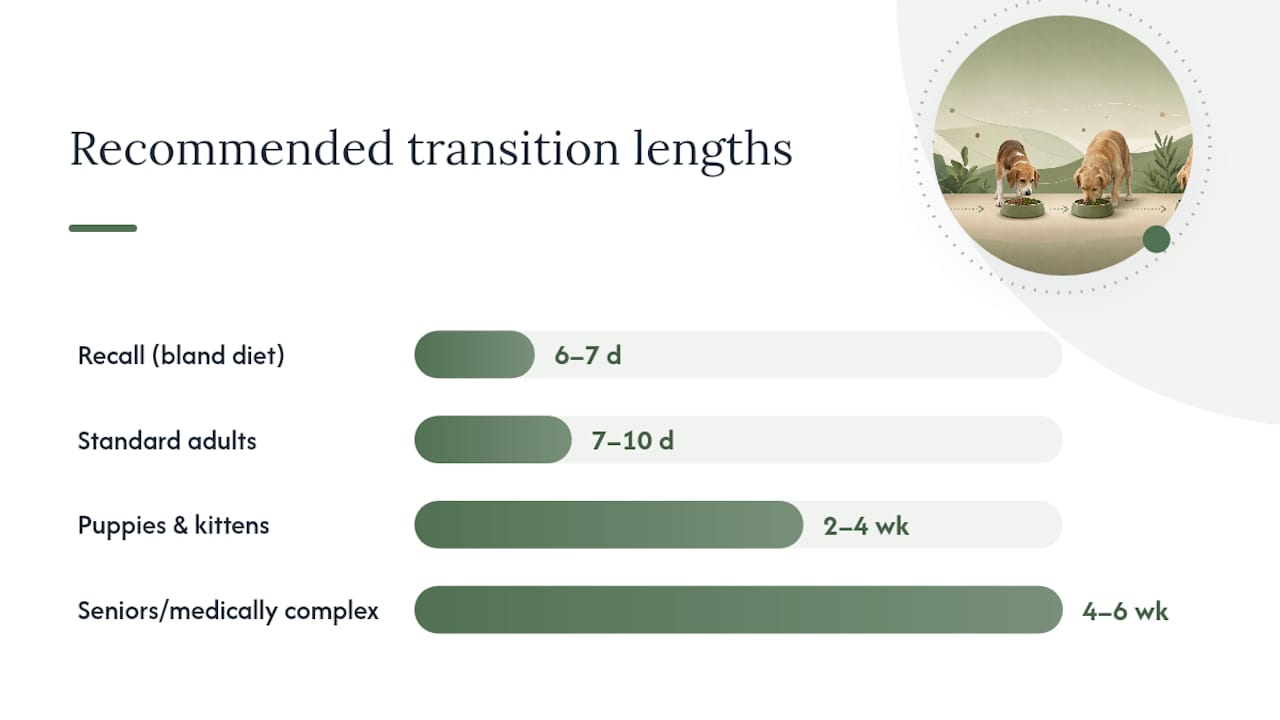
Puppies and kittens are growing fast and can't afford a calorie dip. Maintain full daily calorie targets throughout the switch. Use the slow plan (2–4 weeks) and check weight weekly. A species-specific feeding guide can clarify calorie targets by life stage.
Seniors and medically complex pets:
- Get a vet sign-off before switching, especially for pets managing kidney disease, diabetes, or food allergies.
- Use 10–15% increments and extend the timeline to 4–6 weeks.
- Recheck bloodwork if the diet change is medically driven.
Multi-pet households:
- Feed pets in separate rooms or at separate times to prevent cross-feeding.
- Label each pet's bowl clearly and store new and old foods in distinct containers.
- One pet's reaction to a new food doesn't predict another's, even in the same breed.
Sudden recall or running out of food:
- Day 1–2: 50% current food / 50% bland diet (boiled chicken and rice)
- Day 3–5: 25% current food / 75% bland diet
- Day 6–7: 100% bland diet
- Resume gradual transition to replacement food once sourced
Preventive Vet also cautions that returning to a previously tolerated food is not automatically safe. The gut microbiome shifts over time, so even a familiar brand needs a slow reintroduction.
How to monitor weight and calories during the switch
Track weight and daily calories throughout the transition. A pet that eats less during a switch can lose condition quickly, especially small dogs and cats.
RER (Resting Energy Requirement) is the baseline calorie formula vets use:
| Formula | Example (10 lb dog) |
|---|---|
| RER = 70 × (body weight in kg)^0.75 | 70 × (4.5)^0.75 ≈ 198 kcal/day |
| MER = RER × activity factor | Sedentary adult: 198 × 1.2 ≈ 238 kcal/day |
Activity factors range from 1.2 (sedentary adult) to 2.0+ (working dogs). Your vet or Bowlful's vet-standard meal plan tools can calculate the right factor for your pet's breed, age, and lifestyle.
Monitoring checklist:
- Weigh your pet every 5–7 days during the transition
- Log stool consistency daily (firm, soft, watery)
- Note appetite at each meal
- Adjust portions if weight drops more than 1–2% in a week
When should you call your veterinarian?
Contact a vet if vomiting or diarrhea persists beyond 24–48 hours, or if any of the following appear:
- Blood in vomit or stool
- Severe or sudden lethargy
- Signs of dehydration: dry or tacky gums, skin tenting, sunken eyes
- Repeated vomiting (three or more times in a few hours)
- Refusal to eat for more than 24 hours (cats: act within 12–18 hours to avoid hepatic lipidosis risk)
What to have ready when you call:
- Current food name and brand, and the new food name and brand
- Exact mixing ratios used and for how many days
- Timeline of when symptoms started
- Photos of stool if diarrhea or blood is present
- Your pet's current weight and any recent medication history
Why you can trust this guidance
This guide draws on AAHA's transition timelines, Cornell's veterinary nutrition guidance, CityVet's clinical explanations of microbiome adaptation, and Preventive Vet's practical troubleshooting protocols. Calorie calculations follow the RER/MER formulas used in veterinary practice and referenced in NRC and AAFCO nutritional standards.
Bowlful's vet-approved nutrition principles inform every recommendation here, and the feeding calculators on the site apply these same formulas to individual pets by breed, weight, and activity level.
A note on patience from the author
Patience is the single most underrated tool in a pet food transition. Every time I see an owner push through a pet's refusal or skip steps to finish the switch faster, the outcome is the same: a stressed pet, a frustrated owner, and a longer road back to stable eating. The schedules in this guide exist because the gut genuinely needs time. Small setbacks are normal. A pet that backs off the new food on day four is not being difficult; it's telling you something. Use the schedules, watch the signals, and trust that a slower transition now means a more resilient digestive system later.
Bowlful makes the calorie math easy during any transition
Tracking mixing ratios is straightforward. Tracking whether your pet is actually getting the right calories across two different foods with different calorie densities is where most owners slip up.
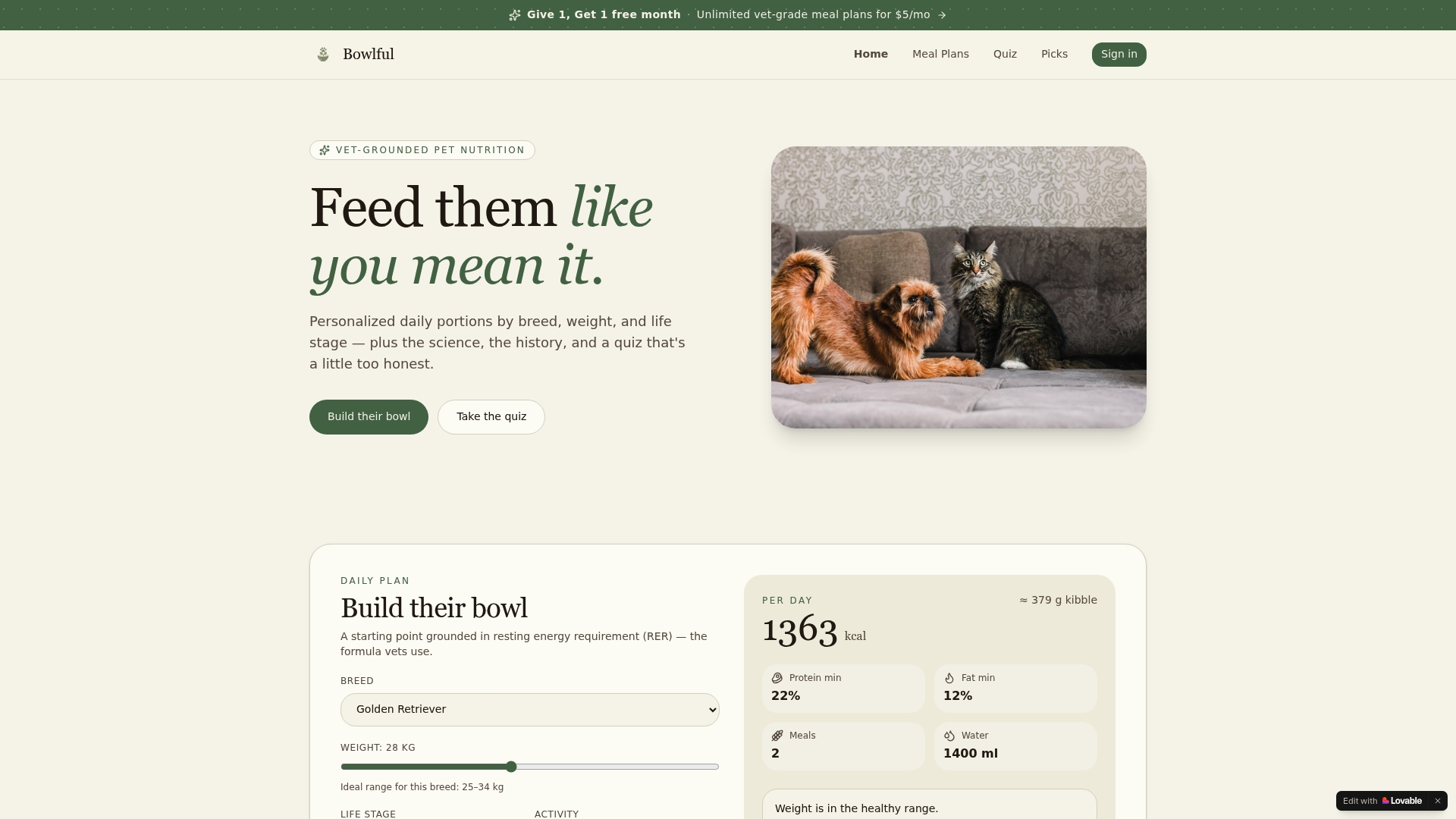
Bowlful's feeding calculators do that math for you, using the same RER/MER formulas your vet uses, adjusted for your pet's breed, age, weight, and activity level. The personalized meal plan PDFs give you a day-by-day calorie target for each phase of the transition, so you're not guessing whether the 50/50 mix hits your dog's maintenance needs. Bowlful is independent, carries no brand affiliations, and recommends only foods that meet AAFCO nutritional standards. If you want a tailored transition plan built around your specific pet, start with Bowlful's free feeding calculator and upgrade to a downloadable meal plan when you're ready for the full picture.
Sources
- How to Change Your Pet's Food Gradually | Preventive Vet
- Tips and Timelines for Transitioning Your Pet to a New Food | AAHA
- Changing too quickly — Cornell Veterinary specialists guidance
- Transitioning your pet to a new food | CityVet
- How to switch your dog's food | PetMD
- Changing dog food: How to switch dog food | Purina