
How many calories does a Cavapoo need each day?
Most Cavapoos need calories adjusted per pound of body weight daily, with amounts varying depending on age, activity level, and whether your dog has been spayed or neutered. An adult Cavapoo who is less active needs fewer calories, while the same dog with high activity requires considerably more energy.
A few things every Cavapoo owner should know upfront:
- Caloric range: 30–40 calories per pound of body weight per day, adjusted for lifestyle
- Spay/neuter impact: metabolic rate drops by roughly 20% after the procedure, meaning calorie needs fall accordingly
- Treat ceiling: treats should never exceed 10% of your Cavapoo's total daily caloric intake
- Puppy feeding: Cavapoo puppies need three to four small meals daily; adults do well on two
- No universal number: weight, age, activity, and body condition all shape the right target, and a vet's input makes the estimate far more reliable
- Key formulas: veterinarians use the Resting Energy Requirement (RER) and Metabolizable Energy Requirement (MER) to calculate precise daily targets
These are the anchors. Everything else in a Cavapoo diet plan builds from here.
How to calculate your Cavapoo's daily caloric needs
The math behind a dog's calorie target is more approachable than it sounds. Veterinary nutritionists start with the Resting Energy Requirement (RER), which estimates how many calories a dog needs just to exist at rest. The standard RER formula is:
RER = 70 × (body weight in kg)^0.75
So for a 10-pound Cavapoo (roughly 4.5 kg), the calculation looks like this:
4.5^0.75 ≈ 3.24 70 × 3.24 = 227 kcal/day (RER)
That number is the floor, not the target. To get the actual daily caloric intake a Cavapoo needs, you multiply the RER by a Metabolizable Energy Requirement (MER) factor, which accounts for life stage and activity.
| Life Stage / Status | MER Multiplier | Example (10 lb Cavapoo) |
|---|---|---|
| Intact adult, typical activity | 1.8 | — |
| Spayed/neutered adult | 1.6 | — |
| Active adult | 2.0 | — |
| Puppy (under 4 months) | 1.8–2.0 | — |
| Senior (low activity) | 1.4 | — |
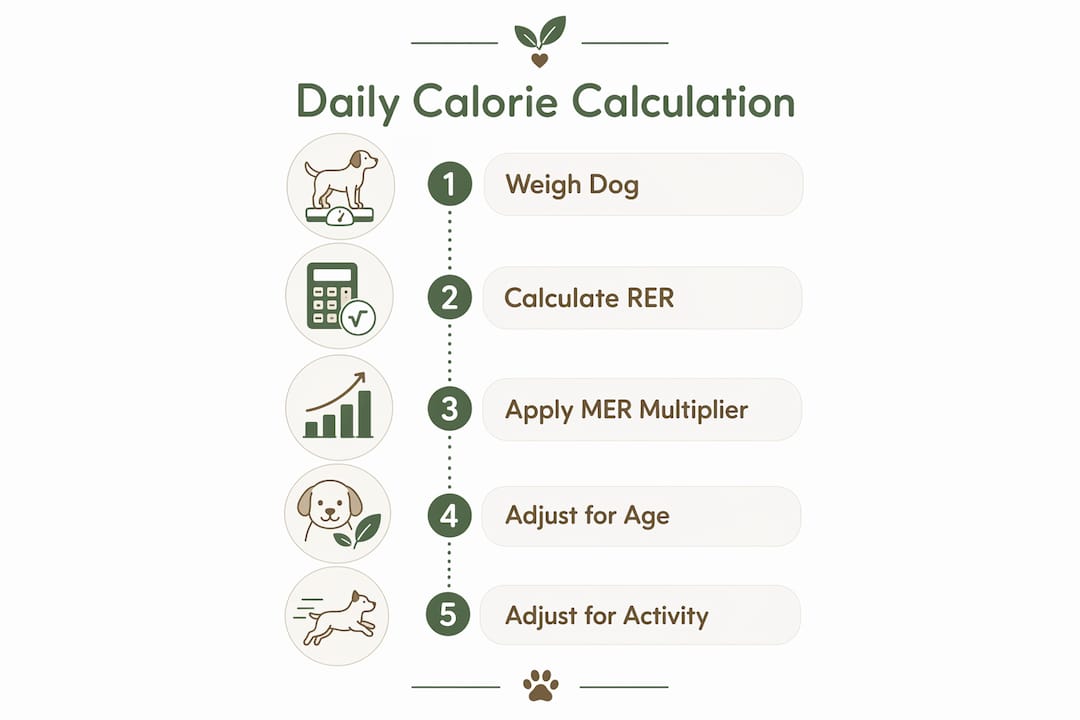
These multipliers come from the same veterinary framework used by the WSAVA calorie guidelines for healthy adult dogs. They are starting points, not final answers. Your Cavapoo's actual needs may land slightly above or below depending on individual metabolism.
Pro Tip: Convert your Cavapoo's weight to kilograms before running the RER formula. Divide pounds by 2.205. A 15-pound dog is 6.8 kg. Getting this conversion right is where most at-home calculations go wrong.
One practical note: if your Cavapoo was recently spayed or neutered, apply the 1.6 multiplier rather than 1.8. That single adjustment, reflecting the roughly 20% metabolic reduction post-procedure, can prevent gradual weight creep that many owners don't notice until it becomes a problem. For a more tailored estimate, Bowlful's dog calorie calculator walks through these steps with your dog's specific profile built in.
What factors change how many calories your Cavapoo actually needs?
The RER and MER formulas give you a solid starting number, but several real-world variables push that number up or down. Understanding them helps you fine-tune rather than just guess.
Breed size and metabolism
Cavapoos are small dogs, typically weighing between 9 and 25 pounds depending on whether they come from a Toy or Miniature Poodle parent. Smaller dogs generally run a faster metabolism relative to their body mass, which is why the per-pound calorie requirement for a Cavapoo tends to be higher than it would be for a Labrador. That faster metabolic rate also means they feel the effects of underfeeding more quickly.
Age
Puppies need the most calories per pound, fueling rapid bone growth, organ development, and near-constant energy expenditure. As Cavapoos move into adulthood (roughly 1–7 years), calorie needs stabilize. Seniors slow down, both physically and metabolically, and often need fewer calories to maintain a healthy weight. Adjusting for each life stage is one of the most overlooked parts of long-term feeding.
Activity level
The difference between a sedentary Cavapoo and an active one is real and measurable in the MER multiplier. A dog who gets two short walks a day and spends the rest of the time sleeping uses far fewer calories than one who plays fetch for an hour and accompanies you on weekend hikes. Overfeeding a low-activity dog, even by 10–15%, adds up over months.
Key factors that shift daily caloric intake for Cavapoos:
- Spay/neuter status: reduces metabolic rate by about 20%, requiring a corresponding calorie reduction
- Age: puppies need the highest calorie density per pound; seniors need the least
- Activity level: sedentary dogs use the 1.4–1.6 multiplier range; highly active dogs can reach 2.0 or above
- Health conditions: joint problems, heart disease, or thyroid issues can all change how the body processes energy
- Body condition score: a dog carrying extra weight should eat toward the lower end of the range until reaching an ideal condition
No single calorie count fits every Cavapoo. As PetMD notes, owners should consider weight, age, activity, and body condition together, and consult a veterinarian when in doubt.
How to track what your Cavapoo is actually eating each day
Knowing the target calorie number is only half the job. The other half is figuring out what your dog is actually consuming, which is harder than most owners expect.

Reading labels and understanding calorie density
Dog food calorie density varies widely from brand to brand and even between formulas within the same brand. A cup of one kibble might contain 320 kcal; another might pack 450 kcal into the same volume. If you're scooping by the cup without checking the specific kcal/cup figure on the bag, you could be off by a meaningful margin every single day.
Pro Tip: Switch from volume to weight. A kitchen scale set to grams gives you a repeatable, accurate portion every time. Calorie density in dog foods varies enough that cup measurements alone can't guarantee precision, especially when you switch brands or formulas.
Logging meals and treats
Tracking works best when you log everything, not just the main meals. Treats, toppers, chews, and table scraps all carry calories. For a Cavapoo, treats should never exceed 10% of total daily caloric intake, regardless of the specific number, to help prevent weight gain.
Practical steps for accurate daily tracking:
- Check the bag: find the kcal/cup or kcal/kg figure, usually printed near the feeding guidelines
- Weigh portions: use a digital kitchen scale rather than measuring cups for main meals
- Log treats separately: note the calorie count for each treat type and tally them against the 10% daily cap
- Account for toppers: broth, wet food, or fresh food additions all carry calories that need to be included
- Reassess monthly: weight and activity change, so the daily target should be reviewed regularly
Hidden calories from treats are the most common reason a Cavapoo gains weight despite an owner feeding the "right" amount of kibble. Keeping treats within the 10% daily limit is one of the most effective single changes you can make.
Practical feeding tips to keep your Cavapoo at a healthy weight
Getting the calorie math right is one thing. Building a feeding routine that actually works day-to-day is another. These are the habits that make the difference between a Cavapoo who stays lean and one who gradually creeps toward overweight.
Meal frequency by life stage
Puppy Cavapoos need three to four meals spread through the day to maintain stable blood sugar and support growth. Once they reach adulthood, two meals daily becomes the standard. Seniors generally do well on two meals as well, though some do better with three smaller ones if digestion slows. For more detail on adjusting amounts as your puppy grows, Bowlful's puppy feeding amounts guide breaks it down by age.
Portion control in practice
Once you know your Cavapoo's daily calorie target, divide it by the number of meals and weigh each portion. Don't eyeball it. A study on feeding measurement accuracy found that owners relying on volume measures consistently over- or underfeed, because calorie density varies so much between products.
Pro Tip: Set a consistent feeding time and stick to it. Dogs who eat on a schedule tend to beg less between meals, because their digestive system learns when food is coming. Free-feeding, where kibble is left out all day, makes calorie tracking nearly impossible.
Feeding do's and don'ts for a healthy Cavapoo
- Do weigh food portions with a kitchen scale at every meal
- Do split the daily calorie budget across two to four meals depending on life stage
- Do count every treat, chew, and food topper toward the daily total
- Do choose foods with clear kcal/cup labeling so you can calculate accurately
- Do adjust portions when your Cavapoo's activity level changes seasonally
- Don't free-feed; it removes all portion control
- Don't use treats as a primary reward system without tracking the calorie cost
- Don't assume the feeding guideline on the bag is right for your specific dog; those guidelines are averages, not personalized targets
- Don't ignore gradual weight gain; a pound on a 12-pound dog is nearly 10% of body weight
Treat quality matters too. High-calorie treats with little nutritional value burn through the 10% cap fast. Choosing lower-calorie options like small pieces of plain cooked chicken or commercial treats with clear calorie counts lets you reward your dog without blowing the daily budget.
Why body condition matters as much as the calorie count
Calories are a tool, not a goal. The actual goal is a Cavapoo who looks and feels healthy, and that means regularly assessing body condition rather than just trusting the math.
How to use the Body Condition Score
The Body Condition Score (BCS) is a 9-point scale used by veterinarians to assess whether a dog is underweight, ideal, or overweight. At an ideal score of 4–5 out of 9, you should be able to feel your Cavapoo's ribs without pressing hard, but not see them from across the room. The waist should be visible from above, and the abdomen should tuck up slightly when viewed from the side. If the ribs are hard to find under a layer of fat, or if the waist has disappeared, calorie intake is likely too high.
Health risks linked to weight in Cavapoos
Maintaining an ideal weight directly reduces the risk of two conditions that affect this breed more than most. Research shows that weight control is preventative for both orthopedic issues like patellar luxation and cardiac conditions like Mitral Valve Disease, both of which appear with higher frequency in Cavalier King Charles Spaniel crosses. Keeping a Cavapoo lean isn't just about appearance.
Signs that calorie intake needs adjustment:
- Gaining weight despite consistent feeding: check treat totals and food calorie density; consider reducing MER multiplier
- Losing weight unexpectedly: rule out illness first, then increase daily calories gradually
- Low energy or lethargy: could signal underfeeding, but also warrants a vet check to rule out other causes
- Visible ribs or prominent hip bones: underweight; increase calories and consult a vet
- Difficulty feeling ribs, no visible waist: overweight; reduce calories and increase activity
- Excessive hunger between meals: may indicate the current calorie target is too low, or that food quality is poor
A veterinarian can assess BCS during a routine visit and recommend specific calorie adjustments based on what they find. That kind of personalized input is something no general formula fully replaces.
How Bowlful uses science to build personalized Cavapoo feeding plans
Generic feeding guidelines on the back of a dog food bag are built for an average dog that doesn't exist. Bowlful takes a different approach, using the same RER formula that veterinary nutritionists rely on to build meal plans tailored to your Cavapoo's actual weight, age, activity level, and life stage.
The process starts with an interactive quiz that captures the details that matter: breed, current weight, spay/neuter status, activity level, and health considerations. From there, Bowlful generates a feeding plan with specific daily calorie targets and portion guidance, rather than a generic cup measurement that ignores everything individual about your dog.
The research behind this approach is compelling. Lean-fed pets live an average of 1.8 years longer than those fed to a heavier body condition, a finding that puts calorie precision in a different light. Getting the daily target right isn't just about avoiding obesity. It's about adding real time to your dog's life.
Steps to get started with a personalized Bowlful feeding plan:
- Take the quiz: answer questions about your Cavapoo's breed, weight, age, and activity level
- Review your calorie target: Bowlful calculates a daily calorie goal using the RER formula and appropriate MER multiplier
- Get portion guidance: the plan translates the calorie target into practical meal portions
- Adjust as your dog changes: update the profile when weight, activity, or life stage shifts
- Use the daily calories calculator: for quick reference between full plan updates
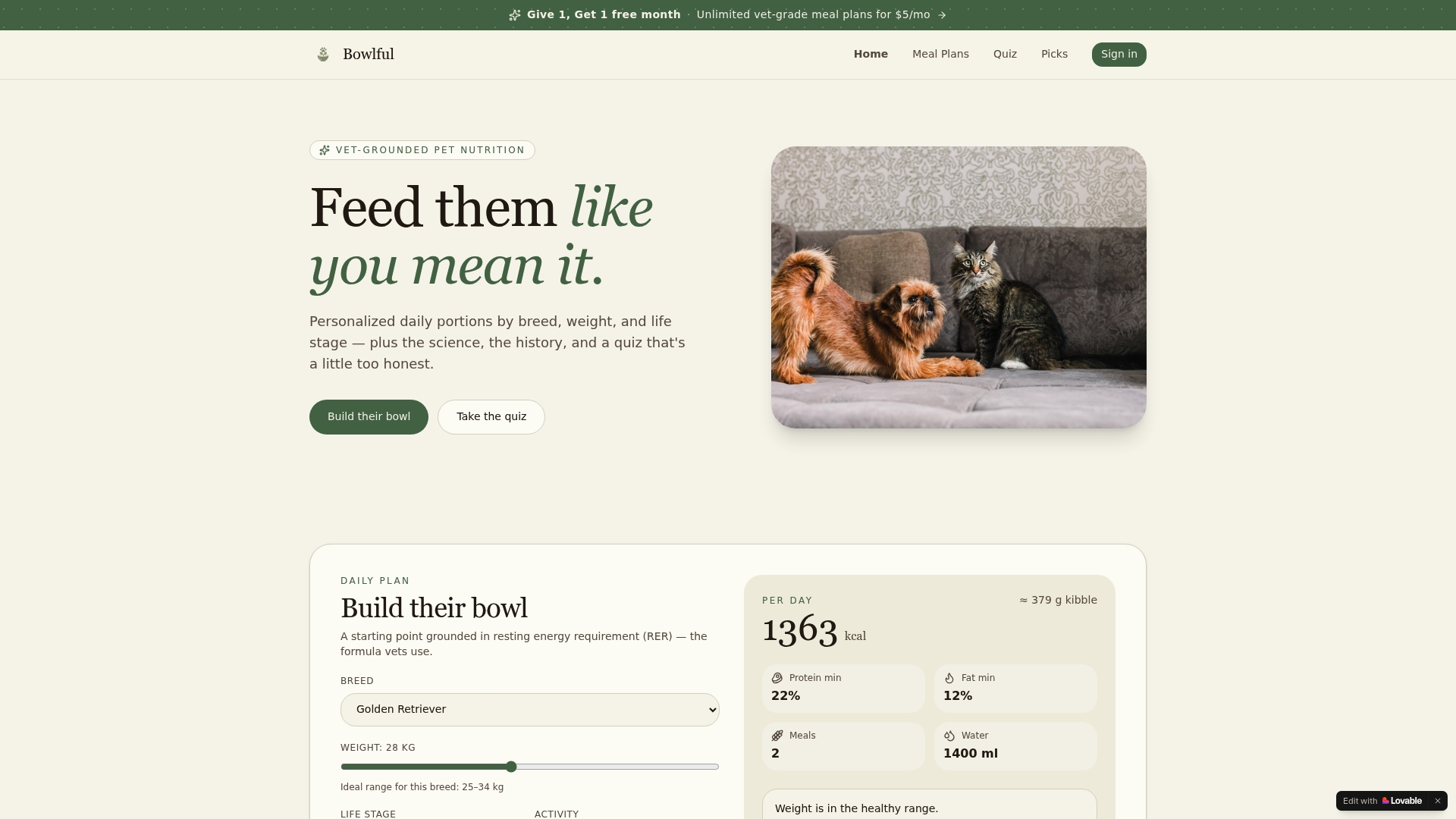
Bowlful's approach works because it treats your Cavapoo as an individual, not a category. The interactive feeding tools account for the variables that generic bag guidelines ignore, and the result is a feeding plan you can actually trust.
Key Takeaways
A Cavapoo's daily calorie needs depend on weight, life stage, activity level, and spay/neuter status, and getting that number right is the foundation of long-term health.
| Point | Details |
|---|---|
| Daily calorie range | Most Cavapoos need 30–40 calories per pound of body weight, adjusted for lifestyle. |
| Use RER and MER | Calculate RER with 70 × (weight in kg)^0.75, then multiply by the appropriate MER factor. |
| Spay/neuter adjustment | Metabolism drops by about 20% after the procedure; reduce daily calories accordingly. |
| Treat limit | Treats should never exceed 10% of total daily caloric intake for your Cavapoo. |
| Weigh, don't scoop | Calorie density varies widely between dog foods; a kitchen scale gives accurate portions. |