
A custom cat nutrition plan is a personalized dietary framework built on scientifically established nutritional adequacy and tailored to your cat's specific life stage, health status, and lifestyle factors. Generic feeding guidelines on the back of a bag assume an average cat that does not exist. Your cat's age, weight, neuter status, activity level, and health conditions all shift calorie and nutrient needs significantly. Getting this right is the difference between a cat that merely survives on its food and one that genuinely thrives. Bowlful's approach, grounded in the veterinary Resting Energy Requirement (RER) formula, reflects exactly this kind of evidence-based personalization.
What does a custom cat nutrition plan actually mean?
A custom cat nutrition plan, or what veterinary nutritionists call a personalized feline dietary protocol, starts with one non-negotiable foundation: the base diet must be nutritionally complete and balanced. The Cornell University College of Veterinary Medicine confirms that a nutrition plan must be anchored in nutritional adequacy before any meaningful adjustment of portions or macronutrients can occur. Without that foundation, you are customizing on top of a deficient diet, which compounds problems rather than solving them.
The customization layer sits above that base. It accounts for whether your cat is a sedentary indoor adult, a lactating queen, a kitten in rapid growth, or a senior managing chronic kidney disease (CKD). Each of these profiles demands different calorie targets, protein levels, phosphorus limits, and feeding schedules. Tools like the Mishcats calculator and resources from the Cornell Feline Health Center help owners translate these variables into concrete daily feeding amounts. The result is a cat food tailored plan that reflects your specific animal, not a statistical average.
The benefits of a personalized cat diet extend beyond convenience. Cats fed to their actual energy needs avoid obesity, a condition linked to diabetes, joint disease, and shortened lifespan. Cats with CKD fed therapeutic renal diets show measurably slower disease progression. The customized cat feeding plan benefits are clinical, not just theoretical.

How do you confirm your cat's base diet is adequate?
The first step in building any nutrition plan for cats is reading the AAFCO nutritional adequacy statement on the food label. AAFCO, the Association of American Feed Control Officials, sets the minimum nutrient standards for pet food sold in the United States. Every label must state which life stage the food supports: Growth/Reproduction, Adult Maintenance, or All Life Stages.
Two types of statements appear on labels, and they are not equal:
- Formulation statement: The manufacturer calculated nutrient levels against AAFCO minimums. No cats were fed the food to verify outcomes.
- Feeding trial statement: The food was fed to real cats for 26 or more weeks, and health outcomes were measured. AAFCO feeding trial substantiation offers stronger evidence of nutritional adequacy than formulation alone.
Feeding trial foods cost more to produce and are less common, but they carry real-world validation. WSAVA guidelines rank feeding trial substantiation as the higher standard for reliable base diet selection.
Beyond the adequacy statement, check the ingredient list and guaranteed analysis. Ingredients appear in descending order by weight before processing. A named protein source (chicken, salmon, turkey) should appear first. The guaranteed analysis shows minimum crude protein and fat percentages, plus maximum fiber and moisture. These numbers tell you the nutrient profile, but they do not tell you bioavailability. That is why the feeding trial distinction matters so much.
Common pitfalls include foods labeled "natural," "holistic," or "grain-free" that carry no AAFCO adequacy claim. These marketing terms carry no regulatory definition. A food without a "complete and balanced" claim is legally limited to intermittent or supplemental feeding only.
Pro Tip: Look for the phrase "Animal feeding tests using AAFCO procedures" on the label. That single line tells you the food passed a real-world feeding trial, not just a nutrient calculation.
How does nutrition change for specific health conditions?
Once the base diet is confirmed as adequate, the real customization begins. Three scenarios demand the most precise adjustments: CKD, obesity, and life stage transitions.
Chronic kidney disease and phosphorus control
Phosphorus restriction is the most impactful dietary intervention for cats with CKD. Transitioning to a therapeutic renal diet is the first clinical step, but it is not the last. Phosphorus binders are added if diet alone does not achieve serum phosphorus targets within 4–8 weeks. Targets are stricter in early CKD stages, making lab rechecks mandatory, not optional. A personalized feline nutrition plan for a CKD cat without scheduled bloodwork is incomplete by definition.
Weight management feeding plans
Feline obesity is defined as body weight 20% or more above ideal. Overweight cats sit at roughly 10% above ideal. The approach to weight loss must be methodical.
- Document baseline body weight and body condition score before changing anything.
- Calculate a calorie target using the RER formula, then apply a reduction factor appropriate for weight loss.
- Set a safe weight loss target of 1–2% of body weight per week. Faster loss risks hepatic lipidosis, a life-threatening liver condition.
- Schedule re-evaluations every 2–4 weeks. If weight loss is not occurring, adjust food amounts by 10–15%.
- Reassess body condition score at each visit, not just the scale number.
Simply feeding less without this structure is insufficient and potentially harmful. Bowlful's safe weight loss guide walks through this protocol in detail.
Life stage adjustments
| Life Stage | Key Nutritional Priority | Feeding Approach |
|---|---|---|
| Kitten (under 1 year) | High protein and fat for growth | Feed Growth/Reproduction labeled food |
| Adult (1–7 years) | Calorie balance, lean body mass | Adult Maintenance or All Life Stages food |
| Senior (7+ years) | Kidney support, joint health | Senior-specific or therapeutic diet as needed |
| Pregnant or lactating queen | Increased calories and calcium | All Life Stages food, free-choice feeding |
Neuter status also matters. Neutered cats have lower energy requirements than intact cats of the same size and activity level. Ignoring this factor leads to systematic overfeeding.
Pro Tip: Weigh your cat monthly on the same scale at the same time of day. Body condition scoring by eye is useful but subjective. A consistent weight log catches creeping obesity before it becomes a clinical problem.
What is the best way to transition to a new diet?
Diet acceptance and gastrointestinal tolerance limit diet switches more often than nutrient calculations do. A cat that refuses a new food or develops diarrhea from it will not benefit from even the most carefully designed custom feline nutrition plan.
A gradual transition over 7–14 days is the standard approach. Start with 75% old food and 25% new food for the first two days. Increase the new food proportion every two to three days until you reach 100% new food by day 7 to 14. Monitor stool quality and appetite throughout. Loose stools or vomiting signal the transition is moving too fast.
Several techniques improve palatability for reluctant cats:
- Warm wet food to just below body temperature (around 99°F) to release aroma.
- Mix a small amount of a familiar flavor into the new food for the first few days.
- Offer the new food in a separate bowl alongside the old food before mixing them.
- Avoid switching foods during periods of stress, illness, or environmental change.
Premature abandonment of a new diet is one of the most common reasons custom plans fail. Tracking stool quality and food intake creates the data you need to make informed adjustments rather than guessing. If vomiting persists beyond two to three days or appetite drops significantly, consult your veterinarian before continuing.
Pro Tip: Keep a simple feeding log during any transition. Note the ratio, stool score (1 to 7 on the Purina Fecal Scoring System), and appetite level each day. This log becomes your evidence base for adjustments and is invaluable if your vet needs to troubleshoot.
Do cat nutrition calculators replace veterinary advice?
Digital tools and ready-made cat nutrition plan services fill a real gap between generic bag instructions and full veterinary nutritional consultations. They do not replace the latter for cats with medical conditions, but they add meaningful precision for healthy cats.
| Feature | Digital Calculator (e.g., Mishcats) | Veterinary Nutritionist |
|---|---|---|
| Cost | Free or low cost | $150–$400+ per consultation |
| Inputs used | Age, weight, neuter status, activity, health flags | Full medical history, bloodwork, body condition exam |
| Output | Daily food amounts, supplement suggestions | Complete diet formulation, therapeutic diet selection |
| Best for | Healthy cats, weight monitoring, general feeding | CKD, IBD, food allergies, multi-condition cats |
| Ongoing support | Self-directed | Scheduled follow-ups |
The Mishcats calculator uses a short set of questions to output exact daily food amounts and monthly supplement needs, factoring in conditions like CKD stages and urinary issues. Tools like this make custom cat meal plan services accessible to owners who cannot afford frequent specialist visits.
A thorough nutrition assessment covers the same inputs these calculators use: age group, activity level, neuter status, and health conditions. The difference is that a veterinarian interprets those inputs against physical examination findings and lab results. For cats with diagnosed conditions, that clinical layer is not optional.
Why personalization is never a one-time event
Most cat owners treat nutrition as a setup task. You pick a food, set a portion, and move on. That model works until something changes, and something always changes. Your cat ages, gains weight, develops a condition, or simply becomes less active after a move or a household change.
The cats I have seen thrive long-term are the ones whose owners treat feeding as an ongoing practice, not a solved problem. A custom plan built in year one needs a review in year three. A weight loss plan that worked at 12 pounds needs recalibration at 10 pounds. The clinical data, body weight, body condition score, and bloodwork for cats with CKD or other conditions, is what separates genuine personalization from guesswork dressed up in a spreadsheet.
The most common mistake I see is owners who start with a solid plan and then stop monitoring. They assume that because the cat is eating and seems fine, the plan is still working. Cats are stoic animals. They do not show early signs of nutritional imbalance or slow weight gain the way dogs do. By the time the problem is visible, it has usually been building for months.
My honest recommendation: schedule a formal nutrition review every six months for healthy adult cats and every three months for cats managing any chronic condition. Use a digital tool like Mishcats or Bowlful's resources to track between visits. Treat the plan as a living document, not a finished product.
— Robert
Start building your cat's feeding plan with Bowlful
Getting your cat's nutrition right does not require a veterinary degree. It requires the right framework and the right tools.
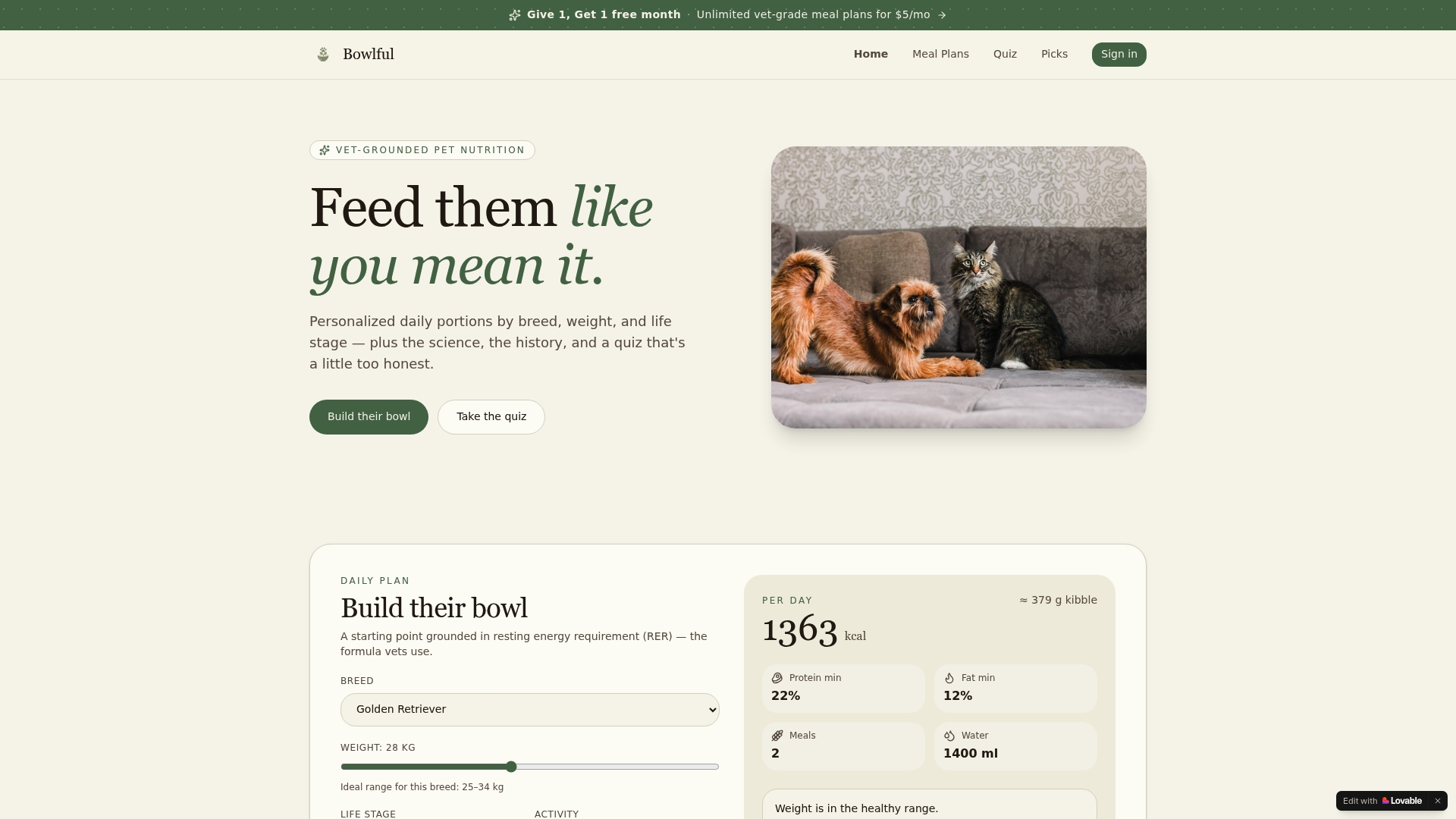
Bowlful uses the same RER formula veterinarians rely on to calculate your cat's true daily calorie needs, then builds a feeding plan around your cat's breed, weight, life stage, and health profile. The interactive quiz takes minutes and produces a personalized meal plan grounded in real science, not bag averages. Research shows lean-fed cats may live up to 1.8 years longer than their overweight counterparts. That kind of outcome starts with a plan built for your specific cat. Visit Bowlful to get started with a data-driven feeding plan your cat's health depends on.
FAQ
What is a custom cat nutrition plan?
A custom cat nutrition plan is a personalized feeding strategy built on an AAFCO-compliant base diet and adjusted for your cat's life stage, weight, health conditions, and activity level. It replaces generic bag guidelines with feeding amounts and nutrient targets specific to your individual cat.
How do i know if my cat's food is nutritionally complete?
Look for an AAFCO nutritional adequacy statement on the label that specifies a life stage and, ideally, confirms the food passed animal feeding trials. Foods without this statement are not suitable as a sole diet.
How fast should my cat lose weight on a custom feeding plan?
Safe feline weight loss is 1–2% of initial body weight per week. Faster loss risks hepatic lipidosis. Re-evaluate food amounts every 2–4 weeks and adjust by 10–15% if the target rate is not being met.
Can i use an online calculator instead of seeing a vet?
Digital tools like the Mishcats calculator work well for healthy cats needing general feeding guidance. Cats with CKD, inflammatory bowel disease, food allergies, or other diagnosed conditions need veterinary nutritional oversight that calculators cannot replace.
How long does a diet transition take for cats?
A gradual transition over 7–14 days, starting with 75% old food and 25% new food and shifting the ratio every two to three days, reduces digestive upset and improves acceptance of the new diet.