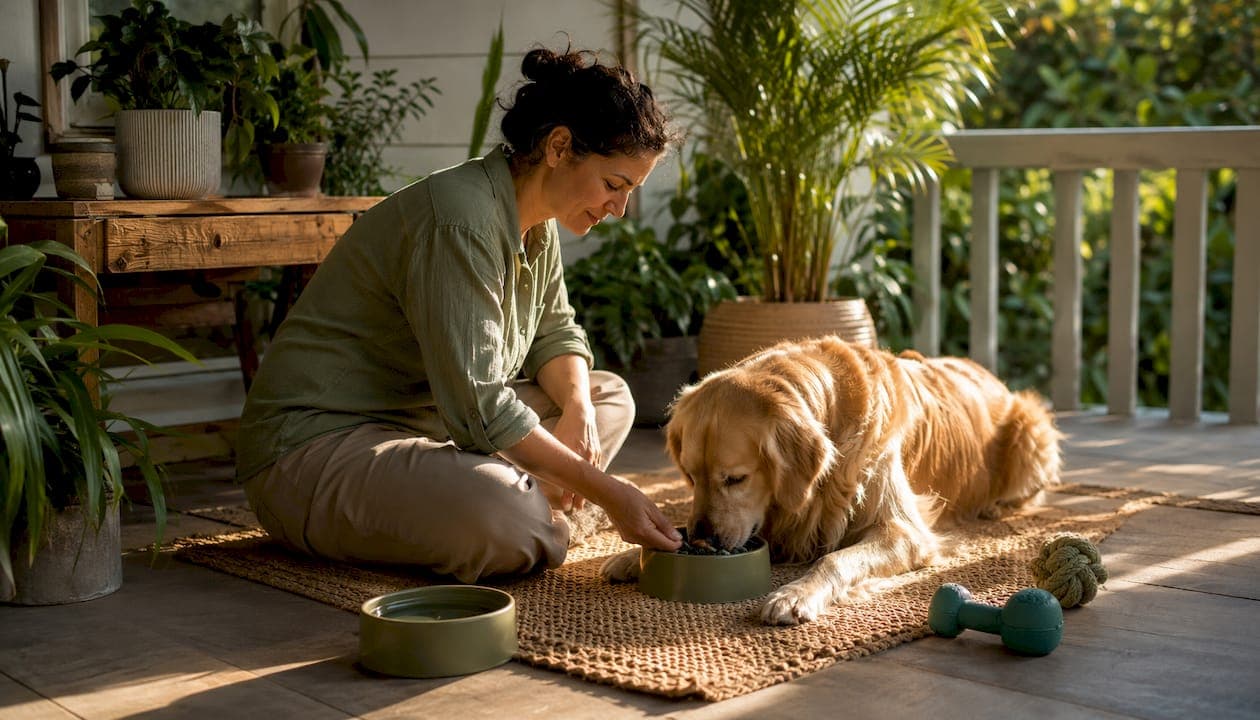
Yes, routine directly affects dog anxiety, and the effect is generally positive. Veterinary behavior experts at Cornell recommend adding consistency and predictability as a frontline strategy for reducing anxious behavior, because predictable sequences help a dog's nervous system downregulate rather than stay locked in alert mode. Around 70% of dogs show at least one sign of anxiety or fear in everyday life, which means this is not a niche concern.
Key signals that your dog may need more structure:
- Pacing or inability to settle during quiet moments
- Increased whining, barking, or destructive chewing
- Sudden clinginess or loss of appetite
- Heightened vigilance around predictable departure cues (keys, shoes)
Bowlful's tailored feeding plans add one more predictable anchor to that structure, pairing consistent mealtimes with calorie levels matched to your dog's specific breed, weight, and life stage.
Table of Contents
- Does routine affect dog anxiety? Here's the mechanism
- Daily routines that actually reduce anxiety
- What to do when your dog is already highly anxious
- How to keep routines flexible without creating fragility
- How to monitor progress and when to consult a professional
- How nutrition and feeding patterns support anxiety management
- Key Takeaways
- Routine works — but perfection is the enemy of progress
- Bowlful's tailored feeding plans complement your routine work
- Useful sources for further guidance
Does routine affect dog anxiety? Here's the mechanism
A dog's brain is essentially a prediction engine. When the environment is consistent, the brain can file away "this sequence is safe" and stop scanning for threats. That threat-scanning state, driven by cortisol, is what owners recognize as anxiety. Predictability reduces the need to constantly scan for threats, and that downregulation is a practical pathway to lower cortisol-driven vigilance.
Around 70% of dogs show at least one anxiety or fear sign in everyday life — making routine one of the most widely applicable, zero-cost interventions available to owners.
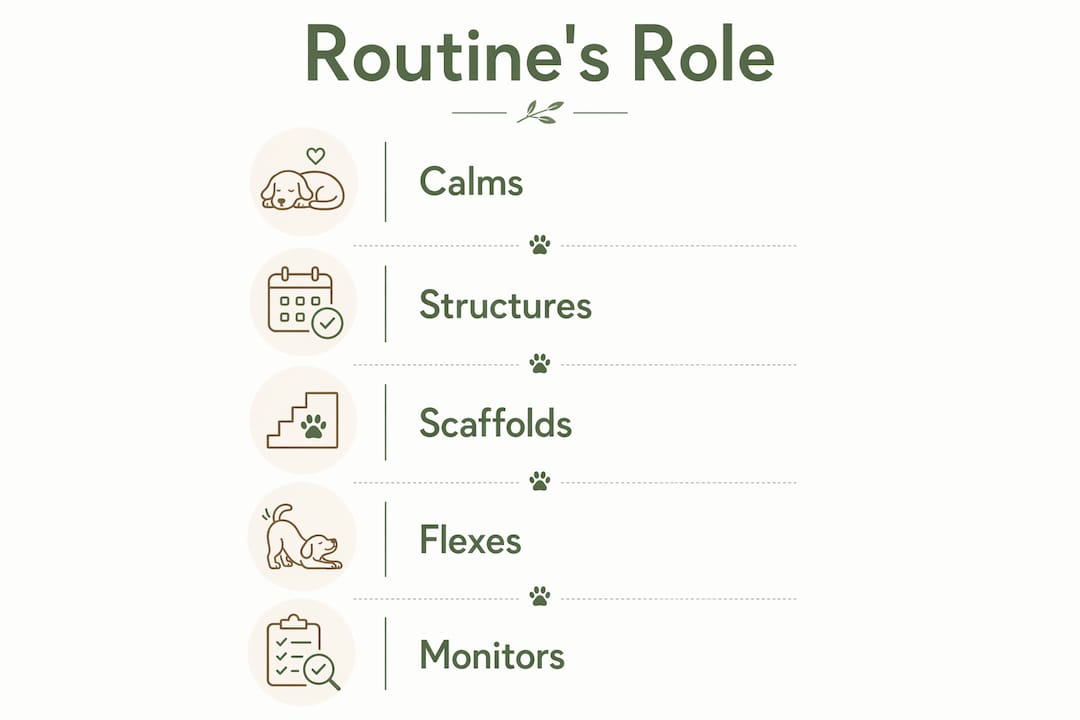
Here is where routines outperform verbal commands. When a dog is already highly aroused, the thinking brain is essentially offline. Telling a panicking dog to "sit" or "settle" asks it to access the very cognitive resources that stress has temporarily shut down. Environmental patterns and routines operate at a more automatic, learned level — they bypass that offline thinking brain entirely.
The contrast matters in practice:
- Verbal commands require the dog to process language, inhibit impulse, and retrieve a trained behavior — all cognitively expensive under stress
- Routine cues (the same leash hook, the same feeding spot, the same pre-bed sequence) are recognized automatically, triggering a calming response without demanding cognitive effort
For rescue dogs or those with limited early socialization, routine also serves as scaffolding — providing repeated, safe experiences that build the flexibility and resilience those dogs missed during development.
Daily routines that actually reduce anxiety
Structure does not mean a rigid minute-by-minute timetable. It means reliable sequences with predictable outcomes. A workable daily scaffold looks like this:
- Morning (7:00–8:00 AM): Same potty route, then breakfast in the same quiet spot
- Mid-morning (9:00–10:00 AM): Walk or structured exercise block (20–45 minutes)
- Midday (12:00–1:00 PM): Enrichment activity — sniff mat, puzzle feeder, or short training session
- Afternoon (3:00–4:00 PM): Rest period in a designated quiet space
- Evening (6:00–7:00 PM): Dinner, then a decompression walk or calm play
- Bedtime (9:00–10:00 PM): Same wind-down cue (a specific mat, a consistent phrase), lights down
A large study published in PLOS One found dogs with more daily exercise had significantly lower levels of fearfulness and separation-related behaviors, with mechanisms possibly involving serotonin changes similar to those seen in humans. That makes the exercise block non-negotiable, not optional.
Quick-start checklist for today:
- Pick two fixed anchor points (morning feeding, evening walk) and protect them
- Designate one quiet feeding spot and use it every meal
- Add one enrichment activity at the same time each day
- Establish a consistent pre-bed sequence of three to four steps
Pro Tip: In multi-dog households, assign each dog a specific feeding station and stagger walk departures by five minutes. Shared anchor points (same walk route, same rest area) reinforce the group's collective sense of predictability without requiring identical schedules.
What to do when your dog is already highly anxious
When a dog is already in a high-arousal state, commands rarely land. Work with the environment instead.
- Remove or reduce the trigger — lower noise, reduce visual stimulation, move to a quieter room
- Activate a known routine cue — go to the feeding spot, pick up the leash for a short sniff walk, or open the puzzle feeder
- Stay calm and move slowly — your own body language is an environmental cue
- Avoid reassurance loops — brief, neutral acknowledgment is fine; extended soothing can reinforce the anxious state
- Return to the normal sequence as soon as the dog shows any reduction in arousal
One underappreciated trigger: pre-departure sequences. Picking up keys or putting on shoes can trigger anxiety long before you actually leave. Deliberately handling keys or putting on shoes at random times with no departure breaks that anticipatory association over two to four weeks.
Timeline expectations:
- Days 1–7: Little visible change; the nervous system needs repetition before it trusts the pattern
- Weeks 2–6: Shorter recovery times after startling events, reduced anticipatory pacing
- Months 2–3+: Fewer baseline vigilance behaviors, more voluntary rest
Seek a veterinarian or certified applied animal behaviorist (ACVB directory) if you observe: aggression, self-injury, inability to eat or sleep, or symptoms that worsen despite four or more weeks of consistent routine.
How to keep routines flexible without creating fragility
Overly strict schedules can backfire. A dog trained to expect a walk at exactly 7:14 AM every morning may become more anxious, not less, when that walk shifts to 7:45 AM. The goal is reliable sequence, not rigid timing.
Pattern games build the tolerance you want. A simple version: ask for a sit, reward, pause three seconds, ask for a down, reward, pause, release to sniff. The predictable challenge-success-reward-calm cycle rehearses recovery from arousal and, with repetition, shifts the dog toward calmer baseline states.
Do/don't checklist for introducing variability:
- ✅ Vary the time of an activity by 15–30 minutes occasionally
- ✅ Change the route of a walk while keeping the duration consistent
- ✅ Rotate enrichment toys while keeping the enrichment time slot fixed
- ❌ Change multiple elements simultaneously
- ❌ Skip anchor points entirely without a substitute cue
- ❌ Introduce variability during an already-stressful period (travel, illness, new household member)
Pro Tip: Change only one routine element per week. Log your dog's behavior for three days after each change. If anxiety signs increase, revert and wait two more weeks before trying again.
How to monitor progress and when to consult a professional
Tracking progress prevents the common mistake of abandoning a routine too early because results feel invisible.
Signs the routine is helping:
- Shorter recovery time after a startle or disruption
- Fewer anticipatory behaviors (pacing before meals, whining before walks)
- Resumed or improved sleep patterns
- Voluntary retreat to the rest area without prompting
- Reduced destructive behavior during predictable alone-time windows
Monitoring timeline:
- Baseline (Days 1–3): Log current anxiety signs, frequency, and triggers before changing anything
- Early phase (Weeks 1–2): Note any reduction in duration of anxious episodes, even if frequency stays the same
- Mid phase (Weeks 3–6): Look for fewer anticipatory behaviors and faster recovery
- Consolidation (Months 2–3+): Assess whether baseline vigilance has dropped and whether the dog initiates rest independently
When you do consult a vet or behaviorist, bring: a written behavior log with dates and times, a short video of the anxious behavior, and your current feeding and exercise schedule. That combination lets a professional assess patterns rather than relying on memory.
How nutrition and feeding patterns support anxiety management
Feeding is not separate from routine — it is one of its most powerful anchors. A consistent mealtime tells a dog's nervous system that resources are reliable and that the world is predictable. Irregular feeding, by contrast, keeps a dog in a low-level resource-scanning state that compounds background anxiety.

Bowlful's approach uses the Resting Energy Requirement (RER) formula, the same calculation veterinarians use, to match calorie delivery to each dog's breed, weight, and life stage. Getting that number right matters beyond weight management: a dog that is chronically underfed or overfed experiences energy fluctuations that can amplify stress reactivity. Consistent, correctly portioned meals remove one more variable from an anxious dog's day.
Practical feeding-pattern principles:
- Feed at the same time(s) each day in the same quiet, low-traffic spot
- Use a structured feeding routine rather than free-feeding, which removes the predictable mealtime cue entirely
- Replace emotional or boredom-driven snacking with puzzle feeders at a scheduled enrichment time
- Avoid feeding during or immediately after an anxious episode, which can inadvertently reinforce the state
Pro Tip: If you are changing your dog's food or portion size, do it gradually over seven to ten days and log behavior alongside the transition. Digestive discomfort from abrupt food changes is a real, often overlooked anxiety amplifier.
For owners of working breeds with high energy demands, calorie adequacy is especially relevant — an under-fueled working dog is a more reactive dog.
Key Takeaways
Consistent, predictable routines reduce dog anxiety by downregulating the nervous system's threat-scanning response, and pairing those routines with correctly portioned, scheduled meals removes one more source of daily uncertainty.
| Point | Details |
|---|---|
| Routine lowers arousal | Predictable sequences help dogs stop scanning for threats, reducing cortisol-driven vigilance. |
| Exercise is non-negotiable | Daily exercise is linked to significantly lower fearfulness and separation-related behaviors. |
| Flexibility beats rigidity | Vary one element at a time; rigid minute-by-minute schedules can increase anxiety when disrupted. |
| Monitor before you quit | Track behavior for at least 2–6 weeks before concluding a routine is not working. |
| Bowlful adds a nutrition anchor | Tailored RER-based feeding plans create consistent, correctly portioned mealtimes that reinforce daily structure. |
Routine works — but perfection is the enemy of progress
The owners I see struggle most with anxious dogs are not the ones who do too little. They are the ones who try to engineer a perfect schedule, then abandon the whole thing the first week it falls apart. Consistency over weeks matters far more than precision on any given day.
What the evidence actually supports is simpler than most guides make it sound: pick two or three reliable anchor points, protect them, and let the dog's nervous system do the rest over time. Add a correctly portioned, scheduled meal to that structure, and you have addressed two of the most controllable variables in a dog's daily experience. That is not a small thing.
The nutrition piece is genuinely underrated in behavior conversations. A dog whose energy needs are met predictably is a calmer dog, and that is not anecdotal — it follows directly from what we know about how stress and resource uncertainty interact in the canine nervous system.
*— Robert
Bowlful's tailored feeding plans complement your routine work
Behavior work and nutrition work better together than either does alone. Bowlful builds feeding plans around the RER formula, matching portions precisely to your dog's breed, weight, and life stage, so mealtimes become a reliable, correctly fueled anchor in the daily routine you are building.
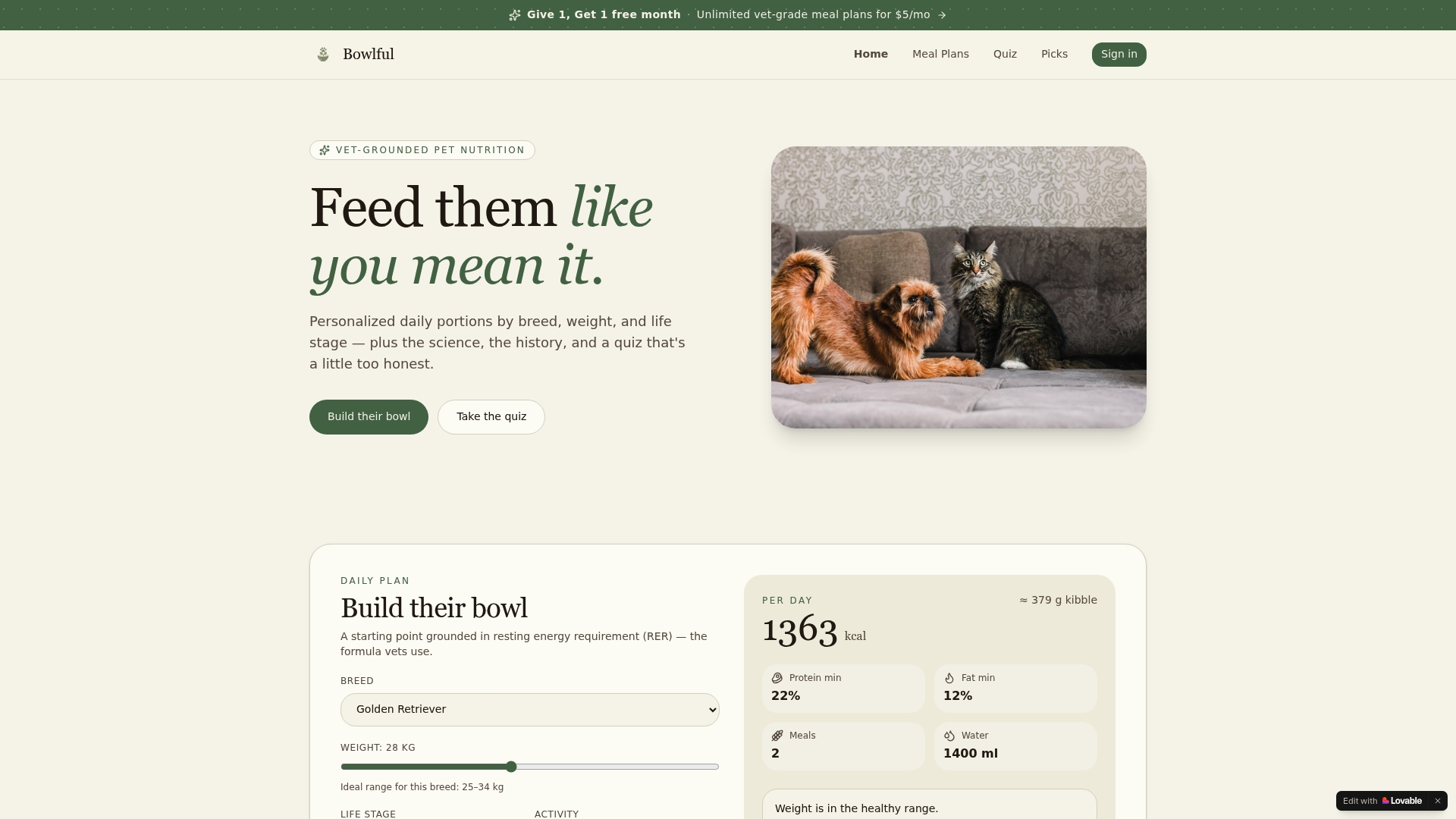
The process starts with a short quiz that takes about two minutes. Bowlful generates a personalized meal plan you can slot directly into your dog's daily schedule, giving you one less variable to manage while you focus on the behavior side. For dogs already showing anxiety signs, that predictable, well-portioned mealtime is a low-effort, high-impact addition to everything else you are doing.
Take the Bowlful quiz and get a feeding plan built around your dog's actual needs, not a generic bag recommendation.
For severe anxiety, aggression, or self-injurious behavior, please consult your veterinarian or a certified applied animal behaviorist before making changes.
Useful sources for further guidance
- Cornell University College of Veterinary Medicine — Best for understanding the predictability and nervous-system mechanism; the primary clinical reference for routine-based anxiety reduction.
- PLOS One — Early life experiences and exercise in dogs — Peer-reviewed data on exercise and anxiety prevalence; use when evaluating how much daily activity your dog needs.
- American Veterinary Medical Association (AVMA) — General veterinary guidance and a starting point for finding a licensed veterinarian in your area.
- American College of Veterinary Behaviorists (ACVB) — Directory of board-certified veterinary behaviorists; consult for severe, worsening, or medication-requiring cases.
- International Association of Animal Behavior Consultants (IAABC) — Certified behavior consultant directory; appropriate for moderate anxiety cases that need professional guidance short of full veterinary behaviorist referral.
- Preventive Vet — Do Dogs Need a Daily Routine? — Practical, owner-facing guidance on building structure without rigidity; good first read for owners starting from scratch.
- Lakewood Ranch Doodles — Leaving your puppy home alone — Breeder-focused guidance on acclimating puppies to alone time; relevant for pre-departure routine modification in younger dogs.