
Organic dog food is worth considering for healthy dogs, but it is not a nutritional silver bullet. The USDA organic seal tells you how ingredients were grown and processed. It says nothing about whether the food meets your dog's actual caloric and micronutrient needs. For most owners, the smarter move is to treat organic sourcing as one factor in a larger, science-based feeding decision.
-
Organic status covers sourcing and production. The USDA seal means at least 95% of ingredients meet federal organic standards, including restrictions on synthetic pesticides and traceability from farm to processor.
-
Organic does not replace AAFCO nutritional adequacy or veterinary therapeutic diets. A food can be certified organic and still be nutritionally incomplete for your dog's life stage or medical condition.
-
When your dog has weight, life-stage, or medical considerations, prioritize a personalized RER/MER feeding plan first. Ingredient sourcing is secondary to hitting the right calorie and nutrient targets. Check the AAFCO statement on any food you buy, and consult your vet if your dog has a diagnosed condition.
Table of Contents
- What does "organic" legally mean on a dog food label?
- How organic certification differs from therapeutic and AAFCO-compliant diets
- Pros and cons of feeding your dog organic food
- How to evaluate and choose an organic dog food
- When does a personalized RER/MER plan matter more than organic sourcing?
- Key Takeaways
- The part most organic food guides skip
- Bowlful builds the plan organic food labels can't
- Sources and further reading
What does "organic" legally mean on a dog food label?
The USDA regulates organic claims on pet food under the same federal framework it applies to human food. To display the USDA Organic seal, a product must contain at least 95% organic ingredients by weight, excluding water and salt, and must prohibit most synthetic pesticides throughout the supply chain.
Three label tiers exist, and they are not interchangeable:
- "100% Organic" — every ingredient (excluding water and salt) is certified organic.
- "Organic" — at least 95% of ingredients are organic; the remaining 5% must come from an approved list.
- "Made with organic ingredients" — at least 70% organic content; the USDA seal cannot appear on the front panel.
What most owners miss is that USDA certification covers manufacturing too, not just the ingredients themselves. Certified manufacturers must document their cleaning agents, packaging materials, and water quality used during processing. Annual audits verify the entire chain of custody, from the farm through the production floor.
Pro Tip: When evaluating an organic brand, ask whether it publishes its USDA certification number and audit date. Brands that do are far more transparent than those that simply print "made with organic ingredients" on the bag.
How organic certification differs from therapeutic and AAFCO-compliant diets
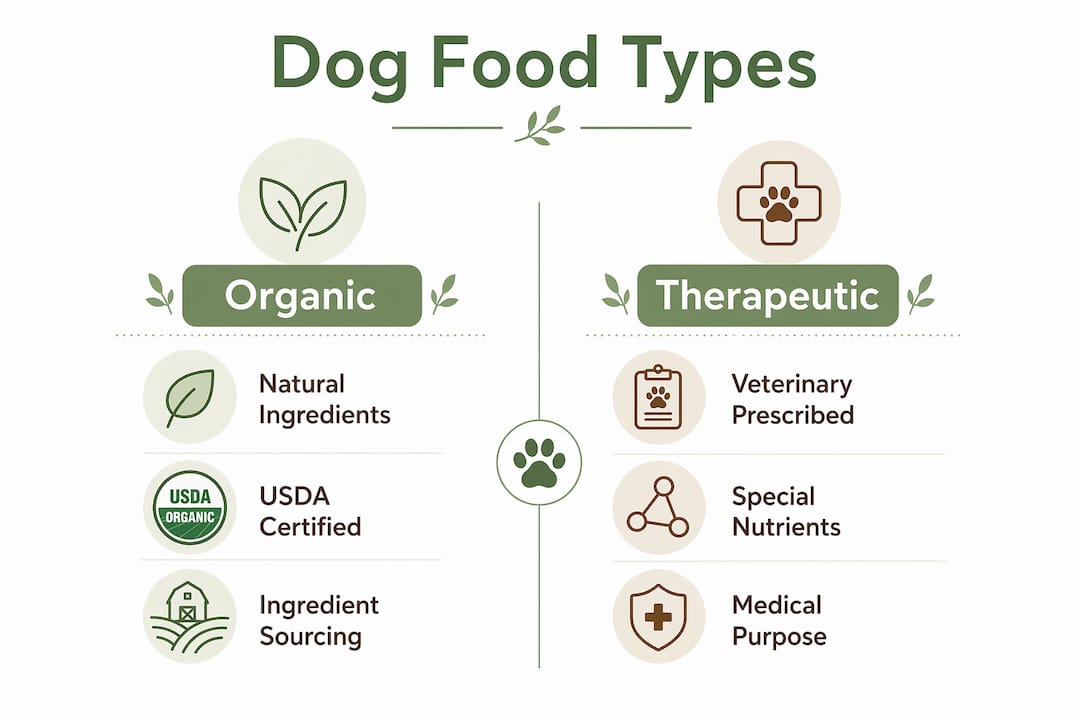
Organic certification and veterinary therapeutic diets solve completely different problems. Organic = production standards. Therapeutic = clinical formulation and testing. Conflating the two is one of the most common mistakes owners make.
Here is how they compare:
- Purpose: Organic certification ensures ingredient sourcing integrity. Therapeutic diets are formulated to manage specific medical conditions, such as kidney disease, urinary stones, or food allergies.
- Availability: Organic foods are sold over the counter. Therapeutic diets typically require a veterinarian's recommendation.
- Testing: Therapeutic diets are developed through feeding trials and clinical studies. Organic certification involves agricultural audits, not nutritional efficacy trials.
- Intended use: Organic foods suit healthy dogs whose owners prioritize sourcing. Therapeutic diets are tools for managing diagnosed conditions.
Feeding trials and clinical research validate what a food does inside the body. Organic certification validates how the ingredients were grown. These are not the same standard, and one cannot substitute for the other.
Prescription formulas may include hydrolyzed proteins, controlled phosphorus levels, or altered fat ratios specifically calibrated to a medical outcome. No organic label can replicate that clinical precision. If your dog has a diagnosed condition, the science of feeding dogs properly starts with your vet, not the ingredient panel.
Pros and cons of feeding your dog organic food
For a healthy adult dog with no medical conditions, the pros of organic food generally outweigh the cons, provided the food carries an AAFCO nutritional adequacy statement. The calculus shifts when cost, availability, or medical needs enter the picture.

| Pros | Cons |
|---|---|
| Reduced synthetic pesticide residue in ingredients | Higher cost than conventional options |
| Stricter ingredient traceability and sourcing transparency | Fewer product options, especially for small dog food or soft dog food formats |
| No artificial preservatives or synthetic additives in certified products | Organic label does not guarantee complete and balanced nutrition |
| Welfare and environmental sourcing standards | Some formulas have lower caloric density, requiring larger portions |
| May suit dogs with certain food sensitivities (single-protein organic options exist) | Contamination risks (e.g., mold, pathogens) are not eliminated by organic status |
A few practical scenarios worth naming:
- Organic as a primary diet makes sense for healthy adult dogs when the food carries an AAFCO statement for the dog's life stage and the owner has verified caloric density against the dog's RER.
- Organic as an adjunct works when you want cleaner ingredient sourcing for toppers or fresh-food additions alongside a clinically validated base diet.
- Organic is not recommended as the sole diet for dogs with kidney disease, severe food allergies requiring hydrolyzed protein, or other conditions where a prescription-level diet is indicated.
How to evaluate and choose an organic dog food
The single most important check is the AAFCO nutritional adequacy statement. Without it, no amount of organic certification tells you whether the food is complete and balanced for your dog.
- Verify the AAFCO statement. Look for "complete and balanced" language and confirm it covers your dog's life stage (puppy, adult, or all life stages). Feeding-trial-substantiated statements carry more weight than formulation-only claims.
- Identify the USDA organic tier. Confirm whether the product is "100% Organic," "Organic," or merely "Made with organic ingredients." The tier affects how much of the diet is actually certified.
- Check the guaranteed analysis and caloric density. Compare protein, fat, moisture, and Kcal/kg across products. A USDA-certified fresh formula typically lists protein, fat, moisture, and caloric density values, useful as a baseline when comparing caloric density between fresh and dry formats.
- Review feeding guidelines and recall history. Cross-reference the brand's recall history on the FDA's pet food recall database. Brands with USDA certification and third-party audits tend to have stronger quality controls.
- Confirm manufacturing transparency. Look for published certification numbers, audit dates, and sourcing disclosures. Vague "natural" claims with no documentation are a red flag.
| Nutrient | Example (USDA-certified fresh formula) |
|---|---|
| Protein | 9.6% |
| Fat | 4.2% |
| Moisture (max) | 70% |
| Caloric density | 1,300 Kcal/kg |
Transition timetable: Switch foods over 7–14 days by gradually increasing the new food's proportion. Monitor stool consistency and body weight weekly. Loose stools in the first few days are common; persistent changes beyond day five warrant a slower transition or a vet call.
Pro Tip: When switching to a fresh or raw organic formula with high moisture content, recalculate your dog's daily portion using Kcal/kg rather than cup volume. High-moisture foods are far less calorie-dense than dry kibble, and volume-based feeding often leads to underfeeding.
When does a personalized RER/MER plan matter more than organic sourcing?
Prioritize RER/MER personalization any time your dog has weight issues, is in a demanding life stage (puppy, pregnant, senior), has high or low activity levels, or carries a medical diagnosis. Ingredient sourcing is a secondary consideration once caloric precision is established.
RER (Resting Energy Requirement) is calculated as 70 × (body weight in kg)^0.75. For example, a dog weighing around 10 kg has a corresponding RER value. MER (Metabolic Energy Requirement) adjusts that baseline by a life-stage or activity factor depending on the dog's condition and activity level. Bowlful's daily calories calculator walks through this step by step and generates a personalized target based on breed, weight, and life stage.
Three practical use cases:
Healthy adult dog seeking organic ingredients. RER/MER sets the caloric target; you then select an organic food whose Kcal/kg allows you to hit that target in a reasonable daily portion. This is the ideal scenario where organic and personalized nutrition work together.
Senior dog needing calorie control. Older dogs often need 20% fewer calories than their adult MER. An organic food with high caloric density can silently cause weight gain if portions are not recalculated. A personalized plan catches this before the scale does. Research suggests lean-fed pets may live up to 1.8 years longer, which makes caloric precision in senior dogs especially consequential.
Dog with a diagnosed medical condition. Here, the prescription diet takes priority. Organic sourcing is largely irrelevant when the clinical goal is, for example, reducing dietary phosphorus for a dog with early kidney disease. The vet's formulation supersedes any ingredient preference.
Organic ingredients can absolutely coexist with a science-based feeding plan. The key is to anchor the plan in caloric targets first, then select the cleanest product that hits those numbers.
Pro Tip: If you want to use an organic food but are concerned about micronutrient gaps, ask your vet about targeted supplementation rather than switching to a less-transparent conventional food. A well-chosen organic base diet plus a vet-recommended supplement often beats a nutritionally complete but heavily processed alternative.
Key Takeaways
Organic dog food can be a genuinely good choice for healthy dogs, but only when it carries an AAFCO adequacy statement and is portioned to match the dog's RER/MER caloric targets.
| Point | Details |
|---|---|
| Organic covers sourcing, not nutrition | The USDA seal guarantees ingredient and production standards, not complete and balanced nutrition. |
| AAFCO statement is non-negotiable | Always verify the food is "complete and balanced" for your dog's life stage before buying. |
| Therapeutic diets are clinically different | Prescription diets are validated through feeding trials; organic certification is an agricultural standard. |
| RER/MER precision matters most | For dogs with weight, age, or medical needs, calorie-accurate personalization outweighs ingredient sourcing. |
| Bowlful personalizes the plan | Bowlful's RER/MER-based quiz generates a tailored meal plan that can incorporate organic food choices. |
The part most organic food guides skip
The organic pet food conversation tends to get stuck on ingredients. Pesticide-free chicken, certified grains, no artificial preservatives. Those things matter. But the question owners rarely ask is: how much of this food should my dog actually eat?
A USDA-certified organic formula with 1,300 Kcal/kg feeds a 10 kg dog very differently than a conventional kibble at 3,500 Kcal/kg. If you switch formats without recalculating portions, you are either underfeeding or overfeeding regardless of how clean the sourcing is. The organic label does not protect against that error.
The other thing most guides understate: organic certification is a systemic audit, not a one-time ingredient check. Brands that publish their certification numbers and annual audit dates are genuinely more accountable than those that print "natural" on the bag and call it a day. That distinction is worth your attention when you compare dog food options.
My honest recommendation is to use organic sourcing as a filter, not a foundation. Start with your dog's caloric needs, confirm AAFCO adequacy, then choose the cleanest product that fits those parameters. That sequence produces better outcomes than starting with the organic label and hoping the nutrition follows.
Bowlful builds the plan organic food labels can't
Most organic dog food brands tell you what went into the bag. Bowlful tells you exactly how much of it your dog should eat, based on their weight, breed, age, and activity level, using the same RER/MER formulas veterinarians rely on.

The process starts with a short interactive quiz. From there, Bowlful generates a downloadable meal-plan PDF with portioned feeding guidance, caloric targets, and curated product recommendations, including organic options that meet your dog's specific nutritional profile. If you want organic ingredients without losing clinical precision, this is the practical next step.
Take the free Bowlful quiz and get a personalized feeding plan built around your dog's actual needs, not a generic serving suggestion on a bag.
Sources and further reading
The claims in this article draw primarily on USDA organic program guidance, AAFCO nutritional adequacy standards, and clinical veterinary nutrition sources. For medical diet decisions, always consult a licensed veterinarian.
- USDA Organic certification and label tiers — Tender & True organic product page with USDA organic explanation
- Veterinary therapeutic diets explained — PetMD on prescription dog food and feeding trials
- USDA organic manufacturing requirements — California Dog Kitchen certified organic product details
- Bowlful RER/MER calorie calculator — step-by-step daily calorie guide for dogs
- Vet-approved nutrition principles — Bowlful blog on clinically designed feeding plans
This article cites five primary sources. For any dog with a diagnosed medical condition, the guidance here is general information, not a substitute for professional veterinary advice. Confirm current dietary recommendations with your veterinarian for your dog's specific situation.