
How many calories does a Husky need each day?
Husky calorie needs vary more than most owners expect. Husky calorie needs vary widely based on activity level, weight, and individual factors. Sedentary adults need fewer calories, with requirements climbing as activity increases, reaching much higher levels for highly active or working Huskies, including competitive sled dogs requiring extensive energy intake.
Calorie needs can be categorized by activity level, from sedentary to working or racing sled dogs, with increasing calorie requirements as activity intensifies, but exact numbers vary by individual and are best determined with personalized assessment.
Weight impacts calorie needs, with lighter Huskies requiring fewer calories than heavier ones at comparable activity levels, though individual needs vary and should be monitored regularly. Neither number is a guarantee. They are starting points, not prescriptions.

How to calculate your Husky's calorie needs using veterinary formulas
The most accurate way to estimate caloric intake for Huskies is through two formulas veterinary nutritionists rely on: the Resting Energy Requirement (RER) and the Maintenance Energy Requirement (MER).
Step 1: Calculate RER
The RER formula is:
RER = 70 × (body weight in kg)^0.75
This gives you the calories your Husky needs just to exist at rest. It accounts for organ function, breathing, and basic cellular activity.
Step 2: Apply the MER activity factor
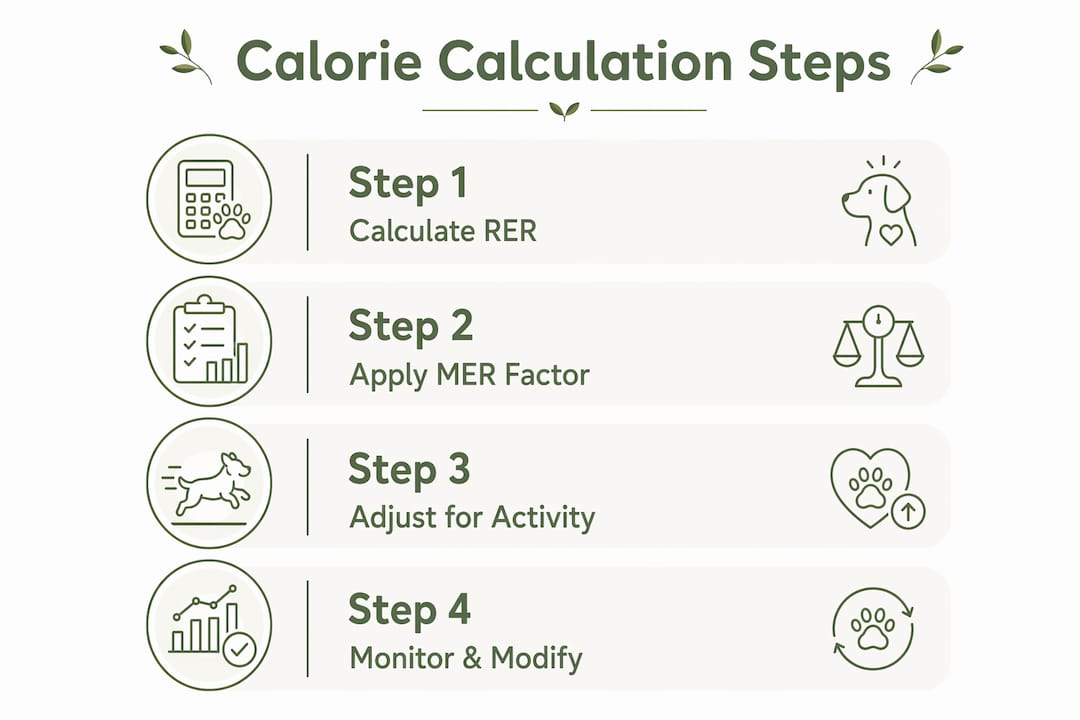
MER = RER × activity factor, where the factor typically ranges from 1.2 for sedentary dogs to 3.0 or higher for working dogs.
Step 3: Work through a real example
Take a moderately active 50 lb Husky:
- Convert weight: 50 lbs ÷ 2.2 = 22.7 kg
- Calculate RER: 70 × (22.7)^0.75 ≈ 70 × 9.8 ≈ 686 kcal
- Apply MER factor (1.6–1.4 for moderate activity): 686 × 1.4 ≈ 960 kcal/day, or 686 × 1.6 ≈ 1,097 kcal/day. For most moderately active adult Huskies, research supports a typical range of 1,100–1,300 kcal/day. Individuals may need to adjust within this range for energy demands and body condition.
Generic bag-of-food guidelines skip this math entirely. They are averaged across dozens of breeds and activity levels, which means they routinely overshoot for a Husky lounging around the house and undershoot for one running trails every morning. Understanding why dogs need different food amounts is the first step toward feeding yours correctly.
Pro Tip: If math feels tedious, Bowlful's dog calorie calculator runs the RER and MER formulas for you. Enter your Husky's weight, age, and activity level and it returns a personalized daily target in seconds.
Effective feeding strategies to meet your Husky's calorie needs
Knowing the number is only half the job. Getting those calories into your Husky in the right way matters just as much.
- Split meals into two servings daily. Adult Huskies do better with two meals per day rather than one large feeding. It reduces bloat risk and keeps energy levels steadier.
- Choose calorie-dense, high-protein, high-fat food. Active Huskies generally burn significantly more calories than similarly sized sedentary breeds, reflecting their higher energy expenditure and metabolic efficiency. A diet built around quality animal protein and fat supports both endurance and coat health.
- Cap treats and table scraps at 10% of daily calories. Treats should stay within roughly 10% of daily intake. For a moderately active adult Husky, this typically amounts to about 110–130 kcal, but adjust according to your dog's actual calorie target.
- Adjust for the season. Huskies burn more calories keeping warm in winter and less in summer when activity often drops. Increase portions slightly in cold months and pull back when the heat arrives.
- Respect self-regulation. When a Husky leaves food uneaten, that is usually accurate self-regulation, not pickiness. Pushing extra food risks obesity.
Pro Tip: If your Husky consistently leaves a noticeable portion of each meal uneaten, reduce the portion size instead of changing foods, as this often reflects accurate self-regulation. The dog is telling you something.
Monitoring Husky body condition and adjusting calorie intake
Calories on paper and calories in practice rarely match perfectly. Body Condition Scoring (BCS) is the tool that closes that gap.
Veterinary nutritionists recommend targeting a moderate body condition score around the mid-range for Huskies to guide appropriate feeding amounts. At that score, ribs are palpable with light pressure but not visible, and a waist is visible from above. Huskies have a natural tendency to self-regulate intake below what commercial guidelines suggest, so BCS gives you a physical reality check that no formula can fully replace.
Practical checks to run every two weeks:
- Rib check: Run your fingers along the ribcage. You should feel each rib without pressing hard. If you cannot, the dog is likely overfed.
- Waist check: Look down at your Husky from above. There should be a visible tuck behind the ribs.
- Weight tracking: Weigh your Husky monthly. A steady upward trend without added muscle warrants a calorie cut of 10–15%.
Overfeeding a Husky does not just cause weight gain. It accelerates joint wear and can shorten lifespan. Underfeeding shows up as low energy, dull coat, and visible spine or hip bones. Both extremes are avoidable with consistent monitoring. Feeding based on the middle column of a commercial food bag often leads to overfeeding Huskies specifically, because those guidelines are not built around their efficient metabolism.
Special calorie considerations for senior and highly active Huskies
These two groups sit at opposite ends of the calorie spectrum, and both need careful attention.
Senior Huskies (7 years and older)
Metabolism slows noticeably after age 7. Senior Huskies generally need fewer daily calories to maintain a healthy weight, and the reduction can be meaningful. The goal is not just cutting calories but shifting toward food that is easier to digest and richer in joint-supporting nutrients. Omega-3 fatty acids and glucosamine become more relevant as mobility decreases. A vet-backed supplement guide can help you identify what to add without disrupting calorie balance. Some owners also find that elevated feeders reduce strain during meals for dogs with arthritis.
- Monitor weight monthly, not quarterly
- Reduce calorie-dense treats first before cutting main meals
- Watch for muscle loss, which can mask fat gain on the scale
Highly active and working Huskies
Working Huskies engaged in high-output activities require substantially increased calorie intake compared to pet dogs, with competitive sled dogs needing very high energy levels during peak racing seasons. At that level, standard kibble often cannot deliver enough calories in a reasonable volume. High-fat performance formulas or supplemental fat sources become necessary. A dedicated working dog feeding schedule helps distribute that calorie load without overwhelming the digestive system.
- Feed smaller, more frequent meals during high-output periods
- Prioritize fat as the primary energy source for endurance work
- Recheck BCS weekly during training season, not monthly
Statistic callout: Competitive sled dogs racing at peak output can require up to 10,000 kcal/day, which is about 8–10 times the needs of a moderately active pet Husky (typically 1,100–1,300 kcal/day).
Key Takeaways
A Husky's daily calorie needs depend on weight, activity level, and life stage, making the RER formula and regular body condition scoring the two most reliable tools for accurate feeding.
| Point | Details |
|---|---|
| Calorie range by activity | — |
| Use the RER formula | Calculate RER = 70 × (kg)^0.75, then multiply by an activity factor (1.2–3.0+) for daily needs. |
| Target BCS of 4–5/9 | Ribs should be palpable but not visible; adjust portions if BCS drifts above or below this range. |
| Limit treats to 10% | Treats and table scraps should stay within 10% of daily calorie intake to avoid overfeeding. |
| Seniors need fewer calories | After age 7, metabolism slows; reduce daily intake and shift to easily digestible, nutrient-dense food. |