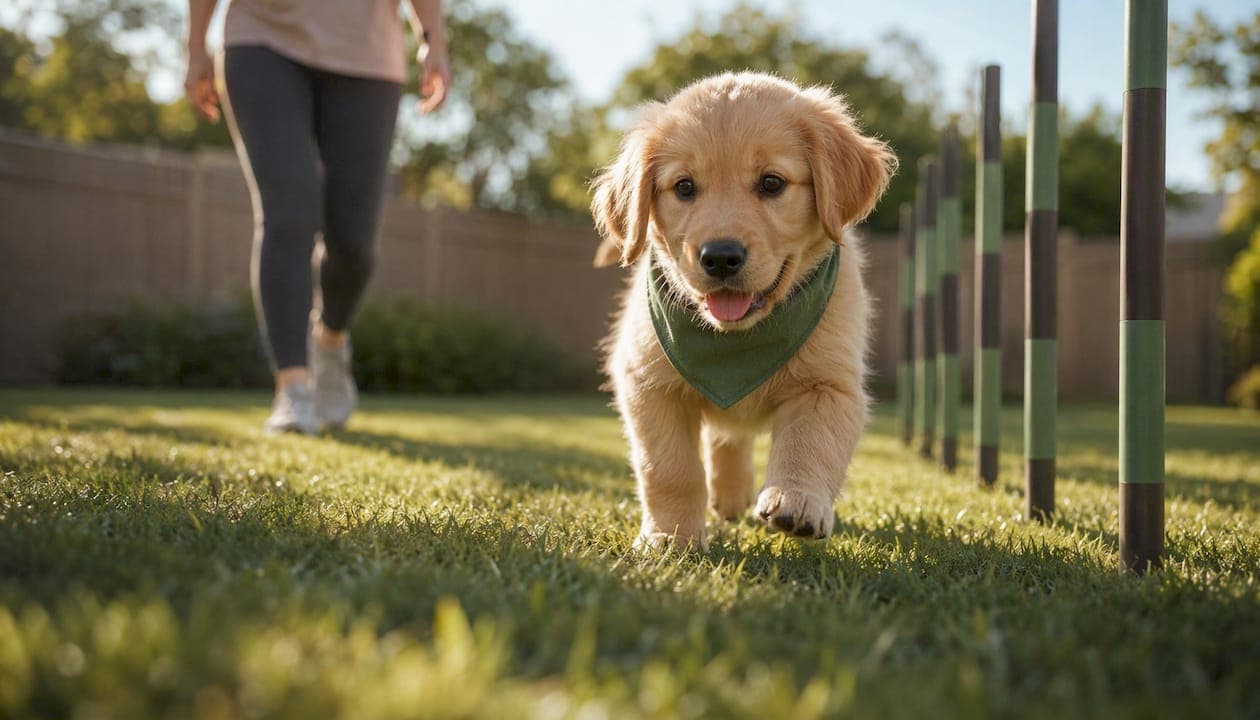
Set a puppy's daily calories by calculating RER (70 × kg body weight to the power of 0.75), multiplying by an age and activity multiplier, then converting the result to grams using your food's kcal per gram. Check the outcome against body condition, not the bag chart, since printed feeding charts assume an average puppy that may not exist. For a number tuned to your dog's breed and routine, run it through the Puppy Feeding Calculator by Breed.
TL;DR:
- Puppy activity levels significantly affect calorie needs, with sedentary puppies requiring fewer calories and active breeds needing more, especially as they age.
- The RER formula accounts for metabolism differences, and multipliers vary based on age and activity, requiring adjustments for large and giant breeds to prevent skeletal issues.
- Converting daily calories into grams depends on the specific food's kcal per gram, and treat portions should stay within 10% of total daily calories to avoid overfeeding.
- Regular body condition checks and incremental portion adjustments help maintain healthy growth and prevent weight-related health problems during development.
- Using a calculator automates the math, providing personalized daily calorie and feeding guidance based on breed, age, and activity, reducing the risk of miscalculations.
Table of Contents
- Estimating Your Puppy's Activity Level for Feeding Calculations
- Calculating RER and Applying the Puppy Multipliers
- Converting Calories Into Grams and Meals per Day
- Monitoring Body Condition and Adjusting Portions Safely
- Bowlful's Tools for Turning the Math Into a Real Feeding Plan
- Mental Stimulation That Complements the Physical Side
- How Activity Shapes a Puppy's Behavior and Growth
- Why the Feeding Math Matters More Than the Exercise Itself
- Get a Personalized Feeding Plan Without Doing the Math Yourself
- Sources
Estimating Your Puppy's Activity Level for Feeding Calculations
Before you touch a calculator, you need an honest read on how your puppy actually spends its day. This matters because the multiplier you choose later swings the calorie total more than almost any other variable in the formula.
Most puppies fall into one of three rough tiers:
- Sedentary or low activity: short leash walks, mostly indoor lounging, common in small apartment dogs or older puppies recovering from injury.
- Average companion activity: daily walks, regular yard play, typical of most family pets like a Cavapoo or a mid-size mixed breed.
- Active or working level: extended off-leash time, structured training, herding or retrieving breeds like Border Collies or working-line Labradors.
Age shifts this baseline. A 10-week-old puppy burns more energy per kilogram of body weight than the same puppy will at 8 months, simply because tissue growth itself costs calories. Large and giant breed puppies deserve extra caution here. Feeding toward the lower end of a calculated range protects growing joints and reduces the odds of skeletal problems tied to rapid weight gain.
Write down your puppy's actual week, not the ideal one. A rainy week with two short walks looks nothing like a week with agility class and a hiking trip, and the calorie target should move with it.
Pro Tip: Keep a simple weekly note of activity changes, like a new dog park routine or a boarding stay, so you can trace a weight shift back to its cause instead of guessing.
Calculating RER and Applying the Puppy Multipliers
The math starts with resting energy requirement, or RER, the baseline calories your puppy would burn doing nothing but existing. The formula is:
RER = 70 × (body weight in kg)^0.75
The exponent, 0.75, accounts for the fact that metabolism doesn't scale in a straight line with body mass. A 30 kg dog doesn't burn triple the calories of a 10 kg dog. That relationship, called metabolic scaling, is why the calculation uses a fractional power instead of simple multiplication, following the standard veterinary RER formula.
RER alone isn't a feeding target. You multiply it by a life-stage and activity factor to get maintenance energy requirement, or MER. Veterinary guidance built on NRC-based multiplier tables commonly uses these ranges for puppies:
- Puppies under 4 months: a higher multiplier around three times resting energy needs
- Puppies 4 months and older: a multiplier close to twice resting energy needs
- Adjust up slightly within either band for genuinely active, high-drive breeds; adjust down for sedentary or recovering puppies
Worked example: A 3-month-old puppy weighing 5 kg.
RER = 70 × (5^0.75) = 70 × 3.34 = about 234 kcal/day
Apply the under-4-months multiplier of ×3.0: 234 × 3.0 = 702 kcal/day
That 702 figure is your starting daily target, not a locked number. Published energy requirement tables that map age against expected adult weight give a useful cross-check if the math above feels off for your puppy's build.
Converting Calories Into Grams and Meals per Day
Calories only mean something once you turn them into food. That conversion depends on calorie density, meaning how many kilocalories sit in each gram of the specific food you feed. Every kibble, wet food, and raw diet carries a different kcal/g value, usually printed on the bag or available from the manufacturer.
The formula is simple:
Grams per day = kcal/day ÷ kcal per gram
- Take your daily kcal target (702 in the earlier example).
- Find your food's kcal/g. A typical puppy kibble runs around 4 kcal per gram.
- Divide: 702 ÷ 4 = about 175 grams per day.
- Split that total across the right number of meals for your puppy's age.
Meal frequency itself follows a predictable curve, as explained in this practical dog feeding routine guide. Puppies at 8 to 12 weeks generally do best on 4 meals a day, dropping to 3 meals by 3 to 6 months, then settling into 2 meals by 6 to 12 months, according to vet-backed feeding guidance. In the example above, a puppy still on 4 meals would get roughly 44 grams per meal.
Treats complicate the math if you're not tracking them. Keep treats at or below 10% of total daily calories, and subtract that amount from the main meal portions rather than adding it on top.
Pro Tip: Switching foods, or mixing wet and dry, means recalculating from scratch. A 175 gram portion of one kibble can deliver a completely different calorie count than 175 grams of another, since kcal/g varies by formula and brand.
Monitoring Body Condition and Adjusting Portions Safely
The calculator gives you a starting point, not a verdict. Your puppy's body tells you whether the number is right.
Check body condition score, or BCS, every 1 to 2 weeks during active growth. You want to feel ribs under a light layer of fat without seeing them, and you want a visible waist tuck when looking down at your puppy from above. A puppy with visible ribs and a sharp hip bone outline is under-fed for its current activity level. A puppy with no palpable waist is running ahead of its calorie needs.
When an adjustment is needed, move in roughly 10% increments rather than large jumps, then wait 1 to 2 weeks before judging the result again. Individual metabolism varies enough between dogs that clinicians favor this incremental approach over chasing precision on the first try.
A few situations call for a vet visit rather than a home adjustment:
- Growth that stalls for more than a week or two
- Rapid widening around the middle despite reduced portions
- Persistently loose or inconsistent stool quality
- Any large or giant breed puppy gaining weight faster than its growth curve predicts
Seasonal shifts, like a switch from summer hiking to winter indoor days, usually call for a modest 10 to 15% tweak rather than a full recalculation. Keep a running log so you can connect a weight change to whatever caused it, the same way you'd track growth stage nutrition shifts over time.
Bowlful's Tools for Turning the Math Into a Real Feeding Plan
Running RER math by hand works, but it's slow and easy to mess up when you're juggling a growth spurt and a new bag of food. The Puppy Feeding Calculator by Breed takes weight, age, breed, and activity level as inputs and returns a daily kcal target along with grams per meal, built on the same RER and multiplier logic covered above.
A few Bowlful guides worth reading next if you want the fuller picture:
- Puppy Feeding Amounts by Age for meal-by-meal breakdowns
- Essential Nutrients New Puppies Need for what should fill those grams, not just how many
- Puppy Growth Calculator if you're unsure what adult weight to plan around
Bowlful builds its recommendations on NRC and AAFCO calorie standards, the same reference points used across veterinary nutrition, rather than a single brand's feeding chart.
Mental Stimulation That Complements the Physical Side
A tired body and a bored mind are two different problems, and feeding plans built purely around physical activity miss half the equation. Puppies that get plenty of leash time but no mental work often burn through their energy allotment fast, then spend the rest of the day restless and chewing on things they shouldn't.
Simple mental work costs almost no extra calories but changes behavior noticeably. Food puzzles turn part of a meal into a 10-minute project. Scatter feeding, where you toss a portion of kibble across the yard or a snuffle mat, taps into a puppy's natural foraging instinct. Basic obedience repetition, five minutes of sit, stay, and recall, taxes a young dog's focus more than most owners expect.
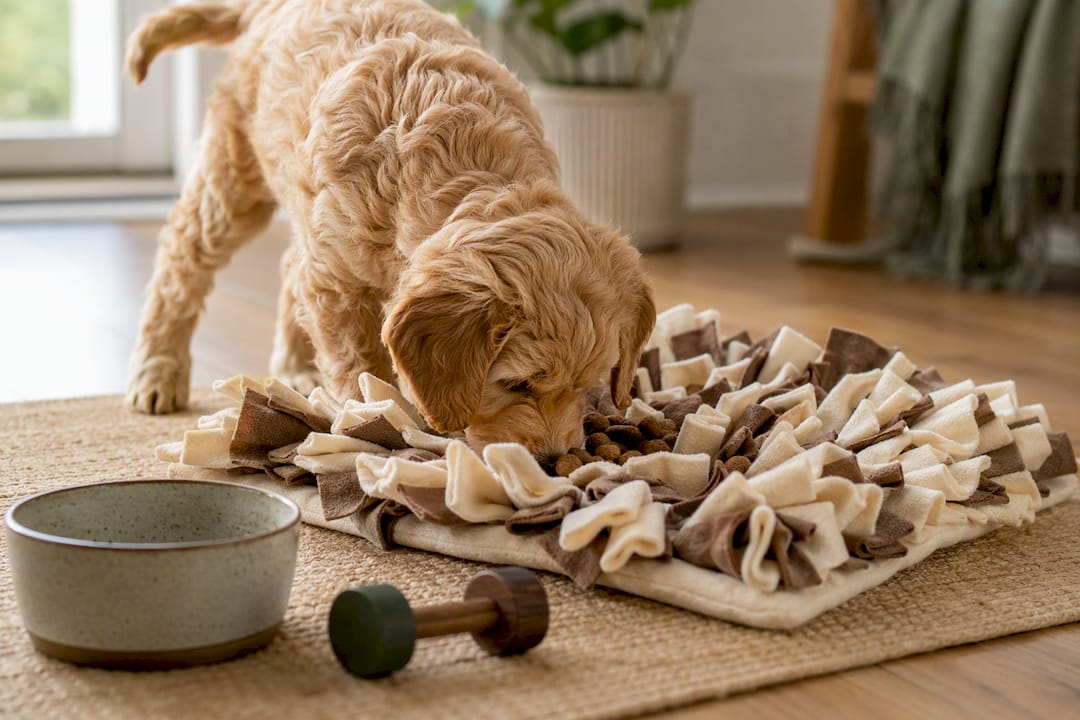
This matters for feeding math in a subtle way. A puppy getting real mental stimulation alongside physical activity tends to settle into a more consistent daily rhythm, which makes activity level easier to rate honestly when you sit down to estimate a multiplier. An erratic, understimulated puppy swings between frantic bursts and crash naps, and that pattern is harder to slot into a clean "average" or "active" tier.
Rotate two or three mental activities through the week rather than repeating the same puzzle toy daily. Novelty is most of what makes the exercise work.
How Activity Shapes a Puppy's Behavior and Growth
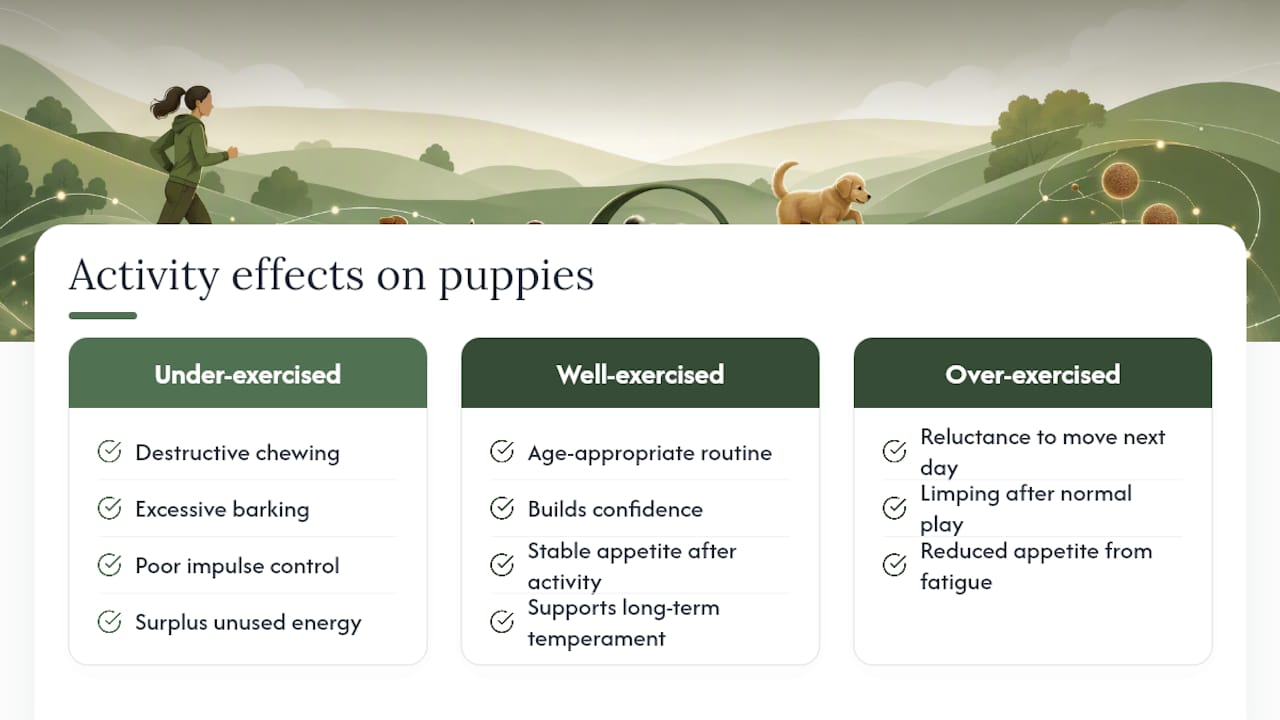
The connection between activity and behavior runs both directions. Under-exercised puppies tend toward destructive chewing, excessive barking, and poor impulse control, not because they're poorly trained but because they have surplus energy with nowhere to go. Over-exercised puppies, particularly in breeds prone to joint issues, show a different set of problems: reluctance to move the next day, limping after normal play, or reduced appetite from fatigue.
Activity level also shapes appetite in ways that feed directly back into your calorie math. A puppy that had a genuinely high-output day, an hour at the dog park plus a training session, may eat with real enthusiasm and finish a portion that looked too generous the day before. It absorbs day-to-day variation without forcing you to recalculate from zero every time.
Development during the first year isn't just physical. Puppies that get consistent, age-appropriate activity tend to build better confidence around new environments and other dogs, since controlled exposure during this window shapes long-term temperament. That's a separate topic from calorie planning, but it's worth knowing that the routine you build for exercise reasons is doing double duty for behavioral development.
Treat activity level as a moving input, not a fixed label. A puppy rated "average" in January might earn "active" by summer once a training routine kicks in, and your feeding math should follow that change rather than lag behind it.
Why the Feeding Math Matters More Than the Exercise Itself
Most advice on puppy activity treats exercise as an end in itself, something to schedule and check off. That framing misses what actually matters for a growing dog: exercise is an input to a calorie equation, and getting that equation wrong causes more damage than an extra ten minutes of walking or a missed one ever will.
The conventional approach, following the feeding chart printed on a bag of kibble, fails because it assumes a puppy that doesn't exist. It can't know your dog's breed, your yard size, or whether your household just added a second dog that turned lazy afternoons into wrestling matches. RER-based math with an activity multiplier corrects for that, but only if you're honest about the activity tier you pick.
If there's one habit worth prioritizing above the rest, it's the body condition check. The formula gets you close. The waist tuck and rib feel tell you whether close was enough. Owners who skip that step and trust the number blindly are the ones who end up back at the vet asking why a "correctly fed" puppy gained too much weight too fast.
— Robert
Get a Personalized Feeding Plan Without Doing the Math Yourself
Running RER by hand works fine once. Doing it every time your puppy hits a growth spurt, switches food, or starts a new training routine gets old fast. A free calculator can do that math automatically, factoring in breed, age, and activity level to hand you a daily kcal target, grams per day, and a meal schedule built around it.
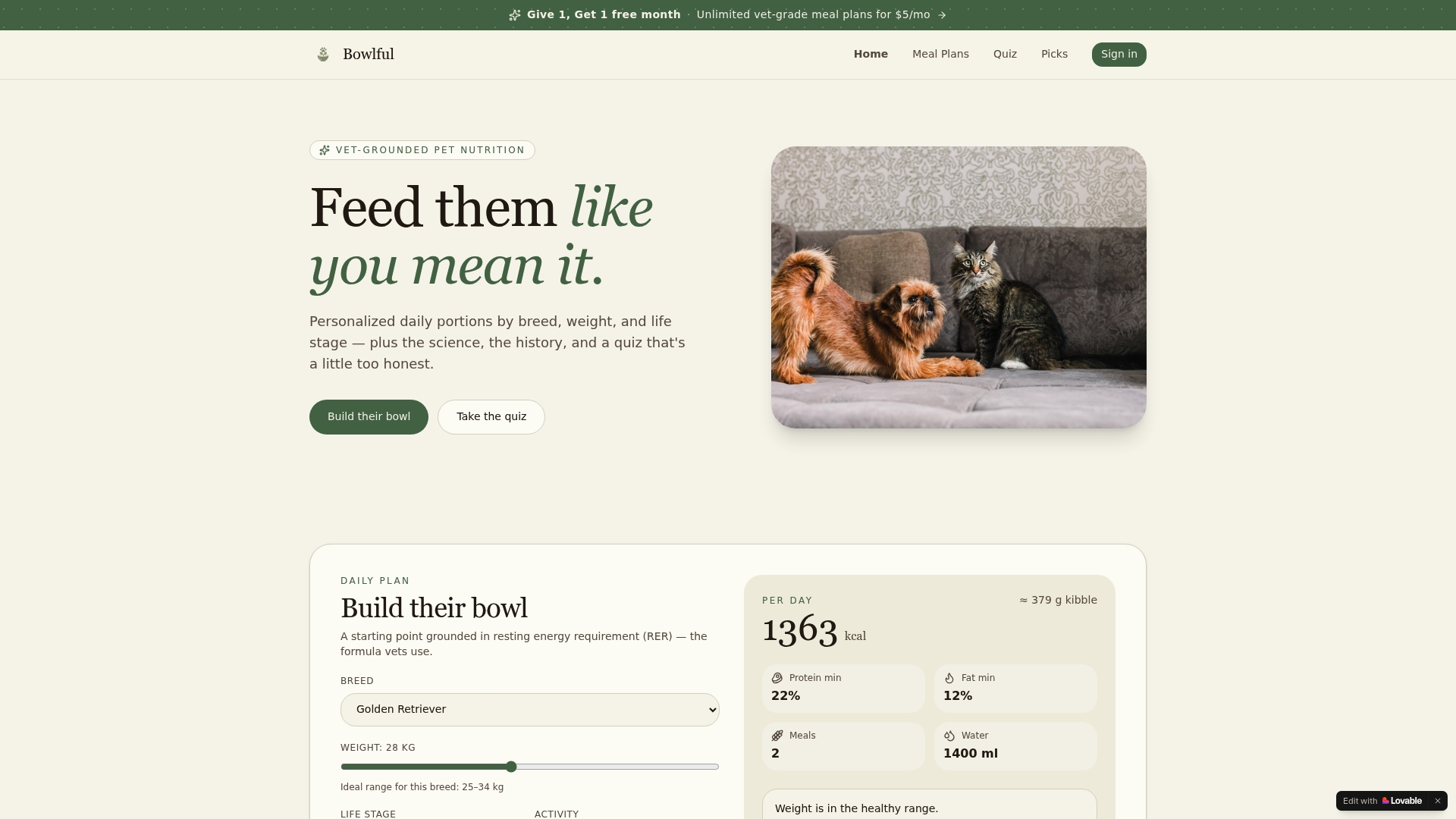
If you want more than the free output, other paid plans build on the same calculation with finer-grained adjustments as your puppy grows, plus downloadable PDFs you can keep or share with a pet sitter. Either way, the starting point is the same free tool. Head to the Bowlful feeding calculator to run your puppy's numbers and get a plan you can actually use at the next meal.
Sources
- Calculated Energy Requirements | WikiVet
- How Much Should I Feed My Dog? A Vet-Backed Feeding Chart by Weight, Age & Activity | Petio
- How Much to Feed a Puppy (the honest answer) | Petcro