
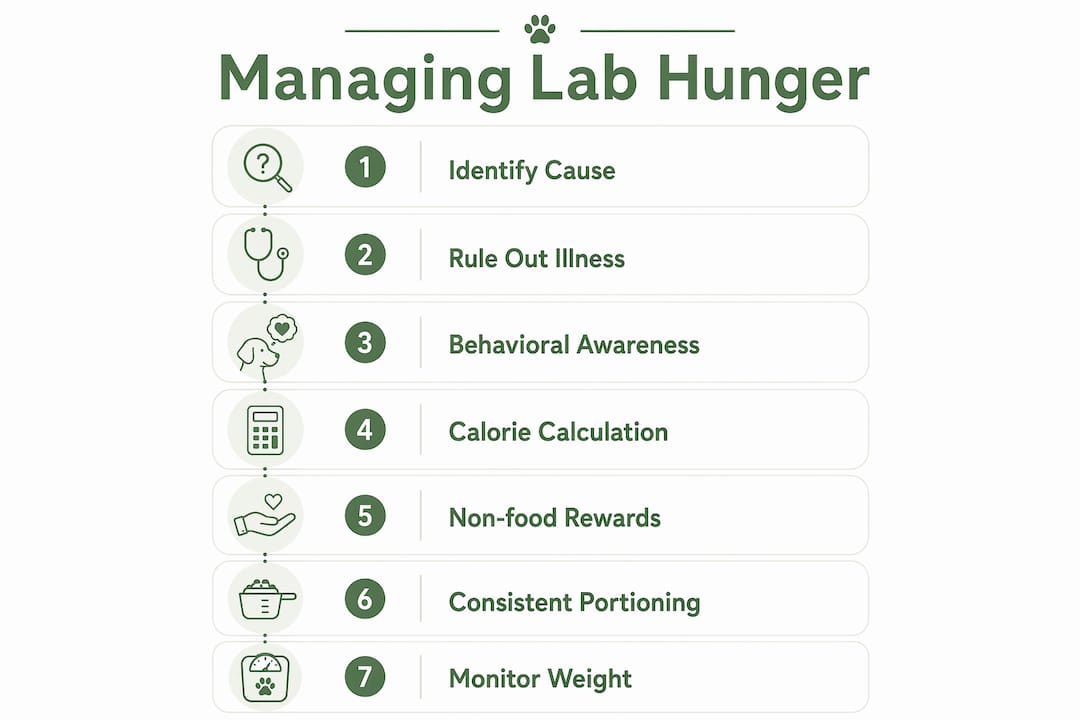
Your Labrador isn't dramatic. Many Labs carry a real genetic mutation that sends a near-constant hunger signal to the brain, and that biology is compounded by learned begging and owner reinforcement. The good news: you can manage it with measured portions, enrichment, and a quick vet check to rule out anything medical.
Start here:
- Weigh your dog and check their Body Condition Score (BCS) this week
- Calculate daily calories using the RER/MER formula (covered below) or the Labrador calorie calculator
- Stop free-feeding immediately and swap at least one food reward per day for play or praise
Table of Contents
- Why Labradors are always hungry: the genetics behind it
- Medical causes to rule out before blaming genetics
- Behavioral and environmental drivers that make it worse
- How to calculate and manage your Lab's calorie needs
- Non-food strategies that actually reduce food-seeking
- Monitoring body condition and managing obesity risk
- What your vet will check and which tests to expect
- Key Takeaways
- The case for strict portioning (and why it's not cruel)
- Bowlful builds the feeding plan so you don't have to guess
- Useful sources and further reading
Why Labradors are always hungry: the genetics behind it
The short answer is a gene called POMC. Researchers at the University of Cambridge identified a 14-base-pair deletion in the pro-opiomelanocortin gene that disrupts production of two neuropeptides: β-MSH and beta-endorphin. Both play a role in hunger signaling and reward. When that signal is broken, the brain never quite registers "full" between meals.
About 23–25% of Labrador retrievers carry this deletion. That's roughly one in four Labs walking around with a molecular starvation signal running in the background. The mutation is also found in flat-coated retrievers, but it's especially prevalent in Labs selected for assistance work, where food motivation was actively bred for.
Statistic: Dogs carrying the POMC deletion burn approximately 25% fewer calories at rest than unaffected dogs, according to metabolic chamber measurements from the Cambridge research team.
Here's the part that surprises most owners: affected dogs don't necessarily eat more when given unlimited access to food. Experimental "all-you-can-eat" tests showed that dogs with the mutation were more focused on food but didn't consume substantially more in a single sitting. The hunger drive shows up as relentless food-seeking between meals, not a larger stomach. That distinction matters for how you manage it: the goal isn't to feed more, it's to redirect the drive.
Medical causes to rule out before blaming genetics
Genetics may be the most common explanation for a Lab's appetite, but a sudden or dramatic increase in hunger always warrants a vet visit first. Several medical conditions can mimic or amplify food-seeking behavior.
See your vet promptly if your Lab shows any of these:
- Unexplained weight loss despite a normal or increased appetite
- Sudden change in hunger after years of stable eating habits
- Increased thirst and urination alongside increased appetite
- Vomiting, diarrhea, or loose stools that persist more than a day or two
- Lethargy, coat changes, or visible muscle loss
The conditions veterinarians most commonly investigate include hypothyroidism (which slows metabolism and can increase appetite), intestinal parasites (which steal nutrients and leave the dog genuinely underfed), diabetes mellitus, and medication side effects, particularly from steroids. Less commonly, Cushing's disease or a malabsorption disorder may be involved.
Ruling these out isn't just a formality. It confirms that diet and behavioral management are the right tools, and it gives you a clean baseline to work from.

Behavioral and environmental drivers that make it worse
Even a Lab without the POMC mutation can become a world-class beggar. The behavioral side of this is well-documented, and it's largely owner-driven.

Labs are retrievers with a scavenging history. They were bred to work closely with humans, stay highly attuned to human behavior, and use food as a primary motivator. That makes them exceptionally good at reading the moment you're about to give in. A soft whine, a paw on the knee, the famous "puppy eyes" — these behaviors get reinforced the moment you hand over a treat, and the cycle locks in fast.
Free-feeding (leaving a bowl out all day) makes this worse by removing the structure that helps a dog understand when food is and isn't available. Easy access to kitchen scraps, counter-surfing opportunities, or multiple family members each giving "just a small treat" can add hundreds of calories a day without anyone realizing it.
Breaking the conditioned begging cycle requires consistency from every person in the household, not just the primary caregiver. One soft touch undoes a week of discipline.
How to calculate and manage your Lab's calorie needs
This is where most owners go wrong: they guess. Bag guidelines are averages built for a theoretical dog, not yours. The vet-standard approach uses two formulas.
Step-by-step calorie calculation:
- Weigh your dog in kilograms (divide pounds by 2.2).
- Calculate RER (Resting Energy Requirement): RER = 70 × (body weight in kg)^0.75. This is the baseline calories needed at rest.
- Apply an activity multiplier to get MER (Maintenance Energy Requirement): use 1.6 for a typical neutered adult, 1.8 for an active intact adult, 1.2–1.4 for a dog on a weight-loss plan.
- Convert MER calories to food volume using the kcal/cup or kcal/100g figure on your kibble bag.
- Subtract treat calories from the daily MER total before measuring meals.
The science of feeding dogs properly consistently shows that RER-based plans outperform bag-guideline feeding for weight management, especially in food-motivated breeds.
Sample daily calorie targets (using a representative kibble at 360 kcal/cup):
| Dog weight | RER (kcal/day) | MER at 1.6x (kcal/day) | Approx. kibble per day |
|---|---|---|---|
| 25 lb | 360 kcal | — | — |
These figures use a 1.6 multiplier for a neutered adult. Adjust for your dog's activity level and always verify with your vet.
Pro Tip: Weigh dry kibble on a kitchen scale rather than scooping by cup. Cup volume varies by 20–30% depending on how tightly the food is packed. A $10 food scale pays for itself in avoided vet bills.
Non-food strategies that actually reduce food-seeking
Enrichment isn't a luxury for bored dogs. For a Lab with a POMC-driven hunger signal, it's a management tool. Cambridge researchers specifically recommended spreading rations through the day and using puzzle feeders or scatter-feeding to slow intake and reduce continuous food-seeking.
Practical options that work well in U.S. households:
- Slow-feeder bowls extend mealtime from 30 seconds to several minutes, which reduces post-meal begging
- Snuffle mats let dogs forage through fabric for their kibble, engaging nose and brain simultaneously; snuffle mats and similar foraging tools are widely available and easy to introduce
- Scatter-feeding in the yard or on a mat turns a meal into a 10-minute activity
- Food-dispensing puzzle toys (Kong-style or sliding-tile puzzles) make the dog work for every bite
For training interactions, replace food rewards with a short tug session, a belly rub, or a game of fetch. This doesn't mean eliminating treats entirely. It means making play and praise equally rewarding so food isn't the only currency. Introduce these swaps gradually: one interaction per day at first, then expand as the dog adjusts.
Pro Tip: Divide your Lab's daily kibble into three portions: two meals and one "enrichment ration" used in puzzle toys or scatter-feeding. Total calories stay the same; the dog spends more time engaged and less time staring at you.
Monitoring body condition and managing obesity risk
Labradors are overrepresented among overweight and obese dogs in multiple surveys, which makes regular body condition monitoring non-negotiable for the breed.
How to assess BCS at home:
- Underweight (BCS 1–3): Ribs visible without touching; prominent spine and hip bones
- Ideal (BCS 4–5): Ribs easily felt with light pressure but not visible; visible waist from above; abdomen tucks up from the side
- Overweight (BCS 6–7): Ribs require firm pressure to feel; waist barely visible; abdomen flat or rounded
- Obese (BCS 8–9): Ribs not palpable under fat; no waist; abdomen distended
Carrying excess weight accelerates joint wear, particularly in a breed already prone to hip and elbow dysplasia. It also increases risk of diabetes, breathing difficulty, and reduced lifespan. Canine obesity prevalence in developed countries ranges from 34% to 59% across studies, and Labs sit at the top of breed-specific rankings.
Safe weight-loss target: 0.5–2% of body weight per week, depending on how much the dog needs to lose and your vet's guidance. For a 70 lb Lab, that's roughly 0.35–1.4 lb per week. Faster than that risks muscle loss.
Weigh your dog on the same scale every week, ideally at the vet's office or a pet store with a floor scale. Log it. A simple notebook or phone note works fine. Consistent data beats memory every time.
What your vet will check and which tests to expect
A focused vet visit for persistent hunger is usually efficient if you arrive prepared. Bring a feeding diary: what you feed, how much, how often, and what treats are given by everyone in the household.
History and physical checks:
- Full diet and feeding history, including treats and table scraps
- Body condition score and weight trend over time
- Medication review (steroids, anticonvulsants, and some other drugs increase appetite)
- Abdominal palpation for organ size and gut motility
Common diagnostic tests:
- Fecal parasite exam to rule out worms and protozoa
- Complete blood count (CBC) and chemistry panel to assess organ function, blood glucose, and rule out diabetes
- Thyroid panel (T4 at minimum) to screen for hypothyroidism
- Urinalysis, particularly if polyuria or polydipsia is present
- Endocrine testing (cortisol, ACTH stimulation) if Cushing's disease is suspected
If all results come back normal, that's a clear signal: diet and behavioral management are the primary tools. Your vet can then help you set a precise calorie target and a weight-loss timeline if needed.
Key Takeaways
Labradors are always hungry primarily because of a POMC gene mutation affecting roughly one in four of the breed, compounded by behavioral reinforcement and, sometimes, underlying medical conditions.
| Point | Details |
|---|---|
| POMC mutation is common | About 23–25% of Labs carry the deletion that disrupts hunger-signaling neuropeptides β-MSH and beta-endorphin. |
| Lower resting metabolism | Affected dogs burn approximately 25% fewer calories at rest, making overfeeding easy even on "normal" portions. |
| Rule out medical causes first | Hypothyroidism, parasites, diabetes, and medication side effects can all drive increased appetite and need vet testing. |
| Measure, don't guess | Use the RER/MER formula and a kitchen scale; bag guidelines are averages that don't account for your dog's actual needs. |
| Bowlful personalizes the plan | Bowlful builds RER/MER-based feeding plans tailored to your Lab's breed, weight, and life stage, with treat budgets and enrichment guidance included. |
The case for strict portioning (and why it's not cruel)
The most common pushback I hear from Lab owners is some version of: "But he looks so hungry. I feel terrible." That feeling is real, and it's worth taking seriously. Dogs with the POMC mutation are receiving a genuine molecular hunger signal. They're not performing. They're not manipulating you (well, not entirely). They actually feel something that resembles persistent hunger.
But here's what that means for management: trying to satisfy that signal with more food doesn't work. The signal doesn't switch off the way it does in dogs without the mutation. You can feed a POMC-affected Lab until they're clinically overfed and they'll still look at you like they haven't eaten in days. Feeding to that signal is the problem, not the solution.
Strict portioning combined with enrichment isn't about denying your dog. It's about redirecting a drive that, left unchecked, leads to joint damage, diabetes, and a shorter life. A Lab that's kept lean and mentally engaged is a Lab that's comfortable, mobile, and with you longer. The evidence on modern dogs gaining weight consistently points to lifestyle mismatch as the core driver: owners assume a "food-motivated" breed needs more food, when the opposite is usually true.
One practical note on household compliance: the plan only works if everyone follows it. That means a family conversation, a posted feeding schedule on the fridge, and a clear rule that no one gives extras without logging them. Consistency is key for effective management.
Bowlful builds the feeding plan so you don't have to guess
Most Lab owners know they should measure portions. Few have a plan that accounts for their specific dog's weight, activity level, neuter status, and treat habits all at once. That's the gap Bowlful fills.
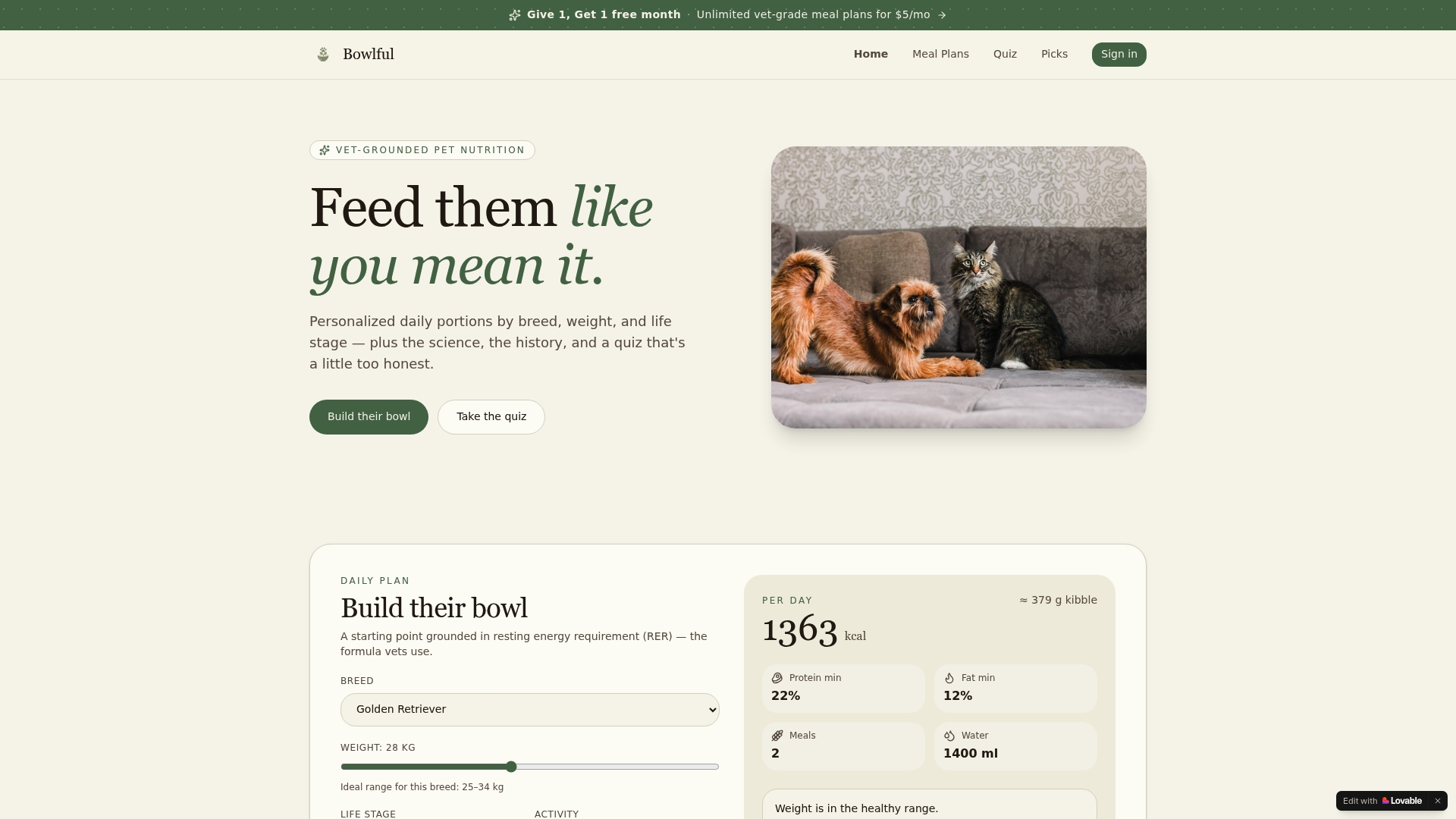
Bowlful uses the same RER/MER formulas veterinarians use, applied to your Lab's exact profile through an interactive quiz. The result is a personalized meal plan with precise daily calorie targets, a treat budget that fits inside those targets, and enrichment recommendations built around the breed's food-motivation profile. Plans are downloadable as PDFs, so you can post them on the fridge or share them with a dog sitter.
Lean-fed dogs live measurably longer. Bowlful's approach is built on that evidence. Take the free quiz at bowlful.org and get your Lab's personalized feeding plan today.
Useful sources and further reading
- Primary research: POMC gene deletion in Labrador retrievers — PMC/Cell Metabolism — the peer-reviewed study identifying the mutation, its prevalence, and its association with weight and food motivation
- University of Cambridge summary: Genetic mutation in a quarter of all Labradors hard-wires them for obesity — accessible overview of the Cambridge research team's findings, including the metabolic chamber data
- Scientific American: Many Labrador Retriever Dogs Really Are Hungry All the Time — covers behavioral findings and the "all-you-can-eat" test results
- ScienceDaily: Why Labrador retrievers are more interested in food than other breeds — context on assistance dog selection and food-motivation traits
- Hill's Pet: Why Are Labradors Always Hungry? — veterinary-reviewed overview of medical differentials and feeding guidance
- PAW Vet Practice: Treatment for obesity in dogs — clinical perspective on diagnosis and weight management protocols
- Bowlful tools: Labrador calorie calculator — free RER/MER calculator for Labs by weight and lifestyle
This article is general information, not veterinary advice. Confirm feeding targets and any medical concerns with your veterinarian for your dog's specific situation.