
Minerals matter in a pet's diet because they build bone, fire nerve and muscle signals, balance fluids, carry oxygen in blood, keep the thyroid and immune system running, and getting the amount wrong in either direction causes real harm. That last part surprises a lot of owners: too little calcium weakens bones, but so does too much, especially in growing large-breed puppies.
Minerals do the structural and electrical work vitamins and proteins can't:
- Build and maintain bone and teeth
- Power nerve transmission and muscle contraction
- Regulate fluid and electrolyte balance
- Support oxygen transport in red blood cells
- Back thyroid function and immune defense
AAFCO and FEDIAF both publish nutrient profiles that set minimum, and sometimes maximum, mineral levels for commercial pet food. The single action to take today: Check that your pet's food carries a "complete and balanced" statement for its life stage, and don't add mineral supplements without talking to your veterinarian first.
Key Takeaways
Minerals govern bone strength, nerve and muscle function, fluid balance, and thyroid and immune health, and both deficiency and excess cause measurable harm.
| Point | Details |
|---|---|
| Minerals split into two classes | Macrominerals (calcium, phosphorus, sodium, magnesium, potassium, chloride) need gram amounts; trace minerals need mg or µg amounts. |
| Calcium:phosphorus ratio is critical | The optimal range for dogs is about 1.2 to 1.4:1, tighter than AAFCO's allowed 1:1 to 2.1:1 window. |
| Large-breed puppies need extra caution | Excess calcium during growth can cause osteochondrosis and other skeletal problems. |
| Homemade diets frequently fall short | An analysis of many homemade recipes found that all failed to meet nutrient requirements, often on minerals. |
| Don't supplement without testing | Confirm deficiency with vet bloodwork before adding any mineral supplement to a complete diet. |
| Bowlful builds plans on the same standards | Bowlful's personalized feeding plans apply AAFCO/FEDIAF profiles and vet formulas to your pet's specific life stage. |
Table of Contents
- Why Minerals Matter in Pet Diet: Macrominerals vs Trace Minerals
- Key Minerals and What They Actually Do for Your Pet
- How Minerals Get Into Commercial Pet Food
- Why the Calcium to Phosphorus Ratio Matters So Much
- Warning Signs of Mineral Deficiency or Excess
- Should You Add Mineral Supplements to Your Pet's Diet?
- A Practical Checklist Before Your Next Vet Visit
- Six Rules to Keep Mineral Nutrition on Track
- Why Bowlful Treats Mineral Balance as Non-Negotiable
- Get a Feeding Plan Built Around Your Pet's Actual Mineral Needs
- Frequently Asked Questions
- Sources
Why Minerals Matter in Pet Diet: Macrominerals vs Trace Minerals
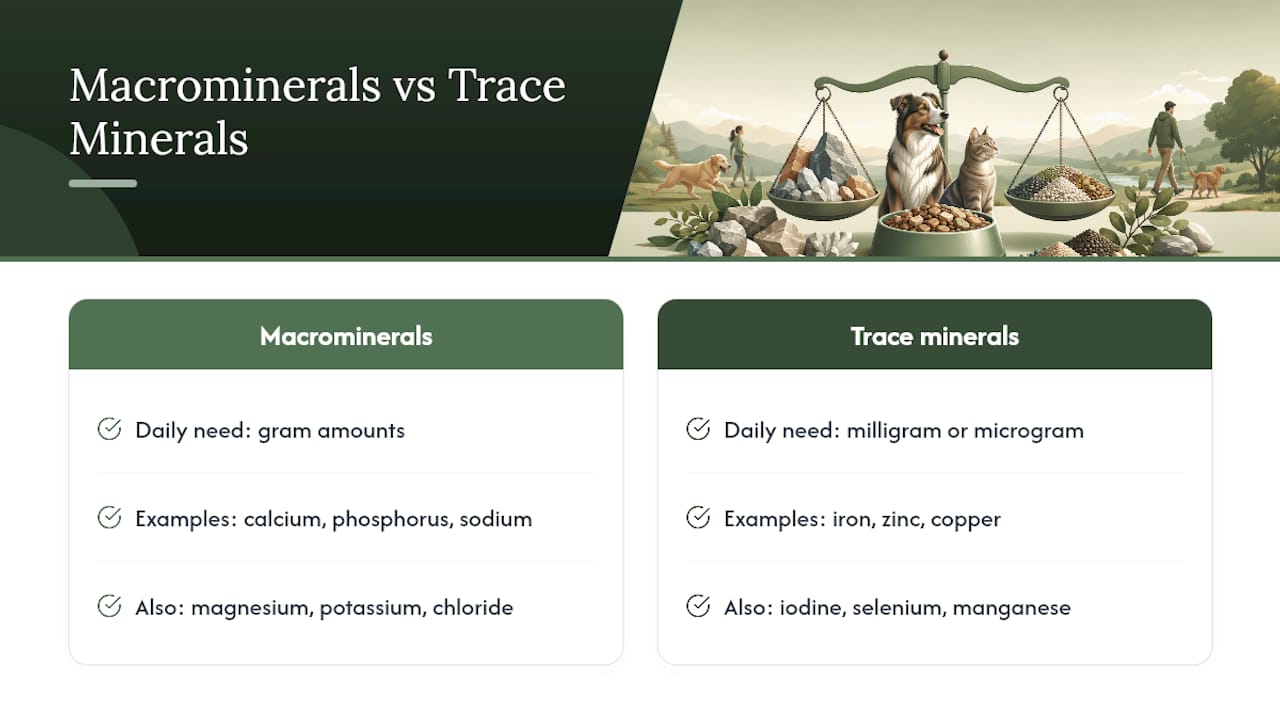
An essential mineral is an inorganic nutrient your dog or cat's body cannot manufacture on its own. Unlike vitamins, minerals carry no calories, but nothing in the body runs without them. They fall into two groups based on how much a pet needs each day.
Macrominerals are needed in gram amounts and include calcium, phosphorus, sodium, magnesium, potassium, and chloride. Trace minerals are needed in milligram or microgram amounts and include iron, zinc, copper, iodine, selenium, and manganese.
This is where regulatory standards earn their keep. Food labeled "complete and balanced" is formulated against AAFCO nutrient profiles in the United States or FEDIAF profiles in Europe, and manufacturers typically rely on a mineral premix to hit those numbers reliably, batch after batch. It's also why a pinch of the wrong supplement can throw off a diet that was otherwise dialed in.
Key Minerals and What They Actually Do for Your Pet
Each mineral has a job description, and most have a failure mode at both ends of the dosage scale. Here's the quick-reference version.
- Calcium: Builds bone and teeth, supports blood clotting and muscle contraction. Deficiency causes soft or fragile bones; excess in growing large-breed puppies can trigger osteochondrosis and skeletal remodeling problems.
- Phosphorus: Works with calcium in bone structure and energy metabolism. Imbalance with calcium disrupts both minerals' absorption.
- Potassium: Maintains nerve and muscle function, especially heart rhythm. Deficiency shows up as weakness or muscle twitching.
- Sodium and chloride: Regulate fluid balance and blood pressure. Deficiency is rare but excess causes thirst and, in severe cases, salt toxicity.
- Magnesium: Supports enzyme function, muscle and nerve activity. High calcium or phosphorus intake can reduce magnesium absorption.
- Iron: Carries oxygen in red blood cells. Deficiency causes anemia, seen as pale gums and lethargy.
- Zinc: Supports skin, coat, and immune function. Competes with copper for absorption, so excess of one can create a shortage of the other.
- Copper: Needed for connective tissue and iron metabolism. Certain breeds are prone to copper storage disease, making balance especially important.
- Manganese: Supports cartilage formation and enzyme activity. True deficiency is uncommon in complete diets.
- Iodine: Fuels thyroid hormone production. Too little or too much both disrupt thyroid function, sometimes severely.
- Selenium: Works as an antioxidant alongside vitamin E. The safety margin is narrow, and excess is genuinely toxic.
Pro Tip: Minerals rarely act alone. If you're evaluating a diet or a supplement, look at the pairs (calcium and phosphorus, zinc and copper) rather than a single nutrient in isolation.
How Minerals Get Into Commercial Pet Food
Whole ingredients like meat, bone meal, and vegetables naturally supply some minerals, but most commercial diets also add a mineral premix to close the gap and keep nutrient levels consistent from bag to bag. The term "ash" on a guaranteed analysis panel refers to the inorganic residue left after burning a food sample. It's a rough proxy for total mineral content, not a red flag on its own.

Bioavailability varies by mineral form and source; zinc oxide, for instance, absorbs less efficiently than some chelated forms. A food formulated to meet a defined nutrient profile is a better bet than one built on guesswork.
Pro Tip: Look for a nutritional adequacy statement naming AAFCO or FEDIAF profiles on the label. That phrase tells you the recipe was formulated to a standard, not estimated.
Why the Calcium to Phosphorus Ratio Matters So Much
Ratios matter as much as raw amounts, and calcium to phosphorus is the one that causes the most real-world damage. The commonly cited optimal range for dogs sits around 1.2 to 1.4:1, while AAFCO allows a wider window of 1:1 to 2.1:1 depending on life stage.
Push that ratio too far with excess calcium, particularly during a large-breed puppy's growth window, and you risk osteochondrosis and other skeletal development problems that show up months later as lameness or joint pain. The same mechanism works elsewhere: high calcium or phosphorus can suppress magnesium absorption, and one mineral's excess routinely undercuts another's uptake.
- Use a growth-formula diet for puppies, not an adult food with extra calcium bolted on
- Never add calcium or bone meal supplements to a large-breed puppy's commercial diet
- Ask your vet before switching a pregnant or senior pet's mineral intake
Warning Signs of Mineral Deficiency or Excess
Symptoms tend to be vague, which is exactly what makes mineral problems tricky to catch early.
- Poor or stunted growth in puppies and kittens
- Bone fragility, lameness, or unexplained fractures
- Seizures or muscle tremors
- Dull coat, hair loss, or slow wound healing
- Lethargy, pale gums, or signs of anemia
- Vomiting, diarrhea, or excessive thirst and urination
Most of these overlap with a dozen other conditions, so a vet visit with bloodwork and a full diet history is the only real way to confirm what's happening. Bring the food label, exact feeding amounts, any supplements, and your pet's life stage to that appointment.
Should You Add Mineral Supplements to Your Pet's Diet?
Don't add mineral supplements to a complete, balanced commercial diet without a specific reason. Deficiency is uncommon when a pet eats a properly formulated food, and stacking supplements on top can create imbalances or toxicities rather than fix anything.
Supplementation makes sense in a few specific situations:
- Your vet has prescribed a therapeutic diet with adjusted mineral levels for a diagnosed condition.
- Bloodwork confirms an actual deficiency, not a suspicion.
- A life-stage condition like pregnancy or a documented medical issue calls for veterinary-directed adjustment.
Before adding anything, ask your vet which tests confirm the need, share the exact food label, and choose a veterinary-grade formulation with known bioavailability.
Pro Tip: Keep one running log of every food, treat, and supplement your pet gets. It's the fastest way to catch an accidental mineral overlap before it becomes a problem.
A Practical Checklist Before Your Next Vet Visit
Run through this before your next appointment so the conversation is fast and specific:
- Confirm the food's label carries a "complete and balanced" nutritional adequacy statement matching your pet's life stage.
- Write down daily food and treat amounts, including any table scraps.
- List every supplement currently in use, with brand and dose.
- Confirm whether your pet is in growth, adult maintenance, pregnancy, or senior life stage.
Bring these questions with you:
- "Does this food meet my pet's mineral needs for their current life stage?"
- "Is there any reason to test my pet's mineral status with bloodwork?"
Bowlful's balanced meal plan guides walk through how these standards translate into an actual daily feeding amount, not just a label claim.
Six Rules to Keep Mineral Nutrition on Track
- Feed a diet labeled "complete and balanced" for your pet's actual life stage
- Skip home-only recipes unless a veterinary nutritionist has formulated them
- Never add mineral supplements without confirmed bloodwork
- Use growth or senior formulas, not adult food adjusted by guesswork
- Watch calcium closely if you own a large-breed puppy
- Remember some minerals have a narrow safety margin. Testing beats assuming.
Why Bowlful Treats Mineral Balance as Non-Negotiable
Every feeding plan Bowlful builds starts from AAFCO and FEDIAF nutrient profiles and the same RER/MER formulas veterinarians use, not a generic percentage pulled from a bag. That's deliberate. Minerals are one of the few nutrient categories where excess is nearly as dangerous as deficiency, and a one-size-fits-all recommendation misses that nuance entirely.
Bowlful stays independent of pet food manufacturers, so the guidance behind these plans doesn't bend toward whichever brand pays for shelf space. If your pet has a diagnosed condition, a personalized plan is a starting point for the conversation with your vet, not a replacement for one.
Get a Feeding Plan Built Around Your Pet's Actual Mineral Needs
Reading nutrient panels and cross-checking AAFCO ratios is tedious work, and most pet owners have better things to do on a Tuesday night. Bowlful's personalized meal plan tool does that cross-checking automatically, using the same RER/MER formulas and AAFCO/FEDIAF profiles covered in this guide, tailored to your pet's breed, age, and activity level.
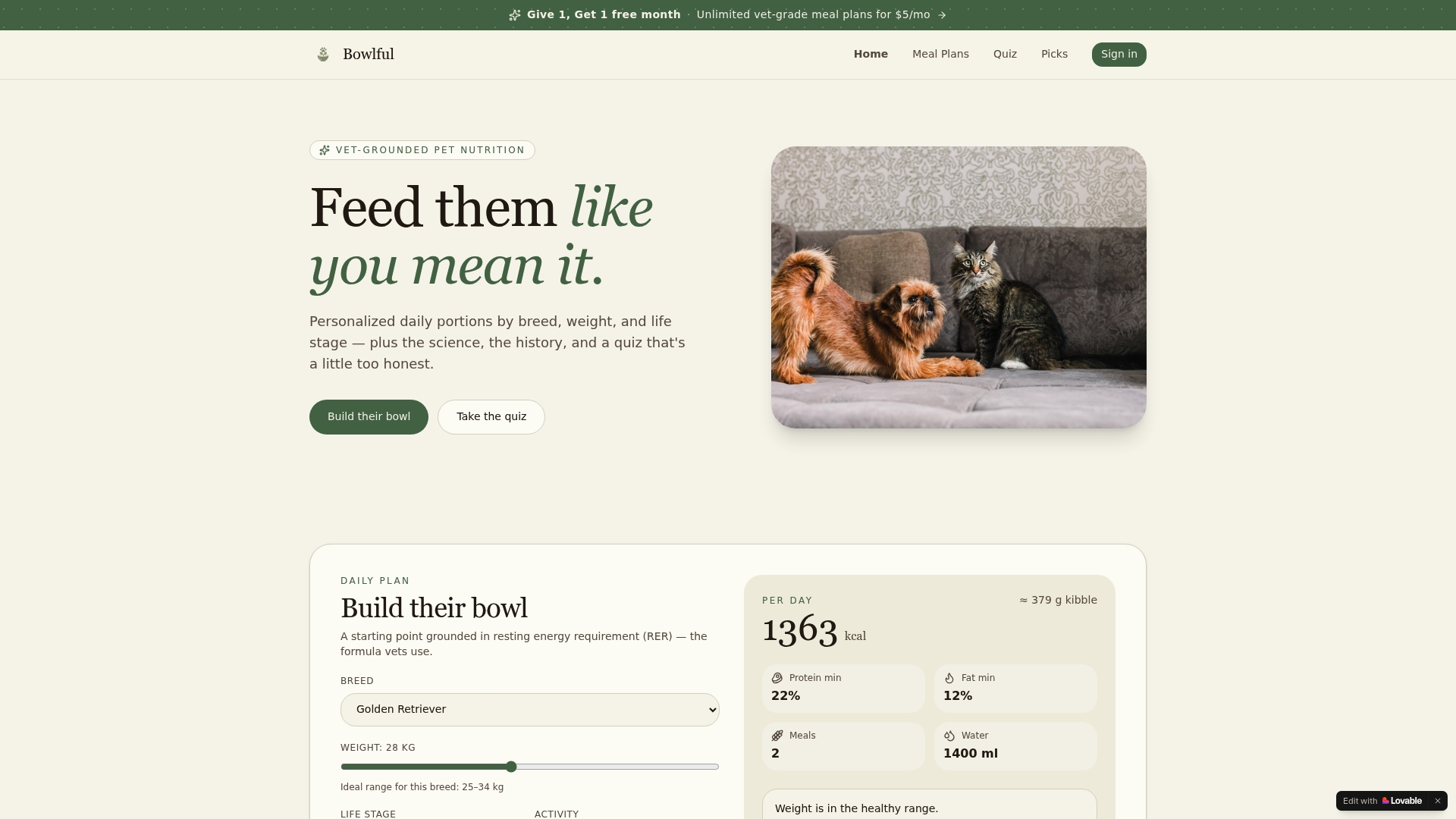
A completed plan gives you specific portion targets, flags whether your current food fits your pet's life stage, and hands you a printable meal plan you can bring straight to a vet visit. If your dog is heading into a growth spurt or your cat is entering its senior years, Bowlful's puppy growth-stage nutrition guide and senior supplement guide cover the mineral adjustments those stages call for. None of this replaces a veterinarian for a medical issue, but it gives you a documented starting point for that conversation. Visit the Bowlful landing page and build your pet's plan in a few minutes.
Frequently Asked Questions
Why do minerals matter in pet diet compared to vitamins? Minerals are inorganic and build physical structures like bone while running electrical processes like nerve signaling; vitamins mostly assist metabolic reactions. Both are essential, but minerals carry a narrower margin between "enough" and "too much."
What are the essential minerals in pet food? The core macrominerals are calcium, phosphorus, sodium, chloride, magnesium, and potassium. The main trace minerals are iron, zinc, copper, manganese, iodine, and selenium.
Can a homemade diet meet mineral requirements for pets? It's difficult without professional formulation. An analysis of 100 homemade recipes found every one fell short of nutrient requirements, minerals included, which is why veterinary nutritionist involvement matters for DIY diets.
How do I know if my pet has a mineral deficiency? Watch for poor growth, brittle bones, dull coat, lethargy, or pale gums, but confirm any suspicion with veterinary bloodwork since these signs overlap with many other conditions.
Is it safe to give my dog or cat a multivitamin with minerals? Not without veterinary guidance. A complete and balanced diet usually already meets mineral needs, and stacking a supplement on top can create toxicities or block absorption of other nutrients.
This article is general information, not a substitute for advice from a qualified doctor. Consult a qualified healthcare professional about your own circumstances before acting on anything here.
Sources
- Nutritional requirements of small animals - Merck Veterinary Manual
- Nutritional requirements of small animals - MSD Veterinary Manual
- MedlinePlus: Minerals