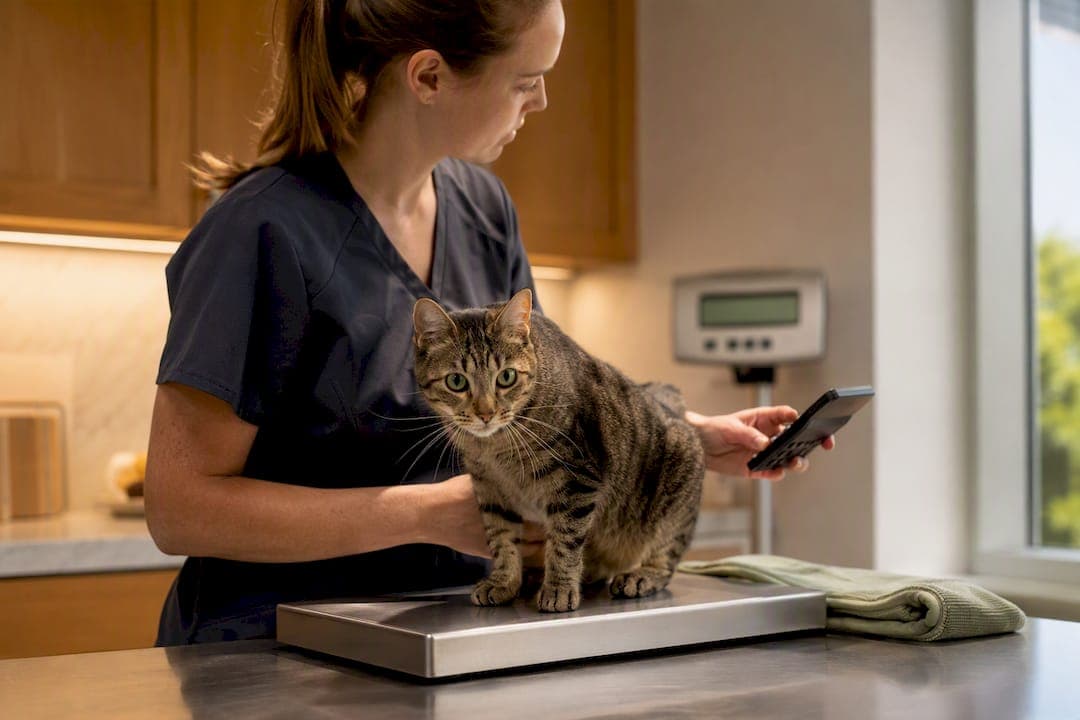
RER for cats equals 70 × (body weight in kg)^0.75 kcal per day. That's the same formula veterinarians use to set a baseline caloric target before adjusting for age, activity, and weight goals. It's an estimate, not a prescription. The sections below walk through the math, common conversion mistakes, and how to turn RER into an actual daily feeding number.
TL;DR:
- The exponential RER formula is more accurate for very small, large, or unusual cats, while the linear version works well for most domestic cats weighing 2 to 8 kg.
- Always convert your cat’s weight to kilograms before applying the formula to avoid significantly overestimating calorie needs.
- To estimate daily maintenance calories, multiply the RER by a factor based on life stage, such as 1.2 for neutered cats or 1.4 for intact or active cats, then adjust based on your cat's condition over time.
- The RER calculation provides a baseline, but body condition, activity level, and health status are essential for fine-tuning actual feeding amounts.
- Using a consistent method to weigh your cat and regularly monitoring their body condition ensures the feeding plan remains appropriate as they age or change.
Table of Contents
- Cat RER Formula and the Alternative You'll See
- How to Calculate RER Step by Step
- The Pound-to-Kilogram Mistake That Skews Everything
- Turning RER Into Daily Feeding Calories (MER)
- Why RER Is a Starting Point, Not a Prescription
- Three Worked Examples You Can Copy
- How Bowlful Applies RER to Real Feeding Plans
- Get a Feeding Plan That Adjusts as Your Cat Does
- Sources
Cat RER Formula and the Alternative You'll See
The formula above, 70 × (BWkg)^0.75, comes straight from the AAHA nutrition guideline and is the version most veterinary calculators default to. The 0.75 exponent reflects "metabolic body size," a concept that accounts for the fact that a 4 kg cat doesn't burn calories at exactly twice the rate of a 2 kg cat. Smaller animals have a higher metabolic rate per unit of body weight, and the exponent corrects for that curve better than a straight linear formula would.
You'll also run into a second version: RER = 30 × (body weight in kg) + 70. This linear formula is used in some hospital settings because it's faster to compute by hand and lands close to the exponential result for cats in the 2 to 8 kg range that make up most house cats.
- For cats weighing roughly 2 to 8 kg, either formula gets you within a few kcal of the same answer.
- For very small kittens or unusually large cats, the linear formula drifts further off, so the 0.75 exponent stays the preferred standard.
- If you're using an app or clinical calculator, it's almost certainly running the exponential version.
How to Calculate RER Step by Step
Grab your cat's current weight in kilograms and a calculator with an exponent function (your phone's calculator app usually has one, even if it's hidden under a "scientific" toggle).
- Get the weight in kg. If you only have pounds, divide by 2.2046.
- Raise that number to the 0.75 power. On most phone calculators, type the weight, hit the exponent button (often labeled x^y or yˣ), then enter 0.75.
- Multiply the result by 70. That's your RER in kcal per day.
- Round to the nearest whole number. Precision beyond that doesn't matter for feeding purposes.
Example calculation: weight raised to the 0.75 power and multiplied by 70 yields RER in kcal per day.
If your calculator doesn't have an exponent button, there's a workaround: 0.75 is the same as raising to the 3rd power and then taking the 4th root. It's clunkier, but it works on basic calculators.
Pro Tip: Enter the weight and hit the exponent function before typing 0.75, not after. Reversing the order on some calculator apps quietly changes the operation and gives you a wildly wrong number without any error message.
The Pound-to-Kilogram Mistake That Skews Everything
The single most common error is plugging a cat's weight in pounds directly into the formula instead of converting to kilograms first. Because the exponent compresses larger numbers less aggressively than it should for this formula's design, using pounds instead of kilograms produces a kcal figure that's off by a wide margin, usually overestimating calories dramatically.
- Always convert to kilograms first.
- Confirm that the kilogram weight is reasonable for an adult cat.
- Unusually high calorie numbers usually indicate a conversion error.
Turning RER Into Daily Feeding Calories (MER)
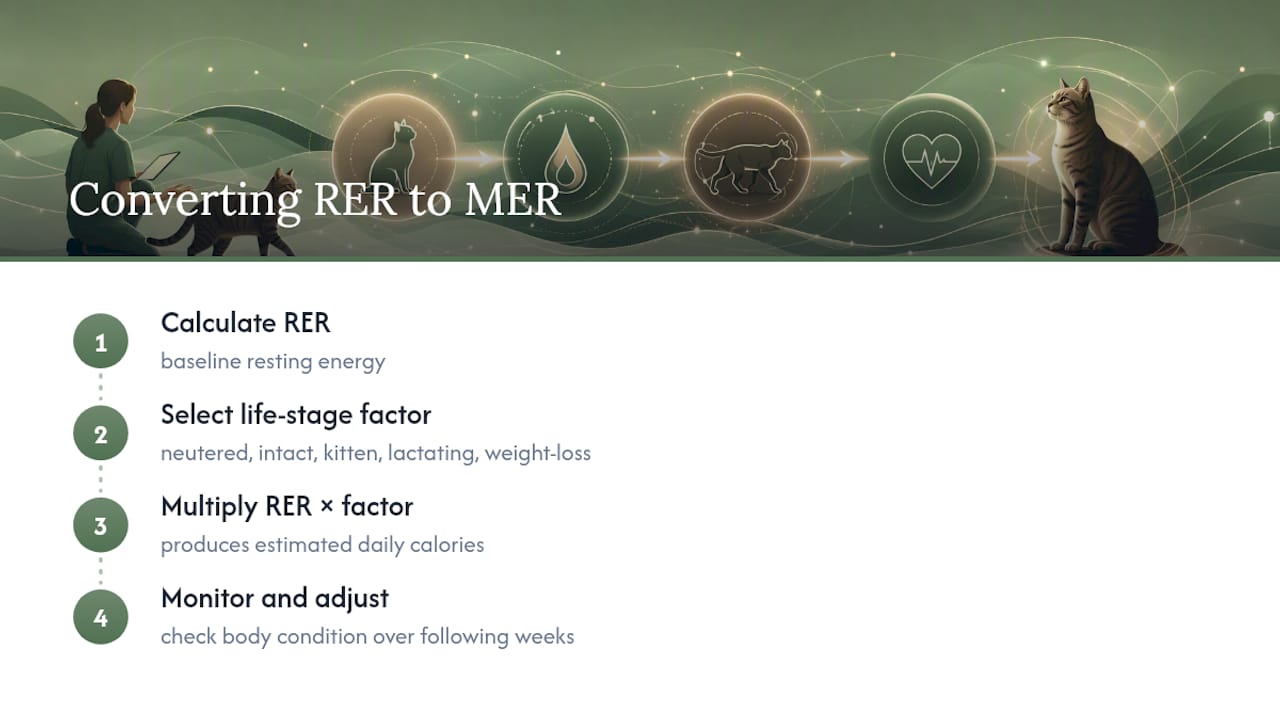
RER tells you what your cat burns lying around doing nothing. Maintenance Energy Requirement, or MER, is what your cat actually needs day to day once you factor in activity, reproductive status, and life stage. The Merck Veterinary Manual's MER tables and APOP's calculator both use the same basic move: multiply RER by a life-stage factor.
Common multipliers to estimate daily energy needs include values appropriate for life stage and condition such as neutered cats, intact cats, weight loss, kittens, and lactating queens, with ranges varying by individual circumstances.
So, a neutered cat with an example RER would have its maintenance calories estimated by multiplying RER by an appropriate factor.
These multipliers are starting estimates. The AAFP's feline guidance is explicit that the number you land on needs to be checked against how the cat's actual body condition and weight respond over the following weeks, not treated as a fixed target locked in forever.
Why RER Is a Starting Point, Not a Prescription
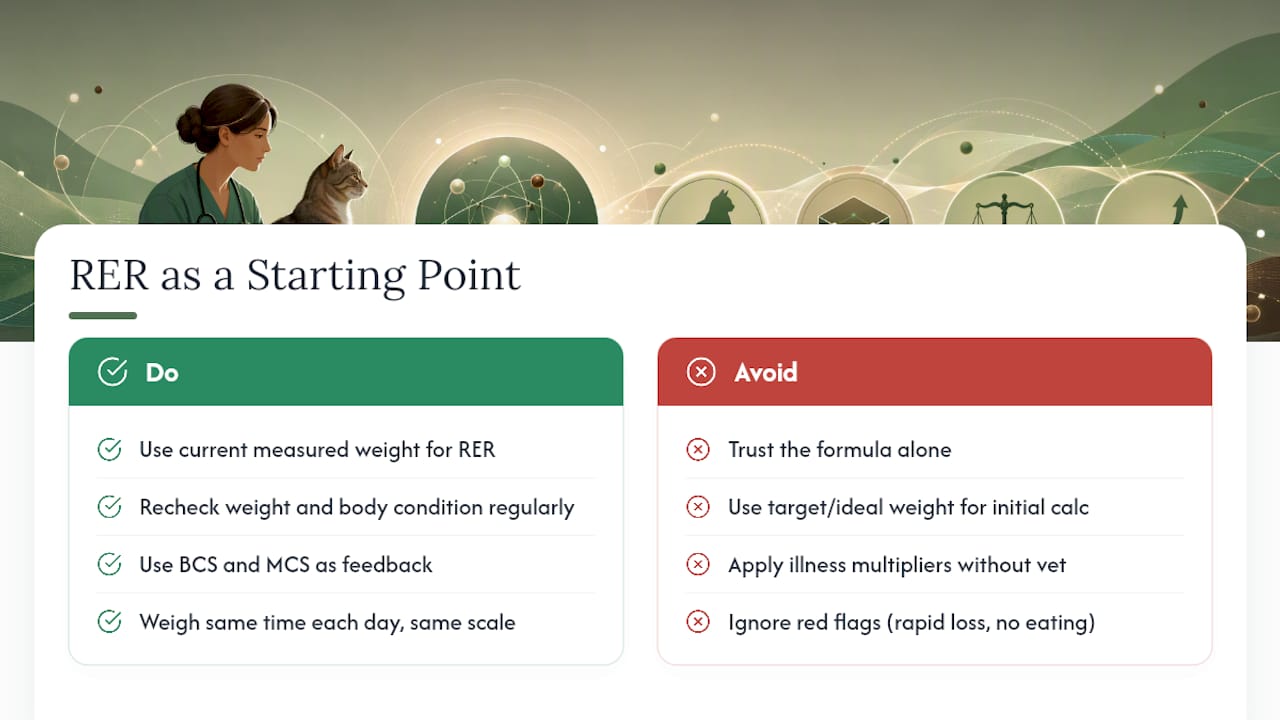
Body Condition Score (BCS) and Muscle Condition Score (MCS) are the real feedback loop here. A cat can hit the "correct" MER on paper and still gain or lose weight because individual metabolism varies, and that's exactly why vets recheck weight and body condition rather than trusting the math alone. The APOP calculator's own guidance stresses using current measured weight, never a target or ideal weight, for the initial calculation.
Watch for red flags that mean the formula isn't enough on its own: rapid weight loss, refusal to eat for more than 24 hours, or a cat recovering from illness. Illness-specific multipliers exist, but clinical nutrition literature warns against applying them without veterinary oversight, since overfeeding a critically ill or previously starved cat can trigger refeeding syndrome, a dangerous electrolyte shift.
If you're managing a heavier cat, Bowlful's healthy weight loss plan for cats walks through safe percentage cuts in more detail, and the senior cat weight guide covers the extra caution older cats need.
Pro Tip: Weigh your cat at the same time of day, ideally before a meal, using the same scale each time. Small variations in when and how you weigh can mask or exaggerate a real trend over several weeks.
— Robert
Three Worked Examples You Can Copy
- Small cat, 6 lb (2.72 kg): RER = 70 × 2.72^0.75 ≈ 70 × 2.13 ≈ 149 kcal/day. Neutered adult MER: 149 × 1.2 ≈ 179 kcal/day.
- Medium cat, 10 lb (4.54 kg): RER = 70 × 4.54^0.75 ≈ 70 × 3.13 ≈ 219 kcal/day. Neutered adult MER: 219 × 1.2 ≈ 263 kcal/day.
- Large cat, 15 lb (6.80 kg): RER = 70 × 6.80^0.75 ≈ 70 × 4.19 ≈ 293 kcal/day. Intact adult MER: 293 × 1.4 ≈ 410 kcal/day.
For the 10 lb cat, comparing formulas shows how close they usually run: the linear method gives 30 × 4.54 + 70 ≈ 206 kcal, about 13 kcal under the exponential result. That gap is small at mid-range weights, which is exactly why some clinics stick with the linear version for quick hand calculations, even though the exponential formula remains the standard for accuracy across the full weight range.
How Bowlful Applies RER to Real Feeding Plans
Bowlful builds every personalized plan on these same vet-standard formulas, then layers in life stage, body condition, and actual weight trends instead of stopping at a single number. A calculation is a starting line, not a finish line, and that's the whole premise behind checking in and adjusting rather than setting a number once and walking away. If you want the fuller picture, Bowlful's custom cat nutrition plan guide and feeding schedule by weight are natural next reads.
Get a Feeding Plan That Adjusts as Your Cat Does
Running the RER formula by hand gets you a solid baseline, but it doesn't track your cat's body condition, adjust for a spay you did last year, or catch a slow weight creep before it becomes a vet visit. Bowlful turns the same AAHA and AAFCO-aligned formulas covered above into a plan built around your specific cat's breed, age, and activity level, then gives you the tools to monitor and adjust it over time.

A Bowlful plan includes a downloadable meal-plan PDF with exact daily calorie and portion targets, feeding schedules broken out by weight, and monitoring check-ins so you're not guessing whether last month's calculation still fits this month's cat. For general day-to-day care basics that pair well with any calorie plan, this cat care overview is a solid companion read. Ready to put your cat's numbers into a plan that actually adjusts with them? Build your cat's feeding plan and get portion sizes matched to your cat's exact weight, life stage, and goals.
Sources
- AAHA weight management / nutrition guideline (RER formula)
- APOP Veterinary DER calculator
- Merck Veterinary Manual — Daily maintenance energy requirements table