
Feeding guides give you a science-based starting portion and calorie target for your dog or cat, but they are not the final word. They set a baseline built from average activity levels and life stage, not your specific pet.
- What they provide: a population-average calorie and portion baseline calculated from a food's kcal density and your pet's life stage.
- What they miss: your individual pet's metabolism, breed tendencies, and real-world activity.
- What you do next: measure portions accurately, track weight and body condition score (BCS) every few weeks, and adjust with your vet when numbers drift.
Used this way, the role of feeding guides in pet ownership is less about giving a final answer and more about giving you a defensible place to start.
Key Takeaways
Feeding guides work as calorie and portion starting points, but only weight checks, BCS monitoring, and vet-informed adjustments turn them into an accurate long-term plan.
| Point | Details |
|---|---|
| Labels give a baseline, not a rule | Feeding tables assume average activity and life stage, so treat the printed amount as a starting figure. |
| Check the adequacy statement | "Complete and balanced" is a defined claim tied to AAFCO life-stage nutrient profiles, not marketing language. |
| Monitor every 2 to 4 weeks | Weigh your pet or check BCS regularly, adjusting total intake by 5 to 10% when weight drifts. |
| Count every treat | Keep treats under 10% of daily calories and subtract their kcal from main meals. |
| Escalate to a personalized plan | Bowlful's RER/MER based quiz and meal plans replace guesswork with numbers built for your specific pet. |
Table of Contents
- What Feeding Guides Actually Promise You
- What Standards Back Up These Feeding Recommendations?
- How Do You Use a Feeding Guide Correctly?
- Do Puppies, Seniors, and Working Dogs Need Different Portions?
- How Do Treats and Home Cooking Throw Off Feeding Guides?
- When Should You Get a Personalized Feeding Plan?
- A Note From Bowlful on Feeding Guides
- Get a Feeding Plan Built Around Your Actual Pet
- Sources
What Feeding Guides Actually Promise You
Every bag of dog or cat food has a feeding table on the back. It lists cups or grams by body weight, and it looks authoritative. But that table is built on assumptions: an "average" adult dog at "moderate" activity, eating only this food, with no treats. Change any one of those variables and the number stops applying to your pet.
Two dry foods with the same bag size can have wildly different calorie densities, so a cup of one brand might feed your dog for the day while a cup of another leaves them hungry within hours. That's why the feeding table itself isn't the guarantee. The real guarantee is the nutritional adequacy statement, the small line confirming the food is "complete and balanced" for a specific life stage.
- Feeding tables assume moderate activity and average metabolism, not your pet's actual life.
- Cup and gram measures vary by product because calorie density differs bag to bag.
- Following the printed amount without ever weighing your pet is a common path to slow weight gain.
What Standards Back Up These Feeding Recommendations?
Feeding guides aren't guesswork dressed up as science. They trace back to formal nutrient standards, mainly from the Association of American Feed Control Officials. AAFCO requires that pet food labels state calorie content in metabolizable energy, or ME, meaning the energy actually available to your pet's body after digestion, expressed as kcal per kilogram or per cup. Labels must also include feeding directions matched to species and life stage.
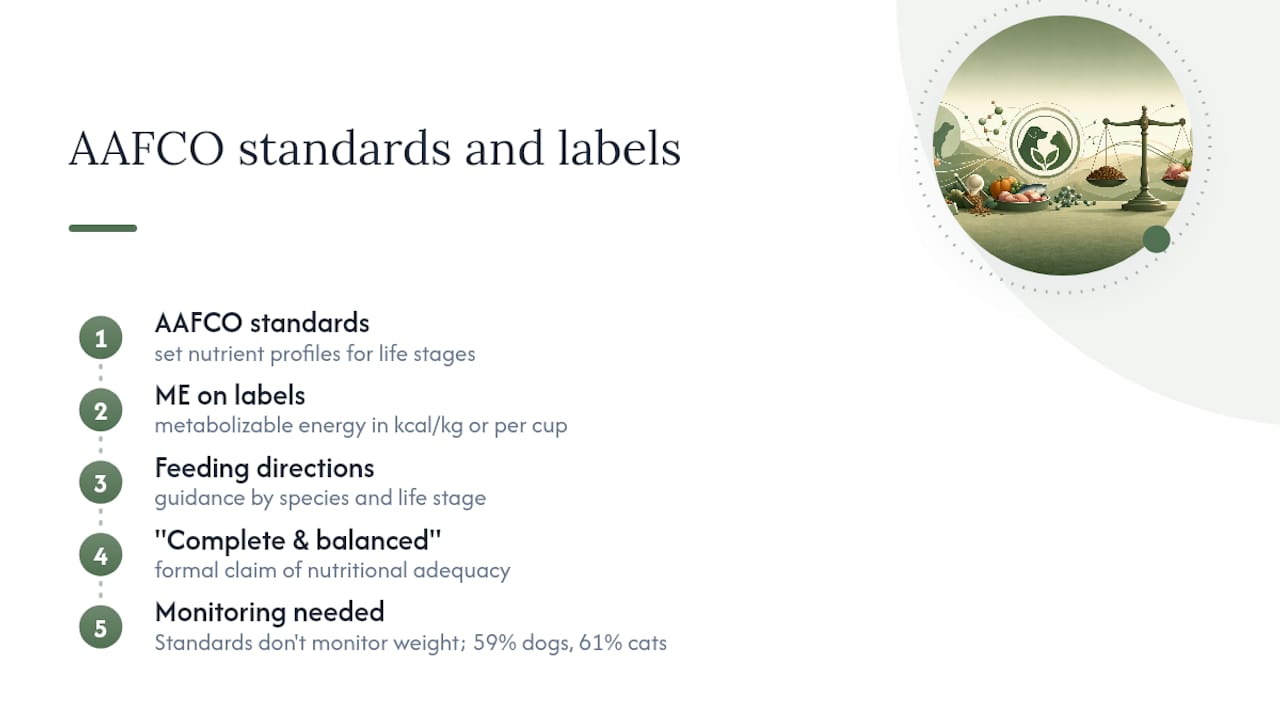
"Complete and balanced" isn't marketing language. It's a defined claim tied to that nutritional adequacy statement, confirming the food meets AAFCO's nutrient profile for growth, adult maintenance, or all life stages.
Why monitoring still matters: as of 2022, roughly 59% of dogs and 61% of cats in the United States were overweight or obese, the most common nutritional disorder veterinarians see in small animals. Standards give you an accurate calorie number on the label. They can't watch your pet's waistline for you.
How Do You Use a Feeding Guide Correctly?
Start with the label, then let your pet's actual body guide the adjustments.
- Find the kcal listing. Locate the ME value, usually kcal per cup or per kilogram, either on the bag or the manufacturer's product page.
- Calculate your daily target. Match your pet's current weight to the feeding table's closest bracket. If your 40 pound adult dog's table lists 3 cups per day at 400 kcal per cup, that's 1,200 kcal daily as your starting point.
- Pick a measuring method. A digital kitchen scale beats a measuring cup every time. Studies from clinical practice show scoop sizes vary enough between owners to throw off calorie counts by 20% or more.
- Set your schedule. Split the daily total across two meals for most adult dogs and cats, which helps prevent obesity compared to free feeding or one large meal.
- Track and adjust. Weigh your pet or check BCS every two to four weeks. If they're gaining, cut total intake by 5 to 10% and recheck in another two to four weeks. If they're losing weight they shouldn't, add back a similar percentage.
A real example: your cat holds steady at 10 pounds on 200 kcal a day, but after switching to a new food, she's crept up half a pound in a month.
Pro Tip: When mixing wet and dry food, convert both to kcal first, not volume. A tablespoon of wet food and a tablespoon of dry food can carry very different calorie loads, and treats need the same treatment. Weigh or count them and subtract that number from the day's main-meal allowance.
Do Puppies, Seniors, and Working Dogs Need Different Portions?
Life stage changes almost everything about how a customised training plan for your dog applies.
- Puppies and kittens need more frequent meals, often three to four times a day for young puppies, because their growth demands higher nutrient density and their stomachs are smaller.
- Adults generally do best on portion-controlled feeding, meaning two premeasured meals rather than a full bowl left out all day.
- Working dogs, pregnant or lactating animals, and seniors often fall outside the standard adult table entirely. A pregnant dog in her final trimester may need significantly more energy; a senior cat with reduced kidney function may need a therapeutic diet a vet prescribes directly, not something a bag label can anticipate.
If your pet fits any of these categories, treat the printed feeding table as a rough sketch, not a plan. Bowlful's dog feeding plan breaks down how portions and schedules shift by life stage in more depth.
How Do Treats and Home Cooking Throw Off Feeding Guides?
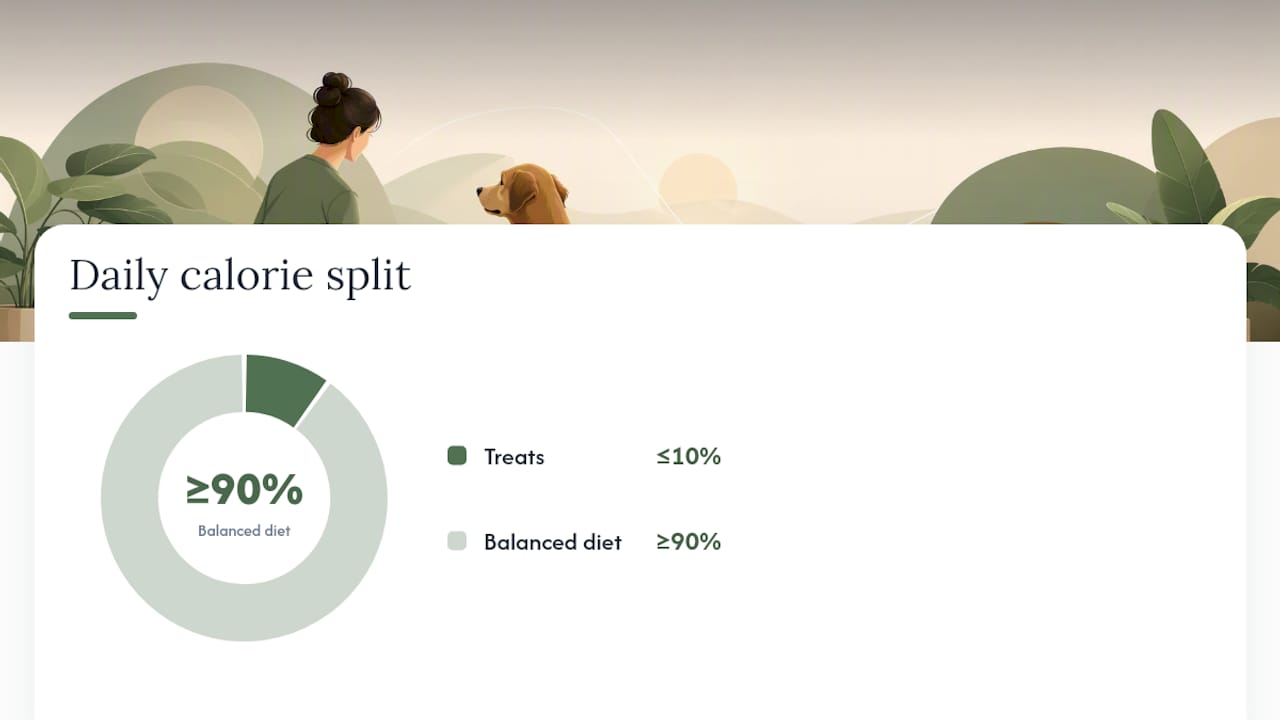
Treats rarely count as complete food, and they almost never show up in the bag's feeding directions, which is exactly why they cause so much unplanned weight gain. Veterinary guidance generally caps treats at under 10% of total daily calories, with the rest coming from the balanced main diet.
Home-cooked meals carry a similar risk in a different form. Without formal testing, they frequently run short on calcium, certain vitamins, or trace minerals. If you want to feed homemade, work from a recipe formulated by a board-certified veterinary nutritionist, not a recipe pulled from a general recipe site.
- Treats commonly push pets over maintenance calories when owners don't track them.
- Unbalanced home diets can cause deficiencies that take months to show symptoms.
- Ignoring calorie differences between products, switching diets frequently, and eyeballing portions instead of measuring are the three mistakes that undo an otherwise solid feeding guide.
When Should You Get a Personalized Feeding Plan?
Certain signs mean it's time to stop relying on the bag and call your vet.
- Sudden weight gain or loss over a few weeks with no diet change.
- A dull, flaky, or thinning coat.
- Chronic digestive issues like recurring loose stool or vomiting.
- A puppy or kitten growing noticeably faster or slower than littermates.
- Any diagnosed medical condition, including kidney disease, diabetes, or pancreatitis.
Your vet calculates resting energy requirement (RER) and maintenance energy requirement (MER) using your pet's actual weight and BCS, then adjusts from there. Bring your current food, the amount you're feeding, and a rough activity log. A personalized plan differs from the bag's directions in the details that matter: calibrated kcal targets, scheduled reassessments, and macronutrient shifts if your pet has specific health needs. Watch for these signs before they become bigger problems.
A Note From Bowlful on Feeding Guides
I work with Bowlful's evidence-based approach to pet nutrition, built on the same RER and MER formulas vets use and informed by AAFCO's nutrient standards. Package feeding guides are a fine place to start. The mistake is treating them as permanent. Owners who measure, monitor, and adjust get far better results than owners who follow a printed number and hope.
Get a Feeding Plan Built Around Your Actual Pet
A bag's feeding table gives you a rough number. Bowlful gives you a calorie and portion target calculated from your pet's real weight, breed, age, and activity level, using the same RER and MER formulas vets rely on. No affiliations with pet food brands means the recommendations stay unbiased.
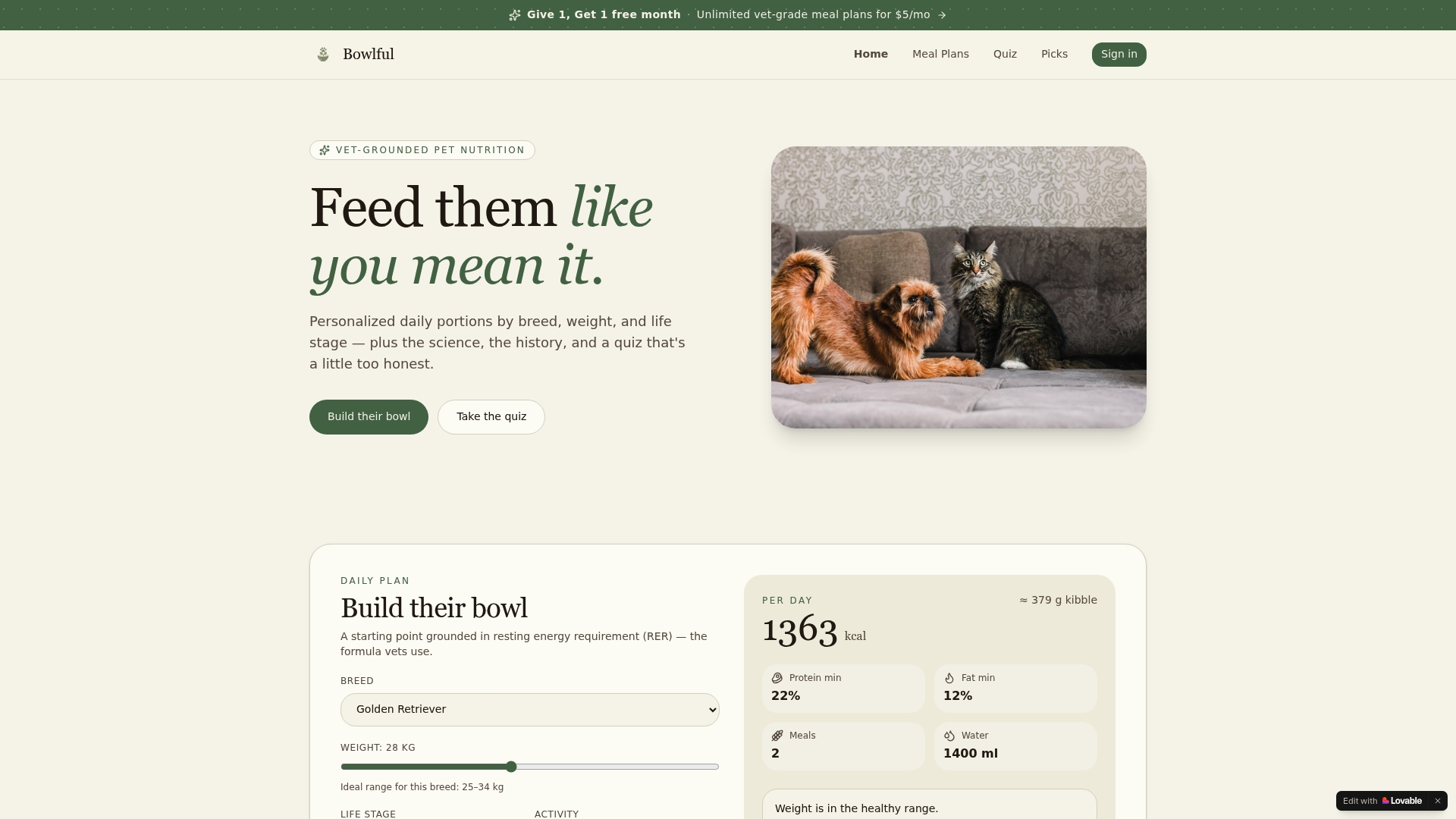
Bowlful's free quiz walks you through your pet's details in a few minutes and produces a downloadable meal plan you can hand straight to your vet or use to reset your measuring cup habits. If your pet's weight has drifted since you last checked the bag's chart, that's the moment to stop guessing and get numbers built for them specifically. Take the free feeding quiz and see what your pet's actual daily targets look like.
Sources
- Pet Obesity Prevention: 2022 state of pet obesity report summary
- VCA Animal Hospitals — Nutrition: general feeding guidelines for dogs
- AAFCO — Selecting the right pet food
- MSD Veterinary Manual — Feeding practices in small animals