
A solid dog feeding plan comes down to three things: a daily calorie target, a consistent meal schedule, and a simple rule for adjusting when your dog's weight drifts. Start with your dog's food label as a baseline, then refine using the RER/MER calorie method (explained below), split the total into two meals per day for most adults, and check your dog's body condition score (BCS) every two weeks to decide whether to stay the course or shift portions by ±10%. For a moderately active adult dog weighing around 25 pounds, a daily calorie intake within a moderate range split across a morning and evening meal is typical. Every plan here is built on the same veterinary-standard formulas used by professionals: RER (resting energy requirement), MER (maintenance energy requirement), AAFCO nutritional standards, and BCS monitoring.
Pro Tip: Start with the label amount on your current dog food, then use BCS at two weeks to decide whether to go up or down. The label is a starting point, not a prescription.
Key Takeaways
A dog feeding plan works when it combines a calculated daily calorie target, a consistent meal schedule, and a BCS-based adjustment rule applied every two weeks.
| Point | Details |
|---|---|
| Start with kcal, not cups | Use RER × MER to find daily calories, then divide by your food's kcal/cup value. |
| Two meals per day for most adults | Split the daily portion into morning and evening meals for digestion and monitoring. |
| BCS beats the scale alone | Check body condition score every two weeks and adjust portions by ±10% increments. |
| Treats cap at 10% of daily kcal | Subtract treat calories from the daily total before dividing into meals. |
| Bowlful automates the math | Bowlful's personalized plans use vet-standard RER/MER formulas and include downloadable PDF schedules. |
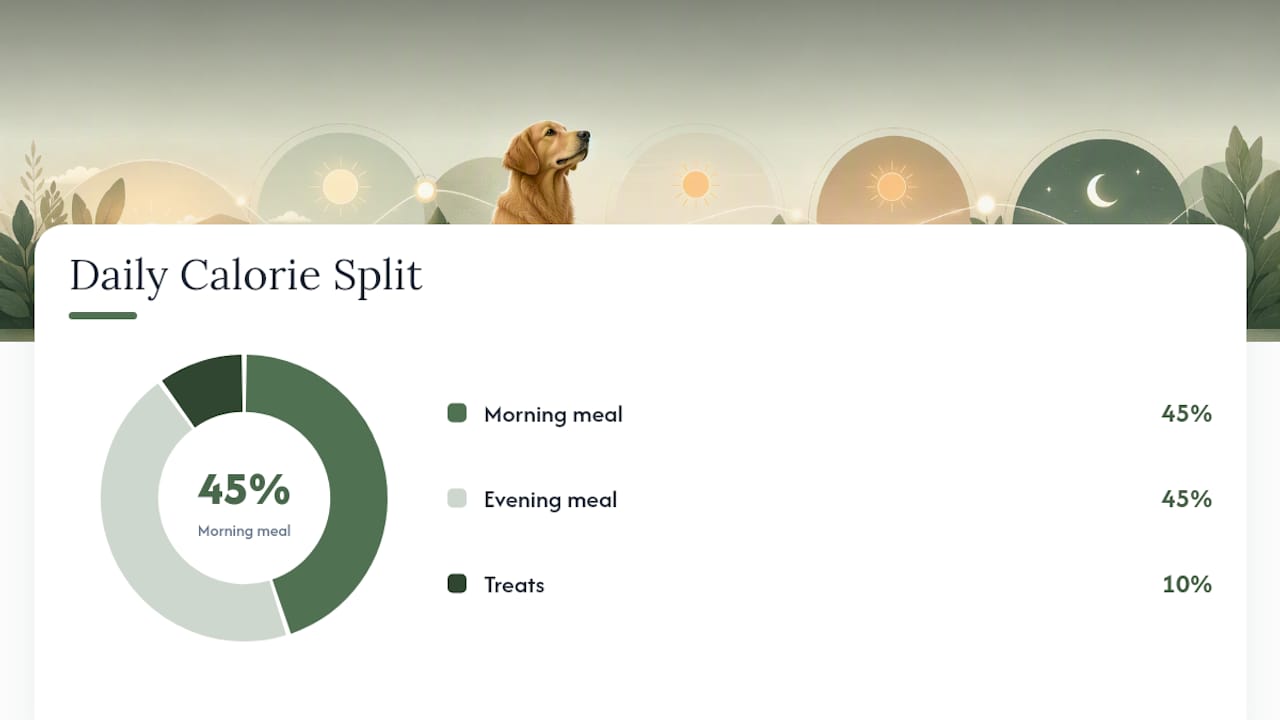
Table of Contents
- What factors change how much your dog actually needs?
- How do you calculate the right daily portion?
- How often should you feed your dog each day?
- How do you build a personalized feeding plan step by step?
- How do you adjust the plan for special situations?
- Sample daily plans for common dog profiles
- When should you switch life-stage foods?
- When should you call your vet or a nutritionist?
- Why the calorie-first approach actually changes outcomes
- Bowlful builds your dog's feeding plan for you
- Sources
What factors change how much your dog actually needs?
Understanding which variables shift calorie needs is what separates a plan that works from one that just sounds reasonable. The same 40-lb dog can need anywhere from 700 to 1,425 kcal/day depending on the factors below. For a deeper look at how these interact, this owner's guide breaks down each one.
- Life stage. Puppies need more calories per pound of body weight than adults, and seniors often need fewer, though some older dogs lose weight and need more. A growing puppy generally needs significantly more calories per pound of body weight than an adult of the same weight.
- Current weight vs. ideal weight. Always calculate portions based on ideal weight, not current weight. Feeding an overweight dog based on what it currently weighs will perpetuate the problem.
- Activity level. A dog that walks 20 minutes a day has very different needs from one that runs trails for two hours. Categories typically run: low, moderate, high, and working/sporting.
- Neuter status. Spayed and neutered dogs tend to have lower metabolic rates, which means their MER multiplier drops slightly. Ignoring this is one of the most common reasons dogs gradually gain weight after surgery.
- Pregnancy and lactation. A nursing dog at peak lactation can need two to four times her normal maintenance calories. This is not the time to be conservative.
- Medical conditions. Hypothyroidism, Cushing's disease, diabetes, and kidney disease all change how the body processes nutrients and energy. A vet-prescribed diet is often non-negotiable here.
- Food calorie density. A cup of one kibble might contain 280 kcal; another contains 520 kcal. The same volume of food can mean wildly different calorie intakes depending on the brand.
Body condition score is the practical tool that ties all of this together. Rather than relying on weight alone, BCS rates your dog on a 1–9 scale (or 1–5 in some systems) based on rib visibility, waist definition, and abdominal tuck. A score of 4–5 on the 9-point scale is ideal. Weight can stay the same while body composition shifts, so BCS catches what the scale misses.
Pro Tip: When activity spikes, such as a weekend hiking trip or a competition, increase daily calories by 10–20% for that period and log both intake and weight. Return to baseline once the activity level drops.

How do you calculate the right daily portion?
Two methods work well together. Use the label as a quick start, then verify with the calorie formula.
Method 1: The food label feeding chart
Feeding charts on packaging are a reasonable starting point, but individual needs often require adjustment based on body condition and activity. Find your dog's ideal weight on the chart, read the recommended daily amount, then reduce it slightly if your dog is sedentary or already carrying extra weight. Always check that the food carries an AAFCO statement confirming it is "complete and balanced" for your dog's life stage.
Method 2: RER → MER calorie calculation
This is the method veterinarians use, and it gives you a number you can actually trust.
- Convert your dog's ideal weight to kilograms (divide pounds by 2.2).
- Calculate RER: RER = 70 × weight(kg)^0.75
- Multiply RER by the appropriate MER factor for your dog's life stage and activity.
- Divide the daily kcal total by your food's kcal-per-cup value to get cups per day.
Common MER multipliers:
Worked example: A 25-lb (11.4 kg) neutered adult dog with moderate activity.
- RER = 70 × (11.4)^0.75 = 70 × 6.07 ≈ 425 kcal/day
- MER = 425 × 1.6 = 680 kcal/day
- If the food contains 340 kcal/cup: 680 ÷ 340 = 2 cups/day
For reference, here is how daily kcal translates to cups at common calorie densities:
The kcal/cup value is printed on your food bag, usually near the guaranteed analysis. If it is not there, check the manufacturer's website.
Pro Tip: Run both methods and compare. If the label says 2.5 cups and your RER/MER calculation says 1.8 cups, start at 2 cups and let BCS guide you from there. The science behind RER/MER explains why the formula often lands lower than label charts.
How often should you feed your dog each day?
Meal frequency matters more than most owners realize. Scheduled mealtimes support digestion, make house training easier, and give you a daily window to notice appetite changes before they become a vet visit. For updated frequency guidance by lifestyle, this 2026 guide is worth bookmarking.
- Young puppies (under 12 weeks): 4 meals per day, spaced evenly. Their stomachs are small and blood sugar can drop between meals. Measured, food-restricted meals are the most effective method for growing puppies.
- Puppies (3–6 months): 3 meals per day. Most medium breeds can drop to 2 meals around 6 months; large and giant breeds often stay at 3 meals longer.
- Adult dogs: 2 meals per day is the standard recommendation. Morning and evening, roughly 8–12 hours apart, works for most households.
- Seniors: 2 meals per day remains appropriate for most. Dogs with GERD or nausea may do better with 3 smaller meals.
- Dogs prone to bloat (GDV): Feed 2–3 smaller meals rather than one large one, and wait at least 1–2 hours before or after heavy exercise. Deep-chested breeds like Great Danes and Standard Poodles are most at risk.
For working owners who are away all day, a morning meal before leaving and an evening meal after returning is perfectly fine. An automatic feeder can handle a midday meal for puppies when needed.
Pro Tip: Feed at least 1–2 hours before any vigorous exercise. A full stomach and hard running is a recipe for discomfort at best and a bloat risk at worst.
How do you build a personalized feeding plan step by step?
This is where the formulas become a real routine. Work through these steps once, record everything, and you will have a baseline to refine over the next month.
- Gather your inputs. Write down your dog's current weight, estimated ideal weight, age, life stage, typical daily activity, any medical conditions, and the kcal/cup of your current food. Assess BCS now so you have a starting score.
- Calculate daily kcal. Use the RER/MER method above, or pull the label amount as a starting point. Record the number.
- Set your meal schedule. Decide on meal times and divide the daily portion accordingly. Two equal meals work for most adult dogs.
- Budget your treats. Keep treats under 10% of daily calories. If your dog gets 680 kcal/day, that is 68 kcal for treats, which is roughly 3–5 small commercial treats depending on the brand.
- Track for 2–4 weeks. Weigh your dog weekly, reassess BCS every two weeks, and note stool consistency and energy levels. A systematic approach to diet changes with documentation makes adjustments far more reliable.
- Adjust in clear increments. If BCS is above 5 (on a 9-point scale), reduce daily kcal by 10% and re-evaluate in two weeks. If BCS is below 4, increase by 10%. Never make large jumps.
When switching to a new food, follow a 7–10 day transition:
- Days 1–2: 75% old food, 25% new food
- Days 3–4: 50/50
- Days 5–6: 25% old food, 75% new food
- Days 7–10: 100% new food
Sensitive dogs may need a slower transition over 2–3 weeks. Watch for loose stools, vomiting, or a sudden drop in appetite during any transition. Obesity is common in pets, and measured portions with consistent monitoring are the most reliable way to prevent it from creeping in during a food change.
Pro Tip: Keep a simple feeding log in your phone's notes app: date, weight, BCS score, and any changes made. Two months of data makes a vet conversation far more productive.
How do you adjust the plan for special situations?
Some dogs need more than a standard formula. Here is how to handle the most common scenarios.
- Weight loss. Start with a 10–20% calorie reduction from maintenance, always based on ideal weight. Increase activity where possible. Rule out medical causes (hypothyroidism is frequently overlooked) before assuming it is purely a diet issue. Portion control and regular BCS monitoring are the most effective tools owners have.
- Weight gain (underweight dog). Increase calories in 10% increments every two weeks. Use a calorie-dense food rather than simply feeding more volume, which can cause digestive upset. Monitor BCS to confirm muscle gain, not just fat.
- Pregnancy and nursing. In the last three weeks of pregnancy, gradually increase food by 25–50%. During peak lactation (weeks 3–4 after whelping), a nursing dog may need two to four times her normal maintenance calories. Prioritize a nutrient-dense food and get veterinary guidance before and during this period.
- Working and high-energy dogs. High-energy dogs need significantly more calories, and meal timing around activity matters. Use a MER multiplier of 2.0–5.0 depending on intensity, and distribute calories to avoid large pre-exercise meals. A dedicated working dog feeding schedule can help structure this.
- Homemade diets. These can work, but homemade recipes are often nutritionally incomplete without a vet-prescribed supplement protocol. Consult a veterinary nutritionist before committing to long-term homemade feeding.
- Medical conditions. Diabetes, pancreatitis, kidney disease, and GERD all require vet-prescribed dietary adjustments. Do not try to manage these with general feeding guidelines alone.
Red flags that need immediate veterinary attention: sudden weight loss or gain of more than 5% in 2–4 weeks, persistent vomiting or diarrhea, complete appetite loss lasting more than 24 hours, or a BCS that keeps moving in the wrong direction despite adjustments.
Sample daily plans for common dog profiles
These examples use the RER/MER method and assume a food with 350 kcal/cup unless noted. Use them as a template, not a prescription.
Treat allocation example (medium active adult, 1,010 kcal/day):
- Treat budget: 10% = 101 kcal
- Meals: (1,010 − 101) ÷ 2 = ~455 kcal per meal ≈ 1.3 cups per meal
- Timing: treats during training sessions, not as free snacks
For balanced meal plan examples with more profiles and food types, Bowlful's blog covers these in detail.
When should you switch life-stage foods?
Getting the timing right on life-stage transitions prevents both nutritional gaps and unnecessary overfeeding.
Puppy to adult food:
- Small breeds (under 20 lbs): switch around 9–12 months
- Medium breeds (20–50 lbs): switch around 12 months
- Large breeds (50–90 lbs): switch around 12–18 months
- Giant breeds (over 90 lbs): switch around 18–24 months
The general rule is to switch when your dog reaches about 80% of expected adult size. For large-breed puppies specifically, staying on a large-breed puppy formula matters because calcium levels are calibrated to support controlled bone growth. Switching too early or using a standard adult food can affect skeletal development. Puppy feeding charts on bags can be off by up to roughly 50% for an individual pup, so BCS and vet guidance are more reliable than the bag alone.
Adult to senior food:
There is no universal age trigger. Most vets suggest considering a senior formula around 7 years for large breeds and 10–11 years for small breeds, but only if the dog shows signs of reduced activity or weight gain. Some healthy older dogs do fine on adult food with adjusted portions.
Transition checklist (monitor during any food change):
- Stool consistency (firm is good; loose or mucousy signals too-fast a switch)
- Appetite (a day of reduced interest is normal; two or more days warrants attention)
- Energy level (lethargy during a transition can signal digestive distress)
- Weight (weigh at the start and end of the transition period)
When should you call your vet or a nutritionist?
Most feeding adjustments you can handle at home. A few situations genuinely need professional input.
- Unexplained weight loss or gain of more than 5% in 2–4 weeks, with no change in food or activity
- Persistent vomiting or diarrhea lasting more than 48 hours
- A BCS that stays above 7 or below 3 despite two or more adjustment cycles
- Appetite changes paired with lethargy, excessive thirst, or changes in urination
- Pregnancy, nursing, or a dog recovering from surgery
- Any dog on multiple medications where food timing affects absorption
For complex cases, including multiple concurrent conditions or repeated failed adjustments, ask your vet for a referral to a board-certified veterinary nutritionist. These specialists can formulate a precise diet, including homemade diet protocols with the right supplement stack.
When you go to the appointment, bring your feeding log, the current food bag (or a photo of the label showing kcal/cup), and your dog's weight history from the past month. That information cuts the consultation time in half.
Pro Tip: Track anxiety and appetite changes together. Behavioral stress is a common and overlooked cause of appetite shifts, and it changes how you approach the feeding plan.
Why the calorie-first approach actually changes outcomes
Most feeding guides tell you to "follow the bag" and "ask your vet." That advice is not wrong, but it leaves a gap: the bag is written for an average dog, and your dog is not average. The RER/MER framework exists precisely because individual variation is large enough to matter. A neutered, low-activity dog eating at the label amount for an intact active dog of the same weight will gain weight steadily, and the owner will wonder why.
What I find underappreciated is how much BCS monitoring closes that gap. The scale tells you a number. BCS tells you what that number means for your dog's actual body composition. Running both together, with a simple feeding log, gives you a feedback loop that no label chart can replicate. Bowlful's approach is built on exactly this: vet-standard RER/MER calculations combined with life-stage templates and ongoing BCS tracking, without any brand affiliation pushing a particular food. The tools exist to make this systematic rather than a guessing game.
Bowlful builds your dog's feeding plan for you
Calculating RER, finding MER multipliers, converting kcal to cups, and tracking BCS every two weeks is manageable once you have done it. But it takes time, and small errors compound. Bowlful's personalized meal plan tool runs the same vet-standard formulas automatically: you enter your dog's weight, life stage, activity level, and food, and it returns a daily kcal target, a portioned meal schedule, and a treat budget in one place.
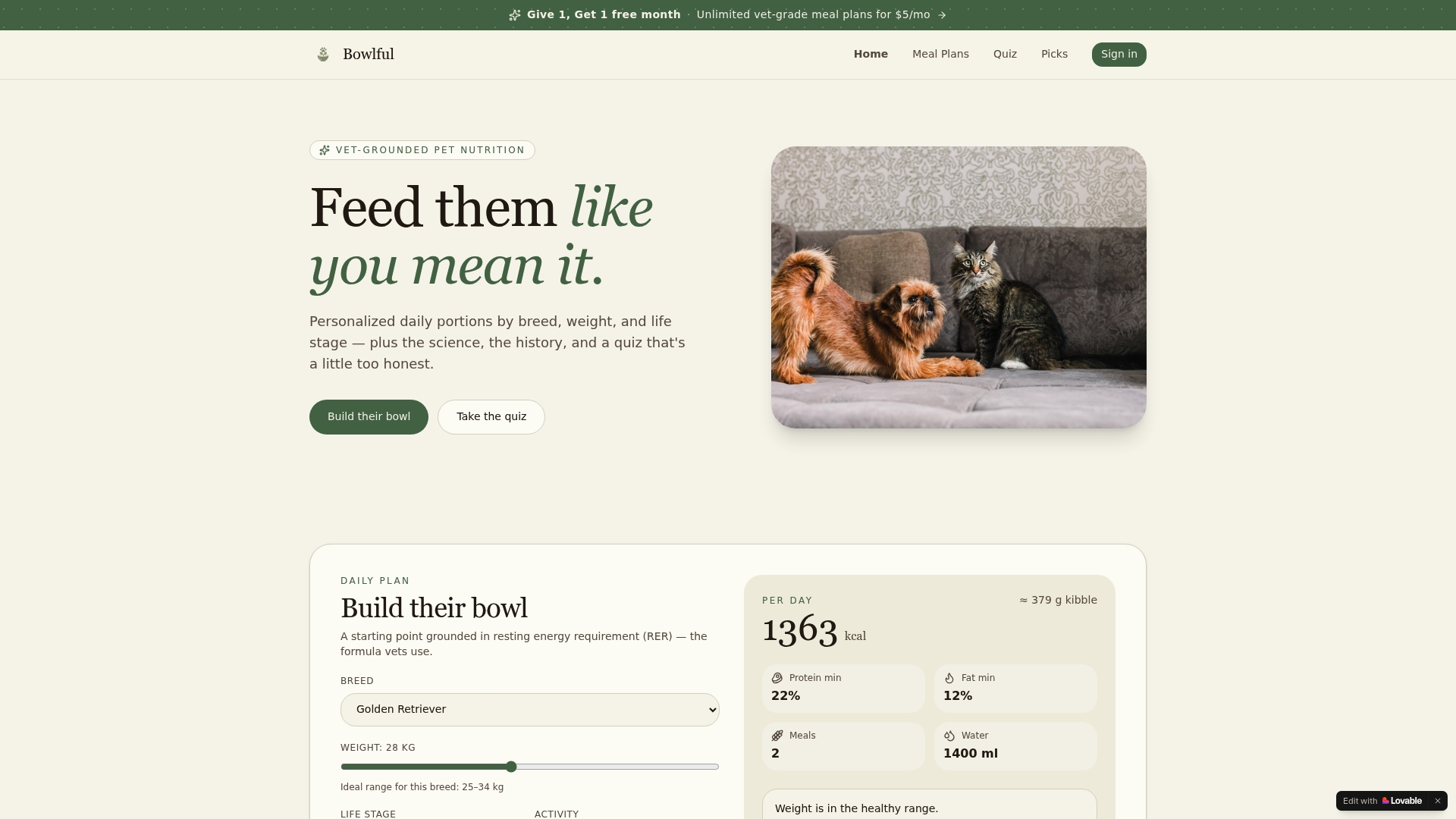
The Meal Plan Pro subscription adds downloadable PDF schedules you can print and stick to the fridge, plus ongoing weight and BCS tracking tools so adjustments are logged automatically. Free resources on the Bowlful blog, including sample plans and feeding guides, are available without a subscription for owners who want to start there. For those ready for a fully personalized plan, Bowlful.
Sources
The following sources informed the calculations, schedules, and clinical recommendations throughout this guide.
- Dog Feeding Chart: How Much Should I Feed My Dog? | Purina US
- Feeding Times and Frequency for Your Dog | VCA Animal Hospitals
- How Much To Feed a Puppy | PetMD
- Puppy care | Merck Veterinary Manual
- Vet-Approved Homemade Dog Food Recipes | The Spruce Pets
- Re-evaluating your dog's diet | Cornell Vet
- Pet Food Report Appendix B | AAFCO
- Pet Obesity Prevention
- Paws