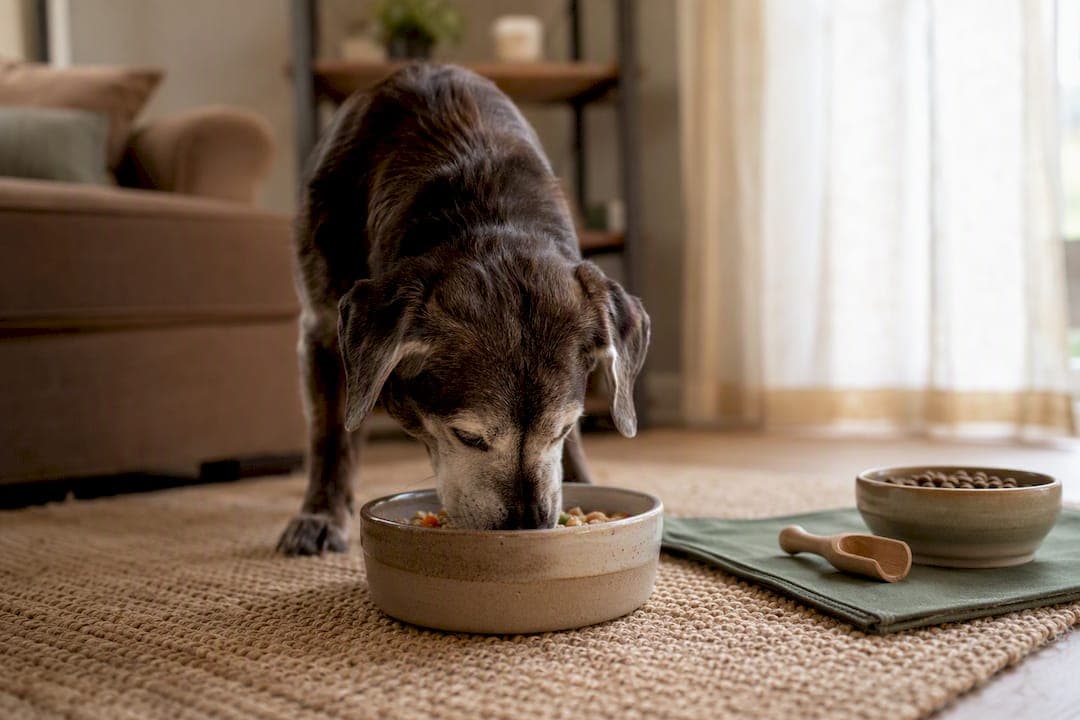
Most healthy senior dogs need their Resting Energy Requirement (RER) multiplied by an activity factor typically between 1.1 and 1.4, generally resulting in fewer calories than they required as young adults. A 25 kg senior dog, for example, has a daily calorie target estimated in a moderate range depending on activity level and body condition.
That's the target. Getting there takes three steps: weigh your dog on an actual scale (not a guess), run the RER math below, and set a daily intake that includes every treat and topper, not just the kibble in the bowl.
The quick math: RER = 70 × weight in kg^0.75. Multiply by an activity factor ranging from about 1.1 (less active senior) to 1.4 (more active senior) to get your daily calorie target.
- Weigh your dog this week, ideally on the same scale each time.
- Calculate RER, then apply the senior multiplier that matches activity level.
- Count treats, dental chews, and food-topper calories toward the daily total.
- If your dog has a diagnosed illness, is losing weight rapidly, or is markedly under or overweight, talk to your veterinarian before changing the plan.
TL;DR:
- Senior dogs' calorie needs vary widely based on weight, activity level, and body condition, requiring careful calculation and adjustment.
- The RER formula is 70 times the body weight in kg raised to the 0.75 power, multiplied by a factor between 1.1 and 1.4 depending on activity.
- Treats and toppers should account for 15% to 20% of daily calories, and all sources of calories must be included in daily totals.
- Regularly weighing your dog and checking body condition every one to four weeks is essential to keep feeding accurately.
- Underlying health conditions like hypothyroidism or arthritis may increase or decrease caloric needs, requiring consultation with a veterinarian.
Table of Contents
- Calculating RER and Choosing the Right MER Multiplier
- Turning Calories Into Cups, Cans, and Combined Meals
- Why Aging Changes What and How Much Your Dog Should Eat
- Setting a Weighing and Body Condition Check Routine
- When a Senior Dog Actually Needs More Calories
- Building a Daily Feeding Plan Your Senior Dog Can Actually Follow
- How Bowlful Builds Its Senior Calorie Recommendations
- Do Breed and Size Change How Many Calories a Senior Dog Needs?
- How Common Senior Health Conditions Change Calorie Math
- What the Research Actually Supports, and What It Doesn't
- Get a Feeding Plan Built Around Your Dog's Real Numbers
- Key Takeaways
- Sources
Calculating RER and Choosing the Right MER Multiplier
The formula every veterinary nutrition team uses starts the same way: RER = 70 × (body weight in kg)^0.75. If your dog's weight is in pounds, divide by 2.2 to get kilograms first. This RER number represents the calories your dog would burn lying around doing essentially nothing, a baseline that has nothing to do with age yet.
Age enters through the multiplier. For adult dogs in their prime, veterinarians typically apply a Maintenance Energy Requirement (MER) factor around 1.6. For seniors, that multiplier usually drops to a range of 1.1 to 1.4, reflecting slower metabolisms and, often, less movement.
- Calculate RER using your dog's current weight in kilograms.
- Pick a multiplier: 1.1 for a senior who mostly naps and takes short walks, up to 1.4 for one who still hikes, swims, or plays fetch daily.
- Adjust further for body condition: adjust downward if your dog is overweight, or upward if they are underweight or losing muscle mass, per body condition assessment.
A 5 kg senior Chihuahua who's still spry might land near 320 kcal a day. A 30 kg senior Labrador with arthritis and low activity might sit closer to 1,130 kcal. Same species, wildly different targets, which is exactly why bag-feeding charts printed for "all adult dogs" miss the mark for aging pets. WSAVA's calorie guidance is the reference most veterinary teams calibrate against, and it's worth checking your own math against it once you have a number.
Turning Calories Into Cups, Cans, and Combined Meals
Once you know the daily kcal target, the label on your dog's food does the rest of the work. Every quality dog food lists a kcal-per-cup or kcal-per-can figure, usually in a "Calorie Content" statement near the guaranteed analysis. Divide your target by that number, and you get the daily volume.
Say your calculation lands at 900 kcal per day. A food with 400 kcal per cup means 2.25 cups daily, split across two meals. A denser food at 500 kcal per cup would need only 1.8 cups for the same dog, which matters more than most owners realize: switching foods without recalculating volume is one of the fastest ways to accidentally over or underfeed a senior dog.
- For wet food, check the kcal per can (often 350 to 400 kcal per 13 oz can) and divide the same way.
- Mixing wet and dry means adding both calorie contributions before comparing to your target, not calculating them separately.
- Recalculate every time you switch formulas. Two "senior" foods from different brands can differ by 100 kcal per cup or more.
Why Aging Changes What and How Much Your Dog Should Eat
Sarcopenia, the age-related loss of lean muscle mass, is the physiological wrinkle that trips up the simple "feed seniors less" rule. A dog losing muscle can actually need more protein, and sometimes more total calories, to slow that decline rather than fewer of both. That's the opposite of what most owners assume when a dog hits "senior" status.
At the same time, activity naturally declines with joint stiffness, reduced stamina, and less enthusiasm for long walks. Left unadjusted, that drop in movement paired with unchanged portions is exactly how weight creeps on. The VCA's feeding guidance points to roughly 20% to 25% fewer calories as a common target for many mature dogs, tied to slowed age-related decline and lower obesity risk.
- Prioritize highly digestible, quality protein over sheer protein percentage on the label.
- Watch phosphorus and sodium only if a vet has flagged kidney or heart concerns, not by default.
- Don't assume a bag labeled "senior" automatically fits your dog. Cornell's veterinary guidance is blunt about this: there's no single senior diet, only diets matched to your dog's actual condition.
Pro Tip: A dog who's still active at 11 doesn't need the same cut as a sedentary 11-year-old of the same breed. Match the multiplier to the dog in front of you, not the birthday on the calendar.
Setting a Weighing and Body Condition Check Routine
Numbers on paper only matter if you track what's actually happening to your dog. Weigh your senior dog every one to two weeks when you're first dialing in a new calorie target, then stretch to monthly once things stabilize. Pair that with a body condition score (BCS) check every two to four weeks, using your ribs-and-waist assessment or the WSAVA body condition chart veterinarians rely on.
- Weigh and note the number, same scale, same time of day if possible.
- Run hands along the ribs and check for a visible waist from above; compare to the BCS chart's 1 to 9 scale.
- If weight or BCS is trending the wrong direction, adjust total calories by 10% to 15%, then hold steady for two weeks before checking again.
- Contact your veterinarian if you notice appetite loss, rapid weight change in either direction, or trouble chewing.
Seniors respond more slowly to calorie changes than younger dogs, so resist the urge to overcorrect after one bad week. Small, steady adjustments beat dramatic swings. And treats count. A 25 kg dog with a 950 kcal budget who gets 150 kcal in dental chews and training treats only has 800 kcal left for actual meals, a detail that portion-feeding guidance from VCA flags as one of the most commonly overlooked pieces of the daily total.
When a Senior Dog Actually Needs More Calories
Not every older dog needs less food. Cachexia from cancer, recovery from surgery or illness, advancing sarcopenia, and certain thyroid or metabolic conditions can all push calorie needs up rather than down. Treating every senior the same way, cutting calories by default, can do real harm to a dog who's already losing weight it can't afford to lose.
The safe path here always starts with a veterinary consult, since underlying illness needs a diagnosis before you feed your way around it. From there, most increases happen gradually.
- Increase calories by 10% to 20% at a time, not all at once.
- Choose calorie-dense formulas or a prescription diet your vet recommends, rather than just adding more of the current food.
- Split the increase across smaller, more frequent meals if appetite is limited.
- Try warming food slightly, moistening kibble, or adding a palatability enhancer if reduced smell or appetite is part of the problem.
Building a Daily Feeding Plan Your Senior Dog Can Actually Follow
A calorie target only works if it turns into a routine. Two measured meals, spaced roughly 8 to 12 hours apart, tend to suit senior digestion better than one large feeding or free-choice grazing all day.
- Split the daily calorie target into two equal meals, morning and evening.
- Reserve 5% to 10% of the daily total as a treat budget, and subtract it from meal portions rather than adding it on top.
- Refresh water at each meal, since older dogs often drink less on their own.
- When switching foods, blend old and new over 7 to 10 days, and recalculate portion size once you know the new food's kcal-per-cup value.
Low-calorie treat swaps make the budget easier to hit: a few pieces of plain cooked green bean or carrot run under 10 kcal, versus 30 to 50 kcal for a standard training treat. Human food should stay occasional and vet-approved, since even "healthy" scraps can carry more sodium or fat than owners expect.
Pro Tip: *Keep a small notebook or phone note logging daily treats for a week.
How Bowlful Builds Its Senior Calorie Recommendations
Bowlful calculates senior feeding targets the same way veterinary teams do, using NRC and AAFCO-aligned RER and MER formulas rather than generic bag charts. The Daily Calories calculator runs this exact math for your dog's weight, age, and activity level in seconds.
- Formulas match the same RER/MER conventions referenced by WSAVA and veterinary nutrition teams.
- Recommendations factor in breed size, life stage, and activity, not a flat percentage cut.
- Guides like the feeding plan resource walk through portioning and schedule adjustments in more depth.
Precise calorie math matters more for seniors than for any other life stage, because the margin for error, between muscle-wasting underfeeding and joint-stressing overfeeding, is genuinely narrower.
..
Do Breed and Size Change How Many Calories a Senior Dog Needs?

Yes, and the differences are bigger than most owners expect. Small and toy breeds tend to have higher metabolic rates relative to their body weight, meaning a senior Chihuahua or Dachshund often needs proportionally more calories per pound than a senior Great Dane. That's a direct consequence of the RER formula itself: because it scales by weight to the 0.75 power rather than linearly, smaller dogs burn more energy per kilogram of body mass than larger ones.
Giant and large breeds carry their own complications. They tend to show visible signs of aging, gray muzzles, joint stiffness, reduced stamina, earlier than small breeds, often by age 6 or 7 rather than 10 or 11. That means the senior multiplier conversation can start years earlier for a Mastiff or Great Dane than for a Yorkshire Terrier or Dachshund, even though both are technically the same "life stage" by different clocks.
Breed-specific joint issues also shape activity level, which feeds directly into the multiplier choice. A senior Labrador with hip dysplasia may move like a much older dog, warranting the lower end of the 1.1 to 1.4 range even if it's chronologically only 8. For readers with a specific large breed in mind, Bowlful's Labrador calorie calculator and husky calorie guide walk through breed-adjusted numbers in more detail than a generic weight chart can offer.
How Common Senior Health Conditions Change Calorie Math
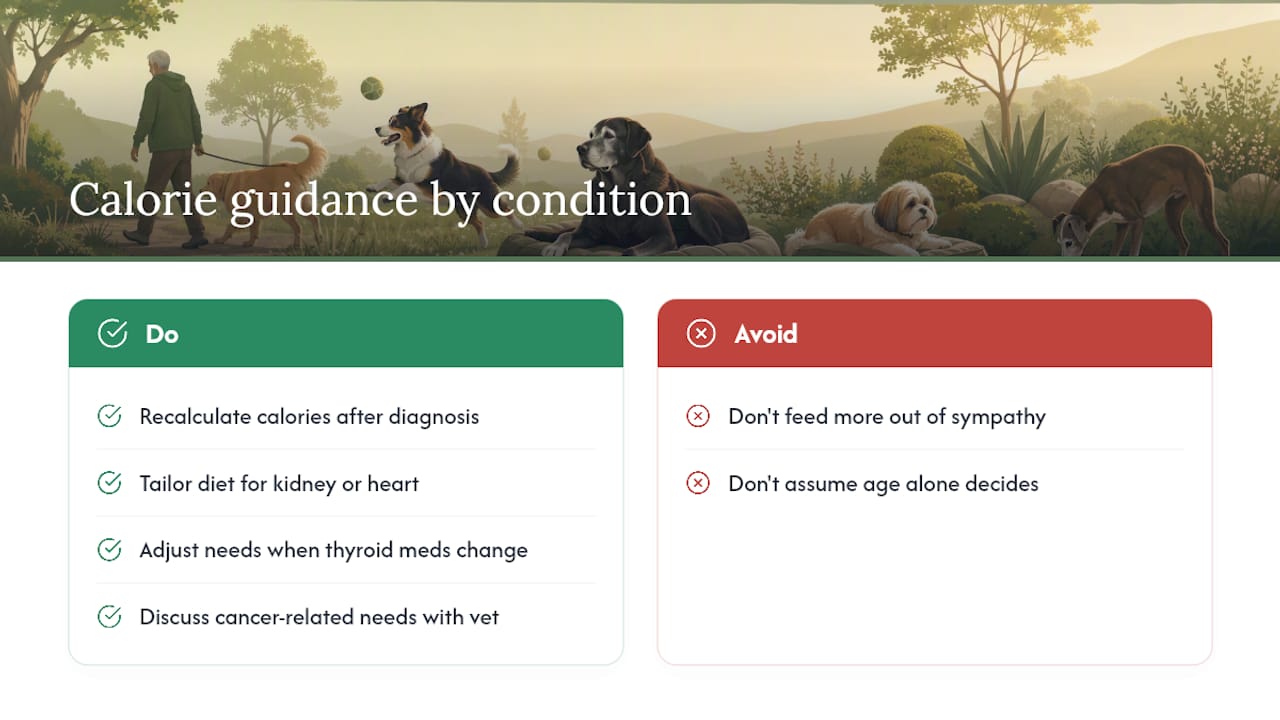
Hypothyroidism, one of the more common endocrine conditions in aging dogs, slows metabolism directly, meaning affected dogs often gain weight on the same calorie intake that maintained them for years. Once diagnosed and medicated, calorie needs often shift again, so recalculating after a new diagnosis or medication change isn't optional, it's necessary.
Arthritis works differently but lands in the same place: less movement, so lower total calorie needs, at the very moment when many owners are inclined to feed more out of sympathy for a dog that seems less active and comfort-food it. That instinct, however well-meaning, is how arthritic seniors end up carrying extra weight that makes joint pain worse.
Kidney disease and heart disease each bring their own nutrient considerations beyond raw calorie counts, often involving controlled phosphorus, sodium, or protein quality rather than simple calorie increases or cuts. Dogs managing cardiac conditions, for instance, benefit from diet plans built around their specific diagnosis rather than a standard senior formula; Bowlful's guide on how heart disease shapes a senior dog's diet covers those adjustments in more detail. Cancer and cachexia, as covered earlier, can flip the calorie equation entirely, pushing needs up rather than down. None of these conditions are optional footnotes. Each one should prompt a fresh calorie conversation with a veterinarian rather than a default assumption based on age alone.
What the Research Actually Supports, and What It Doesn't
Most senior dog feeding advice online treats "cut calories for seniors" as a universal rule, and that's where the conventional wisdom oversimplifies things. The research backs a calorie reduction for a lot of senior dogs, but it backs it as a starting hypothesis to test against your specific dog's body condition and activity, not a blanket prescription. A dog with sarcopenia or early kidney disease can need the opposite adjustment entirely.
What gets underweighted in most advice is monitoring cadence. Owners calculate a number once, feed it for a year, and never check whether the dog's body is actually responding the way the math predicted. The RER and MER formulas are a starting estimate, not a guarantee, and every veterinary source treats them that way even when consumer articles don't.
If there's one priority worth putting above all others, it's this: weigh your dog on a real schedule, and treat the BCS check as seriously as the scale number. The formula gets you in the right neighborhood. Watching your dog's actual body tells you whether you've arrived.
— Robert
Get a Feeding Plan Built Around Your Dog's Real Numbers
Running RER and MER math by hand works, but it's easy to make a small error that compounds over months of feeding. Bowlful's free Daily Calories calculator applies the same formulas covered in this guide automatically, factoring in your dog's weight, age, and activity level so you get a target without doing the exponent math yourself.
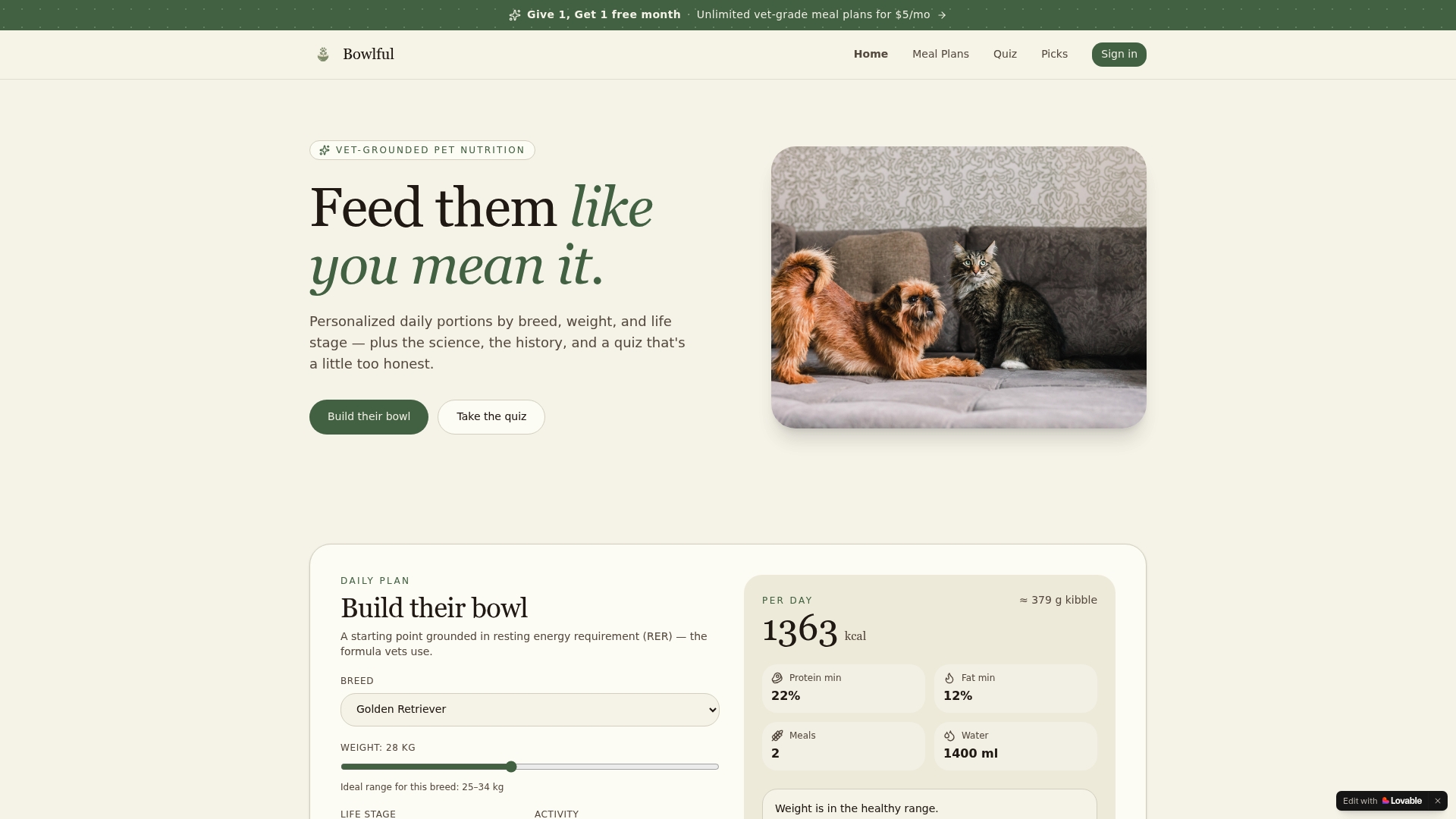
For owners who want more than a single number, Meal Plan Pro turns that calculation into a downloadable, customizable feeding plan, portion sizes, meal timing, and treat budgets included, that adjusts as your dog's weight or activity changes. It's built for the reality of senior dog care: needs shift, and a plan that updates with your dog beats a static chart taped to the pantry door. Head to Bowlful to run your dog's numbers and see what a personalized plan looks like for your specific senior.
Key Takeaways
| Point | Details |
|---|---|
| Calculate RER first | Use RER = 70 × weight(kg)^0.75, then multiply by 1.1 to 1.4 based on activity level. |
| Adjust for body condition | Subtract 15% to 25% if overweight; add 10% to 15% if underweight or losing muscle. |
| Count every treat | Treats and toppers often make up 15% to 20% of daily intake and must count against the total. |
| Monitor on a schedule | Weigh every one to two weeks and check body condition score every two to four weeks. |
| Recalculate for health changes | Hypothyroidism, arthritis, kidney disease, and cachexia all shift calorie needs differently. |
| Use vet-standard tools | Bowlful's calculator applies the same RER/MER math and offers personalized meal plans through Meal Plan Pro. |
Sources
- Feeding mature and senior dogs | VCA Animal Hospitals
- Choosing food for your senior dog | Cornell University College of Veterinary Medicine
- Calorie needs for healthy adult dogs — WSAVA
- How many calories does a senior dog actually need? | Elder Pet Health