
A typical 8 to 10 pound adult Shih Tzu needs roughly 180 to 300 calories a day, which works out to about ½ to 1 cup of a standard kibble split into two meals. A larger 10 to 12 pound adult usually needs 300 to 380 calories, or roughly ¾ to 1¼ cups daily. Those numbers only work as a starting point, though, because kibble calorie density swings from bag to bag.
The real fix is personal math, not a chart. Calculate your dog's resting energy requirement (RER), multiply by the right activity factor to get maintenance energy requirement (MER), subtract whatever you're feeding in treats, then convert the remaining calories to cups using the kcal-per-cup number printed on your food's label. The AAFCO feeding statement on every bag exists for exactly this reason, and Bowlful's calculator runs the same formula automatically.
- 8 to 10 lb adult: moderate daily calories and portion range, typically split into two meals
- 10 to 12 lb adult: somewhat higher daily calories and portion range, usually split into two meals
Quick fact: Excess weight is one of the most common preventable health problems in small breeds, which is why getting shih tzu portions right matters more than picking the "best" brand of food.
Key Takeaways
Precise shih tzu portions come from calculating RER and MER for your dog's actual weight, then converting to cups using your specific food's kcal-per-cup value, not a generic chart.
| Point | Details |
|---|---|
| Start with weight and life stage | Use the 8 to — chart as a baseline, then refine it with RER and MER math. |
| Calculate, don't estimate | RER = 70 × (kg^0.75), then multiply by a MER factor of roughly 1.2 to 2.0 depending on life stage. |
| Cap treats at 10% | Subtract treat calories from the daily total before dividing meals. |
| Adjust in small steps | Change portions by 5 to 10%, then recheck body condition in 2 to 4 weeks. |
| Use Bowlful for exact numbers | Bowlful's calculator runs the same RER/MER formula and outputs a personalized feeding plan. |
Table of Contents
- Shih Tzu Feeding Guide by Weight and Life Stage
- How Do You Calculate Exact Shih Tzu Portions?
- How Often Should You Feed a Shih Tzu?
- Counting Treats Without Overfeeding
- How Do You Know When to Adjust Portions?
- Measuring Food Accurately and Switching Diets Safely
- Why Vet-Standard Formulas Beat Guesswork
- What Most Feeding Charts Get Wrong About Shih Tzus
- Get a Feeding Plan Built Around Your Shih Tzu's Exact Numbers
- Sources
Shih Tzu Feeding Guide by Weight and Life Stage
Weight and age drive calorie needs more than breed alone, but Shih Tzus run small enough that even a quarter-cup error adds up fast. The table below assumes a mid-range kibble at 350 to 420 kcal per cup, a common band for small-breed dry food. Your dog's actual food could sit outside that range, so treat these numbers as a launch point, not gospel.
| Weight | Puppy ranges (higher energy needs) | Adult ranges (moderate energy needs) | Senior ranges (reduced energy needs) |
|---|---|---|---|
| 8 lb | higher calorie and portion estimates for growth and activity | lower calorie range reflecting lower maintenance | reduced calorie range for less active senior dogs |
| 10 lb | increased estimates accordingly | moderate adult calorie and portion range | reduced senior calorie range |
| 12 lb | elevated puppy calorie and portion guidance | moderate adult calorie range | moderate senior calorie guidance |
| — | higher puppy calorie and portion ranges | adult calorie range reflecting weight increase | senior calorie ranges reflecting reduced activity |
A few things worth flagging before you copy these into a feeding routine:
- Puppy ranges assume active growth and run noticeably higher per pound of body weight than adult maintenance.
- Senior figures assume reduced activity, common in Shih Tzus past age 8, and sit below standard adult intake.
- Always check the kcal per cup on your specific bag. A food at 300 kcal/cup and one at 450 kcal/cup will put the same dog on completely different cup measurements for the same calorie target.
How Do You Calculate Exact Shih Tzu Portions?
Charts get you close. Math gets you exact. Veterinary nutritionists calculate calorie needs using resting energy requirement (RER), then scale it up with a maintenance energy requirement (MER) multiplier based on life stage and activity, a method detailed in Pet Nutrition Alliance's MER/RER guidance.
Here's the formula and a worked example for a 10 pound (4.5 kg) adult Shih Tzu:
- Calculate RER: RER = 70 × (weight in kg)^0.75. For 4.5 kg, that's 70 × 3.04 = about 213 calories.
- Apply a MER multiplier. A neutered, low-activity adult typically uses a factor around 1.2 to 1.4; an active adult runs closer to 1.6; growing puppies often need 2.0 or higher depending on age. At 1.4, MER = 213 × 1.4 = roughly 298 calories a day.
- Subtract treat calories. If your dog gets 25 calories in treats, your food budget drops to 273 calories.
- Convert to cups. Check the label. If the food delivers 400 kcal per cup, divide 273 by 400 to get about 0.68 cups a day, split across two meals of roughly ⅓ cup each.
Life-stage energy ranges tracked by the National Academies' dog nutrition reference back up why these multipliers shift so much between puppies, adults, and seniors. A four-month-old Shih Tzu puppy burns calories at nearly double the rate of the same dog at age six, purely from growth demands.
Pro Tip: Skip the scoop entirely and weigh food in grams on a kitchen scale. Cup measurements can vary by 10 to 20 percent depending on how tightly kibble settles, which is a real problem when the whole daily portion is under a cup.
Bowlful's daily calories calculator runs this exact RER to MER sequence and adjusts for your dog's actual weight and life stage instead of relying on average breed ranges.
How Often Should You Feed a Shih Tzu?
Adults do best on two meals a day, spaced around 8 to 12 hours apart, something like 7 AM and 6 PM. Puppies under six months need three to four smaller meals to keep blood sugar stable and support steady growth.
Shih Tzus have a flat, brachycephalic face, and that anatomy matters at mealtime. Large meals fed too fast can trigger post-meal breathing strain, regurgitation, or discomfort. Smaller, more frequent portions ease that pressure, and a slow feeder bowl helps if your dog inhales food in under a minute.
- Adults: 2 meals/day, roughly 12 hours apart
- Puppies (under 6 months): 3 to 4 meals/day
- Fast eaters: use a slow feeder bowl or puzzle feeder
Avoid vigorous play or exercise for about an hour after eating, and keep an eye on water intake right after meals if your dog tends to gulp.
Pro Tip: If your Shih Tzu shows visible breathing strain or repeated regurgitation on a two-meal schedule, splitting the same daily total into three smaller meals often solves it without changing the overall calorie count.
Counting Treats Without Overfeeding
Treats should never exceed 10% of total daily calories, a standard reinforced by Pet Obesity Prevention's research on excess weight risks. For a Shih Tzu eating 300 calories a day, that caps treats at 30 calories total, subtracted from the meal portion, not added on top.
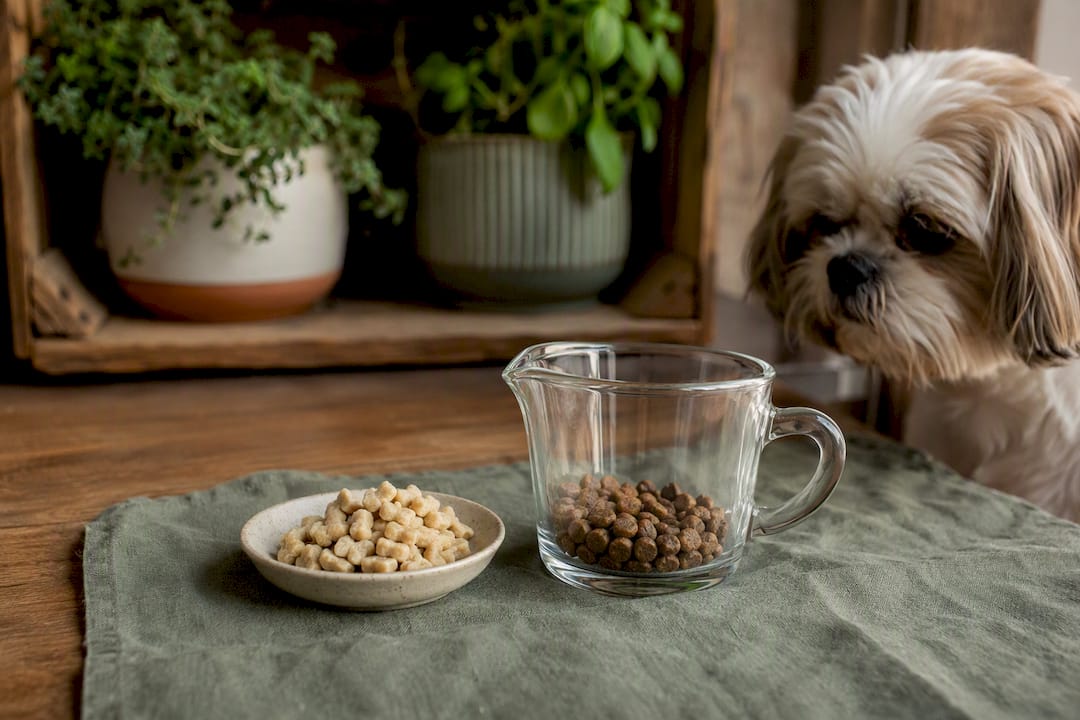
Small breeds make this easy to blow through. A single teaspoon of peanut butter runs 30 to 40 calories on its own, which can eat up an entire day's treat allowance in one lick. A small training treat usually runs 3 to 5 calories, and a pea-sized piece of cooked chicken is close to 5 calories. Stick to tiny training-sized pieces during repetition-heavy training sessions.
How Do You Know When to Adjust Portions?
Run your hands along your dog's ribs monthly. You should feel them easily under a thin layer of fat, without seeing them. If ribs are hard to find, or if your dog's waist has disappeared when viewed from above, it's time to adjust.
- Weigh your dog and note it against last month's weight.
- Reduce or increase the daily portion by 5 to 10%.
- Reassess body condition and weight in 2 to 4 weeks before making another change.
- If two adjustment cycles show no improvement, talk to your veterinarian.
Pregnancy, lactation, illness, and dental problems in older Shih Tzus all change calorie needs in ways a generic chart can't capture. Those situations call for a vet-guided plan rather than a home adjustment. Bowlful's guide on preventing obesity in small breeds walks through body condition scoring in more detail.
Pro Tip: Weigh your Shih Tzu on the same scale, same time of day, once a month. Small breeds show weight swings of just a few ounces that get lost in daily fluctuation but matter a lot on a 10 pound frame.
Measuring Food Accurately and Switching Diets Safely
A kitchen scale beats a measuring cup every time. Once you know your target calories, divide by kcal per cup on the label, then convert that cup amount to grams for a scale reading (most bags list grams per cup, or you can weigh out one cup once to calibrate).
When changing foods, transition gradually over seven days:
- Days 1 to 2: 25% new food, 75% old
- Days 3 to 4: 50/50
- Days 5 to 6: 75% new, 25% old
- Day 7: 100% new food
If you mix wet and dry, calculate calories from each separately, then combine totals before comparing against your daily target. Watch for hidden calories from table scraps, cheese-based toppers, or dental chews. They all count toward that 10% treat ceiling. Bowlful's feeding plan guide includes downloadable transition schedules if you'd rather follow a printed routine than track it manually.
Why Vet-Standard Formulas Beat Guesswork
Bowlful builds every recommendation on the same RER and MER math veterinarians use, cross-checked against AAFCO feeding statement standards and National Academies nutrient guidance rather than marketing copy on a bag.
- Formulas are calculated, not estimated from breed averages
- Portion targets respect life-stage and activity differences
- Recommendations align with recognized obesity-prevention thresholds
Given how directly excess weight drives health risk in small breeds, precision here isn't optional. Run your dog's numbers through Bowlful's calculator and download a feeding plan built around the result instead of a bag's generic suggestion.
What Most Feeding Charts Get Wrong About Shih Tzus
Most breed-specific feeding advice stops at a chart: feed this many cups for this weight, done. That's not wrong, exactly, but it treats every bag of kibble as if it holds the same calorie density, and it rarely accounts for the fact that a neutered, low-activity 10 pound Shih Tzu and an intact, high-energy one of the same weight can have genuinely different calorie needs.
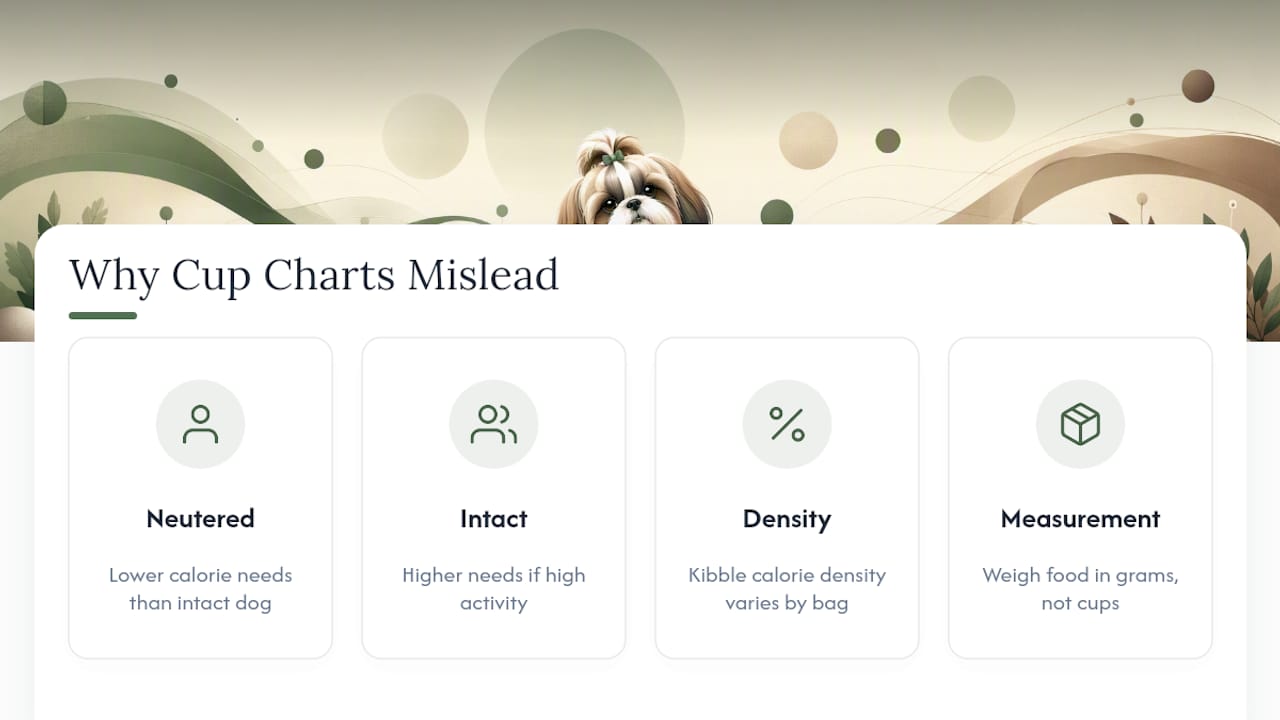
The chart earns its place as a starting point. It doesn't earn its place as a permanent answer. Owners who actually get portions right are the ones who run the RER to MER math once, recheck body condition monthly, and treat the chart as a rough draft rather than a final answer. That's a bigger shift in habit than most feeding guides ask for, and it's the one piece of conventional advice worth ignoring.
If there's one thing to prioritize first, it's the scale, both for your dog's weight and for the food itself. Cup measurements introduce error before you've even started; a gram-accurate portion, checked against your dog's own body condition, removes most of the guesswork breed charts can't.
— Robert
Get a Feeding Plan Built Around Your Shih Tzu's Exact Numbers
Bowlful skips the generic bag suggestion and calculates your dog's actual RER and MER, then turns that into a downloadable feeding plan with real portion sizes for your specific food.
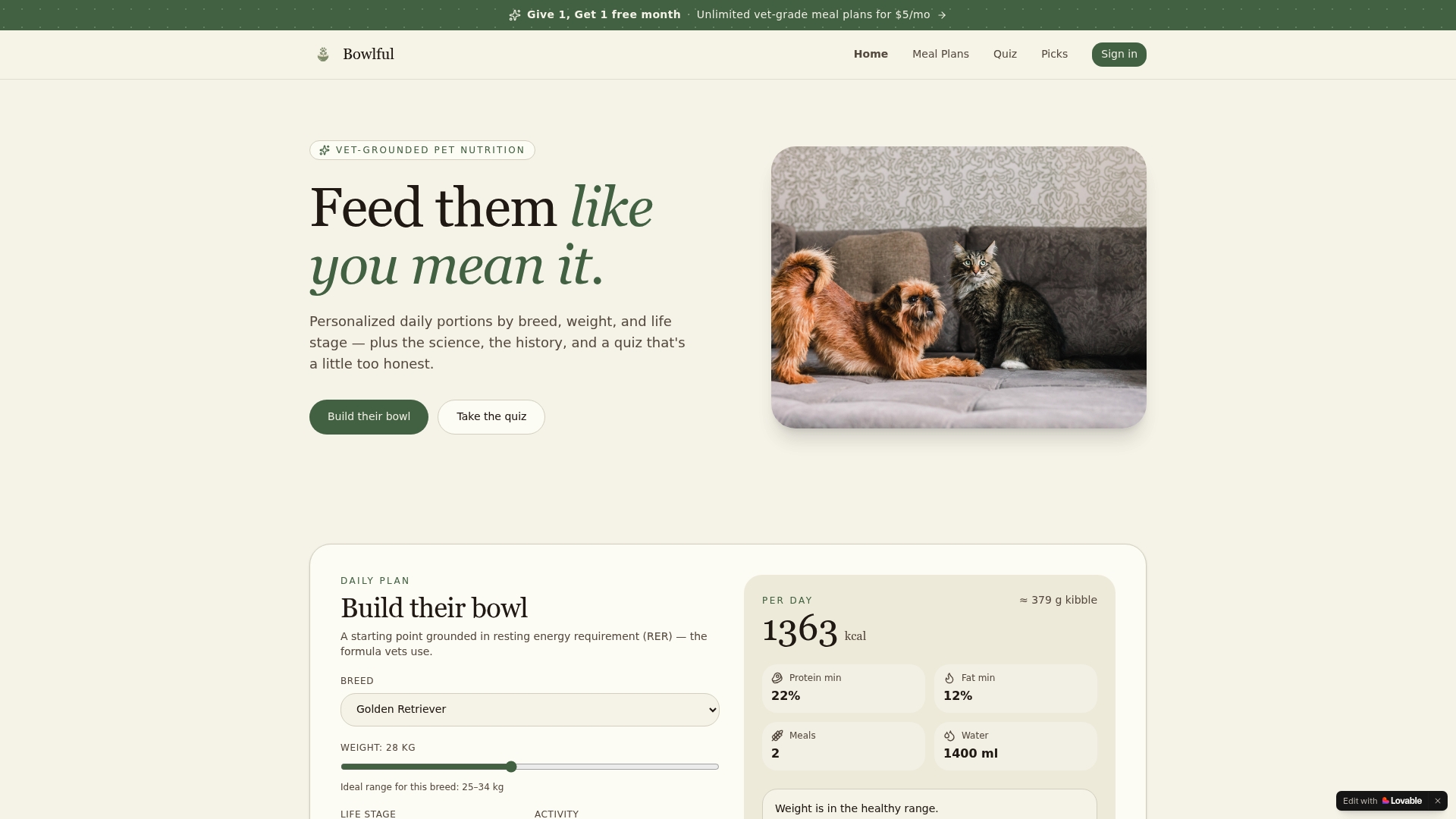
That matters most for a breed this small, where a quarter-cup error can mean a meaningful percentage of total daily calories. Instead of cross-referencing a weight chart against your bag's kcal-per-cup number by hand, Bowlful's calculator does the RER to MER conversion for you and outputs cups or grams based on your dog's food. For puppies specifically, the growth-stage multipliers shift often enough that a one-time chart lookup goes stale within weeks, something covered in Bowlful's puppy feeding calculator guide. New owners juggling feeding schedules alongside vaccinations and socialization might also find this puppy care guide useful for the broader first-year routine.
Run your Shih Tzu's numbers through Bowlful's daily calories calculator now and download a feeding plan built specifically around their weight, age, and activity level.
Sources
- AAFCO — Reading pet food labels
- National Academies Press — Dog nutrition (NRC)
- Pet Obesity Prevention — health risks of excessive weight